How to Start Crypto Trading: A 7-Step Beginner's Guide for 2026
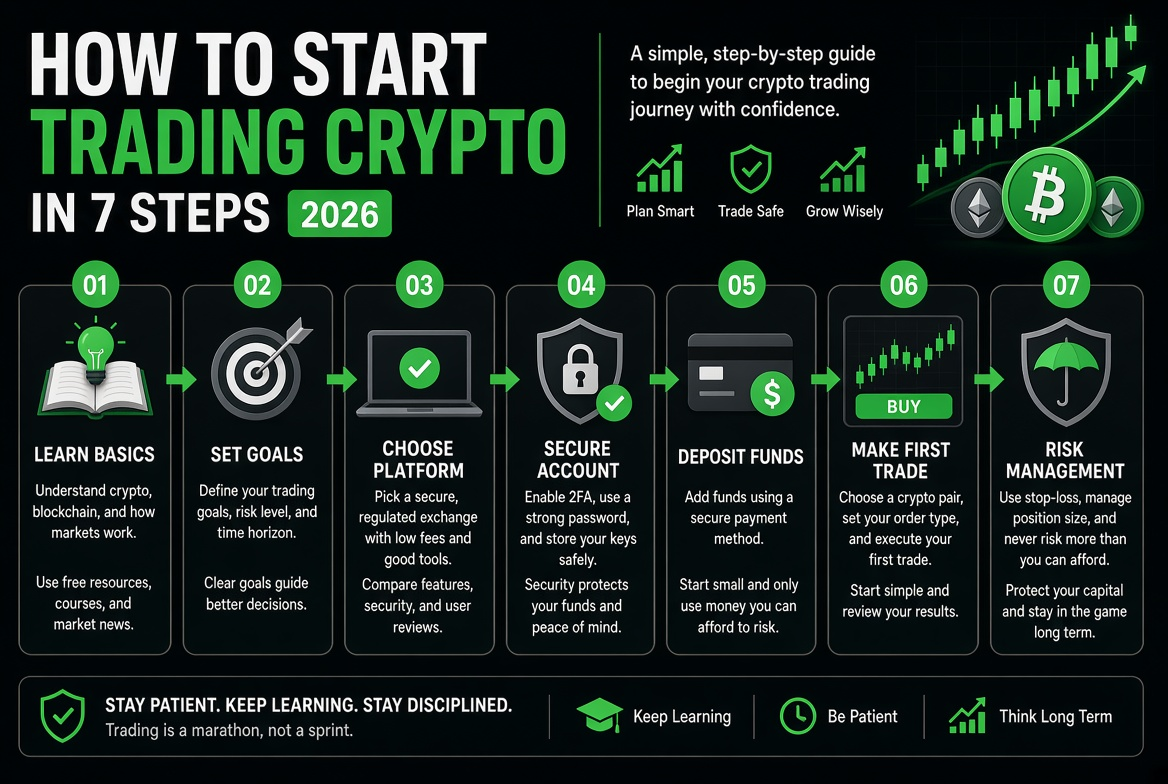
You can start crypto trading in seven steps: learn the basics, choose a platform, set up security, fund your account, place your first order, build risk rules, and keep learning and reviewing. That path helps beginners get started steadily from zero.
For someone with no experience at all, the hardest part of crypto trading is usually not knowing which step comes first. The process below breaks it into seven clear steps. Follow them in order and you will go all the way from opening an account to completing your first trade.
Step 1: Learn the Basic Concepts
Start by separating a few of the most important things:
Spot trading: buy and sell digital assets directly; holding the asset means you own it
Futures trading: trade price movements, go long or short, and take on higher risk
Wallets and exchanges: exchanges make buying and selling easy, while wallets put custody in your own hands
Price change, market cap, and volume: the basic indicators for judging interest and liquidity
Beginners should start with spot trading rather than jumping straight into leveraged futures.
Step 2: Define Your Trading Goals
Different goals call for different methods:
Long-term holding: better suited to dollar-cost averaging or buying in batches
Medium-term swing trading: requires learning some technical analysis
Short-term speculation: higher in both time cost and risk
First write down how much you plan to put in, how much drawdown you can tolerate, and how many hours a week you can spare. The clearer your goals, the less likely you are to trade on impulse later.
Step 3: Choose a Trading Platform and Register
When choosing a platform, focus on:
Its security record and compliance status
Whether it supports your country or region
Whether liquidity in major coins is sufficient
Whether its fees are transparent
Whether it offers demo trading or a solid help center
After registering, complete identity verification (KYC) as required so that deposits and withdrawals work normally.
Step 4: Set Up Account and Asset Security
This is the step beginners most often skip, and it is the most important one.
Turn on two-factor authentication (2FA)
Set a strong password that differs from other sites you use
Enable an anti-phishing code
Never reveal verification codes or your seed phrase to anyone
Consider moving large holdings to a personal wallet later
Security first, trading second.
Step 5: Make a Small Deposit and Get Familiar With the Account Interface
Start by depositing a small amount you can afford to lose, and confirm:
Whether you chose the right deposit network (such as TRC20 or ERC20)
Whether the funds arrive normally
Which account holds the funds (funding account / trading account / futures account)
Get comfortable with the interface before increasing the amount, so you do not make costly mistakes with a large balance right away.
Step 6: Complete Your First Spot Trade
Work through this minimal loop:
Pick a trading pair, for example BTC/USDT
Choose a market order or a limit order
Enter the amount you want to buy
Confirm the fee and the fill result
Check your position on the assets page
Then practise the sell flow once more
The goal of your first trade is not profit. It is getting the whole process to work.
Step 7: Build Risk Rules and Keep Reviewing
Once the first trade is done, add the rules right away:
How much capital a single trade may use
What the cap on total position size is
Whether to use a stop-loss
How often to check the account
What you will refuse to do under any circumstances
At the same time, start simple reviews: why you bought, why you sold, and where your execution was poor. Trading skill usually does not come from inspiration. It comes from correcting mistakes over and over.
Extra Tips That Help Beginners Most
Practise with small amounts first so that your tuition stays within what you can accept.
Do not jump straight into high leverage futures magnify gains, and they magnify losses too.
Be wary of "guaranteed profit" and signal-group promotions high-yield promises often come with high risk or outright fraud.
Control your information sources too much input leads to impulsive decisions; a few reliable sources are enough.
Factor in fees and security costs frequent trading eats into profits, and one security mistake can cost you your principal.
7-Step Checklist
Do you understand the difference between spot and futures?
Are your capital and risk tolerance clearly defined?
Have you completed platform registration and verification?
Have you enabled 2FA and other security settings?
Have you completed a small deposit test?
Have you worked through both the buy and sell flows?
Have you written down your position size and stop-loss rules?
Only when every box is checked have you truly started rather than walked in blind.
Risk Disclaimer
Crypto trading is high risk and prices are highly volatile; you may lose part or all of your principal. This article is for educational purposes only and is not investment advice. Use only funds you can afford to lose, and follow the laws and regulations of your jurisdiction.
FAQ
Q1: Can I start with no experience at all? A: Yes. Follow the seven steps above, starting small with spot trading, and master the process and security before adding complexity.
Q2: How much capital do I need to start? A: There is no single standard. The key is to use a small amount that does not affect your daily life and to complete your learning and process validation first.
Q3: What is a suitable asset for a first trade? A: Beginners usually start with assets that have high liquidity and wide recognition, while keeping position size strictly controlled.
Q4: Do I have to watch the market every day? A: Not necessarily. If you use dollar-cost averaging or hold for the medium to long term, you do not need to watch it constantly; only short-term trading demands a bigger time commitment.
Q5: What should I learn after these seven steps? A: You can go on to study candlestick basics, position management, how to spot common scams, and how to write your own trading plan.
Through these seven steps you now have a clear path to start crypto trading from zero: learn the basics first, then choose a platform, secure your account before anything else, make a small trade, and finally let rules keep your risk in check. The point of getting started is not how much you make on one trade, but building a starting point you can follow for the long run.
Leitura recomendada
Veja mais