Hotcoin TradFi Features Guide: Spot, Perpetual Futures and Leverage
Hotcoin TradFi offers spot and perpetual futures trading tied to the prices of traditional assets, and the two differ in how you hold them and in their risks. This guide helps users who are already familiar with crypto trading locate the product entries, read the order page, and understand the impact of leverage, funding costs and market closures. Paying in USDT does not automatically give you stock ownership, and the word spot alone does not mean a product has been tokenized or can be withdrawn on-chain.
Applicable version: the Hotcoin Simplified Chinese web interface, verified on September 7, 2026. All images are real page screenshots taken while logged out; they do not involve any actual deposit, position opening or position closing.
How Do You Find Spot and Futures in the Same Entry?
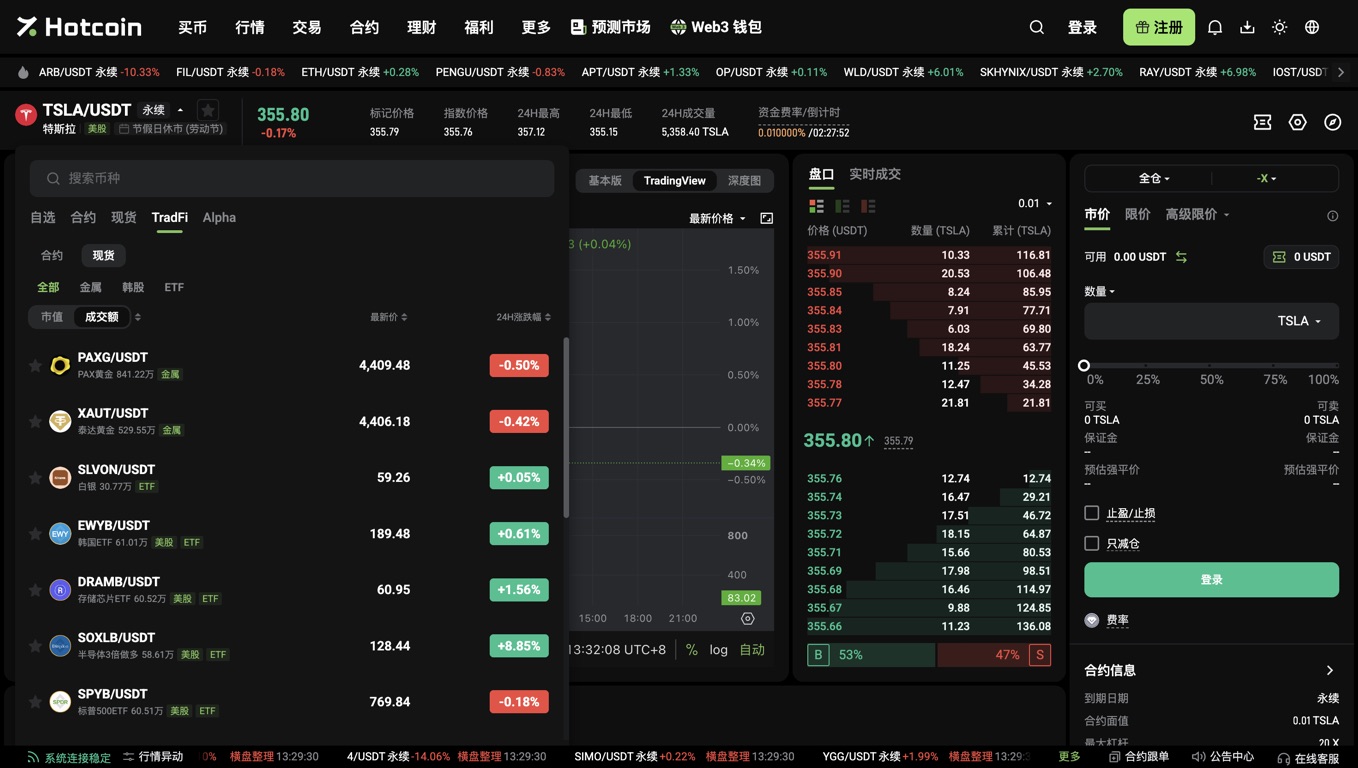
The instrument selector in the top-left corner of the Hotcoin trading page offers a TradFi category. Once inside, you can choose futures or spot and then browse the matching products. This structure lets users compare different trading formats in a similar operating environment, but it does not mean that instruments in the two lists correspond one to one. When you look up a target asset, check the full ticker, the product type and the page label at the same time, so you do not confuse a spot product on one market with a perpetual position.

Product entry: Hotcoin TradFi zone.
What Can You Do on the TradFi Spot Page?
The TradFi spot page is used to buy and sell the corresponding spot products. Users mainly check the buy or sell side, the order price, the quantity and the order value. The SPYB/USDT page opened for this article shows a label related to the S&P 500 ETF and offers limit, market and advanced limit entries, with open orders, order history and assets below. SPYB on the page is a specific product ticker and cannot simply be substituted for SPY shares in a brokerage account when explaining legal rights.
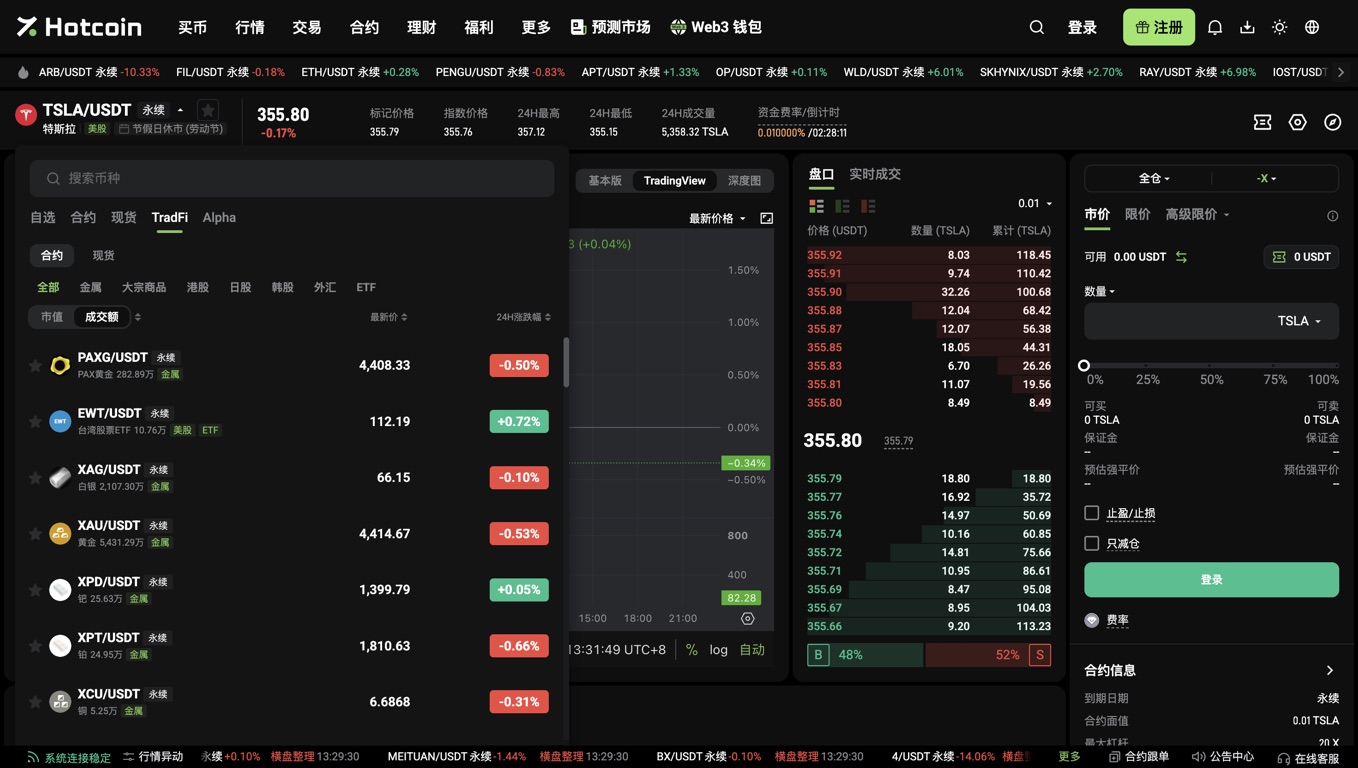
Tested page: SPYB/USDT spot trading.
Can All TradFi Spot Products Be Called Tokenized Stocks?
TradFi spot is a trading category on the platform, while tokenized stocks involve the issuance, asset backing and on-chain rights structure of a specific product, so the two concepts are not equivalent. When users see a stock or ETF related ticker, they still need to check the issuer, the underlying assets, the redemption arrangements and the ability to transfer on-chain. Without that product-level information, you cannot describe every TradFi spot product as a one-to-one stock token, nor promise that it can be withdrawn or that it carries direct shareholding rights.
What Do the "2x" and "3x" Labels in the Spot List Mean?
When the spot list shows names such as "2x long" or "3x short", users also need to understand the leverage or inverse strategy of the linked product rather than only checking whether the trading account has borrowed funds. The multiple targeted by the product itself and the leverage set on a futures account are two different mechanisms and cannot replace each other. For products related to leveraged ETFs, check the reset period and tracking rules as well, and do not simply promise that long-term returns will always equal the underlying asset's move multiplied by the multiple.
What Is the Biggest Difference Between TradFi Perpetual Futures and Spot?
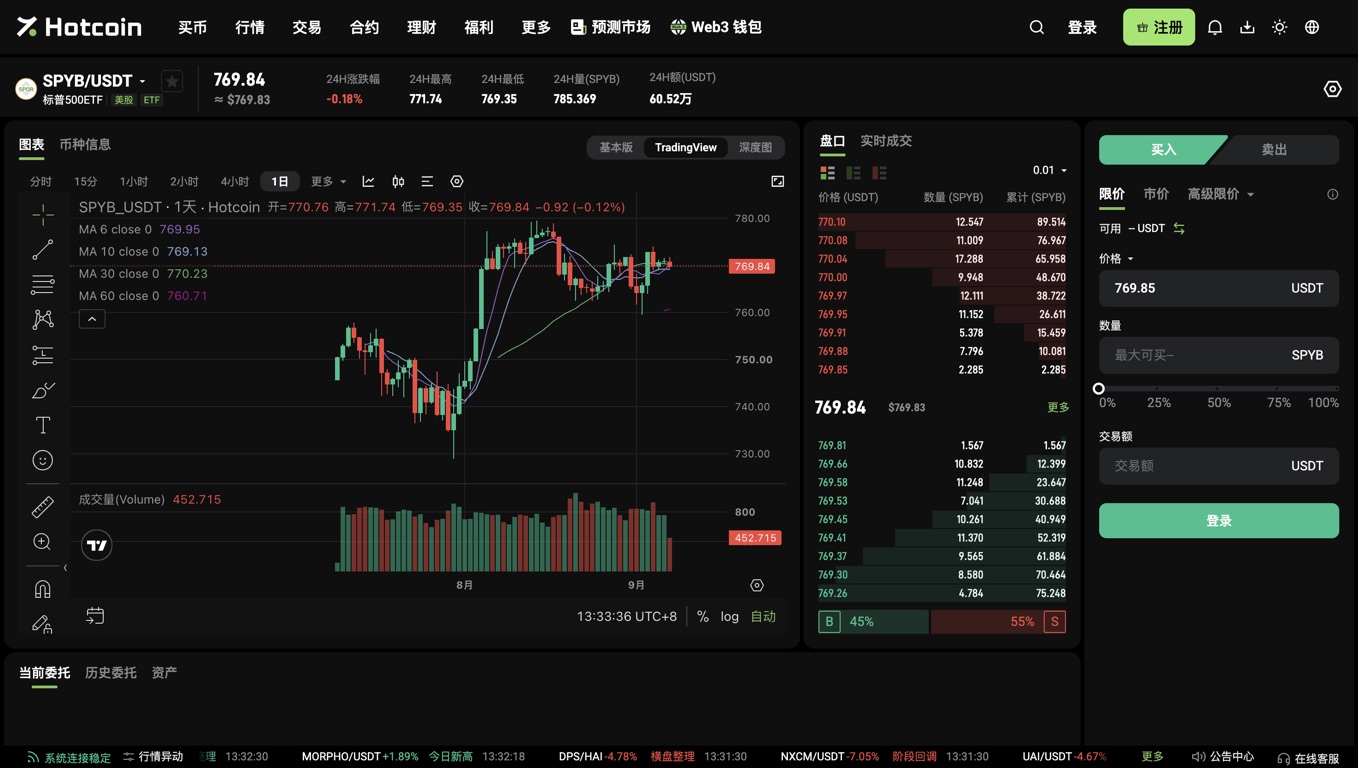
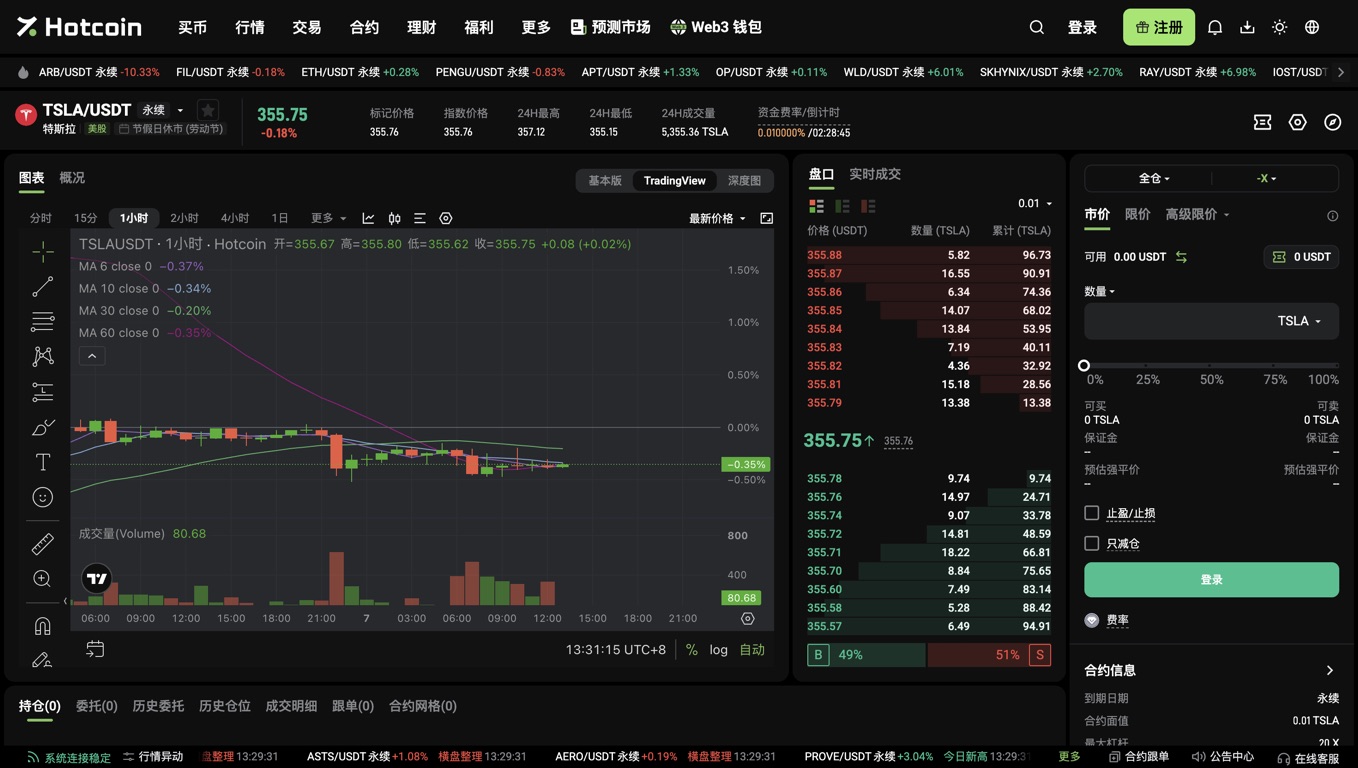
TradFi perpetual futures build price exposure through margin and involve leverage, funding costs and forced liquidation. Taking TSLA/USDT as an example, the page shows a perpetual label, mark price, index price and funding rate, with margin and estimated liquidation price fields on the right. What users manage is a contract position, not a securities account holding obtained by paying the full share price; when judging risk, look at the notional value of the position, not only the funds you put in.
What Is the Leverage Cap on Hotcoin TradFi?
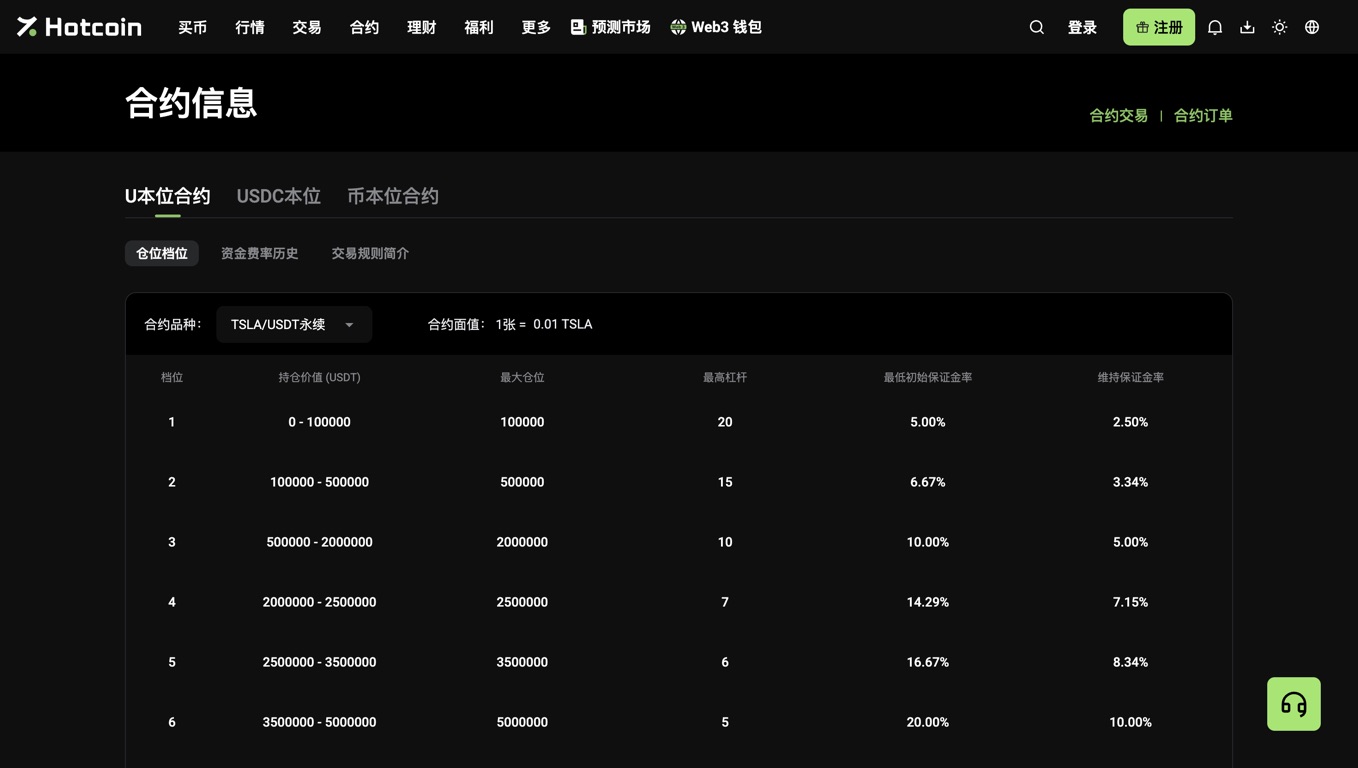
The leverage cap on Hotcoin TradFi has to be checked per instrument and per position tier; you cannot apply one single multiple to every product. At the time of verification, the first tier for TSLA/USDT showed a maximum of 20x, a minimum initial margin rate of 5.00% and a maintenance margin rate of 2.50%; higher tiers step the maximum leverage down. These are the parameters shown on that page at that time; they are not the leverage any individual user has already set, nor trading conditions that stay fixed forever on other contracts.
Parameter entry: TSLA/USDT contract information. Choose "position tiers" or "trading rules" to check the relevant details.
How Should You Understand Leverage Magnifying Gains and Losses?
Leverage magnifies your price exposure relative to margin; it does not improve how often your trading judgement is right. Suppose you open a 1,000 USDT linear contract position with only 100 USDT of initial margin: if the price moves 1% in the direction of your position, the profit or loss before fees is about 10 USDT, and a move in the opposite direction produces a loss of roughly 10 USDT as well. This simplified example is not the platform's minimum order size, and it includes neither funding costs nor liquidation conditions, so it cannot serve as a liquidation price formula.
How Should You Understand Cross Margin and Isolated Margin?
The core difference between cross margin and isolated margin is how margin is allocated and how losses are borne. Cross margin usually supports a position with margin shared across the applicable account scope, while isolated margin allocates margin separately to that position; the actual scope, top-up rules and switchable conditions have to be confirmed on the account page. The screenshot only shows the cross margin entry while logged out and does not prove that the current account has a particular mode enabled; even with isolated margin, you cannot read it as protection from liquidation or a guarantee of exiting at your stop price.
What Is the Difference Between Funding Rates and Trading Fees?
Trading fees relate to order execution, while funding rates are part of the funding settlement arrangement for perpetual futures, so the two should be understood separately. Users need to check the fee information for the specific product, the funding rate countdown and the actual statement, and should not treat a single page value as a fixed annualized return. Order book spreads and slippage also affect trading results, so when comparing the cost of using spot and futures, consider execution fees, holding-period costs and the price you actually get filled at together.
Why Do Perpetual Futures Still Need to Watch Traditional Market Closures?
Perpetual futures have no fixed expiry date, but the linked markets still have trading sessions and holiday schedules. When a related market is closed or adjusts its trading hours, the affected TradFi contracts enter reduce-only mode and no new positions can be added; existing positions still require attention to price, liquidity and margin. On the day of the screenshot, TSLA/USDT showed a Labor Day closure notice, which shows that "the page is reachable", "quotes are updating" and "new positions are allowed" are three statuses that have to be checked separately.
FAQ
Do TradFi Spot and Perpetual Futures Both Use USDT?
Hotcoin TradFi spot and futures are both quoted and settled in USDT, but users still need to check which trading account the funds sit in. The available balance on the spot page should not be read directly as available futures margin, and total account assets do not equal the funds immediately usable for a particular product. Before trading, confirm the account type and currency and then transfer according to what the page actually requires; a zero balance or dash in a logged-out screenshot is only a display state, not proof of a user's assets.
With 1x Leverage, Is a Stock Contract the Same as Spot?
Setting a stock perpetual contract to 1x leverage does not change its contract nature and does not automatically turn it into spot or a securities account holding. Even when the initial margin is close to the notional value of the position, users still have to follow the contract's funding settlement, margin and market status rules. Product costs, price formation and legal rights should still be understood as a contract; when comparing risk, identical leverage alone is not grounds for treating two products as fully equivalent, and you should also look at the actual account arrangements.
If You Do Not Use Futures Leverage, Is TradFi Spot Risk-Free?
Not using futures leverage does not mean TradFi spot carries no risk: falling prices, insufficient liquidity and changes in product structure can still cause losses. Some spot products are also linked to leverage or inverse strategies, and their risk cannot be judged only by whether a leverage button appears on the order screen. Before trading, check the specific product terms, the underlying assets and market sessions, and in particular do not treat spot trading, tokenized rights, direct shareholding and principal-protected products as the same kind of arrangement.
Mechanism check: What is Hotcoin TradFi and the TradFi FAQ. This article is for product education only and is not investment advice.
Leitura recomendada
Veja mais