Gas Fee Optimization: Saving Tips and Gas Tracking
A Gas fee is the network charge paid to execute transactions and consume computation or storage on a blockchain.
On Ethereum and most EVM networks, the fee depends on the Gas actually used and the effective price paid per Gas unit. Congestion raises the price, while complex contract calls consume more Gas. Max Fee and Gas Limit are scheduling and protection parameters, not amounts that are always charged in full.
Optimization does not mean setting every value as low as possible. A low fee can leave a transaction pending, while an insufficient Gas Limit can cause a revert and waste the fee already spent. Effective optimization means understanding the fee model, choosing the right time and network, removing unnecessary steps, and verifying the final result in a block explorer.
For the broader workflow connecting wallets, explorers, approvals, dashboards, and multisig tools, see Essential Web3 On-Chain Tools and Skills.
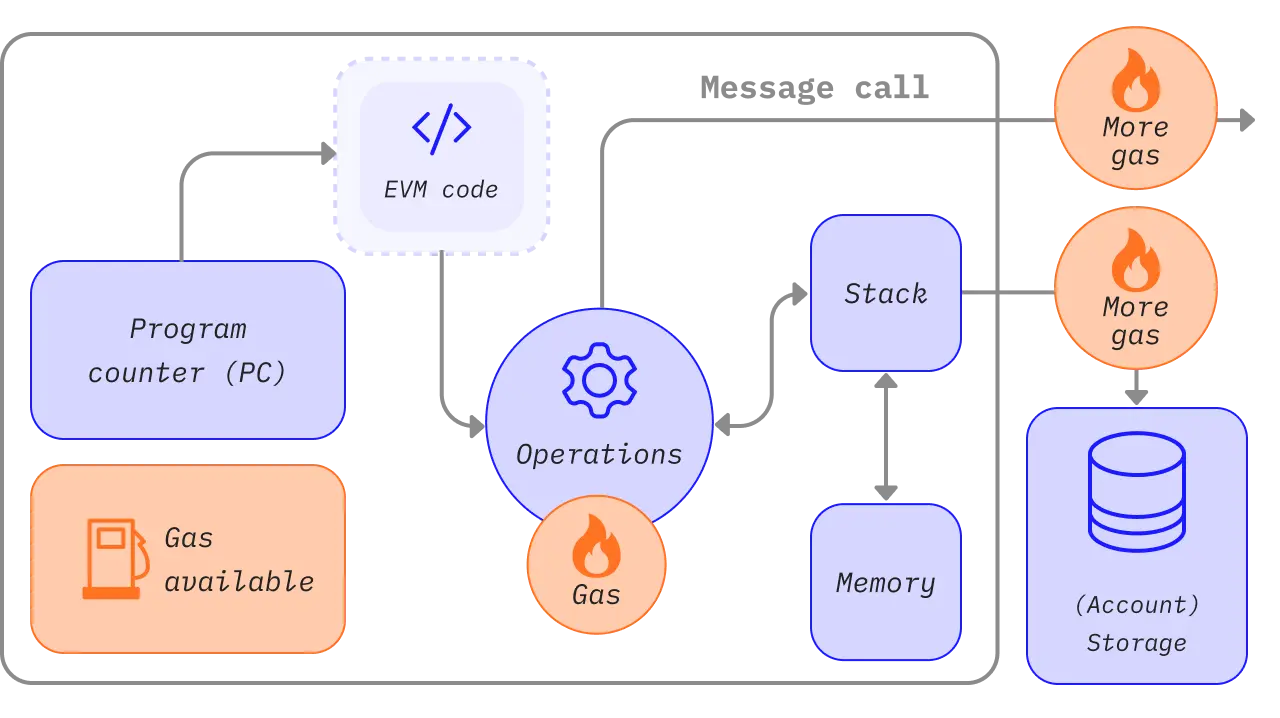
What Is Gas?
Gas is the unit the EVM uses to measure computation and state operations. Transfers, storage changes, contract deployment, logs, and cryptographic operations consume different amounts of Gas.
Using Gas separates resource consumption from the market price of ETH. The protocol assigns a Gas cost to each operation, while the fee market determines how much users pay for each Gas unit.
A basic ETH transfer follows a short execution path. Swaps, NFT mints, bridges, and multi-step DeFi calls require more computation and storage, so their Gas Used is higher. The same contract may also consume different amounts as its state changes.
Gas covers on-chain execution only. Token prices, DEX slippage, bridge service fees, protocol fees, and transfer taxes must be evaluated separately.
How Is a Gas Fee Calculated?
The execution fee is Gas Used multiplied by Effective Gas Price. Gas Used is the resource actually consumed; Effective Gas Price is the final amount paid for each unit.
Fees are settled in Wei and commonly displayed in Gwei and the network's native asset. One Gwei equals one billion Wei. Fiat cost also changes with the native asset's market price.
Gas Limit is the maximum resource allowance. Unused capacity is not charged, but a call that exceeds the limit runs out of Gas and reverts. Max Fee is the maximum price per Gas unit; any unused price headroom is not a fixed expense.
What Are Base Fee and Priority Fee Under EIP-1559?
EIP-1559 transactions divide the fee into Base Fee and Priority Fee. The protocol adjusts Base Fee according to recent block usage and burns it after execution. Priority Fee generally rewards the block proposer.
Users set Max Fee Per Gas and Max Priority Fee Per Gas. The effective price cannot exceed Max Fee. If Base Fee rises above that limit, the transaction may wait for a cheaper block.
A higher Priority Fee can improve competitiveness but cannot guarantee ordering because builders, private order flow, transaction dependencies, and network propagation also matter. Some networks and legacy transactions still use one Gas Price, so always check the network's current rules.
How Do Gas Limit, Gas Used, and Estimate Gas Differ?
Gas Limit is the allowed maximum, Gas Used is actual consumption, and Estimate Gas is a simulation based on current state.
The state can change between simulation and execution. Prices, balances, Nonces, pool reserves, or contract switches may move, causing a previously successful simulation to revert.
Wallets normally add a buffer to the estimate. Cutting the limit is not a saving technique, while raising it cannot repair invalid contract logic. If estimation fails, investigate the revert, RPC, balance, and parameters before forcing a transaction.
Why Does the Same Action Cost a Different Gas Fee?
Network congestion changes demand for block space. Popular mints, airdrops, liquidation events, and market volatility can rapidly raise Base Fee and Priority Fee.
Contract state and transaction input also matter. New storage, multi-pool routing, token quantities, recipient counts, and signature counts can alter the execution path.
Fee models differ across Ethereum, rollups, sidechains, and other EVM networks. Gwei alone is not a complete comparison. Even when on-chain Gas falls, the fiat cost can rise if the native asset appreciates.
How Can You Track Current Gas Levels?
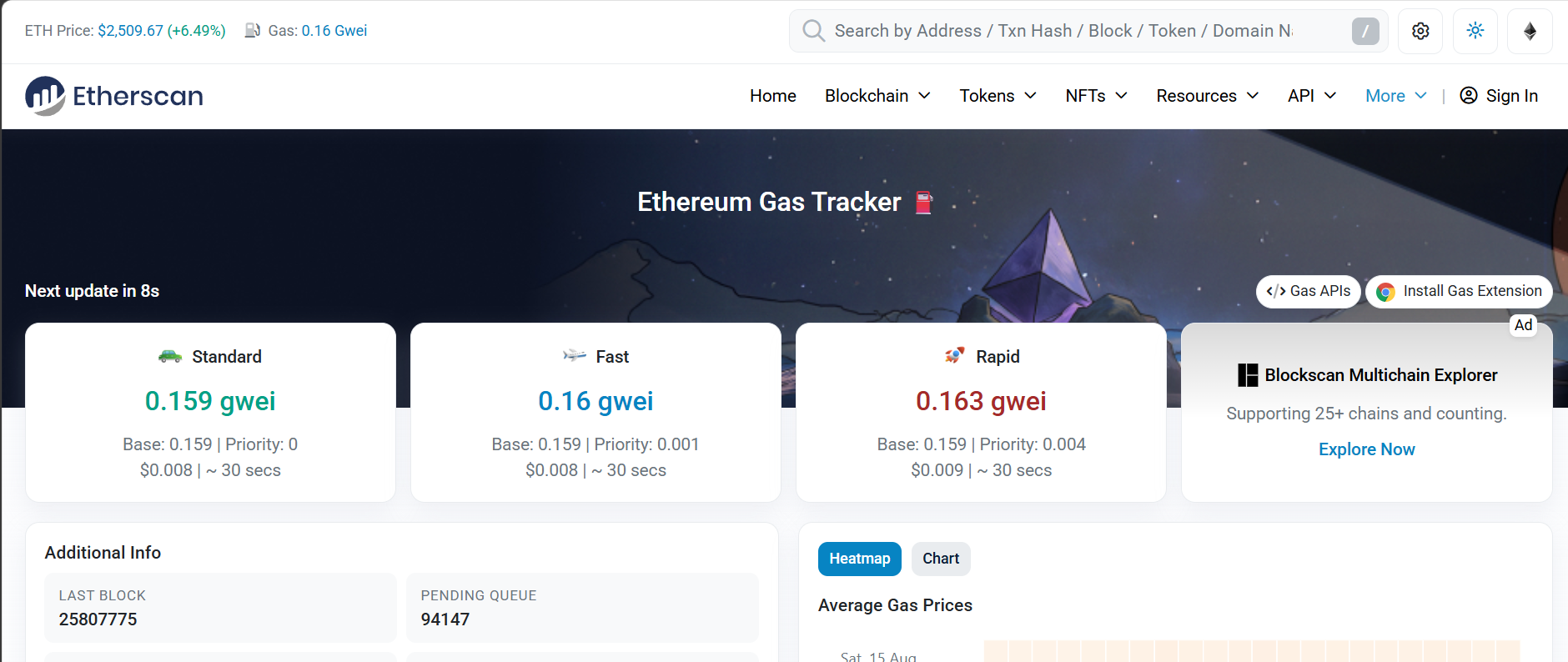
Compare the wallet estimate with Etherscan Gas Tracker, the official network explorer, and reliable data services. Watch Base Fee, suggested Priority Fee, recent block utilization, and quoted speed tiers.
A tracker is an estimate, not a promise. During volatility, its value may be stale before you sign. Observing multiple periods is more useful than relying on a single snapshot, and there is no permanently cheapest global hour.
Historical blocks show Base Fee, Gas Used Ratio, and confirmed transaction fees, helping you judge whether your settings were far from the market.
How Should You Choose Transaction Speed?
For non-urgent actions, a lower Priority Fee with a reasonable Max Fee can wait for costs to fall, provided the contract deadline and market conditions are not time-sensitive.
Swaps, liquidations, mints, and limited-time claims may fail if delayed. Compare the cost of a likely revert with the price of a higher priority setting.
Not every transaction needs the fastest tier. Transfers, approval revocations, and account housekeeping often suit the wallet's middle tier. But an excessively cheap pending transaction can block later Nonces and require a paid replacement.
How Do You Customize Gas in MetaMask?
MetaMask shows estimated fees and speed options. On supported networks, it may expose Max Fee, Max Priority Fee, and Gas Limit; labels can change by version.
Check units carefully because a Gwei or decimal mistake can create an extreme cap. The native-asset amount is what settles on-chain; the fiat estimate is only a convenience.
Priority Fee should not be far above market without reason. Max Fee should cover Base Fee, priority, and short-term movement while remaining affordable. Gas Limit should normally follow the wallet estimate.
For network setup, fee editing, and pending transaction management, read How to Install and Use MetaMask: Your Web3 Gateway.
How Can You Speed Up or Cancel a Pending Transaction?
Transactions from one EVM account execute in Nonce order. A lower pending Nonce may block later transactions even if they offer higher fees.
Speed Up submits the same intent with the same Nonce and a sufficiently higher fee. Cancel usually sends a zero-value transfer to yourself with the same Nonce and a higher fee.
Cancellation is replacement, not reversal. If the original confirms first, its state change remains. Check the Nonce, pending queue, and replacement records in a block explorer before sending repeated alternatives.
Why Does a Failed Transaction Still Charge Gas?
Validators performed computation and consumed block resources even though a revert rolled back state changes. A failed transaction therefore still reports Gas Used and a transaction fee.
Common causes include slippage protection, expired deadlines, insufficient approval or balance, paused contracts, price changes, permission errors, and Out of Gas.
A higher fee improves inclusion but cannot fix business conditions. Use the transaction hash to inspect Status, Revert Reason, Input, Logs, and Trace. For a complete field guide, see Block Explorer Guide: Etherscan, Solscan, and More.
How Can You Reduce Unnecessary Approval Gas?
ERC-20 applications often require Approve before Swap, Deposit, or Bridge. If an existing allowance is sufficient, another approval may be unnecessary.
Unlimited approval reduces repeated fees but expands long-term permission risk. Exact approval reduces exposure but can require more transactions. Choose based on protocol trust, usage frequency, and wallet balance.
Permit and Permit2 may replace a separate approval transaction with a signature. A gasless signature can still grant spending power, so verify the spender, amount, Nonce, and deadline.
Revoking an approval also costs Gas, and disconnecting a site does not change on-chain permissions. See Token Approval Management: Protect Your Wallet with revoke.cash for the cost-and-risk tradeoff.
How Can You Optimize Both Gas and Slippage in a Swap?
Gas is an execution fee; slippage is the difference between the expected and final trade outcome. Raising Gas does not reduce price impact, and raising slippage tolerance does not reduce Gas.
Aggregators may find a better price through multiple pools, but complex routes usually consume more Gas. For a small trade, the execution cost can exceed the pricing improvement.
Too little slippage tolerance may cause a revert; too much can permit a poor fill or sandwich exposure. Check Minimum Received, pool liquidity, token taxes, and transfer restrictions instead of forcing an abnormal quote.
Why Are Layer 2 Fees Different?
A rollup fee can include local execution plus the cost of publishing data to Layer 1. Proof, sequencing, congestion, and operating parameters can also affect the combined amount shown by a wallet.
More transaction data can raise the L1 component. Blob markets and compression reduce some costs but can themselves become congested.
Moving to L2 also involves bridge fees, waiting time, and a future exit. Saving one transaction can be uneconomical after the entire round trip.
How Should You Compare Total Cost Across Chains?
Cross-chain cost may include source approval, the bridge transaction, service fee, destination claim or execution, swap slippage, and the future return path.
Canonical bridges may have clearer trust boundaries, while third-party bridges can be faster but add contract, validator, and liquidity risks.
The destination asset may be native, canonically bridged, or wrapped by another provider. A cheap route is not useful if the resulting asset is unsupported. For small balances, compare total fees with the asset value before moving.
Do Batch Transactions and Automation Really Save Gas?
Batching can share fixed overhead and reduce signatures. Multisig, account abstraction, and router contracts use it to improve workflows.
However, a batch is more complex and has a higher Gas Limit. If one operation causes an atomic revert, the failed cost may be large. Automation also introduces keeper or bot execution and service fees.
A sponsored transaction still has a payer. Check whether a Paymaster, project subsidy, or later reimbursement covers it and who bears the cost of failure.
What Other Practical Techniques Save Money?
Simulate before signing, compare the asset value with the complete fee, reuse safe allowances when appropriate, and ensure the wallet holds enough native Gas asset.
Combine necessary steps only through trusted contracts. Record transaction hashes, actual fees, and operation types so that future decisions use observed cost rather than intuition.
16.1 Optimizing a Basic Transfer
A basic transfer is mainly affected by congestion and priority. Non-urgent transfers can wait for Base Fee to fall. Before depositing to an exchange, confirm the supported network and minimum amount rather than selecting an incompatible chain merely for lower fees.
16.2 Optimizing DeFi Deposits and Withdrawals
The full path can include Approve, Deposit, Claim, Withdraw, and Swap. Estimate the round trip, especially for a small position whose rewards may never cover entry and exit.
When collateral safety is at risk, timely repayment or additional collateral matters more than a small Gas saving.
16.3 Optimizing an NFT Mint
Confirm the official contract, wallet limit, mint price, and deadline. Repeated failed attempts during a congested launch can cost more than the NFT.
Batch minting may reduce unit overhead but increases the total Gas Limit and payment. Use the official simulation to compare both options.
16.4 Optimizing an Airdrop Claim
Compare the tradable value with claim, bridge, and swap costs. A displayed token price without liquidity does not prove the claim is worthwhile.
Never enter a seed phrase or prepay Gas to a private address. Prepare the native asset before the deadline and avoid leaving no time to recover from an error.
16.5 Optimizing Multisig Transactions
Off-chain multisig confirmations usually do not consume Gas; the threshold execution does. Teams can review and sign first, then execute at a suitable time unless the action is security-critical.
Batching treasury actions can reduce overhead but magnifies mistakes. Each signer should verify recipients, calldata, Delegatecall, modules, and total value independently.
Common Gas Scams and Misconceptions
A “Gas refund website” may seek a malicious signature. Unused Gas is settled by protocol rules and never requires a third party to collect a seed phrase.
“Gas Token” offers may be fake; most networks pay fees directly in their native asset. Paying more Gas cannot recover a confirmed transfer or make a malicious contract safe.
L2 is not always cheaper once bridging, data demand, and the full workflow are included. Compare the complete path instead of trusting a slogan.
The Hotcoin GASMAP Six-Dimension Method
GASMAP is a quick pre-signing cost checklist. It helps manage fees but does not prove that a contract or transaction is safe.
18.1 G: Gas Used — How Complex Is the Action?
Distinguish transfers, approvals, swaps, mints, bridges, and batches. Review simulated Gas Used and expected state changes.
18.2 A: Activity — How Congested Is the Network?
Check Base Fee, block utilization, recent events, and trackers. Waiting can help a non-urgent action, but no hour is always cheapest.
18.3 S: Speed — How Urgent Is the Transaction?
Choose priority according to deadlines, prices, and business needs. Routine transfers rarely need an extreme setting; time-limited actions cannot wait indefinitely.
18.4 M: Max Fee — Is the Cap Affordable?
Verify Gwei units, Max Fee, Priority Fee, Gas Limit, and fiat estimate. Make sure the worst acceptable charge does not consume required assets.
18.5 A: Actions — Can You Remove Steps?
Check existing approvals, batching, route complexity, and bridge count while balancing unlimited permission and third-party contract risks.
18.6 P: Proof — Did You Verify the Result?
Save the hash and inspect Gas Used, Effective Gas Price, Status, Nonce, and Replacement in an explorer to build an accurate cost record.
Standard Operating Procedure for Gas Optimization
Before signing, confirm the network and native balance, review congestion in an official tracker, simulate the contract, and compare the complete fee with the transaction value.
At signing, verify Gas Limit, Max Fee, Priority Fee, slippage, and deadline. Choose a suitable speed without extreme manual values.
After submission, save the hash. If it remains pending, inspect Nonce and market fees before waiting, speeding up, or cancelling. Record the final cost and asset result, and include future bridge exits in cross-chain decisions.
Frequently Asked Questions
20.1 Is the Entire Gas Limit Charged When It Is Set High?
Usually no. A successful transaction settles on actual Gas Used, although an abnormal or malicious call can consume more of an overly generous limit.
20.2 Are Max Fee and Actual Gas Price the Same?
No. Max Fee is the price cap per Gas unit; the effective price depends on Base Fee, Priority Fee, and that cap.
20.3 Why Is a Failed Transaction Charged?
Validators already performed computation and consumed block capacity even though state changes reverted.
20.4 Does a Higher Priority Fee Guarantee a Successful Swap?
No. It improves inclusion competition but cannot fix slippage, balance, approval, deadline, or contract logic.
20.5 Can Cancel Reverse a Confirmed Transaction?
No. Cancel is a same-Nonce replacement for a pending transaction. It cannot reverse a state change that already confirmed.
20.6 Why Can an L2 Transaction Suddenly Become Expensive?
L2 fees may combine local execution and L1 data. Congestion, blob demand, data size, and network parameters can all change the total.
20.7 Can Stablecoins Pay Gas When the Wallet Has No Native Token?
Most networks require their native asset. Some account-abstraction or sponsorship systems allow alternatives, but only according to the wallet and network's official rules.
Conclusion: The Cheapest Transaction Is a Necessary Transaction That Does Not Fail
Gas optimization is not about forcing every parameter to the minimum. It is about completing a necessary action correctly at an acceptable total cost.
The most reliable savings come from eliminating unnecessary actions, avoiding avoidable congestion, managing approvals and routing complexity, selecting a suitable network, and recording the actual result in an explorer.
For the wider workflow, return to Essential Web3 On-Chain Tools and Skills. You may connect to dApps through Hotcoin Web3 Wallet, get mobile market and trading tools from the Hotcoin App, or browse more educational material at Hotcoin.
Risk notice: This article is for education and information only and is not investment, trading, cybersecurity, legal, or tax advice. Estimates and trackers may be delayed or inaccurate. On-chain activity may involve reverts, Nonce conflicts, malicious approvals, slippage, MEV, bridge, RPC and front-end attacks, native-asset volatility, and irreversible transfers. Verify current network rules, official documentation, fee settings, and simulations, and use only assets you can afford to lose.
Leitura recomendada
Veja mais