Crypto Trading Strategies Compared: 15 Common Approaches at a Glance
There are at least 15 mainstream approaches to crypto trading, from dollar-cost averaging and trend following to arbitrage and grid trading. They differ widely in time frame, difficulty and risk, so the sensible move is to pick and combine them according to your own goals.
No single strategy suits everyone. What matters is understanding the logic behind each method, the market conditions it fits, and its risk profile, then matching that with your available time, experience and risk capacity. Below is a comparison of 15 common crypto trading strategies to help you build a clear overview quickly.
1. Long-Term Holding (HODL)
Buy and hold for the long term, minimizing market timing.
Suited to people who believe in long-term value and prefer not to trade frequently.
The advantage is simplicity; the drawback is that drawdowns can be severe.
2. Dollar-Cost Averaging (DCA)
Invest a fixed amount at fixed intervals.
Suited to salaried investors and those building positions steadily.
The advantage is less timing pressure; the drawback is that early in a bull market returns may lag a lump-sum purchase.
3. Trend Following
Trade in the direction of the trend: lean long when price rises, lean short or stay out when it falls.
Relies on moving averages, market structure and momentum tools.
Suited to people who accept lag and care about the bigger direction.
4. Swing Trading
Hold positions from several days to several weeks to capture medium-term moves.
Requires skill with support and resistance, chart patterns and risk management.
It balances time commitment against opportunity density.
5. Day Trading
Open and close positions within the same day, with no overnight exposure.
Highly sensitive to execution, discipline and trading costs.
High risk, and not a suitable starting point for beginners.
6. Scalping
Capture tiny price differences within very short windows.
Depends on deep liquidity, low fees and fast order placement.
Intense, with little room for error.
7. Breakout Trading
Enter when price breaks a key range or a high or low.
Success depends on filtering out false breakouts and managing the retest.
It has more room to work when volatility expands.
8. Pullback Trading
Buy pullbacks within an uptrend, or short rallies within a downtrend.
Emphasizes trading with the larger direction and against the smaller swings.
Requires a clear definition of the trend and of the level at which the idea is invalid.
9. Range Trading
Sell high and buy low in a choppy market.
Suited to sideways conditions, not to strong one-way trends.
Once the range breaks, the original logic tends to stop working.
10. Grid Trading
Place layered buy and sell orders across a price range to buy low and sell high automatically.
Suited to ranging markets and easy to automate.
In a one-way market you may end up holding positions passively for a long time.
11. Arbitrage
Exploit differences across markets, contracts or funding rates to earn returns with relatively low directional risk.
Includes spot-futures arbitrage, funding rate arbitrage and cross-exchange spreads.
The barriers are speed, fees, risk control and capital capacity.
12. News and Event-Driven Trading
Position around events such as halvings, ETF developments, network upgrades and regulatory news.
Returns come from the gap between expectations and reality; the risk is that prices fall as soon as good news lands.
Requires sound judgement of information and control of position size.
13. Momentum Trading
Chase strong coins and strong sectors and let profits run.
Its strength is upside elasticity; its weakness is fast drawdowns and fast rotation.
Strict stop-losses are essential to avoid buying at the very end of a move.
14. Mean Reversion
Based on the idea that price returns to its normal range after deviating too far.
Commonly supported by overbought and oversold indicators.
In one-way markets it can trigger repeated stop-outs.
15. Portfolio or Systematic Strategies
Combine two or more methods, such as DCA with a trend filter, or swing trading with a grid.
The goal is greater consistency, not turning any single strategy into a magic formula.
The key is clear rules that keep the strategies from conflicting with each other.
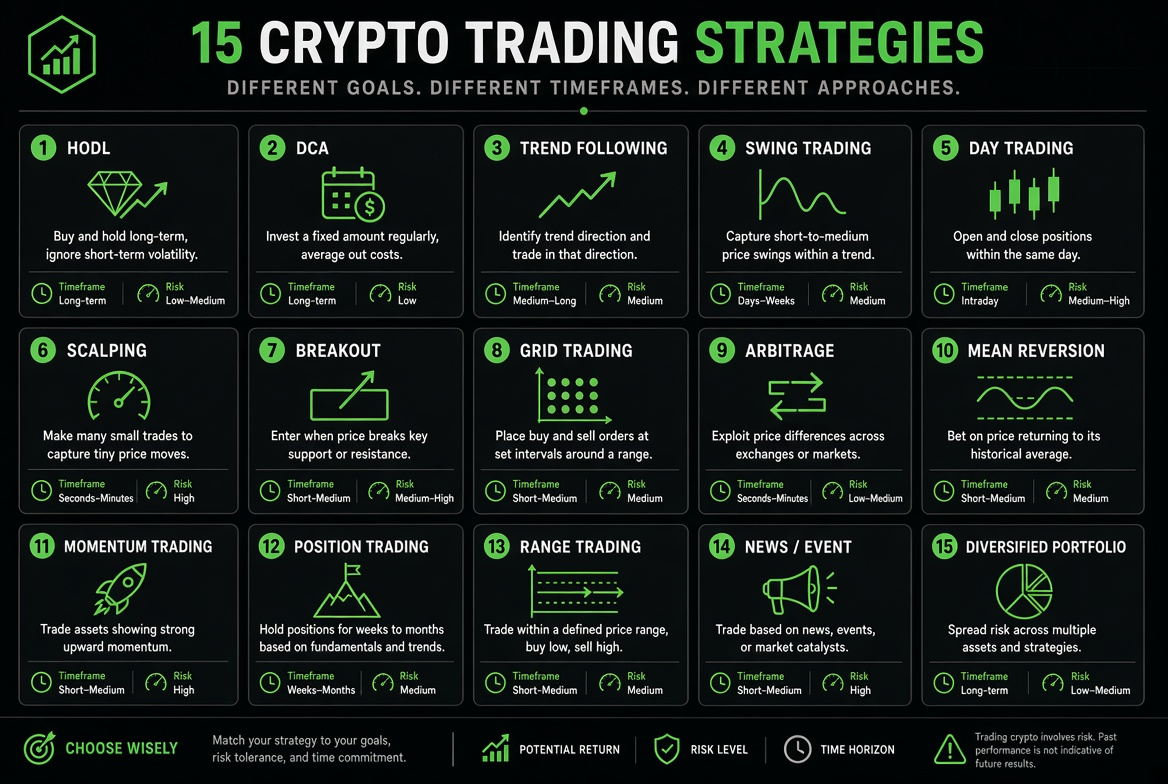
How to Compare These Strategies
You can evaluate them along four dimensions:

A simple matching rule:
No time: DCA, long-term holding
Some background and time to check the market regularly: swing trading, trend following
Experienced with strong execution: breakout trading, momentum, day trading
Systems and risk control in place: arbitrage, grid trading, portfolio strategies
Practical Advice When Choosing a Strategy
Match your lifestyle first, then your return expectations
Build discipline with low-risk strategies before adding complexity
Every strategy needs explicit exit rules
Execution, slippage and emotion stand between backtest and live results
Do not run too many strategies whose logic conflicts
A More Reliable Starting Path for Beginners
Start with DCA or long-term spot holding to build a feel for the market
Learn support, resistance and trends, then try swing trading
Once you have a stable track record, explore breakout, grid or contract-based methods
Always put position sizing and drawdown control first
Risk Disclosure
Every trading strategy can lose money. Past performance does not indicate future results, the crypto market is highly volatile, and leverage magnifies risk further. This article is for educational comparison only and is not investment advice. Choose carefully based on your own circumstances and use only funds you can afford to lose.
FAQ
Q1: Is there a "best" crypto trading strategy?
A: No. The best strategy is one that matches your time, personality, capital and risk tolerance, and that you can keep executing over the long term.
Q2: Which one should beginners learn first?
A: It usually makes sense to start with DCA and the basics of spot trend following or swing trading. Starting directly with scalping or high-leverage contracts is not recommended.
Q3: Can I use several strategies at the same time?
A: Yes, but keep the roles clearly separated, for example DCA in a long-term account and swing trading in a short-term account, so the logic does not become muddled.
Q4: Why does a strategy backtest well but fail in live trading?
A: Common reasons include overfitting, ignoring fees and slippage, inconsistent execution, and emotional interference in live trading.
Q5: How often should a strategy be adjusted?
A: Review it when market conditions change clearly or when the strategy stops working over a long period. Switching strategies frequently is often itself the problem.
Comparing these 15 crypto trading strategies shows one thing: no method is inherently better than another, only more or less suitable. Pick something you can actually execute before chasing efficiency; control drawdowns before optimizing returns. A strategy is a map, but risk control and discipline are what get you all the way through.
Leitura recomendada
Veja mais