The History of Cryptocurrency: From Satoshi to a Trillion-Dollar Market
The history of cryptocurrency did not begin with Bitcoin's first price rally, nor is it a straight success story leading from Satoshi Nakamoto to a “trillion-dollar market.”
Long before Bitcoin appeared, cryptographers had studied digital cash, payment privacy, timestamps, proof of work, and distributed consensus. Satoshi's crucial contribution was to combine existing components into a system that could operate on an open network, be verified collectively by its participants, and prevent double spending.
The industry later passed through the rise of exchanges, smart contracts, stablecoins, initial coin offerings, DeFi, NFTs, Layer 2 networks, institutional investment products, and global regulation. Every expansion introduced new uses as well as new risks. Protocol, smart-contract, custody, leverage, and regulatory risks should not be treated as the same thing.
A “trillion-dollar market” describes aggregate valuations calculated from market prices and circulating supply. It does not mean an equal amount of fiat money entered the market, and it does not mean every asset could be sold at its displayed price. The purpose of studying history is not to search for a price cycle guaranteed to repeat, but to understand where today's products came from, which problems they address, and which assumptions they depend on.
For a complete learning map covering definitions, categories, and safe participation, see the Beginner's Complete Guide to Cryptocurrency.
Why Cryptocurrency History Does Not Begin in 2008
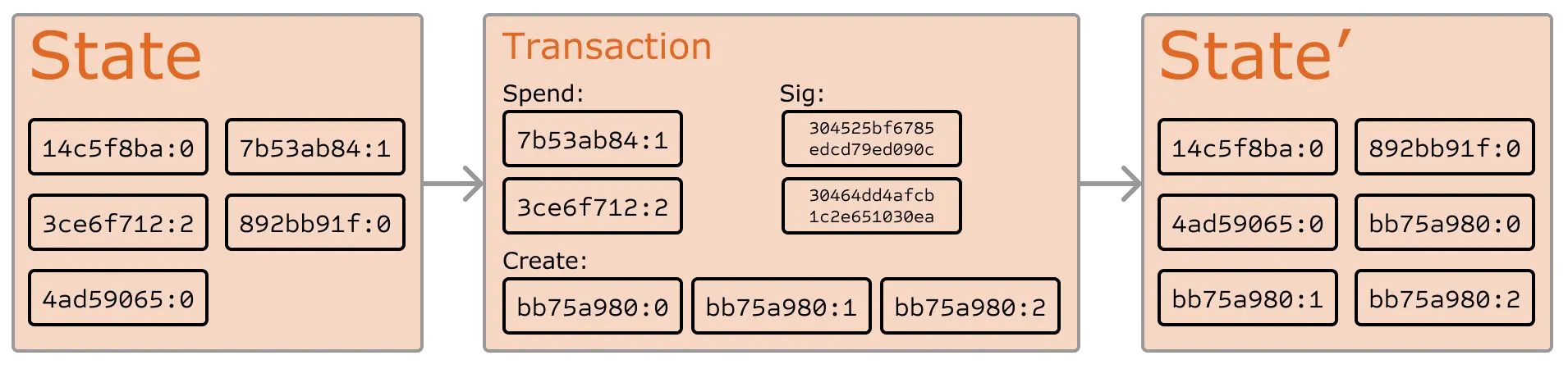
The internet makes information almost costless to copy, but digital money faces the opposite requirement: the same unit of value must not be spent twice by the same person. A bank-managed ledger can check balances and reject duplicate payments. Without a central bookkeeper, the network itself must determine which transaction came first, who has authority to spend, and which history is valid.
Research before Bitcoin supplied many of the necessary parts. Public-key cryptography could prove control, digital signatures could authorize transactions, hash functions could reveal data changes, timestamps could establish order, proof of work could make record creation costly, and Byzantine fault-tolerance research explored how mutually distrustful nodes could agree.
Having the parts was not the same as having an operational monetary network. Early systems often relied on a company, a central server, an anti-counterfeiting database, or identifiable accounts. They could still stop because of business failure, regulation, financing problems, or a single point of failure.
The central thread of cryptocurrency history is therefore the changing structure of trust: from trusting an issuing company, to relying on open protocols and consensus, and then to complex networks involving smart contracts, stablecoin issuers, bridges, oracles, custodians, and governance organizations.
The 1980s: Digital Cash and Private Payments
In 1982, cryptographer David Chaum proposed blind signatures. The method allows a signer to sign without seeing the complete message, providing an important foundation for electronic cash that can be validated while preserving a degree of payment privacy.
Chaum later helped establish DigiCash and brought cryptographic electronic cash into commercial use. Users could obtain digital cash credentials from a bank or issuing system and spend them with merchants. DigiCash showed that digital cash was more than theory, but issuance and settlement still depended on institutions, and the network effect was not sufficient for long-term operation.
The principal question at this stage was how to make digital payments behave more like cash and reduce comprehensive transaction tracking, not how strangers could maintain a currency supply without an issuer.
The fate of early digital cash offered a lasting lesson: cryptography can change payment mechanics, but it does not automatically solve adoption, liquidity, compliance, usability, or sustainable operations.
The 1990s: Cypherpunks Connect Privacy, Code, and Money
During the 1990s, the cypherpunk community discussed online privacy, encrypted communications, digital identity, and permissionless systems. The 1993 Cypherpunk's Manifesto argued that privacy required cryptography, anonymous transaction systems, and publicly available software.
Cypherpunk was not a company with one political view or product roadmap. It was closer to a mailing list and intellectual network of researchers, programmers, and activists. Many people who later influenced Bitcoin discussed there how code might reduce dependence on trusted third parties.
Adam Back released Hashcash in 1997. It originally used computational cost to deter spam and denial-of-service attacks, but its principle—perform verifiable work before earning the right to send or participate—later informed Bitcoin's proof of work.
In 1998, Wei Dai proposed b-money, describing how anonymous participants might create money through computational work and maintain a shared ledger. Nick Szabo's Bit Gold envisioned linking hard-to-produce but easy-to-verify proofs of work into digitally scarce objects.
These proposals were neither early versions of today's Bitcoin network nor complete replicas of its consensus and incentive system. They nevertheless framed the essential questions of digital scarcity, public verification, computational cost, and money without a central issuer.
2008: Satoshi Publishes the Bitcoin White Paper
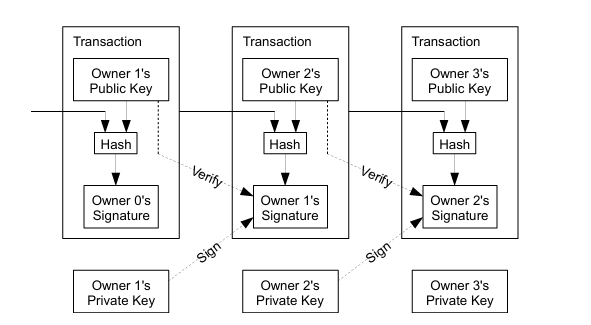
On October 31, 2008, a person or group using the name Satoshi Nakamoto published “Bitcoin: A Peer-to-Peer Electronic Cash System” on a cryptography mailing list. The paper proposed using a peer-to-peer network, digital signatures, a timestamp server, and a proof-of-work longest-chain rule to solve double spending.
Bitcoin did not invent digital signatures, hashing, peer-to-peer networking, or proof of work. Its breakthrough was combining those technologies with economic incentives: miners expend computing power to compete for the right to record blocks, nodes independently verify the rules, block rewards issue new coins, and transaction fees provide a long-term incentive.
The white paper appeared during the global financial crisis, which intensified reflection on banks, payment intermediaries, and monetary systems. The timing alone, however, does not prove that the crisis was Bitcoin's sole cause; the technical ideas had accumulated over several decades.
Bitcoin's core design was not a promise of rising prices. It was a mechanism that lets an open network establish a verifiable transaction order and makes history costly to rewrite without requiring a central payment institution to approve every transfer.
2009: The Genesis Block and Network Launch
Bitcoin's genesis block was created on January 3, 2009. It includes a newspaper headline from that day, serving as a timestamp and often interpreted as commentary on bank bailouts and the financial system.
The Bitcoin software then began operating publicly. Satoshi and Hal Finney completed an early peer-to-peer transfer, demonstrating that the design could move from a white paper to a live transaction.
The early network had few miners, little computing power, and almost no market price or infrastructure. Participants were mainly cryptography enthusiasts and open-source developers. Looking back from today's large network can obscure how experimental and risky Bitcoin remained in 2009.
This stage established three enduring traditions: protocol rules are implemented in public software, any node can verify the ledger, and development depends on developers, miners, users, and businesses that do not share a single employer.
2010–2012: From Experimental Token to Tradable Asset
In 2010, Bitcoin began to acquire product exchanges, quoted prices, and early trading platforms. The famous Bitcoin Pizza Day showed a public purchase of real goods, although one event did not make Bitcoin a widely used currency.
Exchanges solved price discovery and conversion between fiat and Bitcoin, while introducing new centralized risks. Once users deposited coins, an exchange usually controlled the on-chain private keys; a website balance could merely represent the exchange's liability.
More alternative coins appeared from 2011 onward. Some changed the mining algorithm, block time, supply rules, or privacy design, expanding the market from one Bitcoin network into a multi-asset ecosystem.
Bitcoin's first halving in 2012 reduced the block subsidy from 50 BTC to 25 BTC. It showed that issuance rules could execute as programmed, but it did not dictate a fixed price result. Demand, liquidity, miner costs, and the macro environment also influence the market.
2013–2014: Mass Attention and the Collapse of Mt. Gox
Bitcoin prices swung sharply in 2013, attracting sustained attention from the media, regulators, and ordinary investors. Payment companies, mining-hardware businesses, and professional exchanges emerged, moving cryptocurrency from technical communities into public debate.
Mt. Gox handled a large share of Bitcoin trading during this period. In 2014, it halted withdrawals and entered bankruptcy, leaving many users unable to recover their assets for years.
The Mt. Gox failure was not synonymous with the Bitcoin blockchain being hacked. It primarily exposed weaknesses in a centralized exchange's private-key management, internal controls, accounting transparency, and solvency. Distinguishing a failed base protocol from a failed custodian is one of the most important skills in reading crypto history.
Cold storage, multisignature arrangements, proof of reserves, audits, and regulated custody subsequently became major industry topics. No single proof, however, can completely reveal a platform's liabilities, related-party exposures, and future liquidity.
2013–2015: Ethereum Makes Blockchains Programmable
Vitalik Buterin published the Ethereum white paper in 2013, proposing a general-purpose blockchain application platform. Developers would no longer need to create a new chain for every asset or application; they could deploy smart contracts in a shared execution environment.
The Ethereum Foundation was established and conducted a crowdsale in 2014. Ethereum Frontier launched in July 2015. Besides transferring value, ETH pays the Gas required to execute smart contracts.
This development expanded the industry's central question from “Can we create digital money?” to “Can we run programs on a public ledger?” Tokens, decentralized trading, on-chain lending, NFTs, and DAOs gained shared infrastructure.
Bitcoin and Ethereum are not simply old and new substitutes. Bitcoin emphasizes limited supply, censorship-resistant value transfer, and conservative validation, while Ethereum emphasizes programmable state and an application ecosystem. For a deeper comparison, see Bitcoin vs. Ethereum: A Complete Guide to Crypto's Two Leaders.
2016: The DAO Incident and a Governance Fork
In 2016, The DAO, built on Ethereum, was exploited through a smart-contract vulnerability and a large amount of ETH was transferred. The community then fiercely debated whether a network upgrade should change the resulting state.
The chain adopting state restoration continued under the Ethereum name, while participants opposing the change preserved the original chain as Ethereum Classic. This was not an ordinary software update; it showed technical rules, values, and social consensus interacting.
The DAO incident demonstrated that “code is law” does not eliminate human governance. After a major exploit, developers, nodes, exchanges, miners, applications, and users still decide which software version to run.
It also demonstrated that public code is not automatically safe. Audits, formal verification, permission controls, upgrade mechanisms, and emergency pauses can reduce risk, but none can guarantee the absence of vulnerabilities.
2017: The ICO Boom and the First Market-Wide Expansion
Standards such as ERC-20 lowered the technical barrier to token issuance. During 2017, many projects raised funds through initial coin offerings, with investors sending assets to contracts in exchange for new tokens.
ICOs offered open-source projects a new global funding route but also caused serious problems. Teams could raise money without mature products, token rights were unclear, marketing displaced technical validation, and fraud, plagiarism, and misuse of funds became widespread.
Bitcoin and Ethereum both experienced congestion and rising fees. Scaling debates encouraged Bitcoin forks, payment channels, sidechains, and later Layer 2 research.
The era showed that lower issuance barriers can expand innovation and low-quality supply at the same time. A token can be created quickly without possessing sustainable demand, legal rights, or genuine exit liquidity.
2018–2019: Crypto Winter and Infrastructure Building
After the ICO bubble burst, many token prices fell, projects ceased operating, and the market entered an extended adjustment commonly called crypto winter.
Falling prices did not end technical work. Stablecoin trading, institutional custody, hardware wallets, on-chain analytics, smart-contract security, proof-of-stake research, and scaling solutions continued to develop.
Regulators began to distinguish more explicitly among payment, commodity-like, security-like, and utility assets. Exchanges strengthened identity checks, anti-money-laundering procedures, and listing reviews, although definitions and licensing paths differed by jurisdiction.
The key lesson of 2018–2019 was that a bull market can validate demand quickly but is poor at proving sustainable revenue, real users, and complete governance. Industry maturation often occurs after market excitement subsides.
2014–2020: Stablecoins Become the On-Chain Unit of Account
Stablecoins attempt to combine fiat-denominated value with blockchain transfer. After early dollar stablecoins appeared, traders no longer had to return to bank accounts every time they wanted to reduce volatile exposure.
Stablecoins became common settlement assets for centralized trading, cross-border transfers, and DeFi. They also connected crypto markets more directly to banks, short-term government debt, custodians, and issuers.
A stablecoin is not a simple copy of physical dollars. Fiat-backed stablecoins depend on issuers, reserves, banks, and redemption. Crypto-collateralized stablecoins depend on collateral ratios, oracles, liquidation, and governance. Algorithmic designs may depend on incentives and continuing demand.
Their growth showed that crypto had not fully separated from traditional finance. Many high-frequency uses depend on stable pricing, fiat access, and compliant issuing structures.
2020: DeFi Moves Trading, Lending, and Yield On-Chain
DeFi protocols use smart contracts to provide trading, lending, stablecoins, derivatives, and asset management. Automated market makers let liquidity providers deposit assets into pools priced by formulas instead of traditional order books.
Liquidity mining and governance tokens drove the 2020 “DeFi Summer.” Users could combine protocols into composable finance, but an exploit, oracle error, or depeg in one protocol could propagate through those connections.
On-chain transparency lets anyone inspect pools, collateral, and transactions, but it does not mean every user understands the risks. Annualized yield can come from token subsidies, leveraged loops, trading fees, or borrowing demand, with very different sustainability.
DeFi proved that smart contracts can carry complex financial logic while exposing new risks such as front-running, flash-loan attacks, administrator privileges, governance manipulation, and bridge failures.
2020–2021: Institutional Participation and a Trillion-Dollar Market
After 2020, public companies, professional funds, payment businesses, and traditional financial institutions showed greater interest in Bitcoin and digital assets. Derivatives, custody, research, and compliant trading services became more professional.
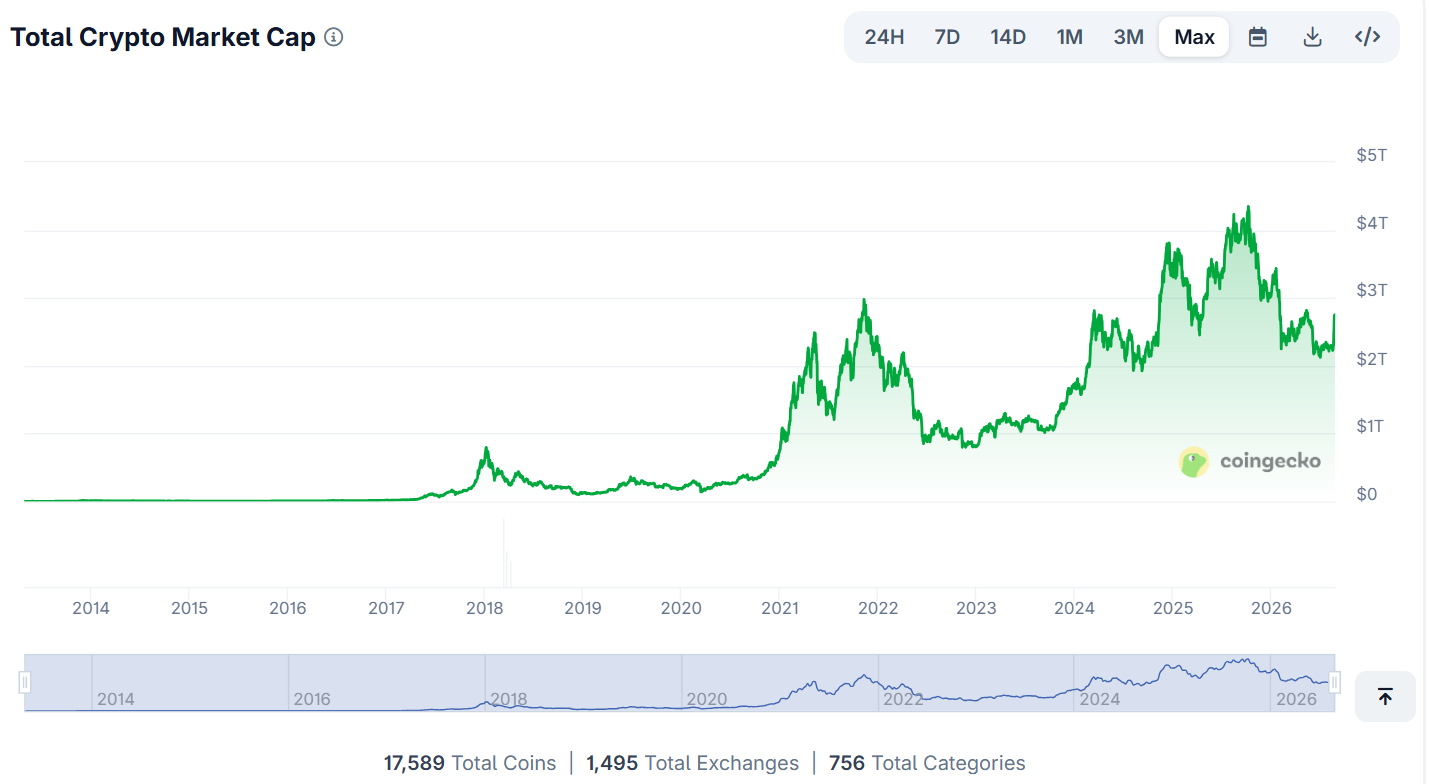
The total cryptocurrency market capitalization first entered trillion-dollar territory in early 2021. It continued to fluctuate and moved above and below that threshold in later cycles.
Market capitalization generally equals each asset's current price multiplied by circulating supply, summed across assets. A small trade can raise the quoted price of an illiquid token, after which its entire circulating supply is valued at that price. Market cap is therefore neither cash held by a project nor the amount all holders can realize at once.
The real significance of the trillion-dollar threshold was that crypto became an asset class global investment, payments, regulation, accounting, and cybersecurity could no longer ignore—not that its risks had disappeared.
2021: NFTs, On-Chain Culture, and Digital Ownership
NFT standards allow every token to have a distinct identifier and attributes. Digital art, profile pictures, game items, tickets, and memberships began to be issued and traded through on-chain contracts.
NFTs expanded crypto use beyond financial users to creators, brands, games, and communities. They also introduced many people to wallets, Gas, contracts, and on-chain marketplaces.
An NFT usually records token ownership and metadata references. It does not automatically grant full copyright, trademark rights, or ownership of a physical object. Images may be stored on external servers or decentralized file networks, while actual rights depend on contracts, metadata, and project terms.
The boom also exposed wash trading, insider minting, royalty disputes, phishing signatures, and poor liquidity. Cultural impact and investment return must be evaluated separately.
2021: New Chains, Cross-Chain Systems, and Scaling Competition
Ethereum congestion and high Gas fees accelerated the development of alternative smart-contract chains. Networks made different trade-offs among consensus, hardware requirements, execution speed, validator count, and developer compatibility.
Bridges attempted to connect assets and messages across separate networks, while Layer 2 systems moved some execution away from a base chain before submitting results or data back to it.
A multi-chain ecosystem increased choice and capacity, but users now had to distinguish native, wrapped, and bridged assets as well as identically named tokens on different networks. Failure of a bridge's locking contract, validators, or message verification could leave mapped assets without backing.
Cryptocurrencies therefore had to be classified not only by use but also by issuing network, settlement layer, execution layer, and cross-chain trust model. See How Many Cryptocurrencies Are There? An Introduction to Token Categories for a fuller framework.
2022: Terra, the Credit Crisis, and FTX
The 2022 downturn exposed risks at several layers. Terra's algorithmic stability mechanism failed, UST lost its peg, and LUNA supply and price entered a destructive feedback loop.
Collateral, loans, and related exposures among centralized lenders, hedge funds, and exchanges then surfaced. Three Arrows Capital and Celsius faced crises, and FTX eventually entered bankruptcy.
These events did not share one cause. Terra concerned a stability mechanism and market incentives; lenders faced maturity mismatch, collateral, and concentrated credit; FTX exposed custody, related-party transactions, and corporate governance failures.
Their common lesson was that high yields and fast growth can conceal leverage, liquidity, and related-party risk. An on-chain reserve snapshot cannot prove that a platform has no liabilities or replace complete governance and financial review.
2022: Ethereum Completes The Merge
In September 2022, Ethereum used The Merge to move from proof of work to proof of stake. The execution layer continued to process accounts and contracts, while validators staking ETH began proposing and attesting to blocks on the consensus layer.
The Merge sharply reduced the network's operational energy consumption and laid groundwork for later scaling. It did not permanently reduce every mainnet transaction fee or make every transaction instantly faster.
The upgrade took years and involved client diversity, test networks, the Beacon Chain, and mainnet coordination. It demonstrated that a large public blockchain could change its core consensus mechanism without discarding application state.
It also reminded users to distinguish protocol upgrades from market narratives. A successful upgrade does not guarantee a higher asset price; technical value, supply and demand, and macro liquidity remain different variables.
2023: Rebuilding and Layer 2 Expansion
After the 2022 crisis, the market paid greater attention to segregated custody, reserves and liabilities, exchange governance, stablecoin quality, and on-chain risk monitoring.
Rollup-based Layer 2 networks gained more applications and users. Their purpose is to reduce execution costs and increase throughput while using a base chain such as Ethereum for data availability or settlement.
Different Layer 2 systems still expose users to sequencer, bridge, proof-system, upgrade-key, and withdrawal-delay risks. Settling ultimately to a base chain does not make intermediate control structures irrelevant.
Account abstraction, zero-knowledge proofs, modular blockchains, and tokenized real-world assets also became important. The focus shifted from merely building a faster chain to combining execution, settlement, data, and user experience.
2024: U.S. Spot Bitcoin ETPs Are Approved
On January 10, 2024, the U.S. Securities and Exchange Commission approved multiple spot Bitcoin exchange-traded products for listing and trading. Investors could obtain products linked to Bitcoin's price through traditional brokerage accounts without directly managing private keys.
This milestone connected crypto assets with conventional brokers, custodians, market makers, and fund infrastructure, changing the route through which institutional capital could access Bitcoin.
An ETP is not direct Bitcoin ownership. Investors own fund shares and bear management fees, tracking error, market-hours limitations, custody risk, and product-structure risk. They also cannot use fund shares to pay Gas or make self-custodied on-chain transfers.
Regulatory approval for listing does not endorse Bitcoin's price, crypto exchanges, or other tokens. A product's compliance status and its underlying asset risks must be understood separately.
After 2024: Institutional Markets, Stablecoins, and On-Chain Finance Converge
Spot crypto products, regulated custody, stablecoin payments, real-world asset tokenization, and bank-grade blockchain services made the boundary between crypto and traditional finance increasingly complex.
Institutional participation improved liquidity, custody, and research in parts of the market, while making prices more sensitive to interest rates, dollar liquidity, securities-market hours, and regulatory policy.
Through 2025–2026, the crypto market repeatedly remained in trillion-dollar territory but varied greatly by quarter. Any current market-cap figure should state its source, time, treatment of stablecoins, and circulating-supply methodology.
The historical direction is neither a simple move from decentralization to complete centralization nor from speculation to pure utility. Open protocols, enterprise services, community governance, and regulatory frameworks continue to coexist.
How Do Bitcoin Halvings Run Through Market History?
Bitcoin reduces its block subsidy approximately every 210,000 blocks. Halvings occurred in 2012, 2016, 2020, and 2024, progressively slowing the rate of new supply.
Halving demonstrates predictable protocol rules and changes miner revenue. If price, fees, and efficiency cannot cover costs, some miners may shut down or relocate, after which hash rate and difficulty adjust.
Markets often connect historical halvings with bull runs, but the sample is small and every cycle has different interest rates, leverage, participants, and regulation. Correlation does not prove that a halving will produce a fixed gain on a fixed schedule.
Halving research should therefore consider issuance, miner fees, hash rate, liquidity, and macro conditions together rather than treating a date as a risk-free signal.
How Did Crypto Asset Categories Multiply?
The first stage centered on native coins such as Bitcoin, issued by base protocols for consensus incentives, fees, and value transfer.
The second introduced smart-contract tokens. They may represent application access, funding interests, governance, rewards, or wrapped assets, but administrators may retain powers to mint, freeze, or upgrade them.
The third brought stablecoins, liquidity receipts, and DeFi positions whose value depends on reserves, collateral, oracles, liquidation, and combinations of contracts.
The fourth included NFTs, game assets, social tokens, and tokenized real-world assets. A token might represent identity, membership, income rights, or an off-chain legal arrangement rather than a fungible quantity alone.
As history advances, an asset's name says less about its risk. Users must inspect its issuing network, contract address, rights, custody, upgrade authority, and exit liquidity.
What Does a “Trillion-Dollar Market” Actually Mean?
Total market capitalization usually multiplies each asset's current market price by circulating supply and adds the results. It is useful for comparing industry scale and cycles, but it is not a cash balance sheet.
First, prices come from marginal trades. A new price created by a small transaction is applied to all circulating supply, although a large sale may execute much lower when market depth is limited.
Second, data providers treat circulating supply, wrapped assets, stablecoins, and illiquid tokens differently, so their totals may vary.
Third, market-cap growth may reflect new funds, price revaluation, token unlocks, or changes in methodology. The increase alone cannot reveal net inflows.
“From Satoshi to a trillion-dollar market” therefore means crypto acquired global scale and institutional influence. It does not mean the asset class became as stable or mature as fiat money, equities, or bank deposits.
How Should Historical Risk Events Be Classified?
Protocol risk includes consensus vulnerabilities, client bugs, network halts, and 51% attacks. It concerns whether a base ledger continues to operate under its rules.
Smart-contract risk includes reentrancy, permission errors, oracle manipulation, failed liquidation, and stolen upgrade keys. A blockchain can operate normally while faithfully executing vulnerable code.
Custody risk includes an exchange losing keys, misusing customer assets, becoming insolvent, or stopping withdrawals. The user holds a claim on an institution rather than direct control of on-chain assets.
Market and leverage risk includes vanishing liquidity, forced liquidation, rising collateral correlations, and stablecoin depegs. Severe losses can occur without a software bug.
Governance and regulatory risk includes project teams changing rules, tokens becoming subject to particular laws, platforms losing permission to operate, or a jurisdiction prohibiting a product. Proper classification tells investigators whether to examine code, reserves, finances, terms, or law.
What Has Not Changed in Crypto History?
First, private-key control remains central to self-custody. Interfaces, wallet types, and account abstraction may change, but loss of the highest authority can still mean loss of assets.
Second, open issuance produces innovation and fraud together. The easier it is to create a token, the more important it becomes to verify contracts, permissions, liquidity, and teams.
Third, every cycle features narratives that “this time is different.” New technology may be real, but valuation, leverage, and exit liquidity still require separate analysis.
Fourth, centralized services remain essential gateways. Exchanges, stablecoin issuers, custodians, RPC providers, and front ends improve usability while creating single points of failure and regulatory dependencies.
Fifth, on-chain transparency is not complete transparency. Public addresses do not automatically reveal real controllers, off-chain liabilities, legal agreements, or internal related-party transactions.
Five Historical Conclusions Beginners Commonly Misread
Misconception one: Satoshi invented every cryptographic technology. Bitcoin actually rests on decades of research into cryptography, distributed systems, and digital cash.
Misconception two: an asset that once rallied will return to its former high. Many early projects stopped development, lost liquidity, or were replaced; survivor bias magnifies success stories.
Misconception three: every halving repeats the same bull market. Macro conditions, market size, derivatives, and investor structure keep changing, and the protocol guarantees no historical rhythm.
Misconception four: every major collapse proves that blockchain failed. Mt. Gox, The DAO, Terra, and FTX involved custody, contracts, economic mechanisms, and corporate governance respectively.
Misconception five: regulation makes prices safe. Compliant products can improve access and disclosure without eliminating market, custody, or technical risk.
The Hotcoin HISTORY Seven-Dimension Method
This framework places a project in its technical and market context. It is not a recommendation of any asset, platform, or cycle.
H: Hypothesis—What Problem Did It Initially Address?
Determine whether the project targeted payments, privacy, scaling, stable pricing, trading, lending, or digital ownership. Do not replace its original goal with a later price narrative.
I: Inheritance—Which Existing Technologies Did It Use?
Identify the consensus, cryptography, virtual-machine, cross-chain, and governance components it inherited. Avoid describing a combination of earlier ideas as an invention from nothing.
S: Structure—How Is Trust Arranged?
Identify who validates, holds custody, can upgrade, supplies data, and honors redemption, and whether critical authority is controlled by one key, a multisignature arrangement, or governance.
T: Turning Points—What Changed Its Direction?
Record mainnet launches, major upgrades, forks, exploits, depegs, regulatory changes, and team changes. Separate marketing milestones from genuine system changes.
O: Outcome—What Did It Actually Produce?
Study real users, fees, liquidity, developer activity, and sustainable demand. A rising token price is not a substitute for product outcomes.
R: Risk Memory—Were Historical Risks Repaired?
Verify causes, compensation, code fixes, permission changes, and conditions for recurrence. A project resuming operation does not mean the risk disappeared.
Y: Your Decision—How Should History Affect Today's Choice?
Translate the history into rules for position size, custody, network selection, approvals, exits, and records, and use only funds you can afford to lose entirely.
Checklist for Reading a Project's History
Find the earliest white paper, technical documentation, and code versions. Distinguish the project's initial objective from later market narratives.
List mainnet launches, token issuance, major upgrades, financing, unlocks, exploits, outages, forks, and regulatory events. Verify when each event happened rather than relying on an article's publication date.
Check historical data definitions. Which venue supplied the price? Which circulating supply produced the market cap? Do on-chain user figures include bots? Does volume include incentives or wash trading?
Separate the protocol, contract, front end, bridge, oracle, stablecoin, and custodian. A failure at one layer does not automatically prove that another layer is safe or broken.
Review how the team handled incidents: timely disclosure, preserved evidence, compensation, tighter permissions, and whether the same risk remains.
Study price only after answering what the asset does, who controls it, how supply works, where exit liquidity comes from, and what the maximum loss could be.
Frequently Asked Questions
Who Created Cryptocurrency?
Satoshi Nakamoto created Bitcoin, but modern cryptocurrency builds on David Chaum, the cypherpunks, Adam Back, Wei Dai, Nick Szabo, and their work on digital cash, privacy, proof of work, and digital scarcity.
When Was Bitcoin Born?
The white paper appeared on October 31, 2008; the genesis block was created on January 3, 2009; the network software then began operating and completed its early transfers.
Why Is Bitcoin Called the First Cryptocurrency?
Digital-cash systems and distributed-money proposals existed earlier, but Bitcoin was the first cryptocurrency implementation to run continuously and gain broad adoption on an open network while using proof of work to solve double spending.
How Did Ethereum Affect Cryptocurrency History?
Ethereum brought general-purpose smart contracts to a major public blockchain, enabling developers to issue tokens and build DeFi, NFTs, DAOs, games, and other on-chain applications.
When Did the Crypto Market Reach One Trillion Dollars?
Major data providers show that global crypto market capitalization first entered trillion-dollar territory in early 2021 and later moved above and below it. The precise figure depends on date, price, circulating supply, and methodology.
Does a One-Trillion-Dollar Market Cap Mean One Trillion Dollars of Cash Entered?
No. Market capitalization multiplies marginal prices by circulating supply, so a price change revalues all supply. Large exits are also constrained by depth, spreads, and liquidity.
Can Studying History Predict the Next Bull Market?
No. History helps identify technical origins, cyclical risks, and recurring failure patterns, but interest rates, regulation, leverage, participants, and market structure change. It cannot guarantee future returns.
Conclusion: Cryptocurrency History Is the Evolution of Trust
Cryptocurrency began with digital cash and cypherpunk ideas, used Bitcoin to establish open consensus, and expanded through Ethereum into smart contracts. Stablecoins provided on-chain pricing, DeFi combined financial protocols, NFTs extended digital ownership, Layer 2 networks and alternative chains competed over scaling, and institutional products and regulation connected the industry more closely to traditional finance.
The history is not a sequence of victories. Mt. Gox, The DAO, Terra, centralized lending failures, and FTX exposed custody, code, economic-mechanism, leverage, and governance risks. History becomes useful only when the failed layer is correctly identified.
A trillion-dollar market demonstrates global influence but proves neither stable prices, mature products, nor complete user protection. Market cap, user counts, and trading volume all require methodological context and must be evaluated alongside security, control, and exit liquidity.
For beginners, the most reliable historical lesson is not “it rose before, so it will rise again.” Every new narrative must return to basic questions: What is the asset? Who controls it? Where does demand come from? How were incidents handled? What is the worst-case outcome?
Continue with the Beginner's Complete Guide to Cryptocurrency for value, categories, legal considerations, terminology, and safe participation. If blockchain, wallets, keys, and transactions are still unfamiliar, begin with What Is Cryptocurrency? A Plain-Language Guide to Digital Currency. For mobile markets and trading tools, visit the Hotcoin App. To connect a standalone wallet to Web3 applications, use the Hotcoin Web3 Wallet. Browse more educational material at Hotcoin.
Risk warning: This article is for education and information only and does not constitute investment, trading, legal, tax, or cybersecurity advice. Historical performance, halving cycles, market-cap growth, and institutional participation do not guarantee future returns. Cryptocurrency may involve severe price volatility, poor liquidity, private-key loss, phishing, platform insolvency or withdrawal suspension, smart-contract vulnerabilities, stablecoin depegs, bridge attacks, manipulation, fraud, and regulatory change. Before participating, verify current local rules, platform eligibility, asset network, contract, fees, control permissions, and custody arrangements, and use only funds you can afford to lose entirely.
Leitura recomendada
Veja mais