Bitcoin DCA Strategy: You Can Buy BTC With $10 a Week
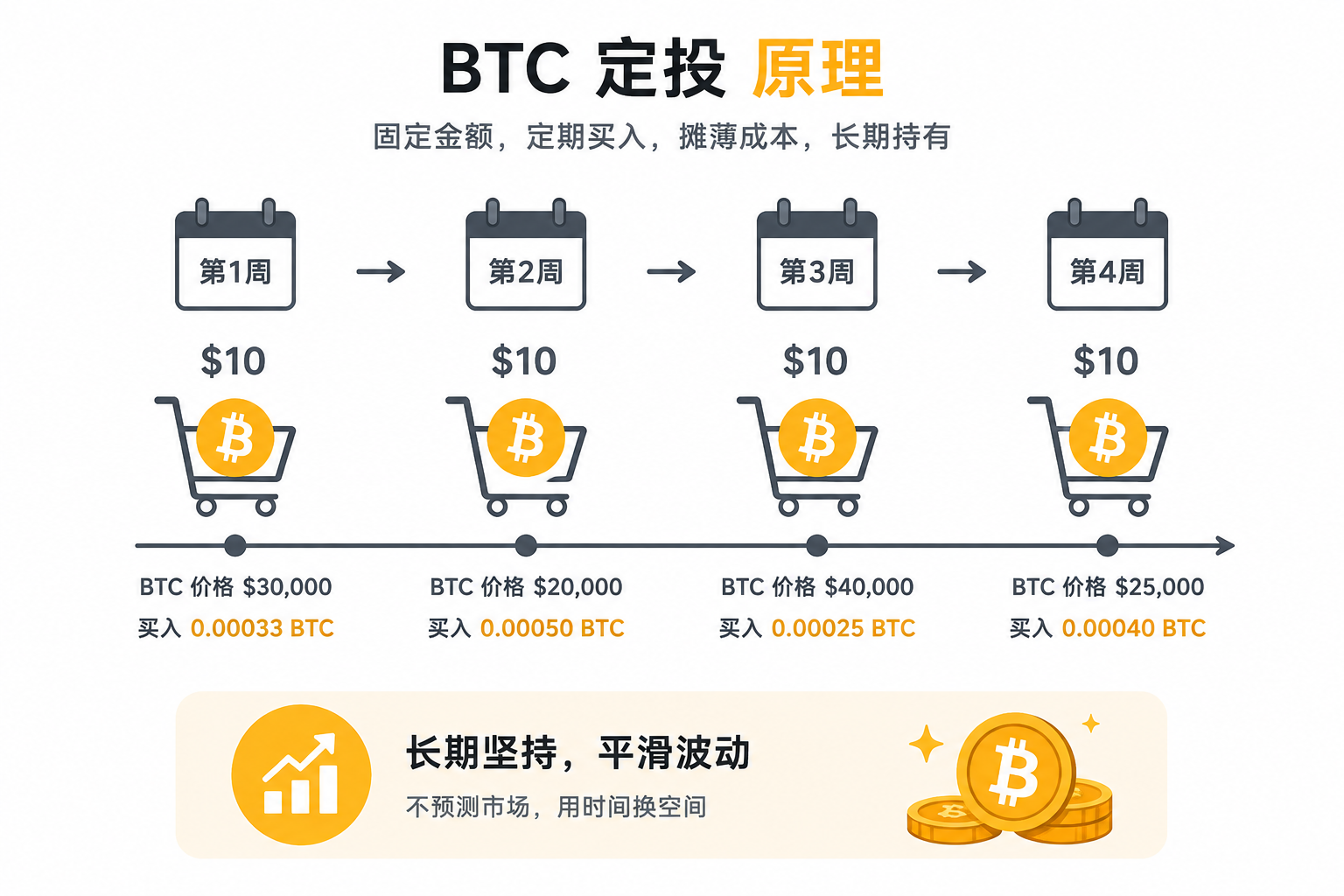
Bitcoin DCA does not require a large one-time purchase. A fixed budget of $10 a week is enough to get started. Dollar-cost averaging (DCA) is not about predicting when BTC will reach its lowest price. It means investing a fixed amount at predetermined intervals. The same budget buys more BTC when the price is lower and less when the price is higher. Over time, your average cost basis reflects purchases made at many prices instead of a single entry point.
However, DCA does not guarantee a profit, and investing more frequently is not automatically better. A practical Bitcoin DCA plan must account for budget, frequency, trading fees, minimum order size, market volatility, and your ability to stay consistent. Hotcoin's spot DCA feature currently lets users select an asset, amount, and daily, weekly, or monthly schedule, after which the system executes the preset plan.
What Is Bitcoin DCA?
Bitcoin DCA means using a fixed amount to buy Bitcoin on a regular schedule.
For example, you decide to buy $10 worth of BTC every week.
Whether BTC trades at $50,000, $80,000, or $100,000 that week, you still invest the planned $10.
The amount of BTC you receive therefore changes with every purchase:
BTC amount = amount invested ÷ BTC purchase price
When the price falls, $10 buys more BTC. When the price rises, the same $10 buys less BTC.
This differs from investing all your money at once. A lump-sum purchase depends heavily on the entry price, while DCA spreads the capital across multiple points in time and reduces reliance on a single price bet.
How Much Does $10 a Week Cost Over a Year?
$10 a week may look small, but the cumulative investment becomes clear over time.
Using 52 weeks per year:
$10 × 52 weeks = $520 per year
If you continue for five years:
$10 × 52 × 5 = $2,600
If you continue for ten years:
$10 × 52 × 10 = $5,200
The $5,200 is only the total principal invested; it is not the future value of your BTC. Bitcoin's price will keep fluctuating, so the final value of your holdings may be higher or lower than the amount invested.
That is why a DCA budget should not be calculated backward from a desired future profit. It should be based on cash flow you can sustain over the long term. Hotcoin's latest DCA guidance likewise recommends setting a sustainable monthly budget first and then choosing a daily, weekly, or monthly schedule that matches your income cycle.
Why Does Bitcoin DCA Not Require Predicting the Bottom?
Because the central purpose of DCA is to reduce dependence on a single purchase time.
Suppose you have $40 available to buy BTC.
One option is a lump-sum purchase: Week 1: $40.
Another option is:
Week 1: $10
Week 2: $10
Week 3: $10
Week 4: $10
The first approach may perform better if the price is low, but it may also coincide with a short-term peak. The second approach spreads the money across several dates.
DCA therefore does not answer, “How can I guarantee that I buy at the bottom?” It addresses a different question: “If I cannot identify the bottom accurately, how can I avoid committing all my money at one moment?”
This is one reason DCA can suit long-term, rules-based capital allocation. It can reduce dependence on market timing, but it cannot eliminate Bitcoin's price risk. General DCA research also notes that the method may reduce emotional timing decisions, although a lump-sum investment can sometimes deliver a higher return in a steadily rising market.
Should You DCA Into BTC Weekly, Monthly, or Daily?
There is no single DCA frequency that is best for everyone. Your cash flow and trading costs should determine the schedule, not a supposed “best day to buy.”
Weekly DCA
Buying once a week is relatively easy to maintain. It is straightforward if you have a fixed weekly surplus or want a balance between spreading purchases and keeping execution convenient.
For example: Every Sunday → $10 BTC
That produces about 52 purchases and a total annual budget of roughly $520.
Monthly DCA
If your income arrives monthly, one purchase per month may be more convenient.
For example: After each monthly payday → $40 BTC
This invests about $480 over a year. It is not identical to $10 a week, but the total capital is similar.
Daily DCA
Daily investing spreads purchases across even more dates, but it also increases the number of transactions significantly.
With a very small budget, dividing the money into daily orders may make each trade too small or even place it below the platform's minimum order requirement. Fees and the bid-ask spread also need to be considered.
Therefore: A higher frequency does not necessarily produce better DCA results.
Hotcoin currently supports daily, weekly, and monthly DCA schedules. Its guidance also states that the appropriate frequency should reflect your budget, minimum order rules, and costs.
How Do You Build a Simple Bitcoin DCA Plan?
If you are trying DCA for the first time, you can build a plan in the following order.
Set a Sustainable Long-Term Budget First
Do not begin by asking, “How much will BTC rise?” Ask instead: “If BTC falls sharply, can I continue investing this amount?”
DCA money should come from funds that will not affect normal living expenses, essential bills, or emergency savings.
If $10 a week does not strain your cash flow, you can begin there. If even $10 could affect daily spending, reduce the amount or postpone the plan.
Then Choose an Execution Frequency
Once the budget is set, decide how often to buy. For example: $10 per week, or $40 per month.
The key is not the frequency itself but whether you can follow the plan over the long term.
Finally, Check the Trading Conditions
Before executing the plan, confirm that:
- Each order meets the platform's minimum amount;
- The trading fee is acceptable;
- The BTC trading pair is operating normally;
- Your account balance is sufficient;
- The scheduled purchase executes successfully.
Hotcoin's current spot DCA feature lets users set the asset, amount, and execution cycle, after which the system carries out the plan automatically.
What Costs Are Most Often Overlooked in Bitcoin DCA?
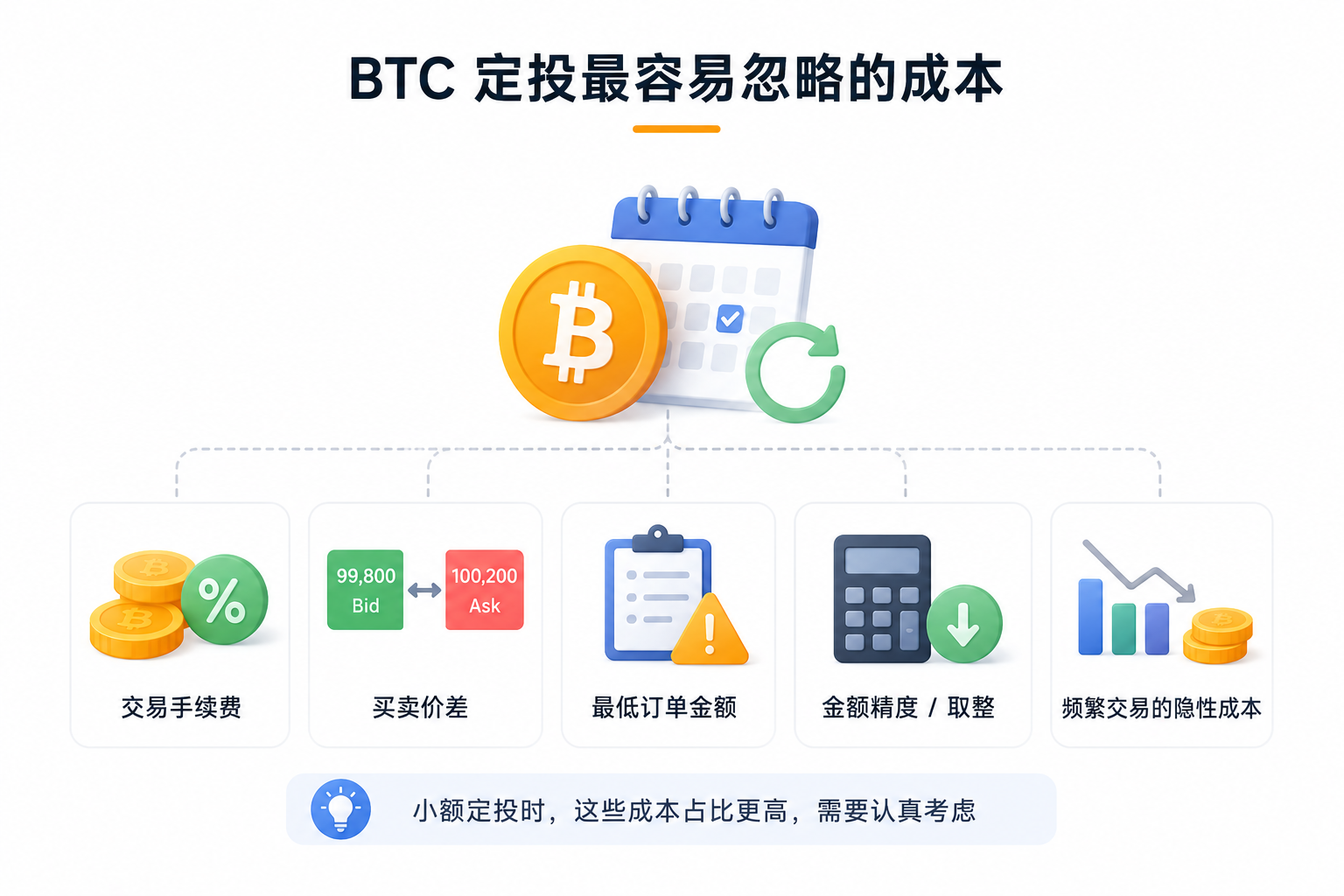
One of the biggest practical concerns with small DCA purchases is the share of the budget consumed by transaction costs.
If you invest only $10 a week and each purchase incurs a fee, that fee can represent a more noticeable percentage of the $10 principal than it would for a larger trade.
You should also consider:
Trading fees
Rates may vary by platform and account tier.
Bid-ask spread
The actual execution price differs from the market midpoint, and this cost matters for repeated small purchases over time.
Minimum order amount
If a platform requires orders above a certain value, a $10 purchase may not execute as planned.
Amount precision
Some platforms impose precision rules on order quantities, so the actual purchase amount may need to be rounded.
DCA frequency should therefore account for more than risk distribution. Fees and minimum order restrictions must be included in the plan. Hotcoin's DCA guidance also warns that excessive order splitting may be affected by fees, spreads, minimum amounts, and rounding.
Should You Double Your Investment When BTC Falls?
Do not automatically turn DCA into “buying more as the price falls.”
Fixed-amount DCA is based on a simple process: Set the rules in advance → follow the rules.
If your plan is $10 a week, a 30% decline in BTC does not mean that the next purchase should suddenly increase to $50.
If you want to invest more during a major market drop, you can create a separate dynamic DCA rule with a predefined extra budget and maximum exposure. That is no longer simple fixed-amount DCA, however, and its risk must be reassessed.
Hotcoin's official DCA guidance likewise recommends avoiding emotional, unplanned increases after a decline because they can rapidly increase both exposure and risk.
What If a Scheduled Purchase Fails?
Automatic DCA does not mean every scheduled transaction is guaranteed to succeed.
Common causes include:
- Insufficient account balance;
- An order below the minimum amount;
- A problem with the payment method;
- A change to the trading pair or product rules;
- Account permissions or system restrictions.
If one purchase fails, do not immediately double the next scheduled amount to make up for it. First identify the reason for the failure, then decide whether the future plan needs adjustment.
For example, suppose the original plan is $10 a week and one purchase fails because the balance is insufficient. The next week's order does not automatically need to become $20, because doing so changes the fixed-amount plan.
Hotcoin's spot DCA guidance also recommends investigating the cause of a failed execution instead of temporarily doubling the next purchase to “catch up.”
When Should You Adjust a Bitcoin DCA Plan?
A sound DCA plan does not have to remain unchanged forever. It should be reviewed when your finances or the execution conditions change.
Your Income Changes
If your income declines or essential expenses rise, you can reduce the weekly DCA amount.
A sustainable $10 plan generally fits DCA logic better than a $100 plan that lasts only two months.
Fees Materially Affect Small Trades
If transaction costs consume too much of each weekly purchase, consider investing less frequently with a larger amount per order.
For example: $10 per week → $40 per month
The annual investment remains similar, while the number of transactions falls.
BTC Becomes a Larger Share of Your Portfolio
Even when the weekly amount stays the same, a long-term rise in BTC's price can make Bitcoin an increasingly large share of your total assets.
At that point, reassess the plan from an overall asset-allocation perspective rather than asking only whether to keep buying each week.
What Are the Common Bitcoin DCA Misconceptions?
Misconception 1: DCA Always Makes Money
It does not. DCA changes how capital enters the market; it does not change Bitcoin's underlying market risk. If BTC falls over an extended period, a DCA position can also lose money.
Misconception 2: Weekly Buying Is Always Better Than Monthly Buying
There is no such fixed conclusion. More frequent purchases spread entry dates further, but transaction count, minimum order amounts, and costs also matter. Hotcoin's current guidance explicitly states that no single DCA frequency suits everyone.
Misconception 3: You Must Increase the Amount When BTC Falls
That is a different strategy, not fixed-amount DCA. Without a predefined budget and rules, an unplanned increase can easily become an emotional trade.
Misconception 4: $10 Is Too Little to Matter
$10 will not immediately give you a large BTC position, but DCA is less about the size of one purchase and more about whether the budget is sustainable and the plan can be followed consistently.
$10 a week equals $520 a year and $2,600 over five years. The final amount of BTC depends on the actual purchase prices throughout that period.
A $10-Per-Week Bitcoin DCA Template
If you want to begin with the simplest possible approach, you can use this template:
The point is not the number “$10” itself, but the creation of a fixed rule you can sustain over the long term.
If your budget is higher, you can scale the same logic: $10 per week → $20 per week → $50 per week.
Before increasing the amount, confirm your cash flow and risk tolerance.
FAQ
Can You Really Buy BTC With $10 a Week?
Yes, provided the platform's minimum order value and quantity allow it. Bitcoin is divisible, so you do not need to buy a full 1 BTC. Whether a $10 order can be completed depends on the current minimum trading rules for the platform and BTC pair.
Can You Lose Money With Bitcoin DCA?
Yes. DCA cannot guarantee a profit. If Bitcoin's market price continues falling, the BTC accumulated through DCA can show an unrealized loss. DCA mainly reduces dependence on a single entry point; it does not eliminate market risk.
Is Weekly or Monthly DCA Better?
There is no universal answer. Weekly DCA provides more purchase dates but also more transactions, while monthly DCA is simpler to execute. Choose according to your income cycle, minimum order size, fees, and execution habits.
Should You Increase the DCA Amount After BTC Falls?
Not necessarily. If your original plan uses fixed-amount DCA, follow the original rule. Consider increasing the amount only when you have predefined an extra budget and risk limit. Otherwise, DCA can turn into an emotional attempt to buy the dip.
How Much BTC Will $10 a Week Buy Over a Year?
It cannot be known in advance because BTC's price changes every week. What you can know is that you will invest $520 over one year. Your final BTC amount is the sum of the BTC bought in every transaction, not simply $520 divided by the price on one particular day.
Before You Start a Bitcoin DCA Plan
If you have decided to buy BTC with a fixed-amount strategy, confirm the purchase amount, execution frequency, minimum order requirements, and transaction costs before creating the plan.
Hotcoin currently supports spot DCA, allowing users to set the asset, amount, and daily, weekly, or monthly execution cycle.
If you are preparing to make your first BTC purchase on Hotcoin, continue with:
Hotcoin Guide to Buying BTC for the First Time
Risk warning: Bitcoin is highly volatile. DCA cannot guarantee the safety of your principal or future returns, nor can it eliminate market risk. The $10 weekly amount in this article is only a budgeting example and is not a return forecast or investment advice. Actual DCA amounts, minimum order requirements, fees, and product features may change; always refer to the latest information displayed on the platform when trading.
Leitura recomendada
Veja mais