
The Rise of On-Chain Equities in 2026: Why Tokenized Stocks Are Becoming the Next Evolution of Investing
Traditional stock markets are no longer the only place to buy and sell equities. In 2026, on-chain equities—also known as tokenized stocks—have emerged as one of the biggest developments in financial markets. By placing shares or stock-backed assets on blockchain networks, investors gain faster settlement, broader global access, fractional ownership, and the ability to use equities within decentralized finance (DeFi). This shift isn't about replacing Wall Street overnight; it's about modernizing how stocks are issued, traded, and managed. As institutional investors, regulators, and fintech companies invest heavily in tokenization, on-chain equities are moving from experimental technology to a legitimate financial infrastructure.
The question is no longer whether blockchain can support equity markets. The real question is why the transition is accelerating now—and what it means for investors over the next decade.
Why 2026 Marks a Turning Point
Tokenized equities have existed for several years, but early versions faced regulatory uncertainty, limited liquidity, and low institutional participation. Those obstacles have gradually diminished. Today, improvements in blockchain scalability, regulated custody, and the rapid growth of real-world asset (RWA) tokenization have created conditions that are far more favorable.
At the same time, investors have become comfortable with digital assets beyond cryptocurrencies. Stablecoins process billions of dollars in transactions daily, tokenized funds are attracting institutional capital, and financial firms increasingly view blockchain as an efficiency upgrade rather than a speculative experiment.
This convergence explains why 2026 is widely seen as the year on-chain equities began entering the financial mainstream.
If stocks can now exist on blockchain networks, what advantages do they offer over the traditional brokerage model that has dominated investing for decades?
Related Article: The Trillion-Dollar Stock Token Market Is Accelerating
What Are On-Chain Equities?
On-chain equities are blockchain-based digital representations of publicly traded shares. Depending on the platform, each token may represent direct ownership of real shares held by a regulated custodian or provide synthetic exposure that tracks a stock's market price.
Instead of relying solely on centralized clearing houses and multiple financial intermediaries, ownership transfers are recorded on a blockchain through smart contracts. The underlying goal is not to change the value of the stock itself but to improve how ownership is transferred, settled, and accessed.
For investors, the experience can feel similar to buying cryptocurrency, but the asset being traded represents equity in a company rather than a digital coin.
Why Investors Are Paying Attention
Traditional stock markets remain highly efficient, but they were designed decades before blockchain technology existed. Many of their underlying processes—including settlement, clearing, and cross-border access—still rely on multiple intermediaries.
On-chain equities address several of these limitations by introducing a more digital-first infrastructure.
Key advantages include:
-
Near-instant settlement instead of waiting for traditional clearing cycles.
-
Fractional ownership that makes expensive stocks accessible to more investors.
-
Greater global accessibility without relying on multiple local brokerage accounts.
-
Blockchain transparency through publicly verifiable transaction records.
-
Integration with decentralized finance applications for lending, borrowing, and collateralization.
These benefits do not necessarily make traditional exchanges obsolete, but they demonstrate why financial institutions are exploring tokenization as the next stage of market modernization.
Faster trading sounds attractive, but how does a stock actually become an on-chain asset?
How Tokenized Stocks Work
Behind every legitimate tokenized equity is an infrastructure that connects traditional finance with blockchain technology.
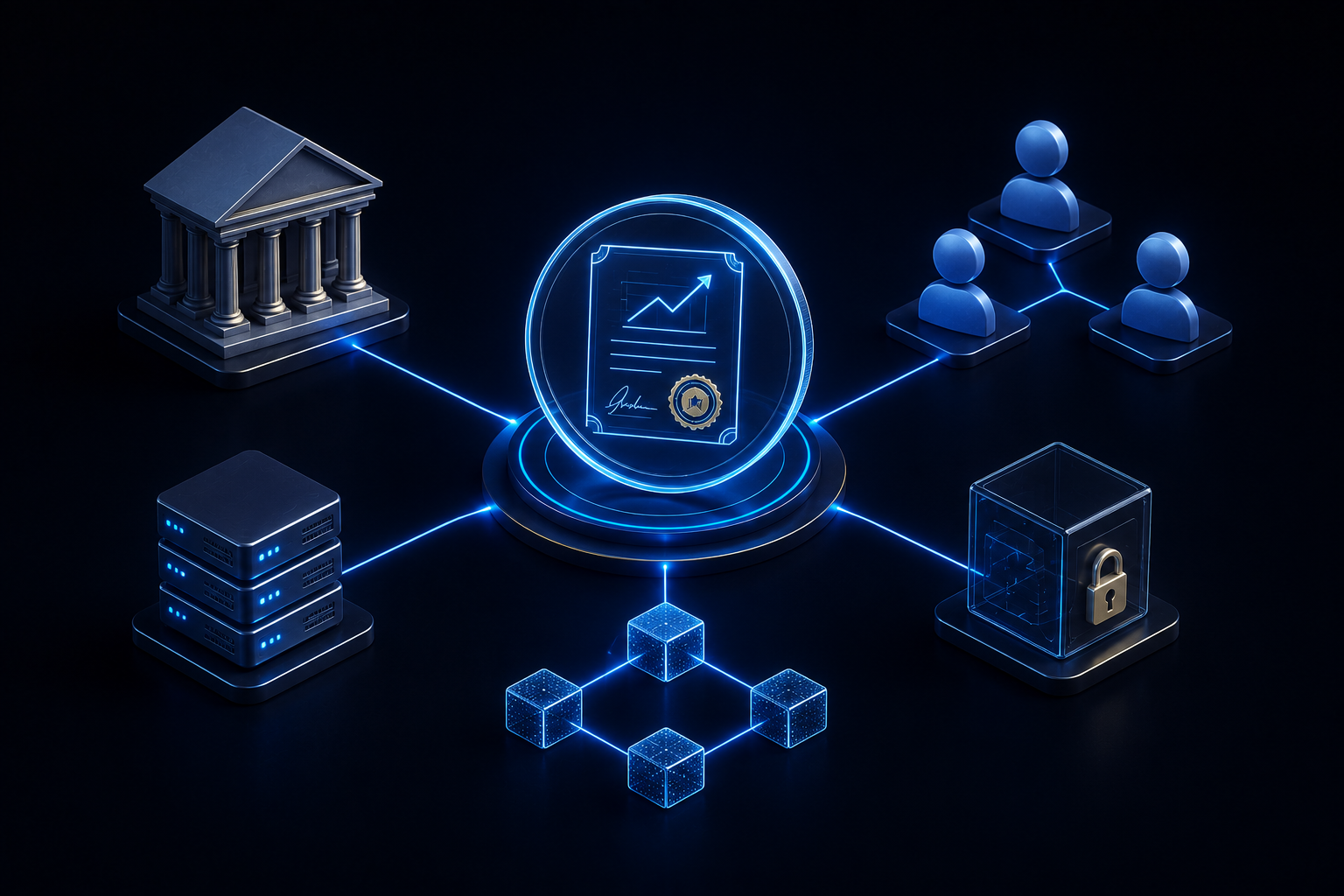
The process generally begins when a regulated institution purchases or holds the underlying shares through a licensed custodian. Digital tokens are then issued to represent those shares or their economic value. Investors buy and sell these tokens on supported platforms, while blockchain technology records ownership changes almost instantly.
Although the user experience appears simple, the ecosystem depends on several participants working together, including custodians, tokenization platforms, blockchain networks, compliance providers, and exchanges.
This layered approach allows tokenized equities to maintain connections with traditional securities markets while benefiting from blockchain efficiency.
Traditional Stocks vs. On-Chain Equities
The biggest difference between traditional and blockchain-based equities is not the investment itself—it is the infrastructure supporting it.
| Feature | Traditional Stocks | On-Chain Equities |
| Settlement | T+1 or longer | Near real-time |
| Trading Access | Exchange hours | Extended or continuous trading |
| Fractional Ownership | Limited | Native feature |
| Transparency | Broker records | Blockchain ledger |
| Global Accessibility | Region-dependent | Broader participation |
| DeFi Integration | Not available | Possible |
For long-term investors, both markets may offer exposure to the same companies. However, blockchain infrastructure introduces efficiencies that become increasingly valuable as financial markets become more digital and globally connected.
Faster settlement and broader access explain investor interest, but institutions—not retail traders—are driving much of the industry's momentum.
Why Institutions Are Embracing Tokenization
One of the strongest signals supporting on-chain equities is institutional participation. Major asset managers, financial technology companies, and digital asset firms are investing in tokenization because it promises lower operational costs and more efficient capital markets.
Instead of viewing blockchain solely as cryptocurrency infrastructure, institutions increasingly see it as a settlement layer capable of reducing paperwork, automating compliance, and enabling programmable financial assets.
This institutional shift also coincides with the rapid expansion of the real-world asset sector, where bonds, funds, treasury products, and increasingly equities are being represented on blockchain networks.
As liquidity grows, tokenized equities become more attractive to both retail and professional investors, creating a cycle that encourages further adoption.
Related Article: From the Cryptocurrency Circle to the Broader Financial Market
Challenges That Still Need to Be Solved
Despite the optimism surrounding on-chain equities, the market is still evolving.
Several challenges remain:
-
Regulations differ across jurisdictions, making global compliance complex.
-
Investors must understand whether a token represents direct ownership or synthetic exposure.
-
Smart contract vulnerabilities and cybersecurity risks continue to require careful oversight.
-
Liquidity remains fragmented across multiple blockchain ecosystems.
These issues are significant, but they are increasingly viewed as infrastructure challenges rather than barriers that prevent adoption altogether.
What the Future Looks Like
The rise of on-chain equities is part of a much larger transformation occurring across global finance. The same technology enabling tokenized stocks is also reshaping bonds, money market funds, private equity, and other real-world assets.
As blockchain networks become faster and regulatory frameworks mature, investors may eventually access global portfolios through a single digital wallet instead of maintaining multiple brokerage relationships across different countries.
Future developments could include tokenized exchange-traded funds, on-chain dividend distributions, automated shareholder services through smart contracts, and deeper integration with artificial intelligence for portfolio management. While traditional stock exchanges will continue to play a central role, blockchain infrastructure is likely to operate alongside them rather than compete directly.
The rise of on-chain equities in 2026 reflects a structural shift in how financial markets are evolving. Tokenized stocks combine familiar equity investing with the efficiency of blockchain technology, offering faster settlement, greater accessibility, and new possibilities for digital financial services.
Although regulatory and technical challenges remain, the growing involvement of institutional investors suggests that tokenization is becoming a long-term strategy rather than a passing trend. For investors, understanding on-chain equities today is less about chasing the latest innovation and more about recognizing how the infrastructure behind global capital markets is steadily changing.
Related Article: Crypto ETFs Enter 2.0
References
BlackRock. BlackRock USD Institutional Digital Liquidity Fund (BUIDL). Accessed July 29, 2026. BlackRock BUIDL Overview.
Investopedia: Tokenized Equity Explained. “Tokenized Equity Explained: How It Works and Real-World Examples.” Investopedia. Accessed July 29, 2026.
Reuters: NYSE Parent Develops 24/7 Tokenized Securities Platform. “NYSE-Parent Intercontinental Exchange Develops Platform for 24/7 Tokenized Securities Trading.” Reuters, January 19, 2026.
Securitize Investor Relations. “Securitize, Jump Trading Group, and Jupiter Launch Fully Onchain, Regulated Trading for Tokenized Equities.” Securitize, May 5, 2026.
The Wall Street Journal: Tokenizing Stocks and Treasurys. “JPMorgan, BlackRock and Goldman to Tokenize Stocks, Treasurys.” The Wall Street Journal, July 2026.
Leitura recomendada
Veja mais
SunPump vs. Pump.fun Comparison
Basic Concepts

What is Intent-Centric Trading?
Basic Concepts
Open Interest vs Trading Volume: Which Better Reflects Market Strength?
Basic Concepts

Contatos de serviço
Service@hotcoin.com
Feedback do produto
Product@hotcoin.com
Cooperação empresarial
Business@hotcoin.com
Contatos Legais
Casecn@hotcoin.com
Quem somos
produtos
Servir
Apoio, suporte
©2017-2026