
How to Set Your DCA Frequency and Amount
Before setting up a dollar-cost averaging (DCA) plan, decide how much you can sustainably invest each month. Then choose a daily, weekly, or monthly schedule that matches your income cycle. A higher frequency is not automatically better, and a larger order is not necessarily better either. A sound plan should leave essential living funds untouched, meet the minimum order requirements, and keep costs manageable.
Start With a Sustainable Monthly Amount
Your DCA amount should be based on your actual cash flow, not reverse-engineered from a target return. First account for housing, living expenses, debt payments, insurance, emergency savings, and known near-term expenses. From what remains, determine the amount you could afford to lose and still invest consistently. Kraken's DCA guide similarly recommends setting order amounts based on essential expenses, savings, and how much you can afford to lose.
The monthly DCA budget can be expressed as:
Monthly DCA budget = the portion of monthly disposable surplus you are willing to put at investment risk
“Disposable surplus” does not mean the entire balance in your bank account. Having more money available in one month does not mean you can sustain that same contribution every month. Set the plan at a relatively conservative level that you can continue even when income fluctuates.
If you plan to accumulate several assets, determine the total budget first and then allocate it among those assets. Do not create a separate budget for each asset and only calculate the combined investment afterward, as several small plans may add up to more than you can reasonably afford.
Choosing Daily, Weekly, or Monthly DCA
There is no single DCA frequency that is best for everyone. The purpose of DCA is to follow a fixed plan consistently, not to identify the “best” hour, day, or date to buy.
-
Daily DCA: Spreads purchases across the most time points, but creates more orders with a smaller amount per order. It may suit users whose budget and the platform's minimum order amount allow it and who have reviewed fees and spreads.
-
Weekly DCA: Offers a practical balance between distributing entry points and keeping execution simple. It may suit users who budget weekly or want fewer executions than a daily plan.
-
Monthly DCA: Is the simplest schedule and often matches monthly salary or income payments, although it creates fewer purchase points over a year.
-
Match your income date: For most users, aligning DCA with predictable income is easier to sustain than choosing a weekday or date because it performed well historically.
Converting a Monthly Budget Into an Amount per Order
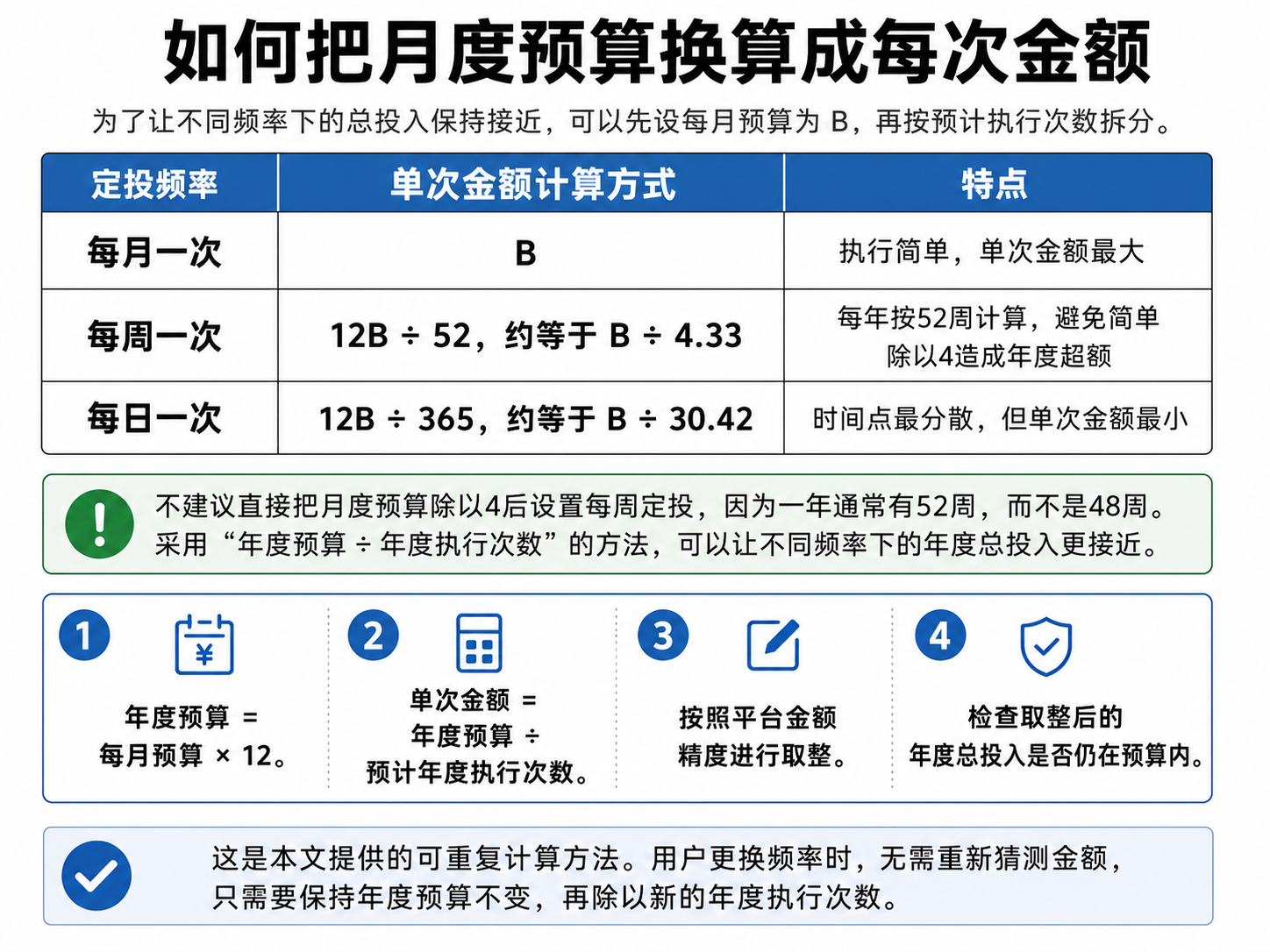
To keep total investment similar across different frequencies, let the monthly budget be B and divide it by the expected number of executions.
For example, avoid simply dividing the monthly budget by four for a weekly plan. A year usually has 52 weeks, not 48. Using “annual budget ÷ annual number of executions” keeps annual contributions more consistent across frequencies.
Use the following calculation:
-
Annual budget = monthly budget × 12.
-
Amount per order = annual budget ÷ expected annual executions.
-
Round the result according to the platform's amount precision.
-
Confirm that the rounded annual total remains within budget.
This repeatable method removes the need to guess a new amount when changing frequency. Keep the annual budget unchanged and divide it by the new expected number of annual executions.
Does a Higher Frequency Always Work Better?
Not necessarily. Increasing the frequency creates more entry points and can make the process of entering the market more gradual, but it does not change the selected asset's long-term price direction or guarantee a lower final cost.
Trading costs depend on the platform's rules. If fees are charged as a fixed percentage of trade value, splitting the same total investment into more orders may not significantly change the proportional fee. However, excessive splitting can reduce efficiency when fixed per-order charges, minimum fees, spreads, minimum order amounts, or amount rounding apply. FINRA and Investor.gov both warn that the costs of more frequent trading can erode investment results.
An order that is too small may also fall below the platform's minimum and fail to execute. Even if it executes, rounding the quantity of a small order can cause actual contributions to drift from the plan over time.
When choosing a frequency, verify three conditions: each order can execute normally, the cost structure is acceptable, and the account can maintain sufficient available balance before every execution.
What to Do When an Execution Fails
Automating DCA does not guarantee that every scheduled order will succeed. Insufficient balance, an invalid payment method, a changed minimum order amount, a suspended trading pair, or a system restriction can all cause an execution to fail.
If an order fails, check the cause first. Do not automatically double the next order to “make up” for the missed purchase. Doing so changes the original risk budget and turns a fixed-amount strategy into an improvised one.
Hotcoin users should confirm that sufficient available balance is held in the spot account before execution and review the actual fill in their order history. Hotcoin's spot trading documentation explains that trades use available account assets and that orders and resulting asset changes can be reviewed in the relevant records.
When to Adjust the Amount or Frequency
A plan should not be changed repeatedly because of a single price rise or fall. It should, however, be reviewed when personal finances or execution conditions change.
-
Income or essential expenses change: If investable surplus falls, reduce the amount first instead of diverting money needed for daily life.
-
Repeated insufficient balance: This indicates that the amount or frequency does not match your cash flow. Reduce the amount per order or choose a lower frequency.
-
Costs become materially higher: If small, frequent orders are too costly, reduce the number of executions and recalculate the amount per order.
-
The asset's risk changes: Reassess whether to continue if the project, liquidity, or regulatory environment changes. Changing only the frequency is not enough.
-
The position exceeds its target allocation: Even if each contribution stays the same, a price rise can increase an asset's portfolio weight. Review it as part of the overall allocation.
A practical approach is to review the plan on a fixed schedule—for example, quarterly—and examine cash flow, costs, execution success rate, and portfolio allocation without reacting impulsively to short-term market moves.
Common Mistakes
Assuming a higher frequency is always safer.
More entry points do not automatically mean lower risk. If each order is too small, costs are high, or the asset keeps falling, frequent purchases can still increase losses.
Dividing the monthly budget by four for a weekly amount.
A year has about 52 weeks. Treating every month as exactly four weeks causes annual contributions to exceed the original budget. Divide the annual budget by 52 instead.
Permanently increasing DCA after one month of higher income.
A one-time bonus or temporary income does not represent a lasting increase in cash flow. A fixed plan should be based on stable income.
Automatically doubling the amount after a market decline.
This departs from fixed-amount DCA and can quickly increase both the position and its risk. Any dynamic adjustment needs its own rules and budget limit.
Scheduling purchases without keeping funds available.
DCA funds should not consume money reserved for essential expenses or emergencies. Otherwise, a market decline could force you to sell at an unfavorable price.
Frequently Asked Questions
Which day of the week should I use for weekly DCA?
No weekday can consistently guarantee better results. A more practical choice is a date after income arrives, when the account balance is stable and you can conveniently review execution results.
Is daily DCA safer than monthly DCA?
Daily DCA creates more entry points, but it does not remove the risk of an asset falling. You still need to check the order amount, fees, and minimum order limits.
Can I increase my DCA amount when my income rises?
Yes, but first confirm that the increase is sustainable. Recalculate essential expenses, emergency savings, and overall asset allocation instead of increasing the amount in response to short-term market conditions.
Should I make up a failed DCA order in the next period?
Not necessarily. Check the cause and the current budget first. An extra contribution changes the fixed plan, so you should not assume that every missed order must be recovered.
Practical Tip
Set an annual or monthly budget first, then calculate the amount per order from the execution frequency. Frequency controls the pace at which funds enter the market; it does not replace asset research, cost checks, or risk management.
Risk Warning
Crypto assets are highly volatile. DCA does not guarantee principal protection or future returns. Frequent execution may also be affected by fees, spreads, minimum order amounts, and insufficient balance. This article is for educational and informational purposes only and does not constitute investment advice.
Leitura recomendada
Veja mais



Service@hotcoin.com
Product@hotcoin.com
Business@hotcoin.com
Casecn@hotcoin.com