
What Is Funding Rate Arbitrage? How It Works and Its Main Risks
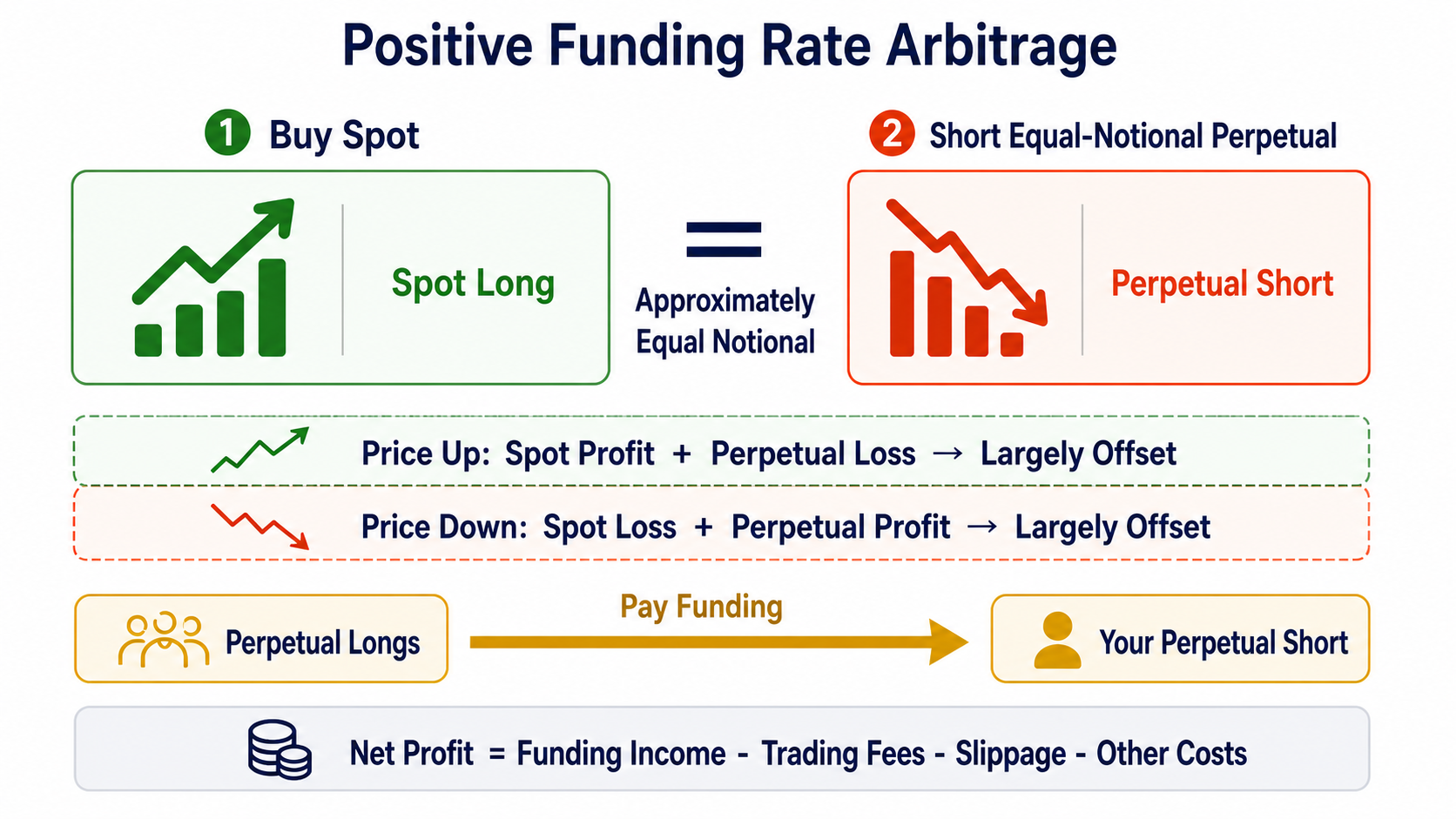
Funding rate arbitrage is a strategy that holds a spot long and a perpetual short with approximately equal notional values. Its aim is to earn positive funding payments while reducing directional exposure to the asset's price. It is not risk-free: the final result depends on funding rates, basis movements, trading fees, slippage, and margin management.
The strategy can lose money. Funding rates may turn negative, the gap between spot and perpetual prices may widen, and fees and slippage directly reduce income. If too little margin supports the perpetual position, that leg can still be liquidated even when the overall portfolio is close to Delta-neutral.
How Does Funding Rate Arbitrage Generate Returns?
Funding rate arbitrage normally begins by opening two new positions at about the same time. The spot long and perpetual short have similar notional values but opposite directions. The trader is not using the pair to predict whether the asset will rise or fall; the goal is to hold it through funding settlements.
When the funding rate is positive, perpetual longs pay shorts. Suppose a trader holds a 10,000 USDT spot long and a 10,000 USDT perpetual short. If the asset rises, the spot leg gains while the perpetual leg loses; if it falls, the reverse occurs. Once the two price gains and losses largely offset each other, the funding received by the short may remain as income.
The relevant comparison is notional value, not the margin allocated to the perpetual position. Margin determines how much capital the position uses and how much leverage it can support; it does not directly determine how much spot is needed for the hedge.
A negative funding rate can create a reverse opportunity: go long the perpetual and short the spot asset. However, shorting spot normally requires borrowing the asset, which introduces borrowing rates, availability limits, and repayment terms. In practice, this is more complicated than pairing a spot long with a perpetual short when funding is positive.
Why Do Perpetual Contracts Need Funding?
Traditional futures generally have an expiry date. As settlement approaches, the settlement mechanism tends to pull the futures price toward the spot price. Perpetual contracts have no fixed expiry, so they need another mechanism to discourage their prices from remaining far away from spot prices. Funding rates serve this purpose.
Funding is usually exchanged between perpetual longs and shorts; it is not the same as a trading fee. The general rules are:
- When the rate is positive, longs pay and shorts receive.
- When the rate is negative, shorts pay and longs receive.
- When the rate is zero, no funding is generally exchanged for that period.
When a perpetual trades at a premium to spot and demand for long exposure is strong, its funding rate is more likely to be positive. This makes long positions more expensive and shorts more attractive, helping narrow the gap between the perpetual and spot prices. Conversely, when a perpetual trades at a discount and short positioning is crowded, the rate may turn negative, requiring shorts to pay longs.
Funding intervals are not uniform across the market. Some contracts settle every eight hours, while others may use one-, two-, or four-hour intervals. Rate caps, floors, and calculation parameters can also vary by platform, trading pair, and market conditions. Always rely on the rate, countdown, and contract rules displayed for the specific contract.
How Does a Funding Rate Arbitrage Position Work?
Under positive funding, a complete position generally passes through four stages.
- Confirm that the same asset has both a spot market and a perpetual contract, then check market depth on both sides. A high funding rate may not compensate for poor liquidity and high execution costs.
- Buy spot and short a perpetual position with approximately the same notional value. The less synchronized the two orders are, the longer the portfolio remains exposed to one-sided price moves.
- While holding the positions, record every funding payment and verify that the two notional values remain close. Partial fills, fee deductions, and contract valuation methods can all introduce discrepancies.
- To exit, close the perpetual short and sell the spot asset. Closing only one leg creates a new directional position.
There is no single entry or exit sequence that works for every market. Liquidity, order types, and system latency all affect the outcome. The important point is not to treat the hedge as complete when one leg has filled but the other remains unfilled for an extended period.
How Are Funding Income and Net Returns Calculated?
Funding for one settlement period can be understood using this basic formula:
Funding income = perpetual position notional value × funding rate for the period
The following numbers are for illustration only. If a perpetual short has a notional value of 10,000 USDT at settlement and the funding rate for the period is positive 0.01%, its theoretical funding income is:
10,000 × 0.01% = 1 USDT
Receiving 1 USDT does not mean earning a 1 USDT net profit. A full strategy cycle involves at least four trades because both the spot and perpetual legs must be opened and closed. Net returns can be calculated as:
Net return = cumulative funding income − trading fees − spreads and slippage − borrowing and transfer costs ± hedging discrepancies
It helps to separate the costs into three ledgers:
| Ledger | What to record |
|---|---|
| Funding | The amount actually received or paid in every settlement period |
| Execution costs | Spot and perpetual entry and exit fees, bid-ask spreads, and slippage |
| Hedging discrepancies | Basis changes, quantity mismatches, and partial-fill gains or losses at entry and exit |
If the strategy also involves cross-platform transfers or spot borrowing, withdrawal fees, network fees, and borrowing interest should be recorded separately. Only the amount remaining after cumulative funding covers all costs is the strategy's net return.
Annualized figures displayed on a platform usually extrapolate a current or recent rate at a fixed frequency. The funding rate may fall or turn negative in the next period, and the settlement interval may change. These annualized figures can help compare current conditions, but they should not be treated as future returns.
What Are the Main Risks of Funding Rate Arbitrage?
Funding Rates and Basis Can Change at the Same Time
A positive funding rate now does not guarantee that it will remain positive. Market sentiment, the perpetual premium, and changes in long and short positioning can push the rate toward zero or below it. A perpetual short that had been receiving funding may then have to pay funding.
Basis is the difference between spot and contract prices. After entry, the perpetual premium or discount may widen further. If the basis at exit differs substantially from the basis at entry, the two legs' price gains and losses will not fully offset each other. Funding and basis are related, but they are not the same value and do not always move together.
Contract Valuation and Margin Can Break the Hedge
Spot assets are usually traded in units of the asset, while perpetual contracts may be quoted in asset units, contract counts, or a fixed contract value. Linear, coin-margined, and inverse contracts also use different notional-value and profit-and-loss calculations.
Comparing only the amounts paid at entry without checking the contract multiplier, mark price, and actual filled quantity can leave residual long or short exposure. Price movements, partial fills, and fee deductions can also cause the two legs to drift apart.
A portfolio being close to Delta-neutral does not mean that the perpetual account cannot be liquidated. Unrealized gains on the spot leg generally do not automatically replenish the contract margin. Some platforms settle funding from the available balance first, and an insufficient balance may affect position margin. The higher the leverage, the less room the position has to withstand basis expansion and short-term volatility.
Execution Costs May Exceed Funding Income
When rates are low or the holding period is short, the fees from the four basic trades can exceed funding income. Low-liquidity pairs also increase spreads and slippage. High funding rates often appear when positioning is crowded or markets are volatile, making it harder to fill both legs at the displayed prices.
If the spot order fills while the perpetual short does not, the trader is effectively holding an unhedged spot position. The same issue can arise during exit. Network delays, rejected orders, partial fills, and platform maintenance can leave this exposure open longer than expected.
Assets May Be Concentrated on Platforms and in Stablecoins
Funding rate arbitrage generally requires holding assets and margin on centralized platforms. Trading or withdrawal suspensions, account risk controls, system failures, and changes to settlement rules can all interfere with position management.
When USDT, USDC, or another stablecoin is used as the quote or margin asset, the possibility of the stablecoin deviating from its target price must also be considered. A cross-platform strategy can compare rates in different markets, but it adds transfer delays, platform price differences, and more counterparties. If one platform stops accepting orders, the position on the other may not be closed promptly.
How Does Funding Rate Arbitrage Differ from Other Strategies?
| Strategy | Common position structure | Main purpose or source of return | Key difference |
|---|---|---|---|
| Funding rate arbitrage | Spot long + short perpetual on the same asset | Collect periodic funding | Perpetuals have no fixed expiry, and funding rates continue to change |
| Ordinary spot hedging | Existing spot holding + short perpetual or futures position | Reduce downside risk on an existing spot position | The hedge protects an existing position and does not necessarily target funding income |
| Traditional cash-and-carry arbitrage | Spot long + short dated futures | Capture the convergence of futures basis at expiry | It usually has a defined expiry and settlement process, and returns depend more on the entry basis |
All three strategies may combine a spot long with a contract short, but they enter for different reasons. Ordinary hedging begins with an existing spot position and adds a short to reduce downside exposure. Funding rate arbitrage generally opens both legs together to collect funding. Traditional cash-and-carry arbitrage relies more heavily on a dated futures price converging with the spot price.
How Can You Decide Whether an Arbitrage Trade Is Worth Opening?
Start by reviewing funding-rate history rather than looking only at the current figure. A rate that has remained positive may be more informative than a one-period spike, but historical data still cannot guarantee the next rate.
Next, verify the contract type, multiplier, margin asset, funding interval, and rate caps and floors. Coin-margined, inverse, and linear contracts cannot all use the same position-sizing formula.
Then estimate the full cost. In addition to entry and exit fees, allow for spreads, slippage, rebalancing, borrowing, and transfers. Subtracting these costs from expected cumulative funding produces a more realistic return estimate.
Finally, define exit conditions. A negative funding rate, rapid basis expansion, a thinner order book, insufficient margin, or a large quantity mismatch between the legs can all change the original assessment. Without an exit plan, a position opened to collect funding can easily become an unwanted perpetual short.
Frequently Asked Questions
Should Funding Rate Arbitrage Use Limit Orders or Market Orders?
Limit orders provide control over the execution price, but they may fill only partially or not at all. Market orders generally execute faster but incur spreads and slippage. The decision should account for market depth on both legs, order size, and the acceptable period of one-sided exposure, rather than comparing fees alone.
Can I Receive the Full Funding Payment by Opening a Position a Few Minutes Before Settlement?
This depends on the platform's rules and whether the orders are filled before the settlement time. Near settlement, orders may be delayed, only partially filled, or miss the period entirely. Even when funding is received, the spreads, slippage, and fees from a short-lived entry and exit may exceed that income.
Should Spot and Perpetual Positions Be Held on the Same Platform or Different Platforms?
Using one platform simplifies fund transfers and management of both legs, but it concentrates assets with one counterparty. Different platforms allow comparison of rates and market depth but add transfer time, cross-platform price differences, and the risk that one leg cannot be traded. The choice depends on liquidity, costs, and available fund-management arrangements.
When Should the Two Legs Be Rebalanced?
There is no universal rebalancing interval. Recalculate net exposure when actual fill quantities differ, the contract multiplier was misapplied, a position was partially closed, or price movements cause notional values to diverge. Rebalancing itself costs money, so an acceptable deviation range should be defined in advance.
Where Can Received Funding Payments Be Verified?
Funding payments are generally recorded in the contract account's transaction history, fund flow, or funding-fee details; the exact label varies by platform. Use the amount actually credited or debited for accounting rather than substituting the predicted rate shown when the position was opened.
Leitura recomendada
Veja mais



Service@hotcoin.com
Product@hotcoin.com
Business@hotcoin.com
Casecn@hotcoin.com