
Ethereum ETFs Are Here: Comparing ETH ETFs and BTC ETFs
Spot ETH ETFs give investors exposure to the price of Ether through a brokerage account, but investors are buying fund shares rather than ETH that can be transferred to a wallet. The main differences from BTC ETFs stem from the underlying networks' purposes and staking yield.
On May 23, 2024, the US Securities and Exchange Commission approved the relevant exchange listing rules. After the registration statements became effective, the first US spot ETH exchange-traded products began trading on July 23. The market commonly calls them ETFs, while SEC filings often use ETP or commodity-based trust because many products are not registered under the Investment Company Act of 1940.
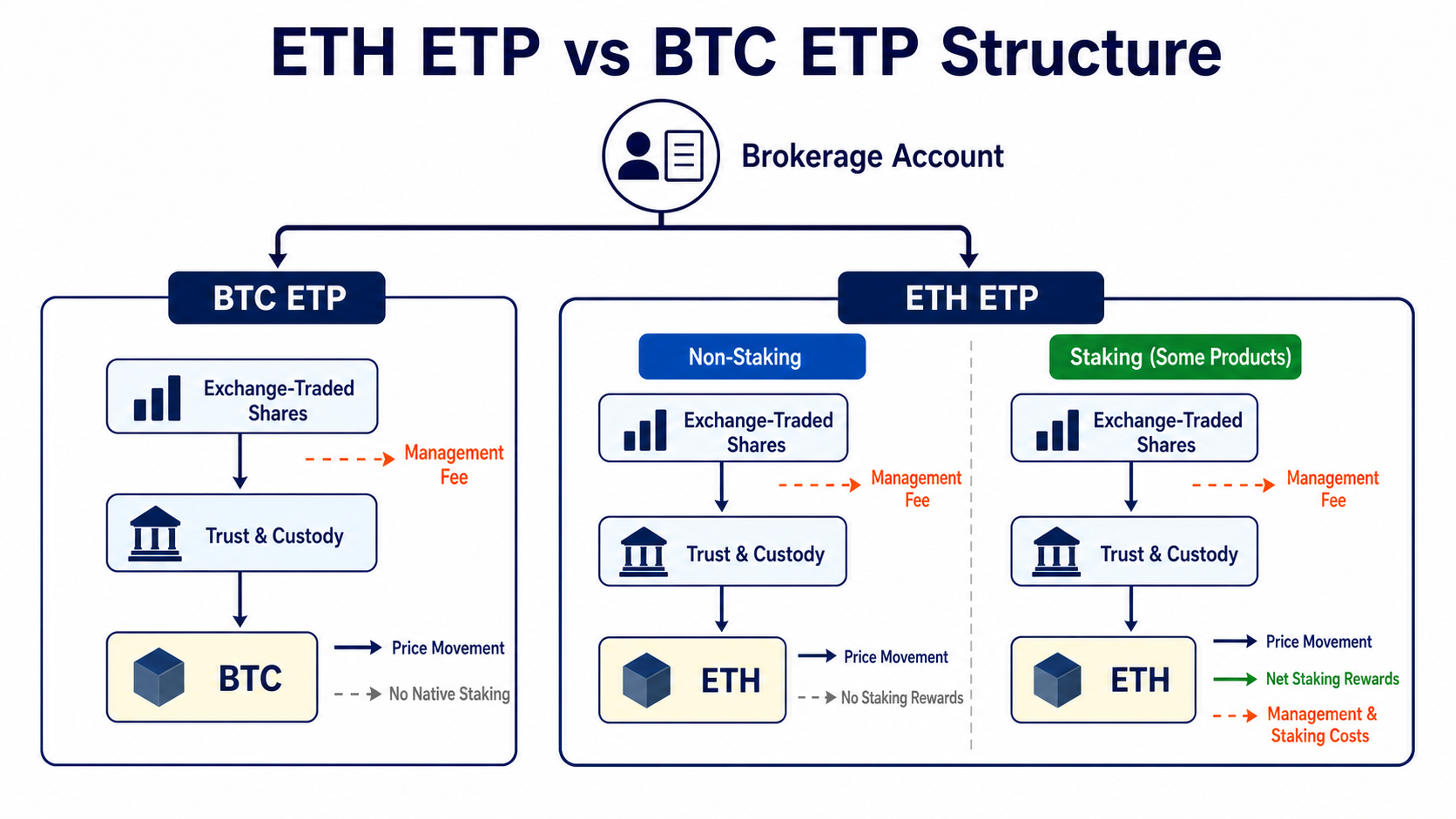
How Does a Spot ETH ETF Track Ether?
A spot ETH ETP typically uses a trust to hold ETH and calculates its net asset value according to a benchmark price. Ordinary investors trade shares on a securities exchange. Institutions authorized to create or redeem shares can submit baskets according to the product's rules and settle with the trust using cash or assets in kind.
This structure separates on-chain custody from securities trading:
- A digital asset custodian safeguards the trust's ETH, while the fund manager operates the product.
- A pricing benchmark aggregates data from designated spot markets to calculate the daily net asset value.
- Authorized participants create or redeem baskets of shares, helping the market price stay close to net asset value.
- Ordinary investors trade shares through brokerage accounts without directly accessing the fund's wallet or private keys.
In July 2025, the SEC permitted in-kind creations and redemptions for crypto asset ETPs instead of limiting them to cash-only processes. Regulatory permission does not mean every product uses the same process, however, so the actual arrangement still depends on the product's latest prospectus.
What Are the Key Differences Between ETH ETFs and BTC ETFs?
The securities-trading structures of the two product types are similar, but the underlying assets are not interchangeable ticker symbols. BTC supports value transfer and proof-of-work settlement on the Bitcoin network. ETH is both the gas asset of Ethereum and a staking asset in its proof-of-stake system.
| Comparison | Spot ETH ETP | Spot BTC ETP |
|---|---|---|
| Underlying asset | The trust holds ETH | The trust holds BTC |
| Network role | Pays gas, executes smart contracts, and participates in PoS staking | Supports value transfer, fee payments, and PoW economic incentives |
| Basic return source | ETH price changes; products that stake may also earn protocol rewards after fees | Primarily BTC price changes; BTC has no native staking reward |
| Supply changes | New issuance, staking rewards, and base-fee burning jointly affect supply | Issued according to the protocol's halving schedule, with a maximum supply of about 21 million |
| Additional technical risks | Smart contract ecosystem, PoS, staking providers, slashing, and exit queues | PoW hash power, miner economics, forks, and the fee-based security budget |
| Shared risks | Price volatility, custody, benchmark pricing, liquidity, tracking differences, and regulatory changes | Price volatility, custody, benchmark pricing, liquidity, tracking differences, and regulatory changes |
ETF shares do not automatically provide airdrops, governance rights, or DeFi returns from Ethereum applications. How a fund handles forked assets, airdrops, and other incidental rights depends on its product documents and cannot be inferred simply from the words "holds ETH."
Do ETH ETFs Currently Include Staking Yield?
The answer depends on the specific product. When the first US spot ETH ETPs launched in 2024, the major products did not stake their ETH. Since then, some existing trusts have revised their staking policies, and dedicated staked ETH ETPs have entered the market. For example, according to SEC filings, the registration statement for the iShares Staked Ethereum Trust ETF became effective in March 2026 and the product listed that month. In June 2026, the trust disclosed its first cash distribution from staking activities.
Consequently, the claim that "US ETH ETFs never stake" is outdated. The opposite claim that "buying an ETH ETF gives investors the full on-chain staking rate" is also incorrect. When evaluating a product, check the following:
- How much of the trust's ETH is actually staked and whether unstaked assets are reserved to meet redemptions and expenses.
- How much of the gross staking rewards goes to the sponsor, execution agent, and staking providers.
- Whether rewards remain in the fund's net asset value, are distributed periodically in cash, or receive some other treatment.
- Who bears losses and liquidity pressure if validators are slashed, go offline, or exit in large numbers.
- Whether the product can suspend staking and how an exit queue could affect creations and redemptions.
Staking rewards are not interest. They come from validators participating in Ethereum consensus, fluctuate with network conditions, and can be reduced by penalties for extended downtime or slashing for incorrect signatures. A non-staking ETH ETP does not automatically earn this return merely because Ethereum uses PoS.
Why Might an ETF's Performance Differ from ETH or BTC?
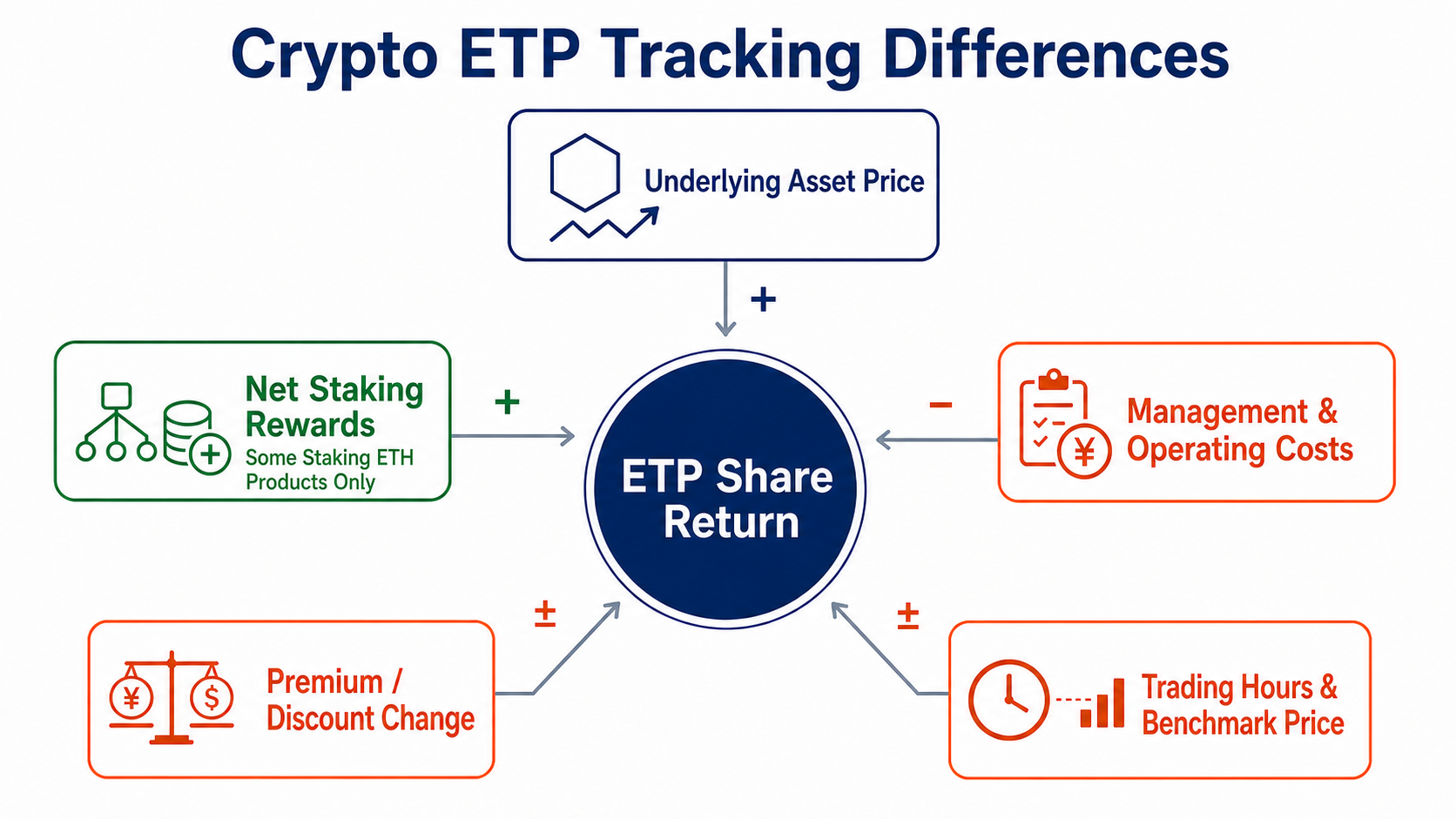
An ETF's market price is determined by exchange bids and offers, while its net asset value is calculated at a specified time using the product's chosen benchmark. Crypto assets trade around the clock, whereas US securities exchanges have fixed trading hours. On-chain market moves overnight or over a weekend may therefore be reflected all at once when the exchange opens.
Rather than comparing only two price charts, share performance can be broken down as follows:
Share return ≈ underlying asset price return + net staking yield earned by the product - management fees and operating costs ± changes in the premium or discount
For an ETH ETP that does not stake, net staking yield is zero. BTC ETPs have no native protocol staking yield. Funds usually need to sell small amounts of BTC, or follow another method specified in their documents, to pay ongoing expenses, so the amount of BTC represented by each share may decline over time.
Short-term differences may also result from suspended creations or redemptions, market liquidity, trading spreads, and disruptions in markets used by the benchmark. Management fees are only one factor when comparing products. Historical premiums and discounts, bid-ask spreads, the amount of assets per share, and the treatment of staking rewards also require review.
What Should You Consider When Choosing Between an ETH ETF and a BTC ETF?
The two are not simply "institutional ETH" and "institutional BTC." Start by deciding which underlying asset exposure you need, then check whether the securities wrapper changes the rights you intended to obtain.
| Review order | Question to answer |
|---|---|
| Underlying exposure | Does the product hold spot assets, futures, or shares of other ETPs? |
| Legal structure | Is it a commodity-based trust or a fund registered under the Investment Company Act of 1940? |
| Asset rights | Can investors withdraw the crypto asset, and how are forks and airdrops handled? |
| Staking policy | Does the product stake, how is the staked proportion determined, and how are rewards reduced by fees and distributed? |
| Tracking quality | How do the benchmark price, premium or discount, spread, and asset amount per share change? |
| Operating chain | Who are the custodian, authorized participants, staking providers, and index provider? |
For a focused explanation of BTC products' approval history and creation-redemption mechanism, read the Complete Guide to Spot BTC ETFs. To first understand where ETFs fit within crypto asset classification and valuation, return to the Beginner's Guide to Crypto Assets.
Frequently Asked Questions
Can ETH and BTC ETPs from the Same Issuer Be Exchanged Directly?
Ordinary investors generally cannot exchange shares of one fund directly for shares of the other. They are separate securities. Adjusting exposure usually requires selling and buying them separately in a brokerage account, while brokerage rules and tax treatment also depend on the account and jurisdiction.
Does SEC Approval of an ETH ETP Mean ETH Is Not a Security?
That conclusion cannot be drawn. Approval of exchange rules and the effectiveness of registration statements concern specific products and their disclosure requirements; they do not create a universal legal classification for all ETH transactions, staking arrangements, or related services.
What Is the Difference Between a Spot ETH ETP and an ETH Futures ETF?
A spot product primarily holds ETH, while a futures product holds ETH futures contracts traded on a regulated market. The performance of a futures ETF is also affected by the futures curve, rollover costs, and margin management.
Does a Split of an ETH ETF Increase the Value of a Holding?
No. A share split adjusts the number of shares and the price per share at the same time, so it does not increase an investor's proportionate interest in the fund. A reverse split works the same way.
Leitura recomendada
Veja mais



Service@hotcoin.com
Product@hotcoin.com
Business@hotcoin.com
Casecn@hotcoin.com