
Hotcoin Research | The Next Battle for Stablecoins: Competing for Control of the Digital Dollar System
TL;DR
Stablecoin Competition Enters a New Phase: From trading instruments to payment and settlement networks; the value chain is being reshaped around issuance, distribution, settlement, yield, and compliance.
Issuance & Distribution Restructured: Competition is shifting from issuance capabilities to user access; the market may evolve into a two-tier structure of general-purpose and application-specific stablecoins.
The Battle for Settlement: Stablecoins are entering real-world commerce; corporate treasury management is becoming a major growth driver, while machines emerge as new settlement participants.
Reserve Yield Rights: Interest earned on reserve assets has become a core revenue source; value redistribution is reshaping the competitive landscape, and yield products are evolving into financial infrastructure.
Opportunities: Cross-border payments and settlement; corporate treasury management; reserve yield monetization; AI Agent payment demand; clearer regulation driving institutional adoption.
Risks: Regulatory and compliance risks; declining interest rates compressing reserve yields; data inflation risk; shifting competitive dynamics; systemic concentration risks.
Outlook & Conclusion: Stablecoins are evolving into a new digital dollar account system; future winners will be those that control issuance, distribution, settlement, yield generation, and compliance capabilities.
Stablecoins are evolving from crypto trading tools into core infrastructure for institutional payments, corporate treasury management, and the emerging machine economy. Visa has positioned 2026 as a pivotal year for stablecoins, with cross-border payments, corporate treasury management, and merchant settlement emerging as key focus areas. Recently, Western Union announced the launch of its U.S. dollar-backed payment stablecoin, USDPT, on Solana. Coinbase announced that it had become the official USDC treasury partner on Hyperliquid. Circle is working with Kyriba to integrate USDC into treasury management platforms already used by enterprises. Coinbase has introduced x402, Stripe participates in payment infrastructure, AI Agent payments are also moving beyond narrative and into real cloud-service products and infrastructure... Together, these developments suggest that the stablecoin value chain is expanding beyond crypto-native markets: from exchanges into enterprise financial systems, from DeFi yield pools into merchant settlement, and from manual payments to machine-driven purchases of APIs, data, compute, and digital content.
I. Stablecoin Competition: From Medium of Exchange to Financial Infrastructure
In the past, stablecoin competition was often simply understood as "who has a larger market capitalization and stronger liquidity". However, as the usage scenarios expand from exchanges to DeFi, payments, settlements, and institutional treasury management, stablecoins are no longer just a substitute for the US dollar in the cryptocurrency market, but are gradually becoming the infrastructure of on-chain finance and global payment networks.
According to Visa Onchain Analytics, the total supply of stablecoins has rapidly expanded from less than $1 billion in 2019 to nearly $280 billion, more than doubling from about $120 billion at the end of 2023, reaching a new all-time high. In the past 12 months, the adjusted trading volume of stablecoins has reached $13.70 trillion, with over 400 million active addresses, indicating that stablecoins are gradually evolving from liquidity tools within the crypto market to a key layer of global settlement infrastructure in the global digital economy.
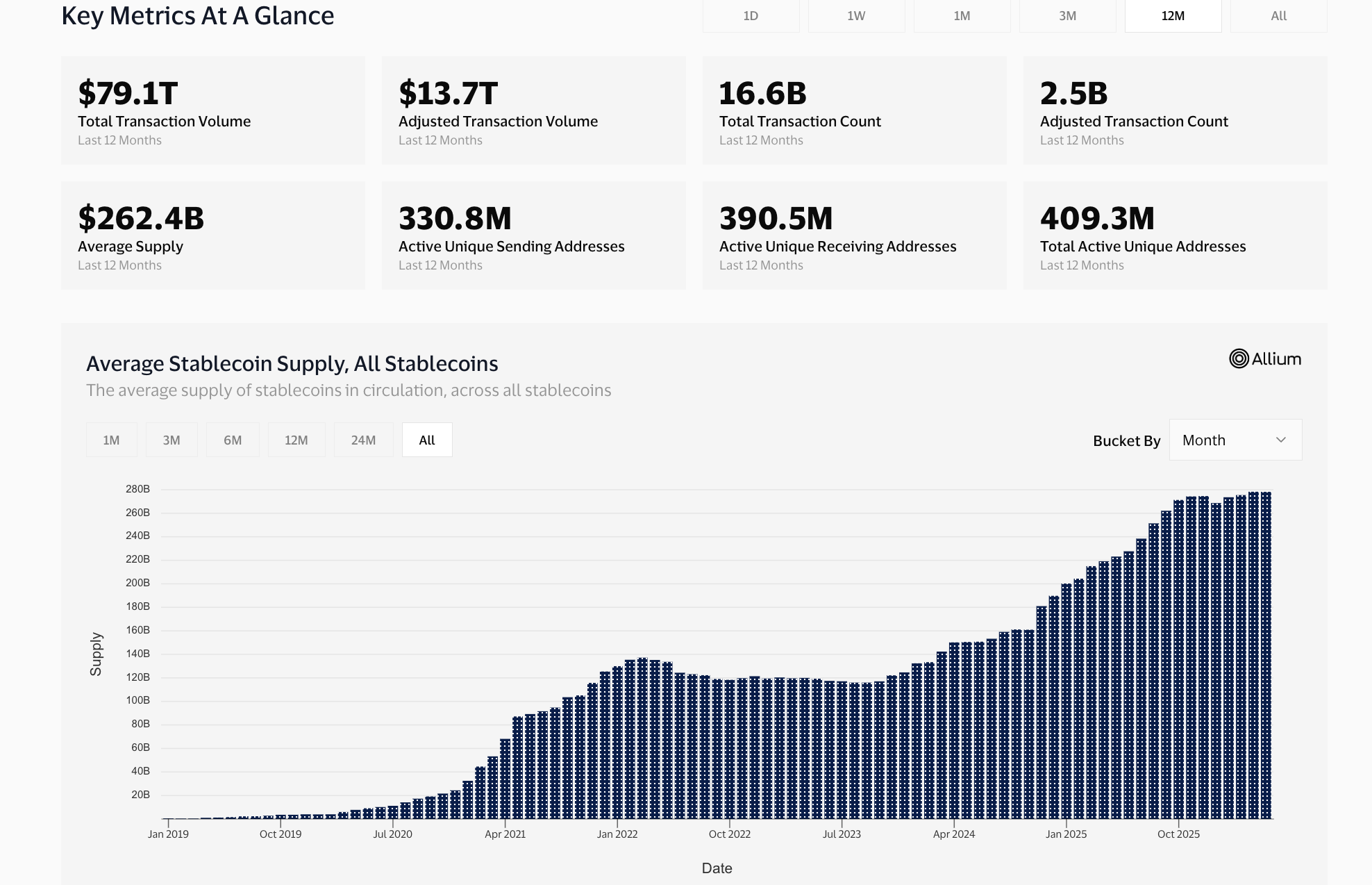
Source: https://visaonchainanalytics.com
1.1 The evolution of stablecoin roles: from a medium of exchange to a payment and settlement network
-
The first stage of stablecoin development was as a medium of exchange. It solves the problems of US dollar pricing, hedging, and liquidity in crypto trading. USDT's long-term leadership relies on the liquidity inertia formed by exchanges, market makers, OTC networks, and users in emerging markets. For many users, USDT is not just a token, but an entry point into US dollar liquidity.
-
The second stage is on-chain financial collateral. With the development of DeFi lending, DEX, perpetual contracts, and RWA protocols, stablecoins begin to serve as basic assets for collateral, clearing, market making, and yield products. At this time, stablecoins needed to be not only tradable, but also composable. USDC became increasingly important during this stage because it is more easily accepted by institutions, regulated trading platforms, and DeFi protocols.
-
The third stage is the payment, treasury, and machine-to-machine payment stage. This stage is already underway. Stablecoins are no longer just serving native crypto users, but entering cross-border remittances, merchant payments, platform payouts, on-chain salaries, B2B settlements, and institutional fund transfers. After traditional payment institutions enter the market, the competitive logic of stablecoins further changes: while issuance scale still matters, the players that can secure lower distribution costs, a wider fiat on- and off-ramp network, stronger compliance licenses, and more stable reserve management capabilities may obtain higher profit margins in long-term competition.
This is also why a "multi-polar structure" is emerging in the stablecoin market. The advantage of USDT lies in its global liquidity and trading network, the advantage of USDC lies in its compliance and institutional settlement, the advantage of PayPal USD lies in payment brand and user networks, the advantage of USDe lies in introducing yield mechanics into the stable-asset narrative, and the advantage of USDS lies in the on-chain collateral and governance system accumulated by MakerDAO/Sky over the years. They are not completely homogeneous competitors in the same dimension, but compete for dominance in different value chain links.
1.2 Reconstructing the Stablecoin Value Chain: Issuance, Distribution, Settlement, Yield, and Compliance
The value chain of stablecoins can be divided into five layers.
-
The first layer is the issuance layer, responsible for mapping off-chain US dollar assets to on-chain tokens, mainly represented by Tether, Circle, Paxos, etc.
-
The second layer is the distribution layer, responsible for bringing stablecoins to users and enterprises. The main participants are exchanges, payment companies, wallets, etc.
-
The third layer is the settlement layer, responsible for the circulation of stablecoins in exchanges, blockchains, payment networks, and merchant systems. The main participants are blockchains, trading platforms, merchant systems, AI Agent protocols, etc.
-
The fourth layer is the yield layer, which determines how to allocate reserve yield, protocol revenue, market-making revenue, and derivatives revenue, including government bond interest, DeFi income, distribution income, protocol revenue, etc.
-
The fifth layer is the compliance layer, which determines whether the issuing entity can continue to operate, whether it can reach institutional users, and whether it can complete redemption and settlement across jurisdictions.
In the past, the market mainly focused on the issuance layer and market cap layer. In the future, it will be more important to focus on the distribution layer, settlement layer, yield layer, and compliance layer. Stablecoin issuers, payment networks, enterprise software, cloud service providers, and blockchain infrastructure are redistributing value around these levels. Stablecoins are evolving from a single product to a competition across multiple layers of financial infrastructure.
II. Issuance and Distribution: Stablecoin Access Points Are Being Redefined
The stablecoin competition seems to be a competition for issuance control, but in fact it is evolving into a joint competition for issuance control and distribution rights. With the lowering of the issuance threshold for stablecoins, simply launching stablecoins is no longer scarce. What is truly scarce is who can continuously reach users, accumulate liquidity, and embed stablecoins into real transactions, payments, and application scenarios.
2.1 From Issuance Competition to User Access Competition
As the market gradually matures, different types of institutions begin to build stablecoin distribution systems around their respective advantages. The stablecoin market has also evolved from a single competition to a pattern of parallel development of multiple distribution networks.
-
The first type is the crypto-native distribution network, represented by USDT. Its core advantage comes from the liquidity system composed of exchanges, market makers, wallets, and OTC networks. Whether it is spot trading, contract margin, cross-border fund transfer, or on-chain asset allocation, USDT has become one of the most common underlying assets. Especially in emerging markets and high-frequency trading scenarios, USDT effectively serves as a digital dollar circulation medium. Its advantage is not in compliance, but in extremely strong availability and liquidity depth.
-
The second category is institutional and enterprise distribution networks, represented by USDC. Compared to USDT, USDC's development path focuses more on the institutional market. Circle not only issues stablecoins, but also actively promotes USDC to enter banks, payment institutions, fintech platforms, and enterprise treasury management systems. Taking Circle's cooperation with Kyriba as an example, USDC has begun to be incorporated into enterprise fund allocation, cash management, and liquidity management processes. For companies, the value of stablecoins is no longer just a trading tool, but a new treasury management infrastructure. As more and more enterprises begin to experiment with on-chain settlement and cross-border treasury management, institutional networks are expected to become an important source of stablecoin growth.
-
The third category is payment and application distribution networks. USDPT launched by Western Union, PYUSD launched by PayPal, and PYUSDx promoted by MoonPay and M0 all belong to this direction. Unlike traditional crypto institutions, these participants have mature payment channels, brand recognition, and user base. Their goal is not to enter DeFi first, but to embed stablecoins into existing payment systems and application ecosystems. For Western Union, stablecoins can become a new carrier for global remittance networks; for PayPal, stablecoins can further strengthen its digital payment ecosystem. As application platforms begin to have their own stablecoin entry points, the competition boundaries of stablecoins are also expanding from the financial market to the internet application layer.
These different types of distribution networks are not in perfect competition, but more like competing for different funding flows and client bases. Crypto-native networks connect transaction liquidity, institutional networks connect corporate capital flows, and payment and application networks connect consumer scenarios and daily payment needs. The competition in the future stablecoin market will increasingly be reflected in the competition between different networks.
2.2 The stablecoin market may move towards a two-tier structure
From a long-term development trend perspective, the stablecoin market is likely not to evolve into a single stablecoin monopoly pattern, but to form a dual-layer structure similar to internet infrastructure.
-
The first layer is the universal stablecoin layer. Its main function is to support open market liquidity, cross-platform transfer, and global settlement. Users, institutions, and protocols need an asset with wide acceptance and high liquidity as a value exchange medium. Currently, USDT and USDC are most likely to continue to play this role. They have a large circulation scale, mature redemption mechanism, and extensive ecosystem support, so they can continue to serve as the foundation layer of the on-chain US dollar system.
-
The second layer is the application-specific stablecoin layer . This type of stablecoin does not pursue becoming a universal asset for the entire market, but serves specific ecosystems and scenarios. For example, payment platforms can issue payment stablecoins, game ecosystems can issue game stablecoins, AI platforms can issue stablecoins for Agent payments, and enterprises may also issue stablecoins for internal settlement and treasury management. They emphasize ecosystem integration, user operation, and closed-loop business models, rather than market liquidity.
The logic behind this trend is very similar to the development of the Internet. The Internet eventually formed a structure where open protocols and application platforms coexist; the stablecoin market may also form a pattern where general stablecoins and scenario stablecoins coexist. General stablecoins are responsible for value circulation and cross-platform settlement, while application stablecoins are responsible for meeting specific scenario needs. Together, the two constitute the future on-chain US dollar system.
Therefore, the competition for issuance control may eventually evolve into an infrastructure competition. The most valuable participant in the future may not necessarily be a single stablecoin issuer, but a network layer that can connect general stablecoins and application stablecoins, and provide issuance, redemption, clearing, liquidity management, cross-chain interoperability, and compliance services. Whoever can become the connector between different stablecoins is more likely to occupy the core position in the next stage of competition.
III. The Fight for Settlement: Payment Networks, Corporate Treasuries, and AI Agents Enter the Market
Stablecoins truly becoming financial infrastructure does not depend on whether they can transfer money on the chain, but on whether they can enter high-frequency, high-value, and low-friction real settlement scenarios. As stablecoins gradually move out of the cryptocurrency market, their competition focus is also shifting from liquidity to settlement networks. Whoever can master more real payment scenarios has a greater chance of becoming an important part of the next generation of US dollar infrastructure.
3.1 Payment network competition: Stablecoins begin to enter the real commercial flow
Cross-border transfer has always been regarded as one of the easiest use cases for stablecoins to gain traction. Compared with the traditional banking system, stablecoins can achieve round-the-clock transfer, faster settlement, and lower cross-border friction, so more and more payment institutions are beginning to incorporate them into the infrastructure system.
Visa emphasizes that the core driving force for institutions to adopt stablecoins is not crypto trading, but cross-border fund flows, merchant settlements, corporate payments, and operational efficiency improvement. Western Union's launch of USDPT should also be understood within this framework. For Western Union, its true value is not issuing a new stablecoin, but embedding stablecoins into existing payment systems through a global network of agents, fiat on- and off-ramp channels, and remittance scenarios. If stablecoins can be deeply integrated with traditional remittance networks, USDPT will compete not only for on-chain users, but also for the global cross-border transfer and remittance market.
In the long run, the competition in stablecoin payment networks is essentially a competition for real fund flows. Whoever can connect more merchants, payment institutions, and cross-border fund needs has a better chance of gaining control over the next stage of settlement networks.
3.2 Corporate treasury: stablecoins are entering company balance sheets
Compared to consumer payments, enterprise treasury management may be a larger market. The collaboration between Circle and Kyriba shows that stablecoins are gradually evolving from trading tools to enterprise treasury infrastructure. For CFOs and finance teams, they are not concerned about on-chain narratives, but more about fund allocation efficiency, cash utilization, audit compliance, and liquidity management capabilities.
Traditional multinational companies often face issues such as bank working hours, long settlement cycles, and multiple layers of approval when conducting cross-border fund transfers. Stablecoins provide another option: companies can achieve 24/7 fund transfers, more real-time liquidity management, and more transparent fund tracking.
This means that the distribution channels of stablecoins are changing. In the past, stablecoins mainly reached users through exchanges, wallets, and DeFi protocols; in the future, they may also enter the daily operational processes of enterprises through ERP, financial management systems, and Treasury platforms. If this trend continues, enterprise funding systems are expected to become one of the most important sources of stablecoin demand after the cryptocurrency trading market.
3.3 AI Agent payments: machines are becoming new settlement participants
In addition to people and enterprises, a third type of potential settlement entity is emerging - AI Agents.
AWS Bedrock AgentCore Payments allows AI agents to make stablecoin payments. Coinbase has launched the x402 protocol, and Stripe is also involved in related payment infrastructure building. The core logic of x402 is to enable machines to complete payment behaviors like humans: when a server returns an HTTP 402 Payment Required response, the agent can automatically complete the payment according to preset rules and obtain APIs, data, content, or computing services.
The significance of this mechanism lies not in the current transaction scale, but in standardizing "machine payment" as a protocol layer capability for the first time. There is a fundamental difference between machine payment and traditional payment. Human payment relies on human decision-making, while AI agents may need to automatically purchase an API call, a piece of real-time data, a content access permission, or short-term computing resources. Such scenarios often have the characteristics of high frequency, small amount, automation, and programmability, while stablecoins naturally have the advantages of 24/7 settlement, on-chain verifiability, and programmatic control.
Of course, AI Agent payments are still in a very early stage. Data compiled by IOSG shows that x402 is currently mainly focused on crypto-native and AI-native services, with limited merchant coverage and some transaction activities possibly driven by incentives. Cryptorefills supports AI Agents to use USDC to purchase gift cards, eSIM, and mobile top-ups, which is one of the few real cases that have been implemented, but there is still a long way to go before forming a large-scale commercial network.
IV. Reserve Yield Rights: The Core Profit Pool of the Stablecoin Business Model
If the issuing right determines who can create on-chain dollars, the settlement right determines who can control the flow of funds, then the reserve yield right determines who can obtain the most stable and sustainable source of profit in the stablecoin system. For a long time, the market has focused more on the circulation scale of stablecoins, but ignored the income structure behind them. As stablecoins gradually evolve from trading tools to financial infrastructure, the distribution of yield generated around reserve assets is also becoming the core focus of a new round of competition.
4.1 Reserve assets: the most important source of profit for stablecoins
The core of the stablecoin business model is the interest yield generated by reserve assets. When users hold fiat-backed stablecoins such as USDT and USDC, issuers usually allocate corresponding reserve funds to low-risk assets such as US Treasury bonds, reverse repurchase agreements, money market funds, and bank deposits. Users receive price-stable digital dollars, while issuers receive the yield generated by these reserve assets.
In the era of zero interest rates, the profitability of this model is not outstanding. However, as US interest rates continue to remain high, reserve yield has gradually become one of the most important sources of income for the stablecoin industry. For stablecoins with billions of dollars in circulation, even a few percentage points of annualized return can create a considerable cash flow.
This is also why stablecoin competition is increasingly attracting attention from traditional financial institutions. Compared to trading platforms that rely on market activity levels, the reserve yield model has stronger sustainability and predictability. As long as stablecoins can maintain circulation, issuers can continue to earn profits. From a business model perspective, stablecoins are essentially becoming a digital balance sheet business: users provide funds, issuers manage reserve assets, and obtain the interest rate differential yield generated from them.
4.2 Profit distribution: stablecoin competition is entering a new phase of value redistribution
With the continuous expansion of reserve yield scale, the market has begun to pay attention to another question: who should own these profits? In the traditional model, most of the profits are retained by the issuer. Users obtain price stability and liquidity, while the interest generated by reserve assets mainly belongs to the issuing institution. This model has helped projects such as USDT and USDC establish a sustainable profit system and promoted the rapid development of the industry.
However, as the market matures, more and more participants are beginning to try to redistribute this part of the profits.
-
One direction is yield-bearing stablecoins. Users can directly share part of the profits generated by reserve assets while holding stablecoins. Products such as sUSDD and sUSDe belong to this idea. Compared with traditional stablecoins, yield-bearing stablecoins are more like an on-chain money market fund, which can maintain a relatively stable value anchor and return profits to holders.
-
Another direction is to reinvest reserve yield into ecosystem expansion. For example, some stablecoin issuers will use reserve yield to subsidize payment networks, liquidity incentives, or on-chain application growth, in order to enhance the distribution and settlement capabilities of stablecoins. The transfer network built around USDT in the TRON ecosystem, as well as emerging stablecoin infrastructure such as Plasma trying to attract users through lower-cost settlement experiences, essentially reflect the idea of transforming reserve yield into network growth.
This change means that the competition for stablecoins is gradually evolving from competition for circulation scale to competition for profit distribution. In the future, when users choose a certain stablecoin, they will not only consider its security and liquidity, but also how much profit they can obtain and whether they can participate in value sharing.
4.3 From yield products to financial infrastructure
The significance of reserve yield rights lies not only in creating profits, but also in their ability to become underlying assets for building new financial infrastructure. In recent years, more and more DeFi protocols have begun to repackage and redistribute stablecoin income. For example, Pendle splits future income into PT and YT, allowing users to trade principal and yield rights separately; lending protocols allow yield assets to participate in further financing as collateral; structured products and yield aggregators are also continuously expanding the application scenarios of stablecoin income.
Based on yield-bearing stablecoins, the market is forming a new layer of yield assets. Stablecoins are no longer just payment instruments or value storage tools, but are beginning to assume functions similar to short-term government bonds, money market funds, and even cash management products. For users, their appeal comes from the combination of stability and profitability; for protocols, their value lies in being an important underlying asset in lending, derivatives, and yield trading markets; for issuers, it means higher fund retention rates and stronger ecosystem stickiness.
In the long run, reserve yield rights may have more strategic value than issuance rights themselves. Issuing stablecoins only creates a digital dollar, while mastering reserve yield rights means mastering the ability of the entire on-chain dollar system to continuously generate cash flow, becoming one of the most important competitive resources for the next generation of on-chain financial systems.
V. Opportunities and Risks: The Stablecoin Value Chain is Reshaping the Global Dollar System
After more than a decade of development, stablecoins have gradually evolved from trading tools in the cryptocurrency market to important infrastructure connecting on-chain finance and the real world. From payment settlement to enterprise treasury management, from yield assets to AI Agent payments, stablecoins are constantly expanding their application boundaries. However, compared with the optimistic expectations of the market, the stablecoin industry is still in its early stages, and there is huge growth space in the future, as well as multiple challenges such as regulation, competition, and business models.
5.1 Opportunities: stablecoins are becoming the next generation of dollar infrastructure
The biggest opportunity for stablecoins lies in their potential to become the dollar infrastructure of the global digital economy era.
-
The payment and settlement market still has huge growth potential. Traditional cross-border transfer systems have long suffered from high costs, low efficiency, and long settlement cycles, while stablecoins have natural advantages such as 24/7 operation, global accessibility, and programmable settlement. With institutions such as Visa, Mastercard, PayPal, Stripe, and Western Union gradually expanding into stablecoin infrastructure, stablecoins are gradually entering the mainstream payment system from the cryptocurrency market.
-
Enterprise treasury management may become one of the most important incremental markets in the future. The cooperation between Circle and Kyriba shows that stablecoins have begun to enter the scenarios of enterprise fund allocation, cash management, and cross-border settlement. For multinational enterprises, stablecoins are not only a payment instrument, but also have the opportunity to become a new infrastructure for treasury management.
-
Reserve yield is driving innovation in on-chain financial products. The development of yield-bearing stablecoins has enabled them to have both payment and income attributes. The lending, yield splitting, structured products, and asset management markets formed around reserve yield are building a new on-chain yield asset layer. This means that stablecoins will not only be a digital mapping of the US dollar in the future, but may also become important underlying assets in the global digital asset market.
-
New scenarios such as AI Agent payments are opening up new demand space. When machines start to independently purchase APIs, data, content, or computing resources, stablecoins naturally have the advantages of programmatic payments and real-time settlement. Although this market is still in its very early stages, its long-term potential is worth paying attention to.
-
Compliance is shifting from a limiting factor to a growth driver. Since 2025, the US Congress has continued to advance digital asset-related legislation such as the GENIUS Act and the CLARITY Act. Regardless of how the final bill details are adjusted, their common significance is to provide clearer regulatory expectations for the stablecoin industry. The establishment of a compliance framework not only means increased regulatory constraints, but also means that stablecoins are obtaining a "license" to enter the mainstream financial system.
In the long run, the biggest opportunity for stablecoins is not to replace traditional finance, but to become a new infrastructure layer connecting traditional finance with on-chain finance.
5.2 Risks: beyond the growth narrative, practical constraints still matter
Although the long-term prospects are broad, the development of the stablecoin industry is not a linear process, and the risks it faces cannot be ignored.
-
Regulatory and compliance risks: Stablecoins are essentially connected to the fiat currency system, payment networks, and capital markets, so they are naturally in the core area of regulatory attention. With the gradual advancement of laws such as the GENIUS Act and the CLARITY Act, the future stablecoin market may shift from the current pattern dominated by crypto-native institutions to a market jointly participated by banks, payment institutions, and large fintech companies, putting pressure on smaller issuers and increasing market concentration. Some projects may gradually withdraw from the market due to their inability to meet new compliance requirements.
-
Business model risk: The profitability of current mainstream stablecoins largely benefits from the high-interest-rate environment in the US. When reserve assets can provide higher returns, issuers can obtain considerable interest income. However, if the future enters a period of interest rate cuts, reserve returns may significantly decrease, and business models that rely on high-yield support will also face pressure. For yield stablecoins, this impact may be more obvious.
-
Data bubble risk: In recent years, the trading volume of stablecoins has grown rapidly, but on-chain trading volume does not necessarily equate to real economic activity growth. A large number of transactions may come from arbitrage, market making, robot activities, and fund circulation between protocols. Compared with the trading volume itself, real payment scale, enterprise adoption, and long-term user growth can better reflect the actual development level of the industry. If the market relies too much on short-term data narratives, it may overestimate the actual penetration speed of stablecoins.
-
Changes in the competitive landscape: In the past, the stablecoin market was mainly dominated by crypto-native institutions, but in the future, banks, payment companies, internet platforms, and fintech companies may all become important participants. With the lowering of the issuance threshold, market competition may evolve from competition between stablecoins to ecosystem competition between payment networks, financial institutions, and technology platforms. For existing issuers, maintaining liquidity advantages and network effect will become a long-term challenge.
-
Systemic concentration risk: Currently, market liquidity and user scale are still highly concentrated in a few top stablecoins. Once there are problems with major issuers, reserve assets, or critical infrastructure, it may have a chain reaction to the entire industry. Therefore, as the industry continues to expand, risk diversification and infrastructure resilience building will also become increasingly important.
In a sense, the stablecoin industry has entered a new stage of "regulatory-driven growth". In the past, liquidity and network effect determined the competitive landscape. In the future, what is truly worth paying attention to is not only who issues more stablecoins, but also who can continuously connect capital flows, users, and real economic activity under the compliance framework. Only by mastering issuing, settlement, income, and compliance capabilities at the same time can we establish a real long-term advantage in the next stage of competition.
VI. Outlook and Conclusion: What Is the Endgame for Stablecoins?
In the past few years, when discussing stablecoins in the market, the most commonly mentioned scenarios are transactions, cross-border transfers, and remittances. These scenarios have indeed driven the rapid growth of stablecoins, but from a longer-term perspective, they may only be the first step in the development of stablecoins, rather than their final form. A question worth pondering is: if all US dollars can circulate on the chain in the future, who will be the real competitor of stablecoins? The answer may not be another stablecoin, but today's bank account system. In the past century, the issuing, circulation, and settlement of US dollars have mainly relied on commercial bank networks. Bank accounts undertake functions such as fund storage, payment settlement, yield management, and credit creation. Stablecoins are gradually replicating and reconstructing this system: issuers are responsible for creating on-chain dollars, payment networks are responsible for value transfer, yield-bearing stablecoins are responsible for cash management, and on-chain lending protocols are beginning to assume some credit intermediary functions.
From this perspective, the development direction of stablecoins may not be to become a new payment instrument, but to evolve into a new US dollar account system. Users no longer hold just a stablecoin balance, but an on-chain US dollar account with payment, yield, lending, and asset management capabilities. At the same time, the gradual improvement of the regulatory framework will also accelerate this process. The significance of legislative promotion is not only to regulate industry development, but also to promote stablecoins from the crypto-native market to the mainstream financial system. In the coming years, banks, payment institutions, internet platforms, and asset management companies may all become important participants in the stablecoin market.
The endgame of stablecoin competition may not be for one stablecoin to replace another, but to form a hierarchical structure similar to a banking system: a small number of basic currency layers with regulatory licenses and reserve capabilities, as well as a large number of scenario distribution layers for payments, corporate finance, AI agents, and financial applications. The real competition in the future is no longer just about issuance control, but about who can control the distribution rights of user entry, settlement network, and reserve yield.
About Us
Hotcoin Research, the core research and investment arm of Hotcoin Exchange, is dedicated to turning professional crypto analysis into actionable strategies. Our three-pillar framework—trend analysis, value discovery, and real-time tracking—combines deep research, multi-angle project evaluation, and continuous market monitoring.
Through our Weekly Insights and In-depth Research Reports, we analyze market dynamics and highlight emerging opportunities. With Hotcoin Selects—our exclusive dual-screening process powered by both AI and human expertise, we help identify high-potential assets while minimizing trial-and-error costs.
We also engage with the community through weekly livestreams, decoding market hot topics, and forecasting key trends. Our goal is to empower investors of all levels to navigate cycles with confidence and capture long-term value on Web3.
Risk Disclaimer
The cryptocurrency market is highly volatile, and all investments carry inherent risks. We strongly encourage investors to remain informed, assess risks thoroughly, and adhere to strict risk management practices to protect their assets.
Connect with Us
Website:https://www.hotcoin.com/en_US/learn/index/
X: x.com/HotcoinAcademy
Email: labs@hotcoin.com
Leitura recomendada
Veja mais
Hotcoin Research | When Leveraged ETFs Meet Perpetual Futures: A Cross-Market Amplifier of Risk and Volatility
In-depth Research

Hotcoin Research | When Macro Factors Become Pricing Logic: Prospective Analysis of Macro Variables in the Crypto Market in 2026
In-depth Research

Hotcoin Research | Play and Earn Web3: Castile - A New Era of 3A Idle RPG in the Fantasy Cthulhu Universe
In-depth Research

Contatos de serviço
Service@hotcoin.com
Feedback do produto
Product@hotcoin.com
Cooperação empresarial
Business@hotcoin.com
Contatos Legais
Casecn@hotcoin.com
Quem somos
produtos
Servir
Apoio, suporte
©2017-2026