
Hotcoin Research | Rebrand or Reinvention? Inside MakerDAO’s Transformation into Sky
TL;DR
-
Background: From DAI to USDS, and from MKR to SKY, Sky’s Endgame is shaping a new layer of on-chain financial infrastructure.
-
Core Architecture: The stablecoin layer forms the liability side; the yield layer turns protocol revenue into user-facing products; the capital allocation layer sources, screens, and manages yield opportunities.
-
Stars / Agents: Spark focuses on liquidity and lending; Grove targets institutional credit; Keel drives Solana-based multi-chain expansion; Obex incubates new asset opportunities.
-
Opportunities: Growing demand for yield-bearing stablecoins; RWA introduces real cash-flow-based yields; multi-chain expansion broadens use cases; Stars / Agents drive network-based growth.
-
Challenges: Intense stablecoin competition; uncertainty around yield sustainability; RWA introduces off-chain credit and liquidity risks; a multi-entity structure may disperse risk while reducing transparency.
-
Conclusion: Whether Sky can become the next-generation on-chain financial foundation depends on its ability to establish a long-term balance among yield, liquidity, transparency, and risk management.
The former DeFi OG MakerDAO is returning to the spotlight with a new identity as Sky. In late April 2026, Spark, the core Stars protocol of the Sky ecosystem, attracted about $1.30 billion in capital inflows in a single week, TVL broke through $5 billion, and SPK tokens rallied sharply; at the same time, the circulation of USDS stablecoins has approached $12 billion, and the sUSDS yield product TVL has stabilized at around $5.40 billion, becoming one of the world's largest yield-bearing stablecoins. From DAI to USDS, from MKR to SKY, from a single stablecoin protocol to a modular Agent Network driven by Stars such as Spark, Grove, and Keel, Sky's Endgame is no longer just a governance blueprint, but an emerging on-chain financial infrastructure stack.
I. MakerDAO's Glory and Bottlenecks: The Origin of Endgame
In the history of DeFi development, DAI plays a pivotal role. After its mainnet launch in 2017, DAI became the earliest decentralized stablecoin to gain large-scale adoption. Unlike stablecoins such as USDT and USDC, which are backed by fiat reserves managed by centralized issuers, DAI's issuance relies on over-collateralization, on-chain liquidations, oracle pricing, and DAO governance: users deposit assets such as ETH, wBTC, stETH, and USDC into Maker Vault to mint DAI. When the collateral ratio falls below the system requirement, the protocol liquidates the collateral to recover bad debt and maintain system solvency.
This design enabled DAI to play an extremely important role as a foundational monetary asset in the early days of DeFi. Lending protocols, DEXs, yield aggregators, leverage strategies, and DAO treasury management all extensively use DAI as a pricing unit, settlement asset, and liquidity medium. It demonstrated something groundbreaking at the time: even without bank accounts, a centralized issuer, or traditional financial intermediaries, USD-denominated credit could be created on-chain through collateralized assets, automated liquidations, and decentralized governance. In a sense, DAI is a key puzzle piece for DeFi to evolve from simple asset trading into a complete on-chain financial system. The success of DAI has gradually pushed MakerDAO towards more complex system boundaries. However, the problem is that the original MakerDAO governance framework was not designed to manage such a complex financial network.
-
Governance Complexity: In the early days of MakerDAO, the focus of governance was more on adjusting collateral ratios, debt ceilings, stability fees, and liquidation parameters. However, as the types of collateral increased, governance issues began to expand to multiple dimensions, such as oracle security, asset credit evaluation, legal structure, PSM asset allocation, RWA custody arrangements, revenue distribution, and protocol capital management. What MKR holders need to deal with is no longer a single DeFi protocol parameter, but an expanding financial balance sheet with multiple assets, multiple maturities, and multiple sources of risk.
-
Growth and user experience: DAI has a strong brand identity among DeFi native users, but for a wider range of users, MakerDAO's product narrative has always been complex. Users not only need to understand what Vault, collateral rate, liquidation threshold, and stability fee are, but also understand the differences between DSR, PSM, MKR governance, risk parameters, and different collateral. Compared to stablecoins like USDT and USDC that are "buy and use", DAI's advantages lie in transparency, on-chain native control, and non-single publisher control. However, its disadvantages are also obvious: the onboarding experience is not intuitive enough, the yield proposition is not intuitive enough, and the product brand is not unified enough.
-
Income Source Transformation: With the fluctuation of crypto-native collateral demand, MakerDAO needs to find a more stable and sustainable revenue source. In 2023, MakerDAO will increase its real-world asset allocation, such as US Treasury bonds, to about $1.20 billion. The introduction of RWA significantly improved MakerDAO's income structure, but also changed the risk nature of the protocol. Unlike on-chain assets such as ETH and stETH, real-world assets such as US Treasury bonds, institutional credit, CLOs, and mortgages involve legal entities, custody arrangements, term mismatches, credit risks, information disclosure, and regulatory frameworks. These risks cannot be fully resolved through smart contract liquidations, nor can they be simply handed over to ordinary MKR governance voting. MakerDAO is facing a problem closer to traditional finance: how to establish a reliable risk control system between on-chain transparency and off-chain legal assets.
-
Stablecoin competition landscape: DAI used to be a representative of decentralized stablecoins, but the scale of the stablecoin market is not entirely determined by the "degree of decentralization". USDT relies on exchange liquidity and global payment networks to form a strong position, USDC relies on compliance, institutional channels, and transparency of US dollar reserves to attract users, and Ethena reactivates the market's demand for high-yield stablecoins through yield-based synthetic US dollars. In this environment, if DAI still stays in the identity of "DeFi veteran stablecoin", it will be difficult for it to bear the next growth target of MakerDAO alone.MakerDAO must answer a new question: How does DAI need to evolve when the competition for stablecoins expands from "who is more stable" to "who can provide better returns, stronger distribution, wider scenarios, and clearer compliance paths"?
The core purpose of Endgame is to establish new organizations and growth methods between these bottlenecks. It is not a simple brand renaming or simply launching a new token, but a structured response of MakerDAO to its own system complexity: reducing the burden of single governance through modular architecture, professionalizing business expansion and capital allocation through Stars/Agents, reducing the contagion of a single business line to the core stablecoin system through risk isolation, improving user experience and making yield generation more accessible through USDS, Sky Savings Rate, and sUSDS, and expanding yield sources through RWA, DeFi lending, and multi-chain layout.
II. From MakerDAO to Sky: Stablecoin Paradigm Upgrade and Systemic Restructuring
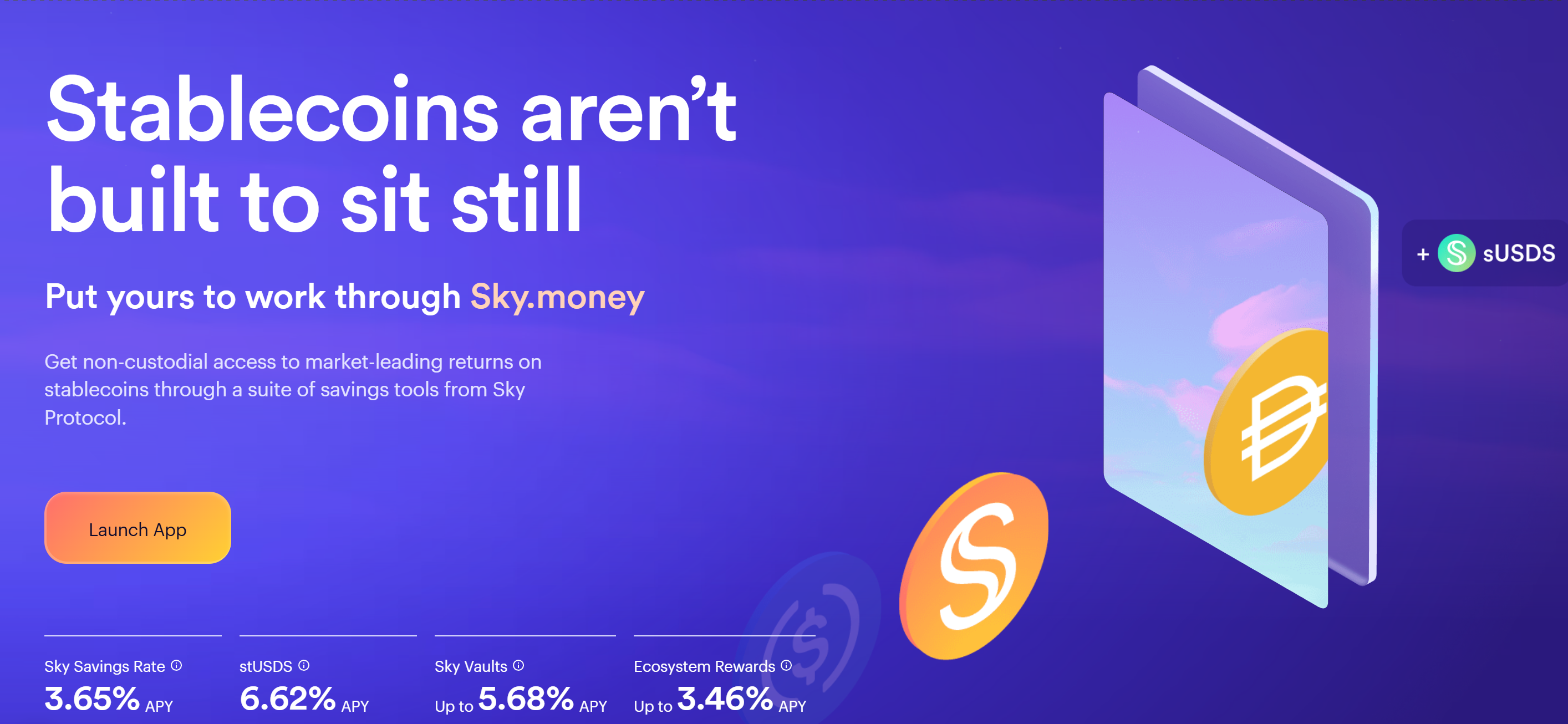
Source: https://sky.money/
Sky is not just a brand upgrade in the history of MakerDAO, but also the result of the upgrade driven by stablecoin credit, RWA experience, and DAO governance contradictions accumulated in the DAI era. MakerDAO has proven that decentralized dollars can be created on-chain, and the question that Sky needs to answer goes further: can a scalable, modular, risk-manageable financial infrastructure network be formed on-chain that can continuously generate real-world yield?
1. From Maker to Sky: Refactoring the Stablecoin Entrance
In August 2024, MakerDAO announced its name change to Sky and launched an upgraded stablecoin USDS and governance token SKY. DAI and USDS can be exchanged at a 1:1 ratio through the official converter, and the exchange ratio between MKR and SKY is 1:24,000. At the same time, DAI and MKR do not disappear immediately, but exist in parallel with USDS and SKY for a long time, providing migration buffers for existing users, DeFi integrators, and governance participants.
(1)DAI → USDS
The core difference between DAI and USDS is first reflected in their product positioning. DAI is a cryptocurrency-native stablecoin in the MakerDAO era, which historically emphasizes decentralized collateral, on-chain liquidations, and DeFi composability. USDS is the flagship stablecoin in the Sky era, emphasizing user growth, access to yield opportunities, reward mechanism, and cross-scenario distribution. The user experience has shifted from simply using a stablecoin to participating in a broader yield and capital allocation ecosystem.
Compared to DAI's decentralized stablecoin brand, USDS is seen by the market as a more suitable product form for exchanges, institutions, real-world assets, and compliance scenarios. Some community members are concerned that USDS's potential freezing function and compliance interface will weaken DAI's long-term accumulation of decentralized asset recognition; supporters believe that if Sky wants to tap into broader liquidity, institutional credit, RWA assets, and multi-chain applications, adjustments must be made in compliance boundaries, risk management, and user entry.
(2) MKR → SKY upgrade
The upgrade of MKR → SKY is essentially a transformation of governance tokens from "high-threshold governance assets" to "ecosystem participation governance assets". MKR used to be the core governance and value capture token of MakerDAO, with a small supply, high unit price, and strong financial attributes, making it more suitable for deep governance participants and long-term capital holders.SKY is closer to the asset form that ordinary users can participate in in terms of unit price, distribution efficiency, and ecosystem incentives. It is used to govern key protocol parameters such as Sky Savings Rate, and can also participate in staking, reward, and lending-related functions in the Sky ecosystem.
However, this also brings new issues: when governance tokens are easier to distribute and participate in, how the protocol avoids the coordination costs of short-term governance, incentive arbitrage, and decentralized voting rights will become an important test of Sky's long-term governance quality.
2. Sky's three-tier architecture: stablecoin, yield layer, and capital allocation network
To understand Sky, we need to break it down into three layers: the stablecoin layer is responsible for forming the liability side, the yield layer transforms asset-side returns into user-facing yield products that users can perceive, and the capital allocation layer is responsible for finding, screening, and managing yield sources.
| Layer | Core Components | User Experience | Main Function | Key Question |
| Stablecoin Layer | DAI, USDS | Users can hold, swap, transfer, trade, and borrow stablecoins | Forms the USD-denominated liability side, supporting DeFi and multi-chain payment, trading, and lending demand | How DAI and USDS can coexist, and whether USDS can gain broader circulation scenarios |
| Yield Layer | Sky Savings Rate, sUSDS, stUSDS, Vaults | Users can deposit USDS into yield products to receive auto-compounding returns or higher-risk yield exposure | Presents protocol revenue to users through savings products, tokenized yield receipts, or higher-risk yield products | Whether yields come from real asset-side returns, and whether they can be sustained during rate declines and market stress |
| Capital Allocation Layer | Spark, Grove, Keel, Obex and other Stars / Agents | Users may not directly interact with the underlying assets, but returns come from these capital allocation activities | Expands Sky’s asset side into DeFi, RWA, Solana, multiple types of credit assets, and institutional-grade projects | Whether multi-entity governance, risk isolation, information disclosure, and execution capabilities are mature enough |
-
Stablecoin Layer: The coexistence of DAI and USDS enables Sky to serve two types of users at the same time: DAI is more inclined towards DeFi native integration, historical credit, and decentralized brands; USDS serves as the primary stablecoin, mainly used for holding, transferring, trading, lending, and entering various Sky products, as a unified entrance to Sky revenue, rewards, and ecosystem applications. Users can swap USDC and USDS 1:1 with zero fees and no slippage, and further enter the sUSDS, stUSDS, or ecosystem reward modules.
-
yield layer: sUSDS tokenizes and standardizes stablecoin yield, allowing users to earn protocol-distributed yield by holding yield-bearing tokens without directly understanding the complex asset side. The income certificate obtained by users after depositing USDS in the savings module is sUSDS, and the yield accrues automatically, suitable for users who want to obtain relatively passive stablecoin yield; stUSDS further introduces a design of higher risk, deeper participation in governance and risk capital arrangements, designed to absorb independent risk exposure related to SKY-backed lending
-
Capital Allocation Layer: Stars/Agents such as Spark, Grove, Keel, Obex essentially undertake specialized asset management functions. Spark is responsible for DeFi lending and liquidity, Grove is responsible for RWA and institutional credit, Keel configures capital for the Solana ecosystem, and Obex is more like an incubation and capital deployment entrance for new RWA and stablecoin projects. They can access different markets, take on different risk profiles, generate diversified sources of protocol revenue, and route liquidity and revenue back to the core protocol through Sky's stablecoin system. Therefore, Sky is no longer just a stablecoin publisher, but is building an on-chain balance sheet management system: which assets can generate yield, who bears risk, how to distribute income, and how to isolate losses have become the core issues of protocol value.
Therefore, from Maker to Sky, it is not a simple brand upgrade, but a stablecoin paradigm shift: stablecoins are no longer just passive mappings of on-chain dollars, but have become financial entrances connecting user funds, protocol revenue, RWA assets, multi-chain liquidity, and governance incentives.
III. Stars / Agents: Moving Sky from Single-Protocol Growth to Networked Growth
If USDS, sUSDS, and Sky Savings Rate constitute Sky's user-oriented front-end products, then Stars/Agents are the true execution layer for Sky's asset expansion, responsible for finding returns, managing risks, and returning liquidity and income to Sky's stablecoin system in different markets. In terms of classification, Spark, Grove, and Keel belong to the Stars in the Sky ecosystem, which are relatively autonomous business units. Obex is more inclined towards agents, responsible for screening and incubating new assets, projects, and yield sources.
1. Spark: Execution layer for DeFi users
Spark is positioned as a gateway for stablecoin savings, lending, and liquidity management. Spark's core is not just to provide a lending market, but to connect Sky's stablecoin capital to different chains and DeFi protocols through SparkLend, Spark Savings, and Spark Liquidity Layer. Spark Liquidity Layer can automate the provision of USDS, sUSDS, and USDC liquidity from Sky, and support users to use sUSDS to obtain Sky Savings Rate on different networks. It also allows Spark to automatically deploy liquidity to the DeFi market to optimize revenue.According to Spark's official website, as of April 29, 2026, SparkLend TVL is about $3.50 billion, Spark Liquidity Layer is about $2.68 billion, and Savings TVL is about $5.60 billion.
Spark's role in the Sky system is similar to that of an "on-chain fund scheduler": one end undertakes the stablecoin debt of USDS/sUSDS, and the other end enters the lending, liquidity, and yield markets. Compared with other DeFi protocols, Spark's advantage lies in its natural binding with Sky balance sheet, governance parameters, and stablecoin liquidity. However, the risks are also clear. Once there are problems with collateral quality, interest rate models, liquidation efficiency, or external integration, the risks will directly affect users' trust in the USDS yield layer.
2. Grove: Towards Institutional Credit and RWA Configuration
Grove undertakes the institutional credit allocation layer function, directing USDS liquidity towards diversified credit strategies through non-custodial, vault-based infrastructure. In June 2025, Grove announced the launch of the institutional credit infrastructure protocol and received a $1 billion allocation to invest in the tokenized Janus Henderson Anemoy AAA CLO strategy, which was known as one of the largest allocations for tokenized strategies at the time. In January 2026, Galaxy announced that its first tokenized CLO had completed an initial fundraising of about $75 million, with Grove providing an anchor configuration of about $50 million.
Grove advances Sky's RWA narrative from "allocating short-term US Treasury bonds" to "putting institutional credit assets on-chain". If short-term Treasury bonds are closer to low-risk interest rate assets, then CLOs, structured credit, and institutional loans are more challenging in terms of credit analysis, legal structure, term management, and default resolution capabilities. Grove may bring more diversified yield sources to Sky, but it also exposes Sky to more traditional financialization risks: underlying borrower credit quality, asset transparency, market liquidity discount, and off-chain legal enforcement efficiency.For Sky, the core value of Grove is not simply "increasing yield", but whether it can establish an institutional credit allocation framework that can be understood, supervised, and constrained by on-chain governance.
3. Keel: Sky's Multi-Chain Attempt
Keel, as the Star of Sky for Solana, was launched in 2025 and plans to send up to 2.50 billion USD capital to the DeFi and tokenized asset market of the Solana ecosystem. Its strategic significance is that if USDS is limited to Ethereum DeFi for a long time, its growth space will be limited by on-chain transaction costs, user structure, and liquidity circle; while the Solana ecosystem has higher transaction frequency, stronger retail participation, and faster application iteration speed. Keel's role is to use the capital allocation ability within the Sky system to push USDS from a stablecoin asset on Ethereum to a multi-chain financial asset.
However, the risks of Keel cannot be ignored. Solana’s faster-paced and more application-driven ecosystem also means faster capital flow and more susceptible strategies to market sentiment and liquidity cycles. At the same time, cross-chain USDS distribution involves bridging, security, clearing, and governance response issues. Whether Keel can become a successful example of USDS multi-chain expansion depends on whether it can maintain stable, transparent, and recoverable capital allocation in Solana's high-growth environment, rather than simply chasing short-term TVL.
4. Obex: Asset Incubator and New yield sources
The Defiant reported that Obex has begun deploying $1 billion USDS to mortgages, AI hardware, and solar, while the Sky community has voted to provide up to $2.50 billion USDS deployment for incubated and approved projects. According to Stabledash, the first batch of Obex projects includes Maple, Securitize, Centrifuge, Daylight, USDai, Better, River, and TVL Capital. These projects will launch tokenized products aligned with USDS around the Sky ecosystem and allow other Sky Agents, such as Spark and Grove, to further deploy capital to these protocols.
Obex expands Sky's asset-side imagination: stablecoin yield no longer comes solely from DeFi lending or US Treasury bonds, but may also come from real cash flows such as mortgages, AI computing power, energy assets, fintech credit, and other real cash flows. However, this also means that risks have expanded from "on-chain liquidatable assets" to "off-chain verifiable cash flows". Once the cash flow quality of the underlying project is insufficient, the term mismatch is serious, the valuation is too high, or the legal structure is unclear, Sky will not only bear the loss of a single project, but also the loss of trust in the USDS revenue narrative.
In short, the true value of Stars/Agents lies not in making Sky appear to have more ecosystem projects, but in institutionalizing specialization, competition, and risk isolation of the asset side. Spark is responsible for DeFi liquidity and lending, Grove is responsible for institutional credit, Keel is responsible for Solana's multi-chain expansion, and Obex is responsible for new asset incubation, jointly pushing Sky from a stablecoin issuance protocol to an on-chain capital allocation network. However, splitting will not make risks disappear, but will only transfer them from the core governance layer to multiple execution entities.What Sky really needs to prove next is that it can not only authorize Stars to pursue profits, but also timely limit risk spillover when a Star experiences strategic deviation, asset loss, or liquidity pressure, protecting the core products that users most directly perceive, USDS and sUSDS.
IV. Opportunities and Challenges: Rebalancing Yield, RWA, and Governance Complexity
After completing the structural upgrade from MakerDAO to Sky, the market's renewed focus is not only on the growth of USDS supply or the rise of a certain Star's TVL, but also on whether Sky has really found a growth path different from traditional DeFi protocols. Therefore, Sky's opportunities and challenges are two sides of the same coin: yield-bearing stablecoins, RWA, and modular capital allocation bring greater upside potential, but also bring more complex risk management pressure.
1. Sky's opportunity: from stablecoin protocol to on-chain financial network
First, the demand for yield-bearing stablecoins is becoming a new dimension of competition for stablecoins. The previous round of DeFi profits relied more on token incentives, liquidity mining, and circular lending. These profits are often difficult to sustain when subsidies decline, leverage contraction, or market sentiment reverses. The demand of stablecoin users is expanding from "whether they can stably exchange for 1 US dollar" to "whether they can generate profits within understandable and verifiable risk boundaries".After users deposit USDS into Sky Savings Rate, they receive sUSDS. The yield accrues automatically without a lock-up period or fees. This means that USDS is no longer just a payment or settlement medium, but is packaged as a stablecoin entrance that can be held, combined, and generate yield.
Second, RWA provides stablecoins with a revenue stream that is closer to real cash flow. Stablecoin protocols used to rely mainly on cryptocurrency collateral demand, stability fees, lending spreads, and liquidity scenarios to generate revenue, but these revenues are highly affected by the cycle of the cryptocurrency market. When the demand for on-chain leverage decreases, the protocol's revenue will also contract. Sky's revenue covers fixed income, structured credit, on-chain capital markets, and infrastructure financing, solving how to match sustainable, transparent, and risk-controlled asset returns for stablecoin liabilities.
Third, multi-chain expansion helps USDS enter a wider range of circulation scenarios. Stablecoin competition not only occurs on the publishing side, but also on exchanges, wallets, payments, lending, perpetual contract margin, RWA settlement, and cross-chain liquidity layers. If USDS only stays in a few Ethereum DeFi scenarios, its growth ceiling will be significantly limited.The positioning of Spark Liquidity Layer is to automate the provision of USDS, sUSDS, and USDC liquidity from Sky, and deploy it to different blockchain networks and DeFi protocols, allowing users to obtain Sky Savings Rate through sUSDS on their preferred network.
Fourth, the Stars/Agents model allows Sky to shift from single-protocol growth to networked growth. The growth of traditional DeFi protocols usually relies on the TVL, transaction fees, or number of users of a single product, while the growth of Sky may be driven by multiple executing entities: Spark is responsible for DeFi lending, savings, and liquidity; Grove focuses on RWA and institutional credit; Keel explores capital allocation in the Solana ecosystem; Obex undertakes the incubation of new real-world yield assets and stablecoin projects. Spark Liquidity Layer not only serves a single lending market, but also automates the deployment of USDS, sUSDS, and USDC to multi-chain and multi-protocol liquidity scenarios. If these Stars/Agents can continue to contribute real income in their respective fields and avoid single-point risk spillover through risk isolation mechanisms, Sky will no longer be just a stablecoin issuance protocol, but closer to an on-chain capital allocation network.
2. Sky's challenge: complexity is also the cost of growth
First, the stablecoin competition landscape will not become easy because of Sky's transformation. USDT still has the strongest exchange liquidity and network effect, USDC has advantages in institutional, compliance, and payment scenarios, and Ethena USDe attracts high-risk funds by synthesizing USD and basis yield narratives. The differentiation of USDS lies in its decentralized governance tradition, yield player design, and RWA allocation capabilities, but it must prove that it can maintain sufficient liquidity and form sustained advantages in revenue transparency and risk disclosure.
Second, the sustainability of yield will directly affect the user stickiness of sUSDS. The appeal of Sky Savings Rate and sUSDS largely comes from users' expectations of stable yield, but income is not generated out of thin air. It may come from protocol revenue, RWA revenue, DeFi lending, liquidity deployment, capital allocation results of Stars/Agents, and governance allocation decisions. Once macro interest rates decline, RWA income compression, on-chain lending demand decreases, or governance chooses to increase capital buffers and reduce revenue distribution ratios, the attractiveness of sUSDS to users may change.
Third, RWA brings real benefits, as well as off-chain credit and Liquidity Risk. RWA, institutional credit, and structured products can indeed provide more diversified yield sources than crypto-native lending, but they also introduce issues such as off-chain defaults, legal enforcement, custody arrangements, valuation lags, term mismatches, and redemption delays. Unlike on-chain assets such as ETH and USDC, institutional credit, structured products, or real-world asset cash flow cannot rely entirely on smart contracts for settlement within minutes. If Sky allocates more complex credit assets through Grove, Obex, or other Agents, it must establish due diligence, disclosure, loss absorption, and risk limit mechanisms that are closer to traditional credit institutions. Otherwise, RWA is not only a revenue source, but may also become an implicit risk in the stablecoin trust system.
Fourth, multi-agent governance may shift from "efficiency gains" to "risk diversification but opacity." The Modularization design of Stars/Agents can increase the degree of specialization, but it may also bring new coordination costs. Each Star may have its own team, risk appetite, growth goals, incentive mechanism, and asset allocation strategy. If the attribution of benefits, loss assumption, risk limits, governance authority, and information disclosure boundaries are not clear enough, Sky may move from "single governance overload" to "multi-agent governance opacity". Especially for multi-chain and multi-protocol deployment mechanisms like Spark Liquidity Layer, continuous management of fund scheduling, withdrawal liquidity, cross-protocol risks, and on-chain asset allocation is required. Whether such mechanisms can remain robust in extreme market conditions, cross-chain risks, or external protocol risks still needs periodic verification.
Therefore, Sky's opportunity should not be simply understood as USDS supply growth or a star's TVL rise. What really determines Sky's long-term value is whether it can establish a sustainable balance between revenue, liquidity, transparency, and risk management. Narrative momentum can attract market attention. Only verifiable revenue, clear asset disclosure, executable risk control framework, and stable user retention can enable Sky to upgrade from the MakerDAO brand and truly move towards on-chain financial infrastructure.
V. Outlook and Conclusion: Can Sky Become the Next-Generation On-Chain Financial Foundation?
According to the Sky Frontier Foundation 2026 Outlook, Sky's narrative for its next stage of growth has shifted from "stablecoin protocol upgrade" to more specific financial indicators: USDS supply, Gross Protocol Revenue, Protocol Profits, Sky Agent Network contribution, and RWA yield sources. Looking ahead, Sky's focus is roughly focused on four main themes.
The first is the supply expansion and real circulation scenario of USDS. Whether USDS can continue to grow depends not only on yield, but also on whether exchanges, wallets, DeFi protocols, RWA projects, and multi-chain applications are willing to adopt it as a default settlement stablecoin. If USDS can only stay in the internal circulation of the Sky ecosystem, its growth space is limited; only by entering a wider range of payment, trading, lending, and settlement scenarios can the stablecoin network effect be truly improved.
The second is the stability of the yield layer. The core attraction of sUSDS/Sky Savings Rate is to allow stablecoin users to obtain relatively intuitive on-chain returns, but whether such funds have long-term stickiness still needs to be observed. The key issue is not whether the APY at a certain stage is high enough, but whether the yield is backed by sustainable revenue generation, whether the funds are retained from real demand, rather than short-term incentives or interest rate arbitrage. If future macro interest rates decline, RWA yields compress, or the protocol chooses to increase capital buffers, the yield of sUSDS may be adjusted accordingly, and user retention will become an important test.
The third is the execution ability of Stars/Agents. Spark, Grove, Keel, Obex and other entities represent Sky's transition from single protocol growth to networked growth, but they cannot only contribute narrative and TVL, but also need to contribute verifiable revenue, clear asset disclosure and controllable risk boundaries. Spark needs to prove its DeFi lending and liquidity scheduling capabilities, Grove needs to prove the transparency and risk control capabilities of institutional credit assets, Keel needs to prove that Solana's multi-chain expansion can bring real demand, and Obex needs to prove that the incubation of new RWA projects is not simply pursuing high returns. Sky's future core competitiveness will increasingly depend on whether these executing entities can strike a balance between expansion and risk isolation.
The fourth is the Sustainability of RWA and institutional applications. RWA can provide Sky with a relatively independent revenue source from the crypto leverage cycle, but it will also bring credit risk, maturity mismatch, legal enforcement, and liquidity discount into the protocol system. If Sky wants to undertake larger-scale stablecoin liabilities, it must establish more mature asset disclosure, risk limits, capital buffers, and loss absorption mechanisms. Especially when the interest rate cycle changes, the protocol cannot only pursue higher returns, but also proves that its asset side can withstand different market environments.
Evaluating Sky should not only focus on short-term supply or the TVL of individual stars, but also continuously observe several key indicators: whether USDS continues to enter external real scenarios; whether sUSDS/SSR TVL is stable; whether Stars/Agents contribute real revenue; whether RWA disclosure is transparent enough; whether Sky is willing to exercise restraint between revenue distribution and capital buffers. If governance chooses to sacrifice some short-term profits to enhance the resilience of the agreement, it may reduce the short-term appeal of APY in the short term, but it will help long-term trust. On the contrary, excessive pursuit of growth and high returns may amplify RWA, multi-chain, and governance complexity risks.
Conclusion
The essence of Sky is not a renaming of MakerDAO, but an attempt by MakerDAO to systematically restructure its organization, assets, governance, and revenue structure through Endgame. USDS is responsible for stablecoin issuance and growth gateway. Sky Savings Rate/sUSDS is responsible for revenue distribution and user entry, and Stars/Agents such as Spark, Grove, Keel, and Obex are responsible for capital allocation and ecosystem expansion. They all point to a larger goal: upgrading from a single stablecoin protocol to an on-chain financial infrastructure.
This transformation positively responds to the core contradictions of the mature stage of DeFi: users want stable yield, protocols need real-world asset exposure, governance must manage more complex risks, and the market requires better product experience and broader liquidity. Endgame has not eliminated these contradictions, but has tried to address them through a modular organizational structure and balance-sheet-based risk management. That said, Sky remains in a validation phase. Whether it can become the foundation of the next generation of on-chain finance depends not on whether it has the most aggressive yield, but on whether it can establish a long-term balance between yield, liquidity, transparency, and risk management. For the market, what the market should really focus on is not whether Sky becomes a market narrative in the short term, but whether it can move from the historical credit of DeFi OG to a verifiable, scalable, and risk-manageable on-chain financial system.
About Us
Hotcoin Research, the core research and investment arm of Hotcoin Exchange, is dedicated to turning professional crypto analysis into actionable strategies. Our three-pillar framework—trend analysis, value discovery, and real-time tracking—combines deep research, multi-angle project evaluation, and continuous market monitoring.
Through our Weekly Insights and In-depth Research Reports, we analyze market dynamics and highlight emerging opportunities. With Hotcoin Selects—our exclusive dual-screening process powered by both AI and human expertise, we help identify high-potential assets while minimizing trial-and-error costs.
We also engage with the community through weekly livestreams, decoding market hot topics, and forecasting key trends. Our goal is to empower investors of all levels to navigate cycles with confidence and capture long-term value on Web3.
Risk Disclaimer
The cryptocurrency market is highly volatile, and all investments carry inherent risks. We strongly encourage investors to remain informed, assess risks thoroughly, and adhere to strict risk management practices to protect their assets.
Connect with Us
Website:https://www.hotcoin.com/en_US/learn/index/
X: x.com/HotcoinAcademy
Email: labs@hotcoin.com
Leitura recomendada
Veja mais
Hotcoin Research | From Play to Earn to Tap to Earn: Insights from Notcoin's Meteoric Rise and the Evolution of Blockchain Gaming Models
In-depth Research
What is Merkle Tree Proof?
In-depth Research
Hotcoin Research | Revolutionizing the Era! How Beam Chain Redefines Ethereum's Modular Future?
In-depth Research

Contatos de serviço
Service@hotcoin.com
Feedback do produto
Product@hotcoin.com
Cooperação empresarial
Business@hotcoin.com
Contatos Legais
Casecn@hotcoin.com
Quem somos
produtos
Servir
Apoio, suporte
©2017-2026