What Is an Airdrop? How to Participate and Avoid Scams
An airdrop is a marketing and decentralization tool in which a project distributes tokens for free to specific wallets. For users, it looks like a reward for early participation; for projects, it is a low-cost way to acquire real users, liquidity, and community buzz. The problem is that airdrops are also one of the most scam-dense environments.
This article covers how airdrops work, common participation models in 2026, how to judge whether an airdrop is worth spending gas on, and most importantly: how to claim without getting hacked.
Key Takeaways
• An airdrop is a project distributing tokens for free to eligible wallets, usually based on on-chain interaction, holding, staking, or testnet participation.
• The common 2026 model is points programs and "interact first, snapshot later," but eligibility and allocation rules are usually not public. Participation is essentially a bet with no guaranteed return.
• The most common loss is not "failing to claim," but clicking a phishing site, signing a malicious approval, or handing over your seed phrase.
• There is only one security principle: enter only through official channels, never sign a transaction you do not understand, and never pay an "unlock fee."
What Is an Airdrop? Why Do Projects Distribute Tokens?
An airdrop means a project distributes tokens for free to a group of wallet addresses. There are three common goals: first, reward early users so people who actually used the product hold governance rights; second, generate buzz and traffic to attract more people into the ecosystem; third, spread tokens among the community and reduce the share held by any single institution.
Airdrops usually target wallets with an on-chain footprint, not a form-based lottery. Projects take a snapshot at a certain block height, recording which addresses completed transactions, provided liquidity, held NFTs, or participated in governance votes within a specified period. The snapshot time is usually not announced in advance to prevent bot farming.
This also explains why airdrops are hard to "guarantee": the rules are set by the project, the snapshot is announced after the fact, and allocation ratios can be adjusted. What you can do is increase your chance of appearing on the list, not treat airdrops as certain income.
What Types of Airdrops Are There?
Airdrop design changes with market cycles. From 2020 to 2023, "retroactive airdrops" rewarded addresses that had used a protocol in the past; after 2024, points programs, quest platforms, and testnet campaigns became mainstream; in 2026, the emphasis is more on "real usage" and anti-sybil review.
| Type | How it works | Common examples | What to watch out for |
|---|---|---|---|
| Retroactive airdrop | Allocated based on past on-chain activity, announced after snapshot | Arbitrum, Jupiter, etc. | Entering after the snapshot is usually too late |
| Points program | Complete tasks to accumulate points, redeem proportionally | Exchange and DeFi points programs | Rules may change mid-way; sybil review is strict |
| Testnet campaign | Join testnet, report bugs, complete tasks | New chains and infrastructure projects | Mostly test tokens; returns are uncertain |
| Holder airdrop | Hold specific tokens, NFTs, or staking receipts | Ecosystem projects rewarding holders | Watch snapshot timing and wallet security |
| Referral and social tasks | Invite codes, follow, repost | Quest platform campaigns | Often involves personal data and fake tasks |
Airdrop types can be mixed, and a project may use multiple rules at once.
How to Participate in 2026: Five Steps
The essence of participating in airdrops is trading time, gas, and risk for a "maybe" under uncertain returns. So the focus is not "do the most tasks" but "complete valid interactions with the lowest risk."
The 2026 environment is also different from 2021. Projects place more emphasis on real usage and anti-sybil measures, allocations to a single wallet are smaller, and the market shows clear "airdrop fatigue." CoinLaw's compiled statistics show that in large airdrops, about 73% of claimants sell their tokens within one day; this means even if you claim, the price often falls quickly after the claim.
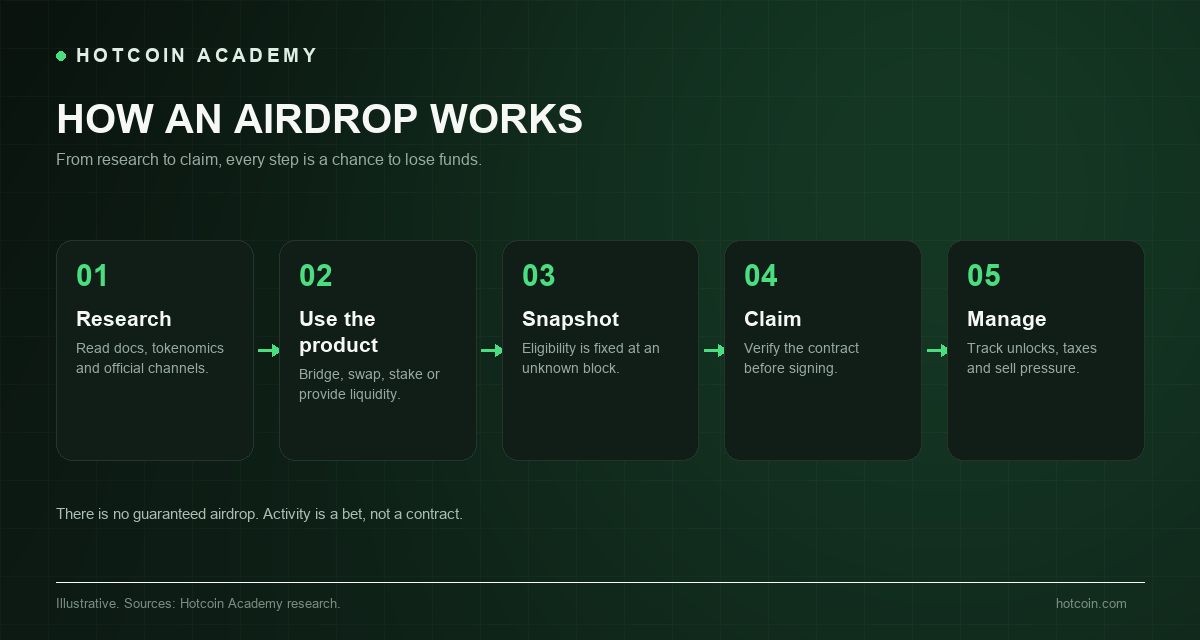
Figure: The five stages of an airdrop, from research and interaction to snapshot, claim, and management.
• Step 1: Research: Enter only through the project's official website, official X, Discord announcements, and documentation. Confirm the tokenomics, investors, whether the product actually exists, and whether there are clear airdrop rules.
• Step 2: Use the product: Actually use the protocol within your means, such as bridging, swapping, staking, or providing liquidity. Small, repeated interactions over time are usually closer to "real user" behavior than one-time farming.
• Step 3: Wait for the snapshot: Snapshot timing is usually not public. Do not believe claims like "the snapshot isn't over yet, it's still not too late to enter."
• Step 4: Claim: Operate only from the claim page in official announcements. First verify the domain name, contract address, and what the wallet pop-up shows, then sign.
• Step 5: Manage: After receiving tokens, assess the unlock schedule, liquidity, and taxes. Do not chase the price the moment a new token launches.
Airdrop Risks: Missing Out Is the Least of It
The biggest airdrop risk is not "wasting time," but "losing your wallet while trying to claim free tokens." Here are the most common loss scenarios.
• Phishing sites: Fake official claim pages that trick you into connecting your wallet and signing a malicious transaction, draining funds instantly.
• Malicious approvals: A signature that looks like "wallet verification" is actually an approve or Permit2, letting the other party transfer your tokens later.
• Fake tokens and address poisoning: Unknown tokens suddenly appear in your wallet, luring you to a fake site to swap; or you copy a lookalike address when transferring.
• Sybil determination: One person operating multiple wallets may be judged as a sybil by the project, canceling all qualifications and even losing gas.
• Costs and taxes: Bridging, gas, and time are all costs; claimed tokens may also be taxed, and the actual return may not be positive.
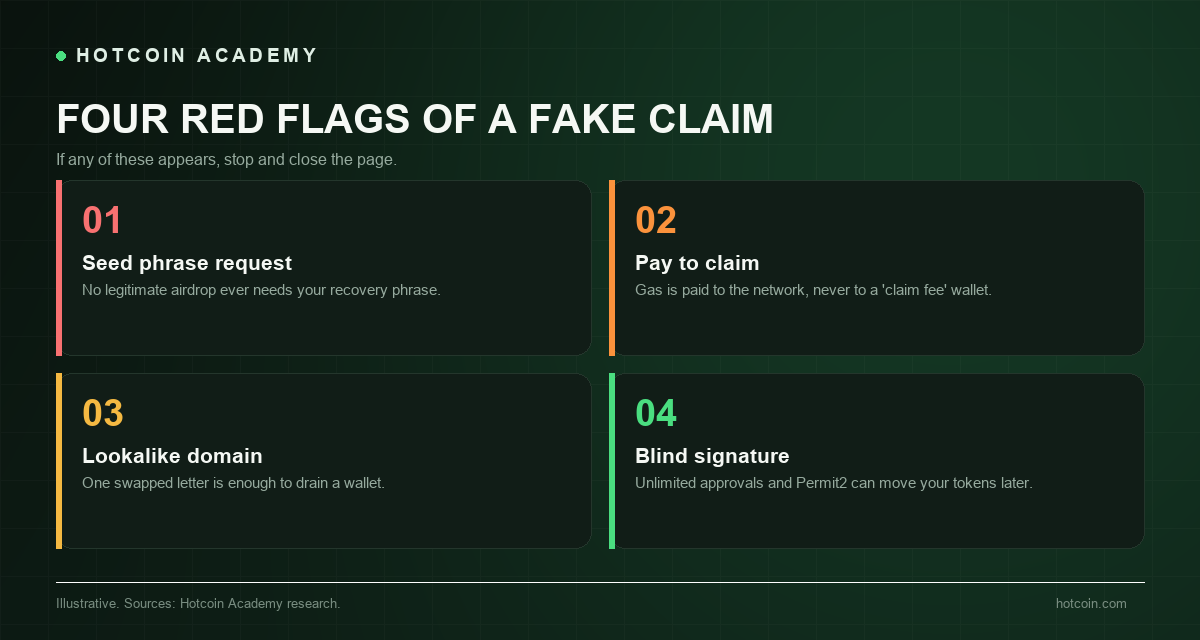
Figure: The four most common fake airdrop red flags; if you see any of them, stop immediately.
How to Identify Scams: Six Checkpoints
Scam flows are usually fixed: use a fake account or ad to bring you to a fake site, create pressure with "limited-time claim," and finally make you sign an approval or transfer. Break any one step and the loss will not happen.
| Signal | What the scam does | What you should do |
|---|---|---|
| Asks for seed phrase/private key | Impersonates support, a campaign form, or wallet verification | Block immediately. Legitimate airdrops never need it |
| Pay first to claim | Claims you must pay gas, tax, or an unlock fee | Do not pay. Real gas is paid only to the blockchain |
| Lookalike URL | Changes one letter or adds a prefix to the official domain | Click from official announcements and manually verify the domain |
| Countdown and intimidation | Creates pressure that "it expires if you don't claim now" | Leave the page first and confirm on official channels |
| Asks for a signature you do not understand | Authorizes transfer rights for all tokens or NFTs | Refuse to sign; check with wallet simulation and revocation tools |
| Community DM outreach | Impersonates official staff offering an "exclusive claim link" | Officials will not DM you a link |
These checkpoints cannot cover every tactic. The principle is: if unsure, do not sign.
Practical Setup for Safe Airdrop Participation
If you decide to participate, separate your "airdrop wallet" from your "main asset wallet." Keep only a small amount of gas and interaction funds in the airdrop wallet, store main assets in a hardware wallet or cold wallet, and do not connect the airdrop wallet to main assets.
• Separate wallet: One wallet dedicated to airdrop interactions, not for long-term assets.
• Small gas balance: Keep only enough ETH, SOL, or BNB to reduce losses if hacked.
• Regularly revoke approvals: Use tools like Revoke.cash to check and revoke unused approvals.
• Hardware wallet: Sign large assets with a hardware wallet so private keys never touch the internet.
• Official bookmarks: Bookmark commonly used official websites to avoid ad phishing in search results.
There is also a reality check: the expected value of airdrops is declining. Projects in 2026 review sybils more strictly, allocations to a single wallet are smaller, and gas and time costs have not disappeared. Treating airdrops as "a byproduct of learning new protocols" is much healthier than treating them as "stable income."
Common Misconceptions
• "Doing more tasks guarantees a reward": Eligibility and allocation are decided by the project; completing tasks may still fail snapshot conditions.
• "Using multiple wallets gets more": Sybil detection links funding sources and behavior, and may cancel all qualifications.
• "Sign first, revoke later": Malicious approvals may execute before you revoke, especially Permit2.
• "The token is in my wallet, so it must be real": Anyone can send tokens to your address; fake tokens are often used to lure you to phishing sites.
FAQ
Are airdrops really free? The tokens themselves are usually free, but participation requires gas, bridge fees, and time, and claiming may also require gas. If someone asks you to pay an "unlock fee" or "tax," it is almost certainly a scam.
How do I know whether a project will airdrop? There is no reliable way. Officials usually do not promise airdrops, and community rumors or KOL calls are not evidence. You can research whether a project has a clear points system or public allocation plan, but still treat it as an uncertain event.
Does claiming an airdrop require KYC? Some compliant projects or exchanges require KYC, especially those involving fiat on/off-ramps or regulated markets. If an unknown website asks you to upload an ID and selfie, first confirm whether it is an official channel.
Do airdrop tokens need to be taxed? Rules vary by jurisdiction. Most tax systems treat airdrops as income or property; the value at receipt may be taxable income, and selling later may create capital gains. Keep on-chain records and consult a local tax professional.
Can stolen assets be recovered after a phishing attack? Blockchain transactions are irreversible, and recovery is extremely difficult. Immediately revoke approvals, move remaining assets to a safe wallet, and report to exchanges and law enforcement. Prevention is always more effective than remediation.
Conclusion
An airdrop is an exchange between a project and its users: you trade real usage for a possible token reward. It can be the starting point for discovering a new protocol, or the endpoint of an emptied wallet; the difference is whether you put security first.
Airdrops in 2026 are more competitive, stricter, and harder to predict. Rather than chasing every rumor, build your own process: separate wallet, official entry points, small funds, and regular approval revocation. To learn more about new projects' backgrounds and risks, read more Web3 beginner articles at Hotcoin Academy.
Risk warning: This article is for educational and informational purposes only and does not constitute investment advice. Airdrop participation involves smart contracts, phishing, and market risks and may result in total loss of assets. Always verify official information yourself.
Leitura recomendada
Veja mais