I. What Is the Optimal N-Level Order
The Optimal N-Level Order is an order placement method based on market depth.
When using this feature, the system starts from the best available price in the order book and executes trades progressively across multiple price levels within the selected range.
It is particularly suitable for fast-moving markets and helps improve execution efficiency.
Compared to a standard market order, it provides better control over the execution price range while maintaining speed, making it ideal for users who want fast execution with reduced slippage.
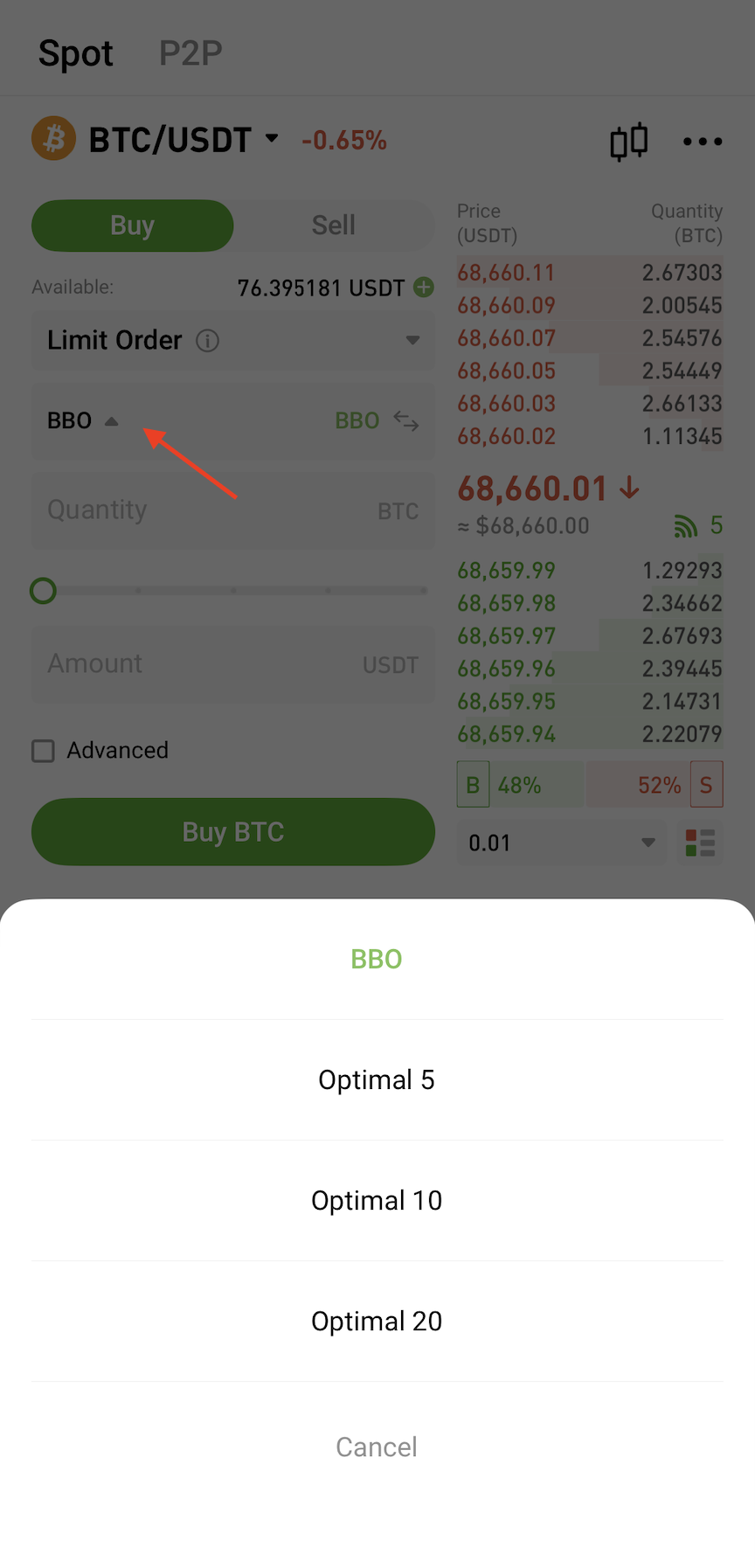
In the trading interface, this feature is available under the “BBO” order type, where users can select different depth options such as Optimal 5, Optimal 10, and Optimal 20.
II. Execution Mechanism
The system starts from the current best price and matches orders level by level until the order is filled or the selected level range is reached. For a buy order, it first executes at the best available ask price. If the available quantity at that level is insufficient, it continues execution at higher price levels until the order is fulfilled or the selected level limit is reached.
When selecting “Optimal 5”, “Optimal 10”, or “Optimal 20” under BBO, the system will only execute orders within the corresponding top N levels of the order book.
III. Differences from Market Orders
-
Market orders execute at available market prices until fully filled
-
Optimal N-Level Orders execute only within the selected top N price levels (e.g., Optimal 5 / 10 / 20 under BBO), and stop once that range is exceeded
-
Compared to market orders, Optimal N-Level Orders offer better control over execution speed and price
IV. How to Use the Optimal N-Level Order
On the spot trading page, click “BBO” (Counterparty Price) and select one of the following options:
-
Counterparty Price (BBO)
-
Optimal 5
-
Optimal 10
-
Optimal 20
After selecting the desired option, the system will execute the order progressively within the selected price range.
V. Order Quantity Calculation
When using the “Optimal N-Level Buy” feature (e.g., Optimal 5 / 10 / 20 under BBO), the system adjusts the order quantity to improve execution success. In simple terms, a portion of funds is reserved to account for potential price increases during execution, preventing order failure due to higher-than-expected execution prices.
Formula:
Order Quantity = ((Total Available × Order Ratio) × (100% - x%)) ÷ Counterparty Price
Where:
-
Total Available: available balance for trading
-
Order Ratio: selected proportion of funds
-
x: safety factor dynamically adjusted based on market conditions
-
Counterparty Price: current counterparty price used as a reference
Why is this necessary?
During execution, orders may be filled across multiple levels in the order book.
For example, if liquidity at the best price is insufficient, the system continues matching at higher price levels, meaning the actual execution price may exceed the displayed counterparty price.
If the order quantity is calculated solely based on the current price and full balance, it may result in an overestimated quantity, higher execution prices, insufficient balance, and potential order failure.
To address this, a portion of funds (x%) is reserved as a buffer against price fluctuations, helping improve execution success.
Example:
Assume the total available balance is 1,000 USDT, the order ratio is 100%, the safety factor x = 5%, and the counterparty price is 100 USDT.
Order Quantity = ((1000 × 100%) × (100% - 5%)) ÷ 100 = 9.5
This means the system places an order for 9.5 units instead of 10, reserving funds to account for potential price increases.
Will this cause any loss of funds?
No. The reserved funds are not deducted or lost; they are simply not fully used for this order. This mechanism is designed to reduce the risk of order failure due to price fluctuations and improve execution success.
VI. Notes
-
If market depth is insufficient, the order may not be fully executed
-
In highly volatile markets, the actual execution price may differ from expectations
-
Optimal N-Level Orders do not guarantee full execution and are subject to market liquidity