
Linea: The zkEVM L2 from ConsenSys
Linea is an Ethereum zkEVM Layer 2 started by Consensys. It executes EVM transactions on L2, produces validity proofs and posts data to Ethereum, keeping something close to the Ethereum developer experience at a lower cost.
Linea mainnet is a public network, and the open-source stack underneath it is now called Lineth. Consensys' background in wallets and developer tooling helps Linea plug into the EVM ecosystem, but the security of the network still comes down to proofs, data, the sequencer, upgrade permissions and bridge flows, not the company brand.
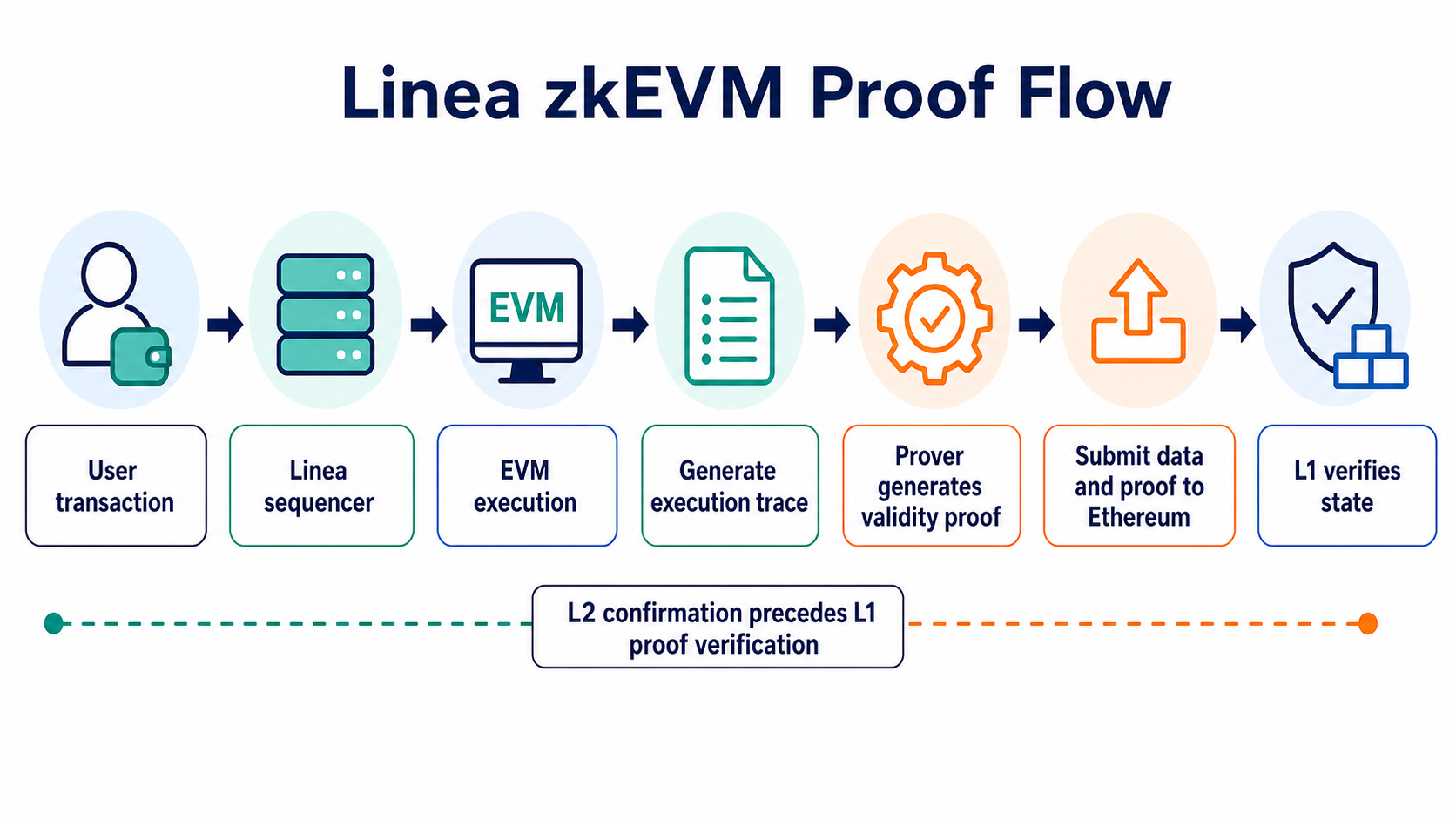
How does Linea's zkEVM work?
Linea's goal is to prove EVM state transitions. Once a user submits a transaction, the sequencer decides the ordering and executes blocks, producing an execution trace for the proving system along the way. A coordination component groups blocks into provable batches, the prover generates a cryptographic proof, and a contract on Ethereum verifies it and updates the state commitment.
A single transaction roughly passes through these stages:
- The wallet sends the signed transaction to a Linea node or the sequencer.
- The Besu-based execution component processes the EVM transaction, updates L2 state and emits an execution trace.
- The coordinator organises batches, state data and proving jobs.
- The prover shows that batch execution satisfies Linea's constraint system.
- Data and proofs go to Ethereum, and the L1 contract accepts the verified new state.
This design spares Ethereum from re-executing every L2 transaction while still letting L1 verify state in batches. The L2 confirmation a user sees usually arrives well before the proof is verified on Ethereum.
What does EVM equivalence actually mean?
EVM equivalence means Linea tries to reproduce the execution behaviour of the Ethereum EVM so that Solidity contracts, JSON-RPC, wallets and developer tools can move over with few changes. It describes execution compatibility, not a claim that "Linea is identical to Ethereum".
Block times, fees, system contracts, bridge messaging, finality and upgrade mechanisms all still differ. Applications that depend on exact gas, block fields, precompiles or low-level client behaviour need to be tested separately on Linea.
A zkEVM also has to balance compatibility against proving efficiency. The closer it stays to the fine detail of the original EVM, the more behaviour the proving system has to constrain. Lineth splits the execution client, trace generation, constraints and prover into separate components so they can evolve independently, but those components still have to stay consistent when upgraded.
What are ETH and the LINEA token each for?
Linea uses ETH to pay ordinary network gas. The LINEA token launched in 2025, but it is not the gas token. The design puts LINEA to work in ecosystem economic coordination and ties part of the network fees to a burn mechanism covering both ETH and LINEA.
That distinction matters:
- A wallet holding only LINEA and no ETH may not be able to pay gas for ordinary transactions.
- Token utility and network validation are separate questions; holding LINEA does not make you a prover or sequencer.
- Token allocation, burn and governance design can change, so early airdrop articles are no substitute for current official documentation.
Where are Linea's security boundaries?
Validity proofs stop states that break the constraints from being accepted on L1, but on their own they do not solve sequencing censorship, contract upgrades or third-party application risk.
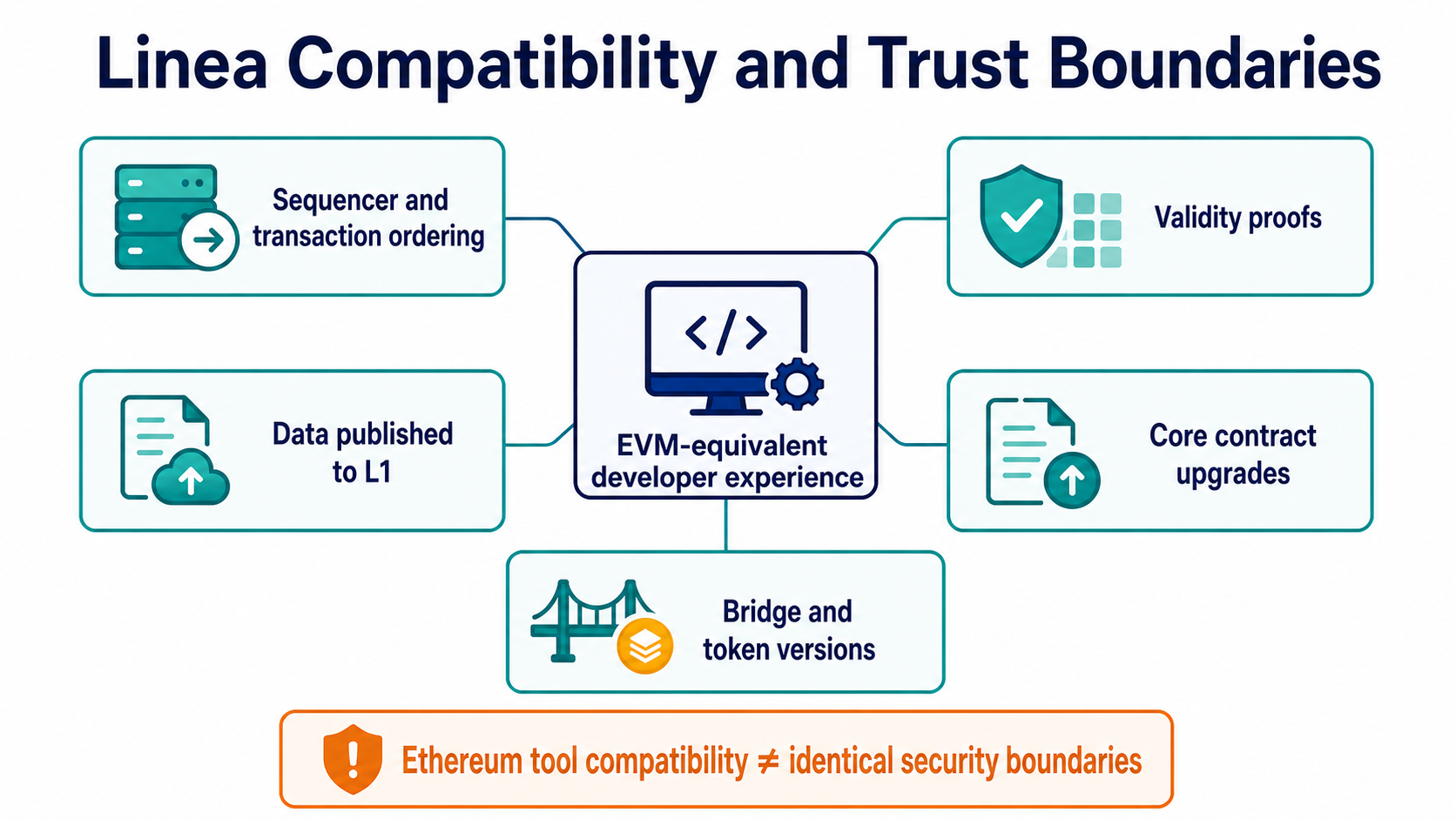
| Layer | Main role | Boundary to check |
|---|---|---|
| Execution | Processes EVM transactions and produces traces | Compatibility scope, system contracts and client version |
| Sequencing | Orders transactions and builds blocks | Operator concentration, downtime and censorship recourse |
| Proving | Proves state transitions satisfy the constraints | Proof coverage, verifier contract and prover liveness |
| Data | Publishes what Ethereum needs to recover state | Data posting frequency and L1 status |
| Governance | Upgrades core contracts and network components | Security council, thresholds, delays and emergency powers |
| Bridging | Moves assets and messages between L1 and L2 | Token versions, message waiting times and contract permissions |
Linea has kept opening up its stack and pushing towards decentralised sequencing and proving, but a roadmap is not the same as a finished state. When you assess the network, look at today's participants and contract permissions rather than quoting future milestones.
How does Linea differ from other ZK-Rollups?
Linea bets heavily on EVM equivalence and Ethereum tooling compatibility. Scroll takes a zkEVM route as well; ZKsync is evolving between a proving-optimised execution environment and EVM support; Starknet uses Cairo and the STARK family instead.
For most users the practical differences are not the proof acronyms but whether the app and asset you want are natively supported, whether the bridge exit path is clear, whether you have the right gas asset ready, and whether proof and withdrawal status can be tracked. For the technical comparison, see ZK-Rollups Explained, and for the wider scaling landscape go back to A Full Guide to Layer 2 Scaling Solutions.
What should you check before using Linea?
Verify the mainnet RPC, chain ID, explorer and bridge entry point from Linea's own materials, and never copy contract or cross-chain addresses from search ads. Keep a small ETH balance in the wallet for gas, and check the official contract for your target token on Linea.
If you arrive over a bridge, record the source-chain transaction, the L1 message status and the L2 credit separately. Leaving again also means budgeting for Ethereum mainnet gas. Third-party fast bridges can cut the wait, but they add liquidity and contract risk.
Developers should also test contract deployment, event indexing, oracles, account abstraction and edge-case opcodes. Compiling on Ethereum does not mean every production dependency is already available on Linea.
FAQ
Are Linea and MetaMask the same product?
No. Both come out of the Consensys ecosystem, but MetaMask is a wallet and its related services, while Linea is a separate public L2 network. The wallet can also connect to other blockchains.
Can the LINEA token be used instead of ETH for gas?
Ordinary Linea network transactions pay gas in ETH. Some applications may offer sponsorship or swap experiences, but that is an extra service, and you should not assume the protocol deducts fees straight from a LINEA balance.
Does a zkEVM make Ethereum mainnet contracts appear on Linea automatically?
No. Developers still have to deploy contracts on Linea and set up the front end, oracles and liquidity. Similar code does not mean shared on-chain state.
What happens to already-sequenced transactions if a Linea validity proof fails?
If a proof cannot be generated or verified, batch settlement on L1 is delayed. The interface may already show the L2 execution result, but asset exits and anything that depends on proven state have to wait for the issue to be fixed or for a later valid proof.
Recommended
View more
service hotcoin.com
producthotcoin.com
businesshotcoin.com
casecnhotcoin.com