What Is a Private Key? Why Controlling the Key Means Controlling the Assets
A private key is a secret value used to create digital signatures. Blockchains execute transactions based on valid signatures, so anyone who can use a private key can authorize operations involving the assets in the corresponding account.
How Does a Private Key Authorize a Transaction?
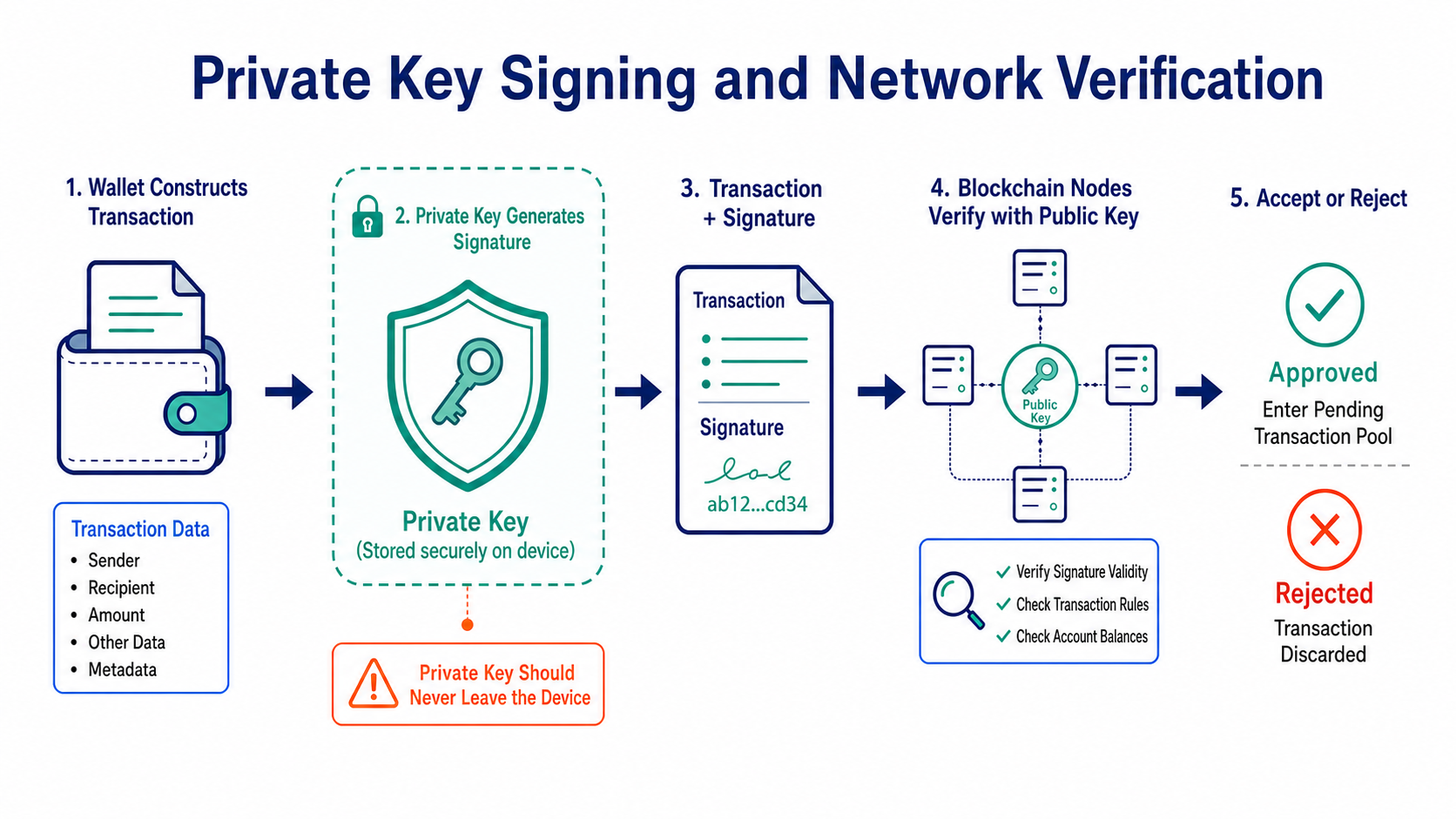
A wallet first constructs the transaction data and then uses the private key to calculate a signature. Nodes use the public key and signature to verify that the transaction was authorized by the controller of the corresponding key and that its contents have not been altered.
Under normal operation, the private key is never submitted to network nodes. A hardware wallet goes further by performing the signature inside a dedicated device, while the connected computer receives only the transaction data to be signed and the resulting signature.
How Are Private Keys, Public Keys, and Addresses Related?
A public key can be calculated from a private key, while an address is usually derived from the public key or from script rules. Publishing an address does not grant signing authority, but it can reveal associated on-chain activity and assets.
With a correct implementation and sufficient randomness, deriving a private key from a public address is computationally infeasible. In practice, the main risks come from faulty random-number generation, malware, exposed backups, phishing, and users deliberately exporting their keys.
Why Does "Control" Not Necessarily Mean Legal Ownership?
A blockchain only determines whether a signature is valid. It does not automatically determine whether the signer stole the key, breached a custody agreement, or acted under coercion. A private key provides technical control, while legal ownership of the assets also depends on contracts, identity, and applicable law.
On a centralized exchange, the platform usually controls the on-chain keys, while users hold account-based and contractual rights against the platform. With a self-custody wallet, users control their keys directly, but they also assume greater responsibility for recovery and accidental or malicious signatures.
What Should You Do If a Private Key Is Exposed or Lost?
An exposed private key cannot be "changed" while keeping the same wallet. Generate an entirely new wallet on a trusted device, transfer tokens, NFTs, staking positions, and cross-chain assets one by one, and revoke the old wallet's permissions in connected applications.
Whether a lost key can be recovered depends on the availability of a seed phrase, backup, other authorized signers, or a smart-account recovery mechanism. If no valid recovery material exists, the network usually has no centralized reset option.
For the relationship between seed phrases and multiple accounts, see Private Key and Seed Phrase Security. For backup practices, read the Seed Phrase Backup Guide.
Frequently Asked Questions
Is It Safe to Transfer a Private Key to Another Phone Using a QR Code?
A QR code is only an encoding format. The camera, the screen, and the receiving device may all retain copies. To migrate safely, transfer assets to an address generated by a new wallet instead of copying the old private key.
Can One Private Key Control Accounts on Multiple Blockchains?
The same key may correspond to accounts on networks that use compatible elliptic curves and address rules, but different chains, derivation methods, and wallet implementations should not be treated as interchangeable.
Is a Wallet Password the Same as a Private Key?
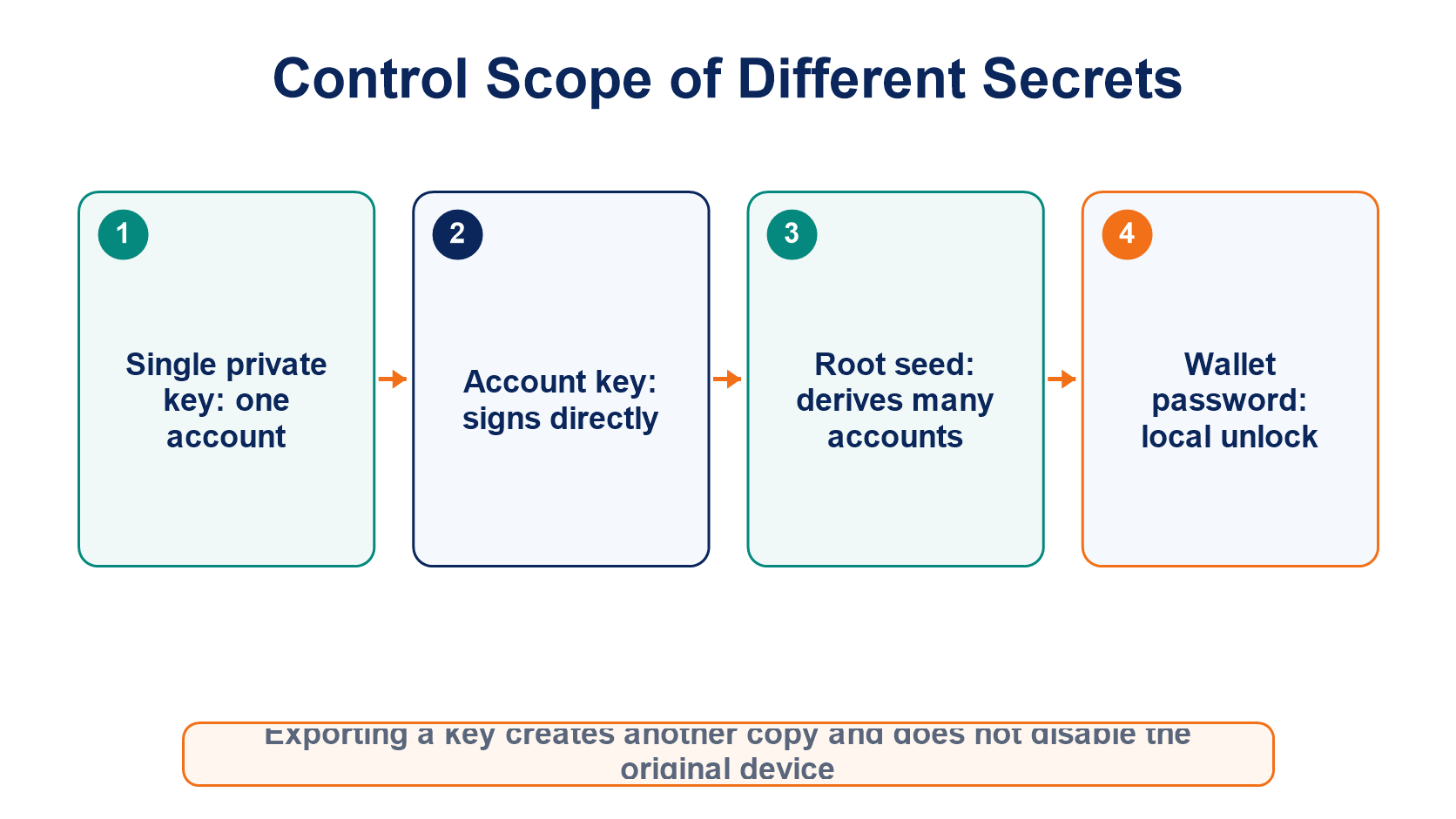
Usually not. A wallet password generally encrypts local data or unlocks an app, while the private key creates on-chain signatures. Whether access can be restored after forgetting the password depends on the available backups.
Does Exporting a Private Key Disable the Original Device?
No. Exporting creates another copy and does not revoke the original device. It therefore increases the number of places from which the key could be exposed.
読書をお勧めします
もっと見る