What Is a Crypto Exchange? A Beginner's Guide to CEX
A crypto exchange is a platform for buying, selling, exchanging, and managing digital assets, while a CEX (centralized exchange) is a trading platform operated by a company or institution. On a CEX, users can typically register an account, complete identity verification, deposit assets, trade through an order book, and withdraw to another wallet or platform when they need to.
What Does a Crypto Exchange Actually Do?
The core job of a crypto exchange is to connect users who want to buy digital assets with users who want to sell them, and to provide basic services such as quotes, order matching, and asset management. Take BTC/USDT as an example: the buyer wants to use USDT to buy BTC, the seller wants to sell BTC for USDT, and the exchange uses its matching system to find orders that fit and complete the trade.
For beginners, it helps to think of an exchange as a "digital asset marketplace," but it is more than a page that displays prices. A CEX also handles account management, deposits, withdrawals, order processing, and some security and compliance services, so users can complete the entire journey from funding an account, to trading, to moving assets out, within a single account.
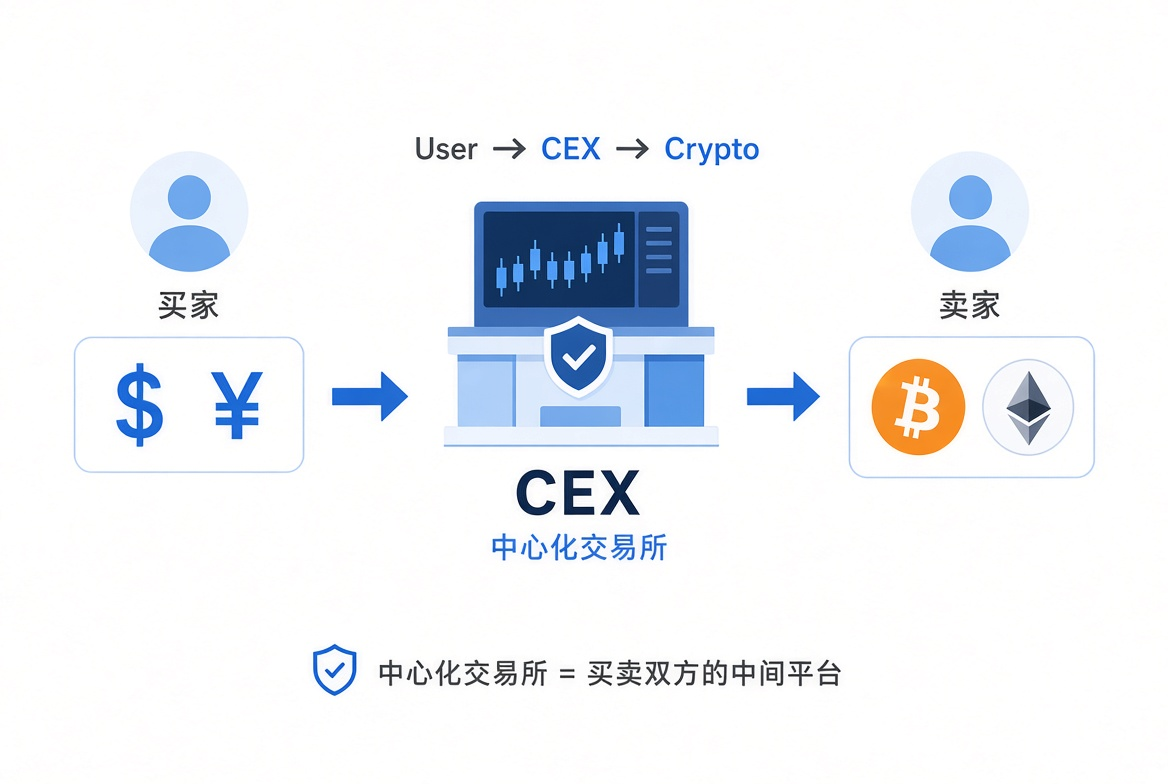
What Is a CEX, and Why Is It Called "Centralized"?
CEX stands for Centralized Exchange. "Centralized" mainly means that a clearly identified operating entity is responsible for managing accounts, the trading system, and the related infrastructure, and that users rely on the platform for these services rather than completing every trade directly through blockchain smart contracts.
A CEX usually matches buy and sell orders with an order book. After a user submits a buy or sell order, the trading system matches orders according to conditions such as price and quantity; when the two sides match, the trade is completed and the asset balances in the user's account are updated.
Here is a concept beginners often overlook: the balance in your exchange account does not mean that every trade you make is a transfer on the blockchain. Many trades inside a CEX are first recorded and settled by the platform's trading system. Asset transfers that genuinely involve a blockchain network usually happen in on-chain operations such as deposits and withdrawals.
What Happens After You Put Assets Into a CEX?
When you deposit digital assets such as BTC or USDT into a CEX, the assets enter the wallet system managed by the platform, and your trading account shows the corresponding available balance. When you then buy or sell assets inside the exchange, your account balance changes according to the executed trades, rather than waiting for blockchain confirmation for every single trade.
For example, after you deposit 1,000 USDT and buy some BTC in the BTC/USDT market, your USDT and BTC balances change accordingly once the trade is filled. This process is mainly recorded and settled by the exchange's internal system, which usually makes it better suited to frequent, continuous trading than swapping assets directly on-chain every time.
This is also an important difference between a CEX and a self-custody wallet: with a CEX, you rely on the platform to manage your trading account and the related custody infrastructure. When choosing an exchange, then, you should look beyond the products offered and the fees, and also consider platform security, withdrawal capability, account protection, and availability in your region.
How Is a CEX Different From a DEX?
The core difference between a CEX and a DEX (decentralized exchange) is who is responsible for the trading infrastructure and for controlling assets. A CEX usually provides accounts, matching, and custody through a centralized organization, while a DEX usually completes trades through smart contracts and on-chain mechanisms, with users connecting their own wallets and controlling their own assets.

This does not mean CEX and DEX can simply be ranked by "which one is safer." They carry different types of risk: CEX users need to consider platform custody and account risk, while DEX users need to pay closer attention to private key management, smart contracts, networks, and transaction approvals.
Why Do Beginners Usually Start With a CEX?
For users buying or trading crypto assets for the first time, a CEX usually provides a more complete, one-stop environment. You can register an account, complete identity verification as required by the platform, then deposit, trade, and withdraw, without needing to understand wallet addresses, gas fees, and smart contract approvals from the start.
Another reason is that a CEX usually concentrates trading functions in a single interface. Users can directly view trading pairs, prices, the order book, account balances, and order history, then choose products such as spot trading according to their needs, a flow that is easier to follow for people who are just learning to trade.
That said, "easy to use" does not mean risk-free. CEX users are effectively using financial infrastructure operated by a third party, so an exchange account should not be treated simply as a bank account, and convenience should not lead you to ignore platform and market risk.
What Can You Do With a CEX?
The specific features of a CEX vary by platform and region, but those beginners use most often are deposits, spot trading, asset management, and withdrawals. Some platforms also offer more complex products such as futures, leverage, earn products, and copy trading, though these features are not a prerequisite for understanding a CEX.
When using an exchange for the first time, it is worth mastering four basic actions first: how funds enter the account, how to find the right trading pair, how to submit an order, and how to withdraw assets. Once you are comfortable with that basic path, learning other trading tools step by step makes risk easier to control than studying every product at once.
If your next step is comparing platforms, continue with Best Crypto Exchanges: How to Compare and Choose, focusing on security mechanisms, trading fees, liquidity, asset coverage, and how you can move funds in and out.
What Are the Advantages and Risks of a CEX?
The main advantages of a CEX are relatively centralized operations, a mature trading process, and usually a wider range of markets and account features. For beginners who want to buy and sell digital assets quickly, this model reduces the learning cost of complex on-chain operations.
But the defining feature of a CEX is also the risk that deserves the most attention: users depend on the platform. If the platform suffers a security incident, your account is restricted, withdrawals run into problems, or its operations and compliance status change, you may be affected. Convenient trading should therefore never be read as "no platform risk."
When using a CEX, you should pay attention to at least the following:
Account security: use a strong password and enable available safeguards such as two-factor authentication.
Platform status: understand the operating entity, its compliance situation, and the regions it serves.
Withdrawal capability: confirm that assets can be withdrawn normally under the platform's current rules.
Fund management: do not keep all your assets on a single platform just because trading there is convenient.
Phishing risk: make sure you use official channels when registering, logging in, and operating your account.
How Do You Know Whether You Need a CEX?
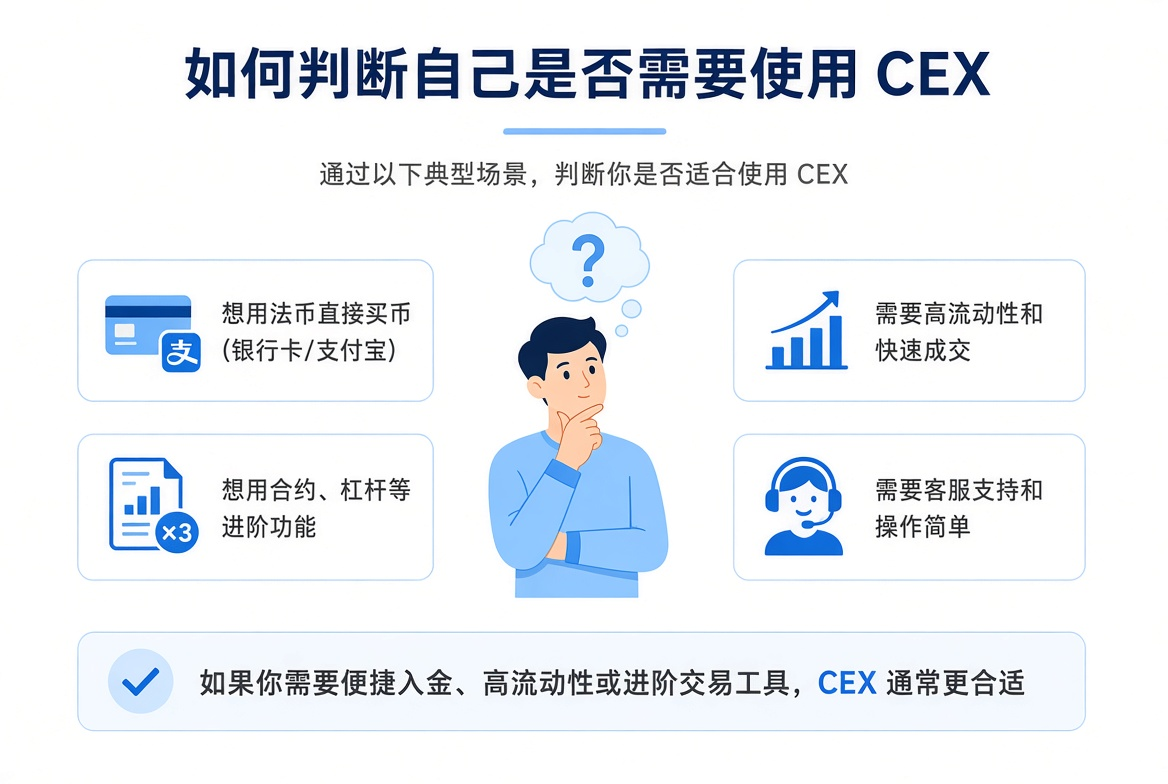
If your main needs are buying digital assets, spot trading, frequent buying and selling, or entering the crypto market through fiat channels, a CEX is usually the more direct choice. It suits users who want to deposit, trade, and withdraw through a single account without handling a lot of on-chain detail at the start.
If your needs lean more toward on-chain asset swaps, using DeFi protocols, or controlling wallet assets directly, a DEX may enter your workflow. Before choosing that path, however, you need to understand wallets, network fees, smart contract approvals, and private key management first, because one small mistake in an on-chain operation can lead to real asset losses.
So the real question is not "is a CEX or a DEX absolutely better," but which infrastructure better fits your trading goals and your approach to risk management. For beginners who have just entered the crypto market, understanding how accounts, trading, and fund flows work on a CEX first, and then deciding whether to explore DEXs, usually makes it easier to build a complete mental model.
FAQ
What does CEX stand for?
CEX stands for Centralized Exchange, a crypto trading platform operated by a company or institution that provides services such as accounts, order matching, and asset management. Users usually need to register an account and complete identity verification as required by the platform before using the relevant features.
How is a CEX different from a crypto exchange?
A CEX is one type of crypto exchange, while "crypto exchange" is the broader concept. Beyond CEXs, there are also DEXs that run on smart contracts and on-chain mechanisms, so not every exchange should be equated with a centralized exchange.
If I buy BTC on a CEX, does the BTC get sent to me on the blockchain?
Not necessarily. Trades inside a CEX are usually settled first as account balances by the platform's trading system; only operations that involve moving assets on-chain, such as deposits and withdrawals, usually need to be confirmed by the relevant blockchain network.
Does a CEX require identity verification?
Many centralized exchanges implement identity verification according to platform rules, the regions they serve, and applicable compliance requirements, but the specific requirements and available features can differ by region and account status. Before registering, check the verification and service conditions the platform currently publishes.
Is a CEX safe?
There is no blanket "absolutely safe" when it comes to a CEX. Beyond watching the platform's own security and operations, users need to protect their account credentials, enable security verification, and manage the assets held on the platform sensibly.
Risk Warning
Crypto assets are subject to high price volatility and market risk, and a CEX adds further risks related to platform custody, account security, withdrawals, operations, and compliance. This article is intended only to help beginners understand the basic concepts of crypto exchanges and CEXs and does not constitute investment advice. Before trading with real funds, make sure you fully understand the relevant products and risks and make decisions carefully based on your own situation.
読書をお勧めします
もっと見る