What Is Base? A Complete Guide to Coinbase's Layer 2 Network
The same ETH can show a different balance in your wallet depending on whether it is on the Ethereum mainnet or the Base chain. When people first encounter Base, the most confusing part is often not the technical jargon but the question: "I have this coin, so why can't I use it on this network?"
Base is an Ethereum Layer 2 network launched by Coinbase. To understand it, you need to distinguish between three layers: the blockchain, the exchange account, and the wallet. You also need to know that low transaction fees do not mean every operation is risk-free.
Key Takeaways
- Base is an Ethereum Layer 2 network, not another name for a Coinbase exchange account.
- The Base mainnet Chain ID is 8453, and transaction fees are paid in ETH.
- The same wallet address has separately recorded balances on different networks; switching networks does not automatically move assets.
- The network was launched by Coinbase, but that does not mean every token and application on the chain is endorsed by Coinbase.
What Is the Base Chain
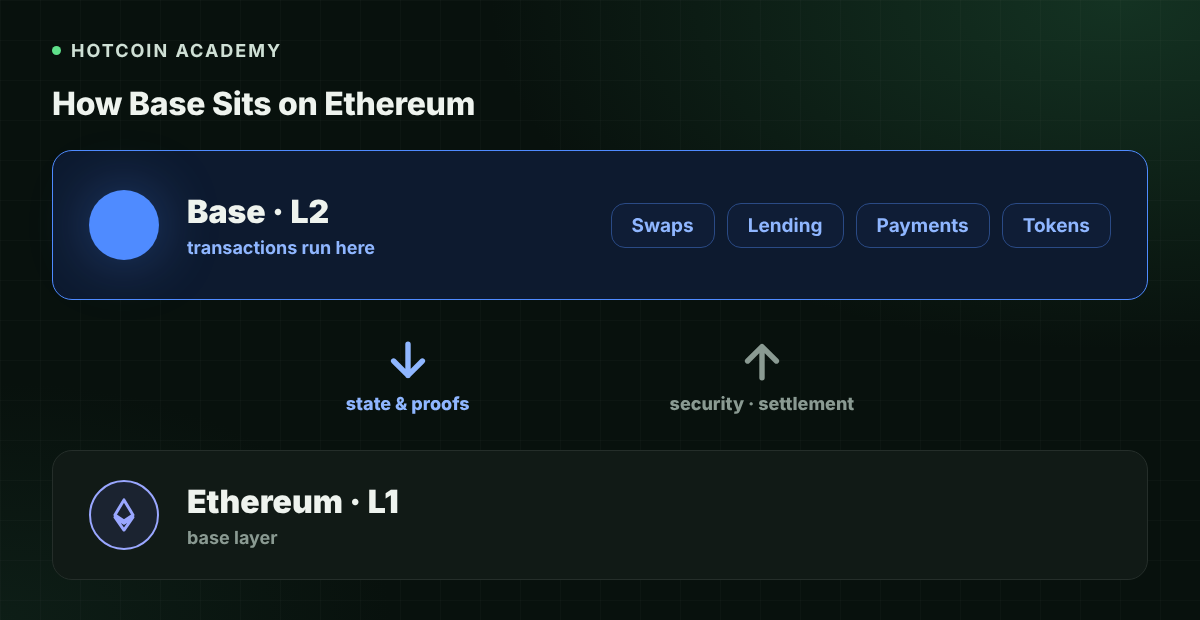
Layer 2 is a scaling solution built on top of a base layer such as Ethereum. You can think of Base as another layer that processes transactions: users transfer funds and interact with contracts on Base, and the related state and proof mechanisms connect back to Ethereum. It is neither the same account balance as the Ethereum mainnet nor something that should be simply understood as an ordinary database independent of Ethereum.
Base's technical architecture and proof mechanisms will evolve with upgrades. When discussing security and withdrawal times, you should read the current official documentation rather than permanently applying descriptions from earlier versions. For ordinary users, the more direct questions are: which chain does the transaction happen on, who controls the private key, and how do funds enter or exit this chain?
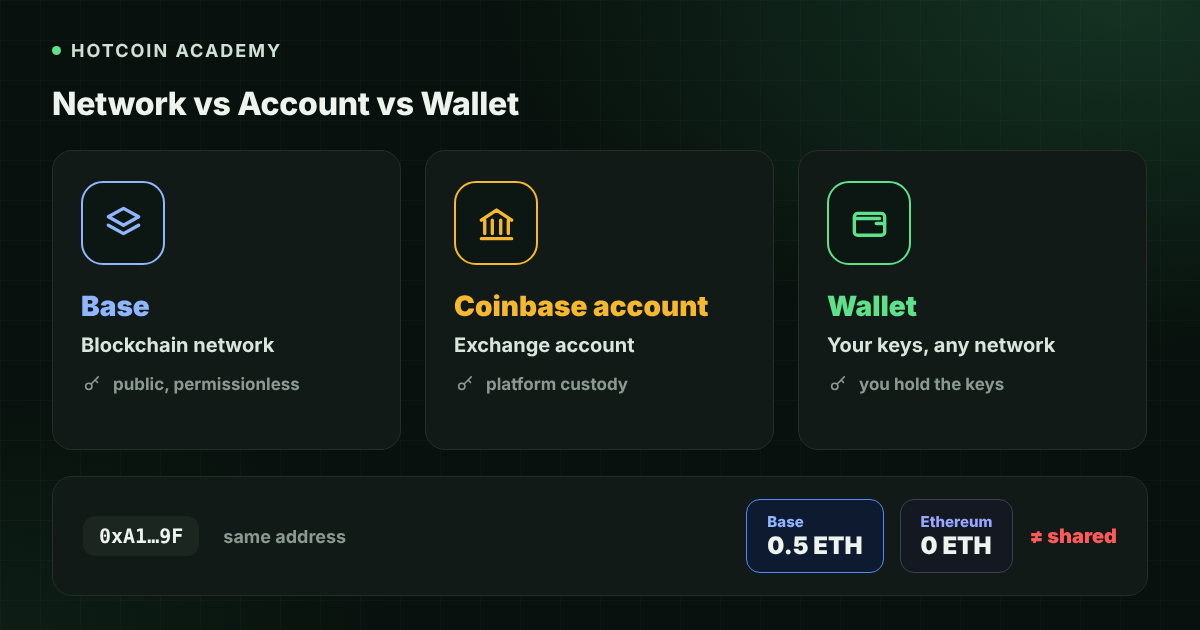
What Is the Difference Between the Base Chain, a Coinbase Account, and a Wallet
| Name | What it is | How assets are managed |
|---|---|---|
| Base chain | A network for executing transfers and smart contracts | Balances and transaction records are on-chain |
| Coinbase platform account | A user account in a centralized service | Deposits and withdrawals are subject to the platform's supported networks and rules |
| Self-custody wallet | A tool for managing private keys and signing transactions | The user is responsible for key and authorization security |
Switching a wallet to Base only changes it to read from and operate on that network. Even if your EVM wallet shows the same 0x address on Ethereum and Base, it does not mean the ETH or token balances on the two chains are automatically shared. When transferring, you also need to confirm whether the recipient supports the corresponding network.
What Parameters Do You Need to Know to Use Base
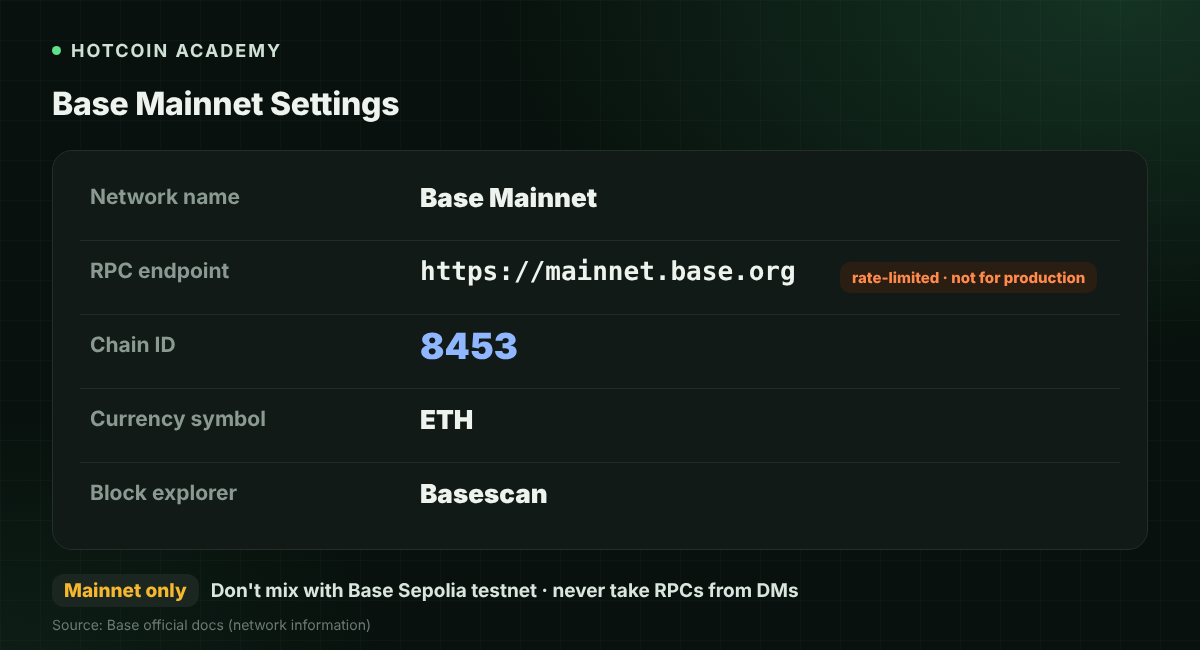
The following mainnet information comes from Base's official connection documentation and applies to Base Mainnet. It must not be confused with the Base Sepolia testnet.
| Parameter | Base Mainnet |
|---|---|
| Network name | Base |
| Chain ID | 8453 |
| Gas token | ETH |
| Official public RPC | https://mainnet.base.org |
| Common block explorer | https://basescan.org |
When adding a network, prioritize information from official sources or trusted wallets, and do not modify RPC settings based on messages from strangers. Public RPCs also have usage limits; you should not treat a connection intended for individual queries as an unlimited service.
What Can You Do on the Base Chain
Base supports smart contract applications. Common use cases include token swaps, lending, stablecoin payments, and digital asset issuance. These are application categories; they do not mean every project within them has the same security standards or operational capability.
For example, a single swap may involve a token contract, an approval contract, and a transaction route. A successful network transaction only means the corresponding transaction was executed; it does not mean the token has value, the contract has no vulnerabilities, or that you will definitely be able to sell it smoothly in the future.
How Do Assets Enter and Leave Base
Common ways to enter Base include withdrawing from a platform that supports the Base network, or bridging in through a bridge that supports the relevant asset and network. Both methods require checking the token, network, contract, and recipient requirements.
When leaving Base, you also need to distinguish between platform deposits, standard protocol withdrawals, and third-party fast bridges. Their waiting times, fees, and risks are not the same. The official documentation currently breaks standard withdrawals into several stages: initiation, proof, and final execution. The final confirmation window is affected by protocol upgrades and the proof path, so it cannot be summarized as "every withdrawal always takes 7 days."
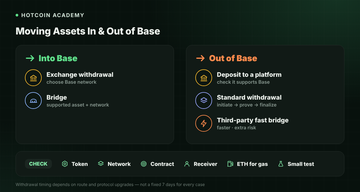
| Path | Key checks | Common risks |
|---|---|---|
| Withdraw from a platform to Base | Whether the platform supports Base withdrawals for that token | Choosing the wrong network or the platform not yet supporting it |
| Bridge into Base | Whether the bridge, source chain, and target token match | Bridge contract, liquidity, and wrapped asset risks |
| Transfer from Base back to a platform | Whether the deposit page explicitly supports Base | On-chain success but the platform cannot automatically credit the deposit |
| Bridge out of Base | The rules of the standard or fast path | Waiting time, fees, and third-party risks |
Before operating, read the rules and do a small test transaction, and reserve ETH on the Base chain for gas; holding only tokens such as USDC may not be enough to pay ordinary transaction fees.
Does Base Have Its Own Token
Do not confuse "Base ecosystem tokens," "tokens with BASE in their name," and "the official Base network token." In an official statement in September 2025, Base said it was beginning to explore a network token, but at that time it did not provide a definite timeline, design, or governance plan.
This is an announcement with a clear date. It should not be rewritten as "will never issue a token," nor does it mean an issuance or airdrop has already been promised. The subsequent issuance status, contract, and claiming method must be based on the latest official announcements; seeing an asset with the same name does not directly establish its official identity.
Common Misconceptions
- "It's a chain launched by Coinbase, so all projects are safe." The network's background does not mean third-party projects are guaranteed.
- "The address is the same, so I can transfer on any chain." The receiving platform may only recognize some networks, and choosing the wrong one can cause losses.
- "Layer 2 fully inherits all of Ethereum's security properties." Specific proof, sequencing, upgrade, and bridge mechanisms also need to be considered.
FAQ
Q1: Are Base and Ethereum the same chain? No. Base is a Layer 2 connected to Ethereum; network identifiers, balances, and transaction records need to be checked separately.
Q2: What is used to pay gas on Base? Ordinary transactions use ETH, and you must hold enough balance on the Base network; special paymaster applications have separate mechanisms.
Q3: Do I need a Coinbase account to use Base? Not necessarily. Compatible wallets can interact with the public network, while using specific platform services requires complying with their account and eligibility requirements.
Q4: Why can't I transfer even though I have ETH in my wallet? First check whether the network the ETH is on is Base, then check the available balance, pending transactions, and wallet prompts.
Q5: Where can I check Base transactions? You can use Basescan, listed in the official documentation, and enter the Base transaction hash or address. Etherscan for the Ethereum mainnet cannot directly replace queries on Base.
Conclusion
The first step to understanding Base is to separate the network, wallet, platform account, and token. Every time you operate, confirming "which chain, which asset, which recipient" is more important than focusing only on whether fees are high or low.
Risk warning: This article is for educational and informational purposes only and does not constitute investment advice. On-chain transactions are usually irreversible, and cross-chain bridges, contract approvals, and key management all carry risks. Network parameters and product rules are subject to current official information.
読書をお勧めします
もっと見る