
Web3 Frontiers 2025: A Panorama of Emerging Sectors
The Web3 frontier in 2025 was not a single sector but a group of interlocking technical and market experiments. AI needs verifiable identity, data and payments; DePIN connects token incentives to wireless networks, mapping and GPUs; cross-chain protocols move assets and instructions between networks; oracles bring external facts into smart contracts; and zero-knowledge proofs, modular blockchains and parallel EVMs seek to improve privacy, throughput and the developer experience. Meanwhile, Ordinals, Runes and meme coins reveal another side of asset issuance, community coordination and attention markets.
This article keeps 2025 as its lens, then looks back from 2026 to distinguish areas that developed usable infrastructure from those that still depend on subsidies or concepts. “Frontier” does not mean “guaranteed to appreciate.” Evaluate a sector by first asking what problem it solves, then whether its users, revenue and security withstand scrutiny.
How should you interpret frontier Web3 sectors?
A new technology typically moves from concept to maturity through narrative, financing, development, testing, subsidized growth, real use and commercial validation. At peak market excitement, a project may have completed only the first few stages. A live technology does not necessarily mean a product has stable demand. At minimum, assess a frontier sector across four layers.
First is demand: do users genuinely need the product? Second is supply: after subsidies decline, will nodes, developers and data providers keep serving the network? Third is trust: can results be verified, and what powers do administrators and contracts possess? Fourth is value: who pays, is a token necessary, and can revenue cover security and operating costs?
The underlying challenge is similar across these themes: enabling unfamiliar participants to exchange computation, data, bandwidth, liquidity and trust. A network is more likely to survive the narrative cycle if developers keep building, users repeatedly pay and the system continues operating through volatility.
AI + Crypto: machines need wallets, identities and verifiable results
The intersection of AI and crypto is not simply about “issuing a token for a model.” Blockchains are good at public accounting, asset settlement, access control and verifiable rules; AI is good at understanding unstructured information, generating content and making automated decisions. They can complement one another in four settings: AI agents using wallets to pay autonomously, data and model contributors receiving on-chain settlement, inference results carrying proofs, and multiple agents exchanging services through open protocols.
The combination also amplifies risk. Models make mistakes, and agents may be manipulated by prompt injection or malicious websites. Once a wallet transaction is signed, an error can become an irreversible loss. A blockchain can prove that a transaction occurred, but not that a model’s conclusion was correct. Agent permissions should therefore be limited by spending caps, allowlists, time windows and human review.
When evaluating a project, ask whether its model or agent truly needs on-chain settlement, whether its data sources are auditable, who judges output quality and what function the token performs beyond speculation. For a fuller view of how data, models, compute, identity and payments fit together, read AI + Crypto: Where Artificial Intelligence Meets Blockchain.
Decentralized AI and Bittensor: an open market does not guarantee quality
Decentralized AI aims to distribute model training, inference, data, evaluation and computing among different participants. Bittensor’s central idea is to use multiple subnets for different tasks. Miners supply results, validators evaluate quality according to task-specific rules and the incentive system distributes rewards. This turns “who can provide the most valuable intelligence?” into an open competition rather than a decision made in advance by one company.
Evaluation is the hard part. Open-ended generation, forecasting and recommendations rarely have a single correct answer. If a scoring rule is predictable, participants may optimize for the metric rather than improve quality. An open market can also develop new centers of power when validation authority or stake is concentrated. Users must distinguish the base network, individual subnets and the applications built on them.
An AI agent ecosystem also needs reliable identities, low-cost payments, service discovery and dispute resolution. Agents may automatically find compute or data, but they should not have unrestricted access to a primary wallet. To understand how TAO, subnets, miners, validators and agents relate, read Decentralized AI: Bittensor (TAO) and the AI Agent Ecosystem.
DePIN: connecting token incentives to physical devices
DePIN stands for Decentralized Physical Infrastructure Networks. It describes networks that use blockchains and tokens to coordinate real-world devices, resources and services. Participants may provide wireless coverage, map imagery, storage, sensor data, energy or GPU compute. The network distributes rewards for verifiable contributions, while customers pay to use the service.
DePIN can reduce the need for centralized capital expenditure, but online hardware does not automatically create useful supply. Duplicate coverage, false locations, poor-quality data and insufficient demand can make “node count” meaningless. Projects must verify contributions, punish cheating and gradually replace simple issuance subsidies with customer payments.
Analyze a project through five steps—device, proof, service, payment and reward. Who buys the hardware? How is a contribution measured? What does the customer receive? How do fees enter the network? Are rewards tied to real demand? For the core concepts and categories, read What Is DePIN? Decentralized Physical Infrastructure Networks.
Helium, Hivemapper and Render: three businesses under one label
Helium focuses on wireless networks. Hotspots supply coverage, mobile providers and users consume connectivity, and an on-chain system records some state and distributes rewards. Its value depends on useful coverage, data offload and commercial demand—not simply the number of hotspots shown on a map.
Hivemapper lets contributors capture street-level imagery and help train mapping AI, while developers and companies consume map data. Current maps require continual updates, so the network must reward fresh, unique, high-quality coverage while limiting repeated routes and low-value data.
Render Network connects available GPU capacity with rendering demand and is expanding into AI compute. It resembles a compute marketplace, where relevant indicators include available hardware, job quality, queues, prices and actual workloads.
All three are called DePIN, but the same metric cannot evaluate them. Wireless networks should be judged by coverage and traffic, mapping networks by freshness and customer queries, and GPU networks by compute utilization and delivery quality. For a deeper comparison of their mechanisms, read Leading DePIN Projects: Helium, Hivemapper and Render Network.
Cross-chain interoperability: from moving assets to communicating intent
A multichain world needs users, assets and applications to cross different execution environments. Early cross-chain products generally locked an asset on one chain and minted a representation on another. Broader messaging protocols can transmit arbitrary instructions, including cross-chain governance, collateral operations, swaps and account actions. Chain abstraction goes further by letting users state an objective while the underlying system handles networks, gas, routing and settlement.
Interoperability does not automatically merge all chains. Instead, it adds trust boundaries. A protocol may depend on validators, light clients, multisignature wallets, oracles or liquidity providers. One click can conceal authorization, exchange, validation and destination-chain execution; failure at any stage can cause loss.
When evaluating a cross-chain design, understand who verifies messages, whether failed actions can be retried, whether assets are locked by a custody contract, how destination-chain reorganizations or pauses are handled, and whether the interface discloses the actual route. For the differences among bridges, messaging protocols, liquidity networks and multichain applications, read Cross-Chain Interoperability: Bridges, Messaging Protocols and a Multichain Future.
Cross-chain security: the easiest entry point may have the largest attack surface
Cross-chain bridges are high-value targets because their contracts may lock substantial assets while interpreting the state of multiple chains. Common risks include key compromise, weak verification thresholds, message replay, contract vulnerabilities, faulty upgrades, fake interfaces and unlimited approvals. High TVL, multiple audits and a well-known brand cannot eliminate risk.
Users should prefer official project entry points and verify the source chain, destination chain, token contract, asset received and expected completion time. Test a new route with a small amount, avoid unlimited approvals for unfamiliar routers and do not repeat a large transaction when messages behave unexpectedly. If the destination chain or bridge is paused, waiting for an official explanation is usually safer than trying a supposed “recovery website.”
Protocols need least-privilege access, rate limits, anomaly monitoring, pause mechanisms, delayed upgrades and multiple layers of verification. For a practical pre-bridge checklist and common attack paths, read Cross-Chain Bridge Security: Historic Attacks and Protection Guide.
Oracles: how do smart contracts learn what happened off-chain?
Blockchain nodes can validate on-chain transactions but cannot directly determine an asset price, weather event, sports result or banking record at a given time. Oracles use data sources, node networks, aggregation and update rules to convert external information into results that contracts can read. DeFi lending uses prices to measure collateral ratios, derivatives need indices and settlement data, and insurance and games may require events or randomness.
Oracle risk extends beyond whether data is true. It also includes delayed updates, thin market liquidity, outliers, administrator permissions and how an application consumes the result. Developers cannot read one price and assume it will always be fresh; they must check timestamps, deviation limits, outage handling and supported networks. Networks such as Chainlink also provide automation, randomness, cross-chain communication and verifiable computation, but each service has its own trust and fee model.
When users analyze a protocol, they should identify the source of critical data, its update frequency, whether the protocol pauses on failure and whether liquidation can be manipulated through one market. For an introduction to data sources, nodes, aggregation and Chainlink’s product suite, read Blockchain Oracles: Chainlink and Bringing Off-Chain Data On-Chain.
Zero-knowledge proofs: scaling, privacy and verifiable computation
A zero-knowledge proof lets a prover demonstrate that a statement is true without revealing all the information used to create the proof. For blockchain scaling, a system can execute many transactions off-chain and submit a proof on-chain. In privacy applications, users may prove that their age, qualifications or balance meet a requirement without revealing their full identity or data. In AI and compute markets, proofs may also confirm that a program ran as specified.
“Zero knowledge” does not make every user anonymous. Transaction amounts, network metadata, account behavior, interfaces and proving services may still reveal information. Systems must also balance proving and verification costs, trusted setups, hardware requirements and circuit vulnerabilities.
The focus in 2025 shifted from “Can ZK work?” to “Can proofs become faster, cheaper and easier to develop?” Looking back from 2026, zero-knowledge proofs remain long-term infrastructure rather than a single token narrative. To study completeness, soundness, zero knowledge, rollups and identity applications, read Zero-Knowledge Proofs Explained: Privacy and Scaling.
Modular blockchains: splitting one chain into composable services
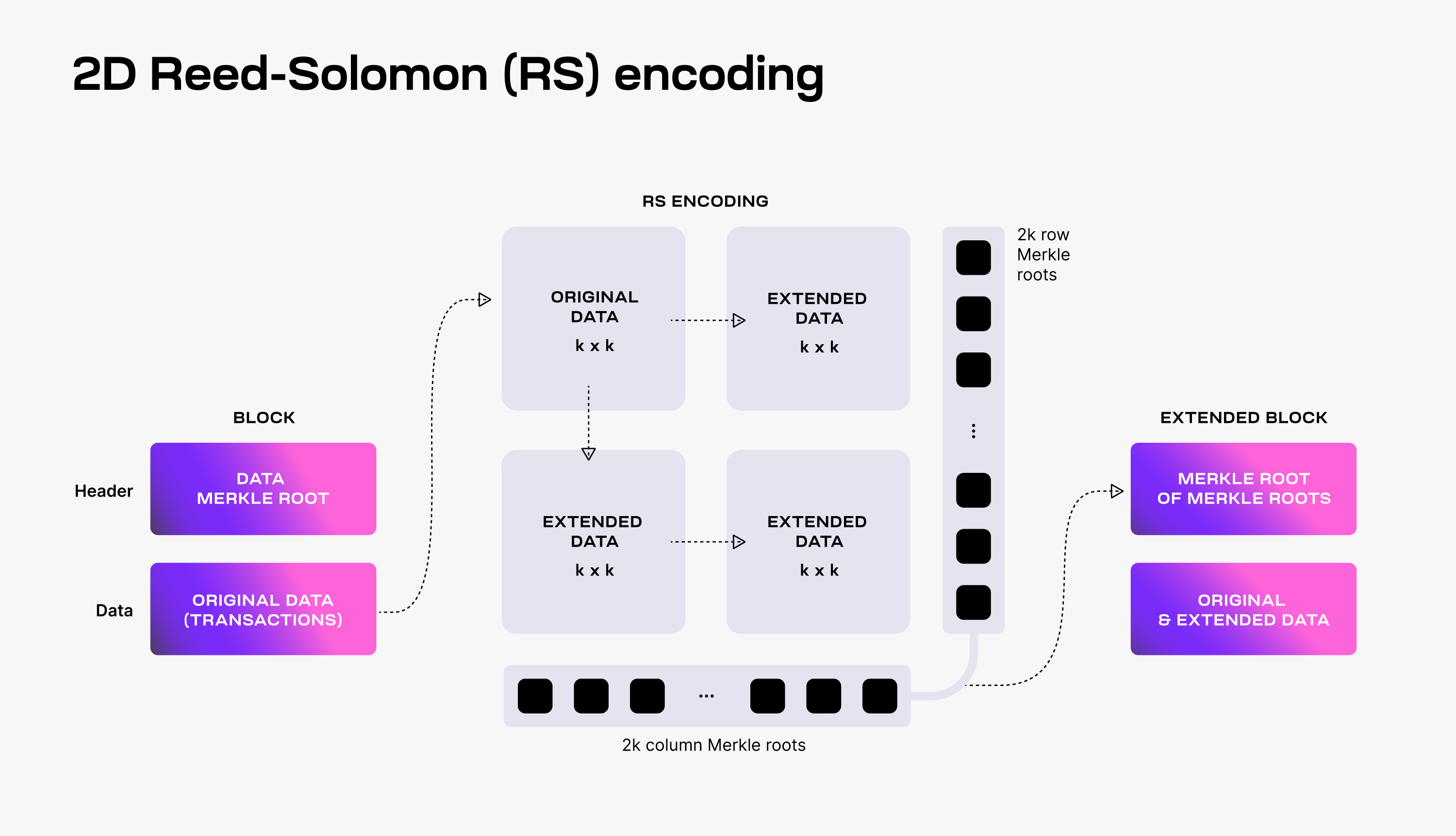
Traditional monolithic chains usually execute transactions, settle state, reach consensus and publish data. Modular blockchains separate these responsibilities, allowing rollups or appchains to select different execution environments while reusing settlement, security or data-availability services. Celestia concentrates on data availability: it orders and publishes data, while light nodes use data-availability sampling to determine whether block data has been made available and applications execute above it.
Modularity creates customization but also introduces compositional risk. A rollup may depend on a sequencer, proving system, data-availability layer, settlement chain and bridge. An outage or configuration error in any layer can affect withdrawals. Modularity separates risk; it does not remove it.
Do not judge a modular network only by data prices or advertised throughput. Ask who can recover the data, whether light nodes actually operate, how applications settle, what verification bridged assets depend on, and whether users can force an exit during a failure. For the full relationship among execution, settlement, consensus and data availability, read Modular Blockchains: Celestia and the Separation of Execution and Settlement.
Parallel EVM: retaining Ethereum tools while increasing execution capacity
The EVM ecosystem offers Solidity, wallets, development frameworks and a large application base, but traditional sequential execution updates state one transaction at a time. Parallel EVMs attempt to process nonconflicting transactions simultaneously before committing results according to deterministic rules. Monad also pursues performance through asynchronous execution, storage and consensus optimizations, while Sei is building around parallel execution and a high-performance EVM.
Parallelization does not make every transaction faster by a fixed multiple. If many transactions compete for the same contract or storage location, they still need ordering. Contract state design directly affects results. Throughput numbers must also be understood alongside hardware requirements, decentralization and sustained load.
Looking back from 2026, Monad has moved from a 2025 high-performance narrative to a public mainnet stage, while Sei continues to evolve its EVM. Users should still treat official performance figures as capabilities under specific conditions, not an experience guaranteed to every application. For the tradeoffs among optimistic parallelism, state conflicts, asynchronous execution and compatibility, read Parallel EVM: Monad and Sei’s Path to High Performance.
The Bitcoin ecosystem: from settlement layer to native digital assets
Ordinals assigns a serial number to every satoshi and allows inscriptions to associate content with a specific satoshi. BRC-20 uses inscriptions to define the issuance and transfer of fungible tokens. Runes encodes fungible-asset protocol information in Bitcoin transaction outputs. These protocols have not turned Bitcoin into a general-purpose smart contract platform, but they have expanded how people use block space, collectibles and native assets.
Supporters argue that new applications strengthen the fee market and ecosystem activity, while critics focus on congestion, speculation and the user experience. The existence of a protocol does not give an asset value, and consistent indexers do not make an issuer trustworthy. Users must verify the protocol version, asset format and transaction fees.
In 2026, Ordinals and Runes remain important examples for understanding programmable assets on Bitcoin, but interest, liquidity and tool support can change quickly. For technical differences, minting processes and risks, read New Narratives in Bitcoin: Ordinals, BRC-20 and Runes.
Meme coins: attention can move on-chain without making value stable
Meme coins combine internet culture, symbols, communities and liquidity into tradable assets. They spread quickly, have low participation barriers, and issuance platforms and automated market makers have greatly reduced creation costs. Communities may organize content, events and donations around a shared identity, but most tokens lack cash flow, redemption rights or verifiable utility. Their prices depend largely on attention, liquidity and holder concentration.
A “supercycle” is a market narrative, not a verifiable law. Low-cost issuance also enables insider allocations, bot sniping, liquidity removal, fake accounts and copycat tokens. Even when market capitalization looks high, available exit liquidity may be very limited.
Analyze contract permissions, holder concentration, liquidity locks, creator history, on-chain trading and community authenticity. No profit screenshot can replace an assessment of exit liquidity. For community dynamics, issuance mechanisms, attention economics and common scams, read The Meme Coin Supercycle: Community-Driven Value Discovery.
How do the twelve sectors connect into one map?
These trends can be organized into four layers. AI agents, wireless networks, mapping, GPUs, Bitcoin assets and meme communities belong to the demand and application layer. Cross-chain systems and oracles belong to the connectivity and data layer. ZK, modular data availability and parallel EVMs belong to the scaling and verification layer. Tokens, fees, staking and rewards form an incentive mechanism running through every layer.
They can also combine. An AI agent might read data through an oracle, move capital across chains, buy compute from DePIN and use ZK to prove the computation. The more systems combined, the more dependencies appear across wallets, RPCs, bridges, sequencers and contracts—and the more transparent responsibility boundaries must become.
Hotcoin’s eight-part FRONTIER framework
To avoid chasing terminology, use the eight-part FRONTIER research checklist. It is not an investment rating.
15.1 F: Function—is the function real?
What task does the product complete? Is it a usable service or a future roadmap? Are the blockchain and token necessary?
15.2 R: Revenue—where does revenue come from?
Does revenue come from external customers, or from token inflation, subsidies and circular incentives?
15.3 O: Operators—can suppliers sustain operations?
After rewards decline, can nodes, validators and hardware providers continue delivering the service?
15.4 N: Network—can network effects form?
Does adding participants improve coverage and liquidity, or merely create duplicate supply?
15.5 T: Trust—where are the trust boundaries?
What powers do administrators, multisignature wallets, oracles, bridge validators and sequencers hold?
15.6 I: Incentives—do incentives reward value?
Do rewards encourage contributions customers need, or volume farming, duplication and token locking?
15.7 E: Exit—can users leave safely?
Can assets be redeemed? Can a bridge provide a forced exit? What happens during an outage?
15.8 R: Risk—are the loss boundaries clear?
Review contract, market, legal and operational risks together, and confirm that the worst case remains bearable.
How can ordinary users participate in frontier sectors?
First, learn the product before researching the token and confirm that it is more than a website concept. Second, verify the official domain, contract address, network and token symbol. Third, use a separate wallet for new applications, isolate primary assets from frequent signing and revoke approvals regularly.
Fourth, limit the risk of each action and do not treat short-term rewards as guaranteed returns. Fifth, record your assumptions: who are the users, where do fees come from, and what metric will verify the thesis in six months? If the only answer is “the community will grow,” the research is incomplete.
Sixth, monitor changes to mainnets, tokens, rewards, administrators and bridges. Tutorials and addresses expire, so recheck official materials before use.
To isolate DApp activity and manage multichain assets, use Hotcoin Web3 Wallet. For mobile market data and trading tools, visit the Hotcoin App. To explore more Web3 education, visit Hotcoin.
Frequently asked questions
17.1 What is the most important Web3 sector from 2025?
There is no single answer for everyone. AI + Crypto and DePIN are closer to new demand; cross-chain protocols and oracles provide connections; ZK, modular systems and parallel EVMs are infrastructure; and Bitcoin assets and meme coins are more influenced by market culture. Judge them by real use, revenue, security and your own capabilities.
17.2 Is an article with 2025 in the title already outdated?
This article treats 2025 as the observation window in which these trends formed and looks back using public developments from 2026. Mainnet status, rewards, contract addresses, data and token details can still change. Consult current official materials before using or trading anything.
17.3 Can an AI agent control a wallet completely autonomously?
It can technically receive transaction authority, but unlimited access should not be the default. A safer design uses a separate account, spending limits, allowlists, session keys, simulation and human approval to contain losses from model errors or prompt injection.
17.4 Does a higher DePIN node count mean a more valuable project?
Not necessarily. Nodes may duplicate coverage, remain offline or lack customers. Examine useful supply, service quality, usage, customer payments, anti-cheating measures and unit economics rather than device counts and rewards alone.
17.5 Are cross-chain bridges and cross-chain messaging protocols the same?
No. Asset bridges focus on moving or representing assets, while messaging protocols transmit more general instructions. A product may contain both. Each must verify the state of another chain, so users need to understand verification, custody and failure handling.
17.6 Do zero-knowledge proofs provide complete anonymity?
No. ZK can hide some information used in a proof, but address links, amounts, timing, network metadata, interfaces and other services may still reveal identity clues. Privacy depends on the design of the entire system.
17.7 Are tokens from frontier sectors suitable for long-term holding?
Technical potential and token value are different questions. Even a useful product can have a token facing dilution, weak value capture, concentrated holdings, regulation and liquidity risk. This article makes no judgment about returns on any asset.
Conclusion: from a narrative map to a verification map
The central change in Web3 during 2025 was the growing connection among sectors. AI needs data, compute, identity and payments. DePIN turns physical resources into coordinated networks. Cross-chain systems and oracles transmit state and facts. Zero-knowledge proofs, modular blockchains and parallel EVMs compete to make execution and verification more efficient. Bitcoin-native assets and meme coins bring issuance, culture and attention on-chain.
Looking back from 2026, none of these directions won simply by owning a keyword. Launching the technology is only the beginning. Long-term value still depends on real users, external revenue, sustainable supply, security boundaries and exit mechanisms. The most valuable research habit is to break every grand narrative into questions that can be verified: who uses it, why do they pay, who controls it, what happens when it fails, and is the token necessary?
For ordinary users, the safest sequence is to understand the demand and architecture, try the product with a small amount and only then evaluate the asset. Developers and founders should prioritize measurable customer problems and disclose permissions, cross-chain dependencies, data dependencies and security assumptions. Being at the frontier does not mean having no rules; the closer a system is to a technical boundary, the more it needs clear verification methods and risk budgets.
Risk warning: This article is for education and information only and does not constitute investment, legal or tax advice. The technology, mainnets, tokens, incentives, contract permissions, cross-chain routes and market status of frontier Web3 projects may change rapidly. Before participating, buying equipment, staking, bridging or trading, verify the latest official documentation, contract addresses, wallet signatures and local rules, and risk only what you can afford to lose.
読書をお勧めします
もっと見る


service hotcoin.com
producthotcoin.com
businesshotcoin.com
casecnhotcoin.com