
Modular Blockchains: Celestia and the Separation of Execution and Settlement
A modular blockchain is an architecture that separates execution, settlement, consensus, and data availability, assigning each function to a different network or component.
Traditional monolithic chains usually make the same set of nodes perform every task: executing transactions, confirming state, ordering blocks, and retaining enough data. A modular architecture instead works like a composable technology stack. A Rollup can focus on execution, a settlement layer can resolve disputes or verify proofs, and a network such as Celestia can provide consensus and data availability.
This division of labor may lower the barrier to launching a new chain, increase throughput, and let developers choose their own virtual machine and governance rules. It also creates new dependencies: data must remain recoverable, cross-layer messages must be reliable, sequencers must not be able to censor users indefinitely, and settlement and upgrade mechanisms must be explicit.
To first place modular blockchains alongside AI, DePIN, interoperability, oracles, and zero-knowledge proofs, see the 2025 Web3 Frontier Landscape.
What Is a Modular Blockchain?
A modular blockchain is not one particular public chain. It is a system design method. Instead of requiring every node to run a complete virtual machine, re-execute every application transaction, settle results, and retain all data, it assigns distinct responsibilities to specialized networks.
The four most common responsibilities are execution, settlement, consensus, and data availability. Their boundaries vary by project. Some systems combine settlement with consensus, some let Rollup nodes determine the canonical chain, and others use a smart contract on another chain to verify state commitments.
The “modular chain” label is therefore not enough. The important questions are where transactions execute, where state becomes final, who determines data order, where data is published, and whether users can recover their assets if one component stops operating.
Why Do Monolithic Blockchains Face Scaling Pressure?
A monolithic blockchain makes the same set of full nodes perform several jobs. Each node generally downloads block data, validates transactions, executes state transitions, and stores state. Larger blocks can increase throughput, but they also raise bandwidth, storage, and computing requirements, potentially reducing the number of people able to run independent nodes.
The advantage of a monolithic design is a clear security boundary. Data, execution, and consensus reside in one system, so developers and users do not need to analyze several networks' failure modes at once. However, when many applications compete for limited block space, rising fees, slower synchronization, and higher hardware requirements become bottlenecks.
The modular approach is not simply to enlarge one chain. It lets each component scale for its particular task. Execution layers can process transactions in parallel, data availability layers can specialize in data throughput, and settlement layers can retain the minimum logic needed to verify state and resolve disputes.
What Do the Four Core Blockchain Layers Do?
3.1 The Execution Layer Computes State
The execution layer receives transactions and applies state transitions, including checking signatures, updating balances, calling smart contracts, and computing a new state root. EVM, WASM, and application-specific state machines are all execution environments.
In a modular architecture, a Rollup or application chain can customize its virtual machine, Gas model, block time, and permission rules without requiring the data availability network to understand every transaction. Full nodes, fraud proofs, validity proofs, or another verification mechanism must still guarantee correct execution.
3.2 The Settlement Layer Confirms Results and Resolves Disputes
The settlement layer receives state commitments from the execution layer and verifies results according to the protocol. An Optimistic Rollup may provide a challenge window and fraud proofs, while a ZK Rollup submits validity proofs that a settlement contract checks.
Settlement also concerns asset ownership, bridges, and final exits. If a Rollup locks assets in an L1 contract, users generally depend on the state root that contract recognizes. Not every modular Rollup uses a separate settlement layer: a sovereign Rollup may let its own full nodes determine the valid chain.
3.3 The Consensus Layer Orders Data and Establishes Agreement
The consensus layer enables nodes to agree on block order and canonical history. It determines which data enters a block, in what order, and which block receives final confirmation. Consensus guarantees consistent ordering without necessarily understanding all transaction semantics in upper-layer applications.
3.4 The Data Availability Layer Ensures Data Was Published
Data availability, or DA, ensures that the transaction data needed to verify state has been made public so other participants can download it and reconstruct state. If a block producer publishes only a state root while withholding the underlying transactions, users may be unable to inspect state, generate proofs, or exit safely when the operator stops.
Data availability is neither permanent archiving nor proof that the data's contents are correct. A DA layer mainly demonstrates that data was published and retrievable during a required window. Indexing, permanent storage, and application semantics may still be handled by other services.
What Is Celestia?
Celestia is a modular data availability network for Rollups and application chains. Its validators use proof-of-stake consensus to order blocks and data while providing verifiable Blob space to upper layers. Celestia itself does not execute the application transactions inside those Blobs, nor does it determine whether a Rollup's balance changes comply with its business rules.
Developers can publish batches of transaction data to Celestia, then have their own execution nodes read that data and update state. A project may operate as a sovereign Rollup or settle on Ethereum or another smart-contract chain, using a bridge or proof mechanism to bring Celestia data commitments into the settlement environment.
Celestia's native asset, TIA, can pay for Blob space, participate in staking and governance, and may serve as an initial Gas token or asset for some Rollups. Its precise role depends on network and application design and should not be treated as a price or return guarantee.
How Does Celestia Process Data Blobs?
A Blob can be understood as a piece of raw data submitted by an upper-layer Rollup. Celestia consensus nodes do not need to interpret whether it represents a transfer, a game action, or input for another state machine. They only need to order and encode the data and allow the network to verify that it is available.
Submitters use PayForBlobs transactions to pay for the space occupied by a Blob. Each Blob is associated with a namespace so data can be separated by application. Rollup nodes can search for data in their own namespace without treating every other application's Blobs as business inputs.
This creates a division between data and execution: Celestia determines whether data was included and made available, while the Rollup determines the state produced by executing it. Celestia will not correct a flaw in the Rollup's rules, and the execution layer cannot independently verify state if data was not published reliably.
How Does Data Availability Sampling Work?
6.1 Why Is a Block Header Alone Insufficient?
A light node that receives only a block header and data commitment cannot know whether the block producer actually published the complete data. A malicious producer could publish an apparently valid commitment while sending only fragments to a few nodes, preventing others from reconstructing the block.
Data availability sampling, or DAS, lets light nodes request small random pieces from erasure-coded data. A single successful sample cannot prove with certainty that all data exists, but after many independent nodes sample repeatedly, the probability of hiding enough data without detection falls rapidly.
6.2 What Does Two-Dimensional Erasure Coding Do?
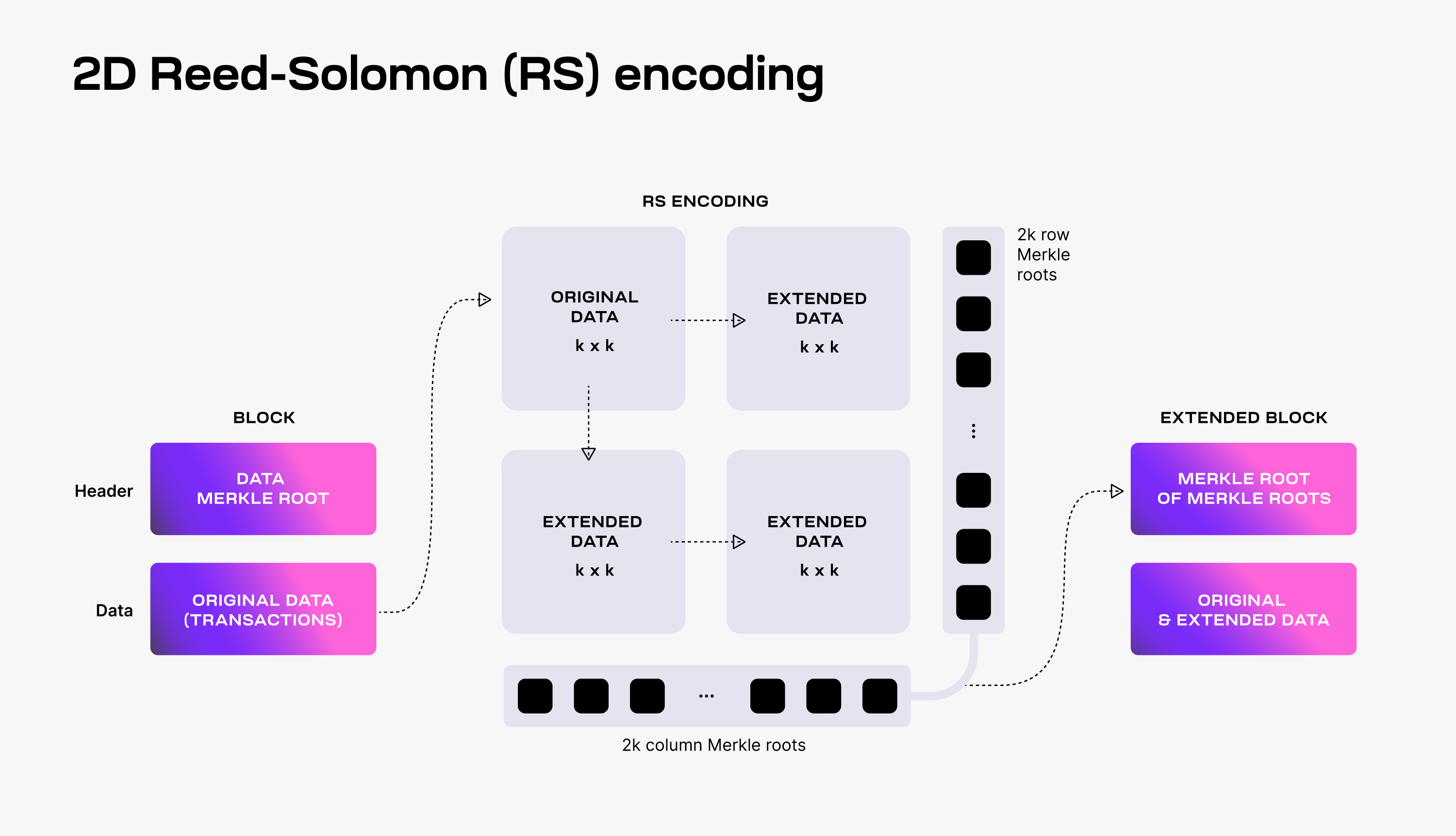
Celestia arranges the original data in a two-dimensional matrix, then applies Reed-Solomon erasure coding across rows and columns to form an extended data square. A full node can reconstruct the original data when it obtains a sufficient portion of the pieces; if the encoding is incorrect, the network can identify the problem using the relevant proofs.
This structure enables light nodes to sample availability without downloading the entire block. As the number of light nodes and samples increases, the network can support more data while keeping individual verification costs relatively low. The design still depends on enough genuine participants, robust network propagation, and correct encoding implementations.
Why Are Namespaced Merkle Trees Important?
A standard Merkle tree can prove that a piece of data belongs to a block, but it cannot naturally filter data efficiently by application. Celestia uses a Namespaced Merkle Tree, which groups data from the same namespace and retains namespace range information in node hashes.
A Rollup can request data from its own namespace and verify an inclusion proof. When a namespace has no data in a block, it can also verify a non-inclusion proof. This reduces the work application nodes need to find relevant Blobs and allows many Rollups to share the same DA block space.
Namespaces classify data; they are not a privacy mechanism. Blob contents may remain public for anyone to download and analyze. Privacy-sensitive applications should encrypt data before publication or use techniques such as zero-knowledge proofs, while also considering key availability and censorship risk.
How Can Modular Rollups Be Composed?
8.1 Ethereum Execution, Settlement, and DA
A common Ethereum Rollup executes offchain, publishes batch data to Ethereum, and settles through an Ethereum contract. It inherits Ethereum's data availability and settlement security but must pay for Ethereum block space or Blob space.
For the complete relationship among different Rollups and sidechains, see What Is Layer 2? A Complete Guide to Ethereum Scaling.
8.2 External DA with Ethereum Settlement
Another design executes in a Rollup and submits state or proofs to Ethereum while publishing transaction data to an external DA network such as Celestia. This may reduce data costs but introduces cross-network security assumptions. The Ethereum settlement contract must be able to establish that the corresponding data was actually available on the external network.
8.3 Sovereign Rollups
A sovereign Rollup publishes transaction data to Celestia, while its own nodes download, execute, and determine canonical state. It does not require Celestia or an external smart contract to verify state transitions. Upgrade rules and fork choice are determined by the Rollup community, clients, and nodes, giving the system greater autonomy but requiring users to trust and run its validation logic directly.
8.4 Validium and Modular Rollups
A Validium also keeps data outside the settlement chain, but an external committee or dedicated network may host it. Validity proofs can ensure that state transitions are correct, yet data availability must still be solved separately. A Celestia-based design may provide more open DA verification, but the presence of a proof is not a reason to ignore data recovery and exit conditions.
A validity proof shows that computation satisfies a circuit; it does not by itself prove that all transaction data was published. For the underlying concepts, see ZK Zero-Knowledge Proofs: The Ultimate Path to Privacy and Scaling.
What Does Blobstream Do in a Modular Architecture?
Blobstream is a mechanism for relaying Celestia data commitments to EVM chains. Celestia validators commit to data roots. After an EVM contract receives and verifies those commitments, a Rollup contract can check whether data from a particular namespace was included.
Blobstream addresses how a settlement environment recognizes Celestia data commitments. It does not automatically verify upper-layer transaction execution or decentralize a Sequencer. Applications still need state verification, bridging, challenge or proof mechanisms, upgrades, and emergency exits.
Cross-layer delivery also adds bridge and relay risk. Users should examine who submits commitments, how validator thresholds are configured, how signatures or proofs are verified, how long updates take, and whether contracts pause, revert, or continue accepting state during an incident.
What Are the Advantages of Modular Blockchains?
First, execution environments are more flexible. Applications can choose EVM, WASM, a specialized virtual machine, or a custom state machine and set their own fees, block times, and governance rules.
Second, data throughput can scale independently. A DA layer does not re-execute every Rollup transaction, so it can focus resources on data publication, encoding, propagation, and sampling.
Third, the barrier to launching a new chain may fall. Teams can reuse external consensus and data availability without building a complete validator set from scratch, then concentrate engineering resources on application execution and user experience.
Fourth, modules can theoretically be replaced or upgraded. A project may migrate its execution environment, DA layer, or settlement design instead of remaining permanently locked into one technology. Real migrations, however, involve bridges, state, contracts, and governance and are far more complicated than replacing a software component.
Fifth, applications can have greater sovereignty. A dedicated Rollup does not need to share execution resources with unrelated applications and can design fees and state rules around its own users.
Sixth, ecosystems can share infrastructure. Multiple Rollups can reuse the same DA network, node tools, and data-reading interfaces while retaining different execution rules. Shared infrastructure does not make their states inherently interoperable; cross-Rollup assets and messages still need bridges, shared settlement, or dedicated interoperability protocols.
What Are the Risks and Limitations of Modular Blockchains?
11.1 Security Assumptions Become Fragmented
Users no longer trust just one chain. They must evaluate execution nodes, Sequencers, Provers, settlement contracts, DA validators, bridges, and governance at the same time. Failure of any critical component can cause downtime, censorship, or an inability to exit assets.
11.2 Data Availability Does Not Mean Permanent Retention
A DA layer confirms that data can be retrieved during the protocol's required window. It does not guarantee that every historical item will be archived forever. Projects still need reliable full nodes, archive nodes, indexers, and backup strategies.
11.3 Sequencers May Be Centralized
A single Sequencer can control ordering, delay transactions, or extract MEV. A DA layer can prevent it from secretly withholding data that was published, but may not force it to include user transactions promptly. Forced inclusion, shared sequencing, and decentralized Sequencers are separate problems.
11.4 Cross-Layer Bridges Expand the Attack Surface
External DA and settlement layers must exchange data roots, state roots, or verification proofs. Bridge contracts, signature thresholds, relays, light clients, and upgrade keys can all fail. More combinations make failure analysis more complex.
11.5 Fees Span Multiple Tokens and Networks
Users or operators may pay execution, DA, settlement, proof, and bridge fees at the same time. Lower DA prices do not ensure lower end-user fees because batch utilization, token volatility, and settlement frequency all affect costs.
11.6 Development and Operations Are More Complex
Modularity creates choice but also integration cost. Teams must maintain nodes, data readers, state synchronization, proof systems, settlement contracts, bridges, and monitoring. An upgrade to one interface may affect the entire system.
11.7 Responsibility for Failure Recovery May Be Unclear
When a Rollup stops producing blocks, users need to know who can submit batches, whether they can bypass the Sequencer, how to obtain complete data, and which contract enables an exit. Documentation that describes only normal operation but not recovery leaves the true security boundary incomplete.
11.8 Replaceable Modules Do Not Make Migration Risk-Free
In theory, a Rollup can replace its DA layer, settlement layer, or proof system. In practice, it must manage old state snapshots, pending withdrawals, bridged assets, contract addresses, data indexes, and client upgrades. If administrators perform the migration directly, users may also face sudden rule changes.
A reliable migration should disclose the activation block, state verification method, dual-running period, rollback conditions, and user exit window. State mappings between the old and new networks should also be verifiable, preventing “modular composability” from being mistaken for a free, instant switch.
How Should You Evaluate a Modular Blockchain Project?
First, draw the actual architecture. Identify who provides execution, settlement, consensus, DA, ordering, proofs, and bridges instead of relying only on labels such as L2, Rollup, or modular chain.
Second, check where data is published. Determine whether full transaction data or only state roots are published, how long data is retained, how ordinary users verify availability, and how recovery works if archive services fail.
Third, check state correctness. Learn whether the system depends on fraud proofs, validity proofs, committee signatures, or full-node social consensus. Proof activation, challenge windows, and verifier upgradeability should all be public.
Fourth, check downtime and exit paths. If the Sequencer, Prover, bridge, or DA layer pauses, can users force transactions, reconstruct state, and exit without permission?
Fifth, inspect governance powers. Review multisig participants, timelocks, pause authority, verifier contract upgrades, DA migration, and parameter changes. A decentralization roadmap does not mean current powers are already distributed.
Sixth, compare total costs. Evaluate execution, data, settlement, proofs, bridging, and liquidity together, using peak periods rather than only the lowest quoted price.
Hotcoin's Six-Dimension MODULA Framework
The MODULA checklist offers a quick way to break down a modular project. It identifies architecture and risk; it is not an investment rating or security certification.
13.1 M: Modules — Who Is Responsible for Each Module?
List the execution, settlement, consensus, DA, ordering, and proof components. Rollups with the same category label may use entirely different module combinations, so classification alone does not determine security.
13.2 O: Ordering — Who Determines Transaction Order?
Check the number of Sequencers, failover, forced inclusion, censorship resistance, and MEV rules. Eventual data publication does not mean user transactions will be ordered promptly.
13.3 D: Data — Can the Data Be Recovered?
Confirm Blob publication, sampling, historical retention, namespaces, and archive nodes. If the operator goes offline, independent nodes should be able to obtain the data and reconstruct state.
13.4 U: User Exit — How Can Users Leave?
Review normal bridging, emergency exits, proof generation, and challenge processes. Exit protection may be inadequate if users must rely on one website, centralized relay, or administrator signature.
13.5 L: Link — Are Cross-Layer Connections Reliable?
Verify data commitments, state roots, light clients, bridge contracts, and relay updates. Understand latency, verification thresholds, rollback, and incident handling rather than treating a bridge as equivalent to underlying consensus.
13.6 A: Admin — What Can Administrators Change?
Review multisigs, timelocks, pauses, verifier replacement, DA migration, and Sequencer privileges. Even when the underlying DA network is decentralized, upper-layer administrators may retain substantial control.
Frequently Asked Questions
14.1 Is Celestia Layer 1 or Layer 2?
Celestia is an independent proof-of-stake network that primarily provides consensus and data availability. It is not an Ethereum L2 and does not execute the Rollup transactions that use its Blob space.
14.2 Does Celestia Validate Rollup Transactions?
No. Celestia verifies that data was ordered and made available. Rollup full nodes, fraud proofs, validity proofs, or settlement contracts determine whether state transitions are correct.
14.3 Are Data Availability and Data Storage the Same Thing?
No. Data availability concerns whether block data is public when verification requires it. Long-term historical storage depends on full nodes, archive nodes, indexers, and other retention services.
14.4 Is a Modular Blockchain Always Safer Than a Monolithic Chain?
No. Modularity can reuse specialized security layers, but it also adds dependencies on DA, bridges, settlement, and ordering. Overall security depends on the weakest critical component and its recovery mechanisms.
14.5 Can Data Availability Sampling Prove with 100% Certainty That Data Exists?
DAS provides a probabilistic guarantee. Random sampling by many light nodes makes hidden data increasingly difficult to conceal, but actual security still depends on sampling parameters, node counts, network propagation, and implementation quality.
14.6 Is TIA Only a Fee Token?
TIA can pay for Blob space and participate in staking and governance. A Rollup may also use it as a Gas token or bootstrap asset. Current network rules should determine its specific functions and risks.
14.7 How Can an Ordinary User Tell Which DA They Are Using?
Review the project's official architecture, block explorer, bridge documentation, and settlement contracts to determine where batch data is published. A wallet interface rarely displays every underlying dependency.
Conclusion: Modularity Is Division of Labor, Not Security Outsourcing
Modular blockchains separate execution, settlement, consensus, and data availability so each layer can scale around a specialized task. Through Blobs, Namespaced Merkle Trees, two-dimensional erasure coding, and data availability sampling, Celestia provides shared consensus and DA infrastructure for Rollups.
This design makes it easier for developers to build specialized execution environments and choose settlement models flexibly. Celestia, however, guarantees data ordering and availability only within its own responsibility. It does not automatically secure Rollup business logic, Sequencers, fair ordering, bridges, or administrator upgrades.
Viewed through the Web3 Technology Stack: From Base Chains to Applications, modularity does not eliminate layers; it redistributes their responsibilities. An assessment should map normal operation, component outages, data recovery, and user exits in the same architecture diagram.
Returning to the 2025 Web3 Frontier Landscape, you can further compare modular blockchains with ZK, interoperability, oracles, DePIN, and parallel EVM designs.
To connect to Web3 applications with a standalone wallet, consider Hotcoin Web3 Wallet. For mobile market data and trading tools, visit the Hotcoin App. For more educational content, visit Hotcoin.
Risk warning: This article is for education and information only and does not constitute investment, trading, blockchain development, legal, or tax advice. Modular blockchains may face unavailable data, centralized nodes or Sequencers, bridge and relay vulnerabilities, proof-system errors, settlement-contract upgrades, loss of historical data, cross-layer outages, token volatility, and regulatory risk. Before participating, verify current official documentation, audits, data publication locations, administrator privileges, fee structures, and forced-exit mechanisms, and commit only assets you can afford to lose.
読書をお勧めします
もっと見る

Service@hotcoin.com
Product@hotcoin.com
Business@hotcoin.com
Casecn@hotcoin.com