
How to Choose an L2 Network: Gas Fees and Ecosystem Comparison
When choosing an L2, first identify the target application and asset, then compare the full cost, confirmation stages, exit paths, and permissions. The lowest gas quote from a single moment cannot determine which network is best for you.
Work backward from the task instead of ranking every L2 in a fixed order. Stablecoin transfers, DeFi, contract deployment, and frequent gaming interactions have different requirements for liquidity, compatibility, and security-related waiting times.
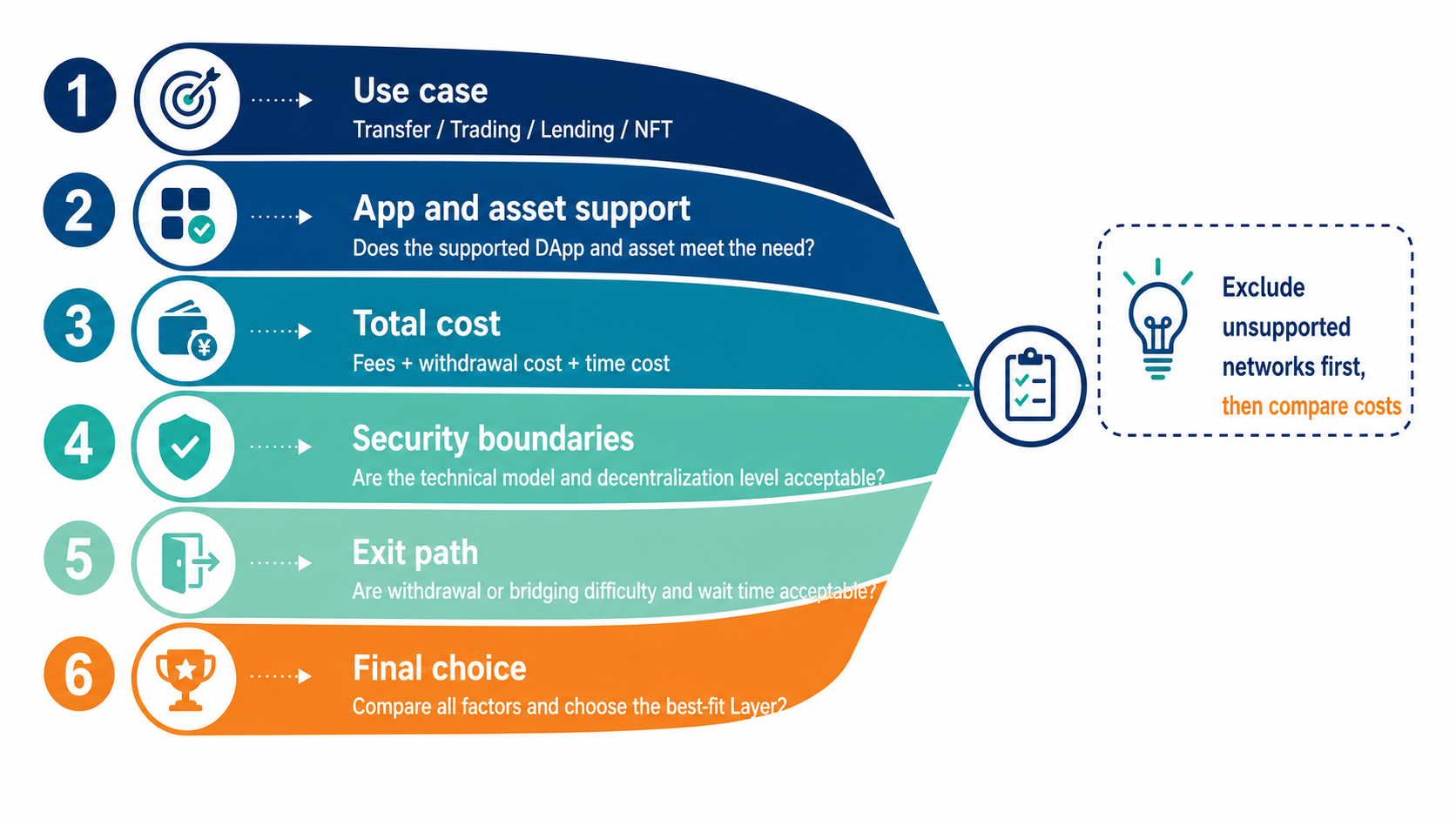
Step 1: Confirm That the App and Asset Are Actually Supported
Even the cheapest network cannot complete your task if the target application is not deployed there or the asset lacks reliable liquidity. Check the networks and contracts listed on the application's official website, then confirm support from wallets, exchanges, and oracles.
Tokens with the same symbol may come from three sources: native issuance by the issuer on that L2, mapping through the rollup's official bridge, or wrapping through a third-party bridge. Their contract addresses, redemption routes, and liquidity differ. Never rely on the token symbol and icon alone.
For trading, also inspect the actual pool depth and expected slippage for the target pair. A shallow pool on a low-gas network can produce a higher final execution cost than a network with higher gas but deeper liquidity.
Step 2: Calculate the Total Cost of a Complete Operation
The fee for an L2 transaction usually consists of:
L2 network fee = L2 execution fee + L1 data fee + protocol surcharge
However, the total cost of completing a task is broader:
Total cost = network entry cost + approval fee + application transaction fee + slippage + exit cost
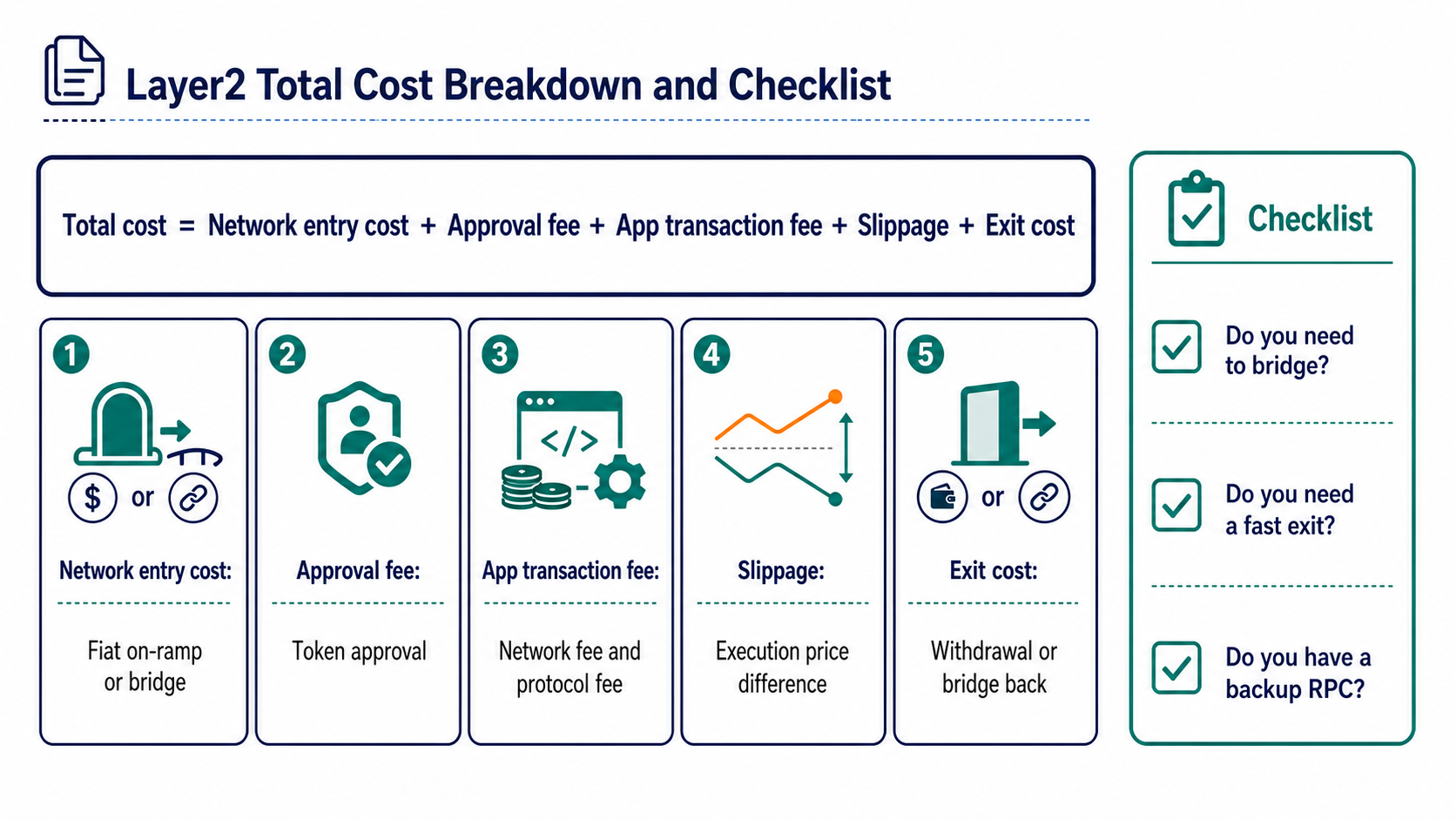
Compare candidates by simulating the same operation on each network and recording the wallet's estimated gas, the application's quote, and the minimum amount received. Do not compare a simple transfer on Network A with a complex contract call on Network B.
Real-time gas rankings can also be misleading. Blob prices, network congestion, batch frequency, and protocol parameters all change. A snapshot only describes that moment, not long-term costs.
Step 3: Separate the Four Levels of Speed
A “two-second confirmation” may refer only to sequencer inclusion; it does not mean the state has settled on L1. At minimum, distinguish these levels when comparing speed:
| Level | What to Observe | Useful For |
|---|---|---|
| Preconfirmation | Whether the sequencer commits to the transaction order | User-interface responsiveness and low-value interactions |
| L2 block | Whether the transaction is included in a block on the target chain | Whether the application has updated its local state |
| L1 data publication | Whether the batch has been submitted to Ethereum | Whether the state can be reconstructed from L1 data |
| L1 settlement | Whether a challenge or validity proof has completed | High-value confirmation and protocol-level exits |
Standard withdrawals from optimistic rollups may be subject to a challenge period, while ZK rollups must wait for proof generation and verification. Third-party fast bridges reduce the user's wait by supplying liquidity in advance, but introduce another set of contract and liquidity assumptions.
Step 4: Compare Five Security Boundaries
Do not treat “uses ZK,” “built on the OP Stack,” or “Stage 1” as a complete conclusion. Check each dimension:
- Data availability. Determine whether the data needed to recover state is held on Ethereum, an external DA network, or by a committee.
- State validation. Verify whether fault proofs or validity proofs are actually running rather than existing only on a roadmap.
- Sequencer. Identify who orders transactions, whether users can force inclusion from L1 during downtime, and whether rapid confirmations can be reversed.
- Upgrade permissions. Determine who can update core contracts and whether there is a timelock, security council, and user exit window.
- Asset exits. Check whether the standard bridge supports an independent exit, how long it takes, and which additional signer or liquidity dependencies a third-party bridge introduces.
Independent resources such as L2BEAT can help break down these dimensions, but their stage labels measure maturity and progress toward decentralization. They are not star ratings that guarantee asset safety.
Step 5: Compare Ecosystems by Use Case
| Use Case | Prioritize | Do Not Judge Solely By |
|---|---|---|
| Stablecoin transfers | Exchange deposits and withdrawals, native assets, arrival time, and ordinary transfer fees | Total on-chain TVL |
| DeFi trading | Target protocol, pool depth, oracles, slippage, and liquidation infrastructure | Lowest fee for one transaction |
| NFTs and games | Wallet experience, cost of small interactions, marketplaces, and indexing services | Theoretical TPS |
| Contract deployment | EVM compatibility, debugging, RPC, precompiles, and verification tools | A claim that it “supports Solidity” |
| High-value settlement | L1 data, proofs, upgrade permissions, and official exits | Sequencer preconfirmation speed |
Arbitrum and OP Mainnet are both optimistic rollups, but their multichain stacks and execution roadmaps differ. Base is pursuing its own multiproof evolution, while ZKsync, Starknet, Scroll, and Linea also differ in execution compatibility. Do not infer ecosystem depth directly from a technical category.
L2 Checklist Before Opening a Position or Transferring Funds
- Confirm the network and contract through the application's official entry point; do not use addresses shown in search ads.
- Verify the chain ID in your wallet and prepare the correct native gas asset.
- Test deposits, application actions, and the exit path with a small amount, recording the actual cost of each step.
- Check whether the token is native, officially bridged, or wrapped through a third party.
- Review the live status of the sequencer, proof submission, and bridge; do not repeatedly submit transactions during an incident.
- Simulate the quote again before a large operation because gas, blob fees, and slippage can change.
- Keep the source-chain transaction hash, destination-chain transaction hash, and bridge message ID for troubleshooting.
To establish the technical categories first, read A Complete Guide to Layer 2 Scaling Solutions. To understand how responsibilities are divided between the base layer and scaling layer, see The Relationship Between Layer 2 and Layer 1.
Frequently Asked Questions
Does a Lower Average L2 Gas Fee Always Mean Lower Long-Term Costs?
No. An average can hide the costs of complex contracts, congestion, and changing data fees. The complete cost also includes entry, approvals, slippage, and exit. Simulate your actual operation instead.
Is the L2 with the Highest TVL Best for New Users?
Not necessarily. TVL reflects a certain measure of asset value; it does not directly describe wallet usability, liquidity for a specific pair, contract permissions, or ease of exit.
Can I Send Assets Directly from One L2 to the Same Address on Another L2?
A normal transfer within one chain does not cross chains automatically. Even when the destination address has the same format, you still need a supported cross-network withdrawal from an exchange, an official route, or a third-party bridge. Otherwise, the assets remain on the source network.
If a Small Test Transfer Succeeds, Is a Large Operation Safe?
A small test only verifies the address, network, and basic process. Slippage, bridge limits, application contract risk, and market liquidity can differ for a large transaction, so you must check them again.
読書をお勧めします
もっと見る
service hotcoin.com
producthotcoin.com
businesshotcoin.com
casecnhotcoin.com