
How to Buy Bitcoin (BTC): The Complete 2025 Guide
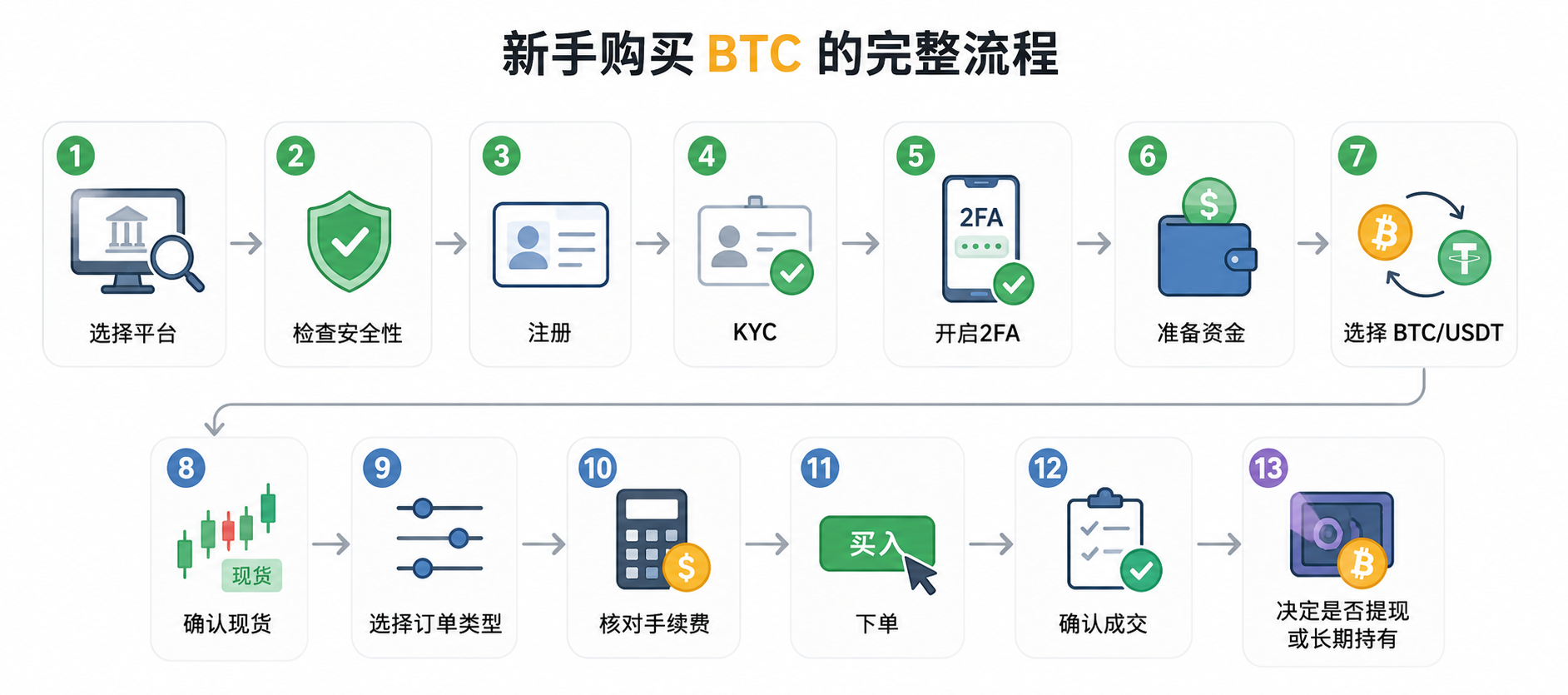
Buying Bitcoin (BTC) is usually done through a cryptocurrency trading platform. For beginners, the most common process is: choose a suitable platform and purchase method → register and complete identity verification → secure the account → fund it → select a BTC trading pair → place a buy order → confirm the fill → decide how to store the BTC.
You do not need to buy 1 full BTC at once, nor must you predict the market bottom before getting started. What matters is understanding the available purchase channels, trading costs, order types, and asset security before choosing an approach that fits your budget and goals.
Before Buying Bitcoin, Decide How You Want to Buy It
There is more than one way to buy BTC. Common methods include spot trading on a centralized exchange (CEX), an exchange's instant-buy service, P2P trading, and bank card or third-party payment channels available in certain regions.
For first-time BTC buyers, spot trading is usually one of the easiest methods to understand. You can use USDT, USDC, or another supported quote asset to buy BTC. Once the trade is complete, you own BTC rather than a contract position that merely tracks its price.
P2P trading connects you directly with other users. It may offer more flexibility in payment methods and prices, but it also requires greater attention to merchant reputation, payment procedures, and scam risks.
If you are unsure which method to choose, read Where Is the Safest Place to Buy Bitcoin? Comparing BTC Trading Platforms and then decide based on your region, available payment methods, and trading needs.
Step 1: Choose a Suitable BTC Trading Platform
When choosing a platform, do not look only for the “lowest fees” or “highest trading volume.” A platform suitable for buying BTC should be evaluated in terms of transparency, account security, liquidity, fees, and withdrawal arrangements.
First, check the platform's operating entity, supported regions, and applicable rules to make sure its services are available where you live.
Second, review its account security features, such as two-factor authentication (2FA), withdrawal address whitelisting, anti-phishing codes, and login alerts. After registering, configure these protections before making your first trade.
Third, consider liquidity in the BTC market. Trading volume, bid-ask spread, and order book depth can all affect the final execution price. Looking only at the displayed BTC price is not enough, especially for a large purchase.
Finally, check withdrawal fees, minimum withdrawal amounts, supported networks, and processing rules. Buying BTC is not necessarily the end of the process; the ability to transfer it safely to your own wallet is also important.
For more platform-selection criteria, see Where Is the Safest Place to Buy Bitcoin? Comparing BTC Trading Platforms.
Step 2: Register an Account and Complete KYC
Once you have selected a platform, you will generally need to create an account with an email address or phone number and complete KYC (Know Your Customer) identity verification according to the platform's and your region's requirements.
KYC requirements may vary by platform, region, and service type. Some platforms unlock their full trading, deposit, or withdrawal functions only after verification is complete.
Use a strong, unique password when registering. Do not reuse a password from your email, social media, or another financial account.
After registration, prioritize the following security settings:
- Enable 2FA: Add another verification step for sign-ins and sensitive actions.
- Set withdrawal protection: If the platform supports address whitelisting, restrict withdrawals to addresses you have approved in advance.
- Enable anti-phishing features: Make it easier to distinguish legitimate platform emails and notices from impersonation attempts.
- Protect your email and phone: The security of your trading account also depends on the email address and phone number linked to it.
These measures do not make the investment itself “risk-free,” but they can reduce the chance of assets being transferred if an account is compromised.
Step 3: Prepare Funds to Buy BTC
Once the account is ready, the next question is what you will use to buy BTC.
If the platform lets you buy BTC with fiat currency, you may be able to pay by bank card, bank transfer, or a third-party payment service. Supported methods, fees, limits, and processing times can vary significantly by region, so rely on the current information displayed by the platform.
Another common approach is to acquire USDT first and then buy BTC through the BTC/USDT trading pair.
For example, if BTC/USDT is quoted at 100,000 USDT, it means 1 BTC is priced at 100,000 USDT. You do not need 100,000 USDT to make a purchase because Bitcoin can be bought in fractions.
If you are unfamiliar with BTC/USDT, bids, asks, or the order book, start with BTC/USDT Trading for Beginners: How to Read a Bitcoin Trading Pair.
Step 4: Understand the BTC/USDT Trading Pair
This is one of the most common sources of confusion for first-time BTC buyers.
In the BTC/USDT pair:
- BTC is the base asset—the asset you buy or sell.
- USDT is the quote asset used to express BTC's price.
- “Buy BTC” means exchanging USDT for BTC.
- “Sell BTC” means exchanging BTC back into USDT.
For example, if you have 1,000 USDT and want to buy Bitcoin, you can open the BTC/USDT spot trading page and place an order based on the current price and your budget.
One important distinction is that BTC/USDT spot trading and a BTC/USDT perpetual contract are not the same product.
If your goal is simply to buy and hold BTC, make sure your first transaction is on the spot market—not in futures, margin, or another derivatives section.
Step 5: Choose a Market Order or Limit Order
After opening the BTC spot trading page, choose an order type.
A market order aims to execute as soon as possible against the prices currently available in the market. It is easy to use and generally fills quickly, but the final execution price may change as it moves through the order book.
A limit order lets you specify the price you are willing to pay. It executes only when the market reaches that price and enough sell orders are available to match it.
In simple terms, a market order may be easier to understand if this is your first small BTC purchase. If you are familiar with order books and want greater control over your entry price, you can consider a limit order.
For a detailed comparison, read Bitcoin Limit Orders vs Market Orders: Which Should You Use to Buy BTC?.
Step 6: Calculate the Real Cost, Not Just the BTC Price
The real cost of buying BTC may not equal the quote displayed on the screen.
At minimum, consider:
Actual trading cost ≈ trading fee + bid-ask spread + any payment or withdrawal fees
Trading fees often vary by platform, user tier, order type, and product. Maker and taker rates may also differ, so a single fixed percentage cannot represent every user's cost.
If you buy BTC with a bank card or third-party payment channel, the payment provider may also charge a fee or embed a spread in the quoted price.
That is why comparing platforms should involve the final amount paid and the amount of BTC received, rather than only searching for the “BTC trading fee.”
To learn more about maker fees, taker fees, and other trading costs, read How Much Are Bitcoin Trading Fees? A Detailed Calculation Guide.
Step 7: What Is the Minimum Amount Needed to Buy Bitcoin?
You do not need to buy a whole BTC.
Bitcoin can be divided into very small units, so trading platforms generally allow fractional purchases. However, the actual minimum purchase depends on the platform's minimum order size, the trading pair rules, and any payment-channel limits. These conditions differ among platforms.
Instead of asking only “How much does 0.001 BTC cost?”, confirm three things:
- What is the current market price of BTC?
- What is the platform's minimum BTC order size?
- Does your purchase method impose a minimum payment amount?
If your budget is limited, see What Is the Minimum Amount Needed to Buy Bitcoin? Understanding BTC's Smallest Purchase Unit.
Step 8: Confirm the Order Filled and Check Your BTC Balance
After placing an order, do not assume that BTC has been purchased merely because the platform says the order was submitted successfully.
A market order usually fills quickly, but a limit order may remain open. If the market never reaches your limit price, the order will not execute at that price.
Once the order fills, open your spot asset page to confirm the BTC amount, then review the order history and execution price.
This step may seem simple, but it is especially important on a first trade: check the order status first, then verify the asset balance, and do not place a duplicate order because the page changed.
Step 9: Where Should You Keep BTC After Buying It?
After buying BTC, decide whether to leave it on the trading platform or transfer it to your own wallet.
Keeping BTC on the platform may be more convenient if you trade frequently. For long-term holding, you may want to learn about self-custody and hardware wallets.
Self-custody does not mean “absolute safety.” If a wallet's private key or recovery phrase is lost, the assets may be unrecoverable. If that information is exposed to someone else, the assets may be stolen.
Before withdrawing BTC to an external wallet, check at least the following:
- Is the wallet address complete and correct?
- Does the withdrawal network match a network supported by the receiving wallet?
- What is the minimum withdrawal amount?
- What is the current withdrawal fee?
- Can you make a small test transfer first?
Do not approve a large withdrawal simply because the address looks similar.
Step 10: Consider BTC Dollar-Cost Averaging Instead of Buying All at Once
Not everyone wants to commit a lump sum to BTC at one time.
If your goal is long-term accumulation, you can consider regular fixed purchases, commonly known as DCA (Dollar-Cost Averaging).
For example, you might schedule a fixed amount every week or month instead of deciding every day whether the market has reached its lowest point.
This method reduces dependence on a single entry price, but it does not guarantee a profit or eliminate Bitcoin's price volatility.
If you are focused on long-term accumulation, read BTC Dollar-Cost Averaging: Buying Bitcoin with $10 a Week.
The Complete BTC Buying Process for Beginners
The entire process can be summarized as follows:
Choose a platform → check its security → register → complete KYC → enable 2FA → prepare funds → select BTC/USDT → confirm it is spot trading → choose an order type → review fees → place the order → confirm the fill → decide whether to withdraw or hold long term.
For a first purchase, there is no need to learn futures, leverage, options, and complex trading strategies at the same time. Completing one spot trade that you fully understand is more useful than rushing into a complicated product.
Checklist Before Buying BTC for the First Time
Before placing the order, review the following items:
- Is the platform available in your region?
- Have you completed KYC, enabled 2FA, and configured the necessary security settings?
- Are the funding method, payment costs, and processing time clear?
- Are you on the BTC spot trading page rather than a futures or margin product?
- Have you checked the order type, trading fee, and final amount of BTC you will receive?
- If you plan to withdraw, have you verified the wallet address, network, and fee?
Submitting the order only after confirming these items is safer than clicking “Buy” immediately.
Frequently Asked Questions
How Much Money Do I Need to Buy Bitcoin?
There is no universal minimum. You can buy a fraction of BTC rather than a whole coin. The actual minimum depends on the platform's smallest order size, the current BTC price, and your chosen payment method.
What Is the Easiest Way to Buy Bitcoin?
For beginners, a platform that supports BTC spot trading is generally straightforward. After registering and completing KYC, fund the account with a supported asset, open a spot pair such as BTC/USDT, choose a market or limit order, and confirm the transaction.
What Does BTC/USDT Mean?
BTC/USDT is a trading pair in which BTC is the base asset and USDT is the quote asset. It represents buying and selling BTC with USDT. For example, a BTC/USDT quote of 100,000 means that 1 BTC is quoted at 100,000 USDT.
Should I Use a Market Order or Limit Order to Buy BTC?
Use a market order if quick execution matters more to you. Consider a limit order if controlling the purchase price matters more. Neither is universally better; the choice depends on whether you prioritize execution speed or price control.
Must I Withdraw BTC to a Wallet After Buying It?
Not necessarily. Frequent traders may keep it on a trading platform, while long-term holders may explore self-custody. Withdrawing also means taking responsibility for the address, network, private key, and recovery phrase, so learn how wallet operations work before proceeding.
Is a Lump-Sum BTC Purchase Better Than DCA?
Each method has different characteristics. A lump-sum purchase is more sensitive to the entry point, while DCA spreads purchases over time and reduces dependence on one price. Neither guarantees a profit. The choice should reflect your investment horizon, risk tolerance, and financial plan.
Buy Bitcoin with Hotcoin
If you understand the BTC purchase process and have compared platforms, security measures, fees, and order types, you can create a Hotcoin account and explore BTC spot trading.
Buy Bitcoin with Hotcoin → Register
According to Hotcoin's official information, users can register with an email address or phone number. Its spot trading interface supports pairs including BTC/USDT and provides order types such as limit and market orders.
Before buying, confirm that the service is available in your region and review the current fees and trading rules.
Risk warning: Bitcoin is highly volatile, and buying BTC can result in a loss of principal. This article is for educational purposes and does not constitute investment advice. Service availability, trading rules, fees, minimum order sizes, and withdrawal policies may vary by region and change over time. Always consult the platform's latest rules before acting.
読書をお勧めします
もっと見る

Service@hotcoin.com
Product@hotcoin.com
Business@hotcoin.com
Casecn@hotcoin.com