
Hotcoin Research | The Rise of Yield-Bearing Stablecoins: A Review of Value Appreciation Strategies in Volatile Markets
Introduction
In the recent turbulent market environment, stablecoins have emerged as a crucial safe haven for investors due to their value stability. However, traditional stablecoins like USDT and USDC are no longer sufficient to meet investors' yield demands. The rise of yield-bearing stablecoins fills this market gap. This article provides a detailed analysis of the operational mechanisms, income sources, application scenarios, and value appreciation strategies of yield-bearing stablecoins in volatile markets.
I. Overview of Stablecoins
Stablecoins are cryptocurrencies pegged to fiat currencies, precious metals, or other assets, combining the stability of digital currencies with the decentralization and security of cryptocurrencies. Due to their value stability, stablecoins are often used as important hedging tools in volatile markets.
The principle of stablecoins is to stabilize their value through various mechanisms (such as fiat collateral, crypto asset collateral, algorithmic control, etc.). These mechanisms ensure that stablecoins maintain their pegged value during market fluctuations, such as maintaining a 1:1 exchange rate with fiat currencies like the US dollar.
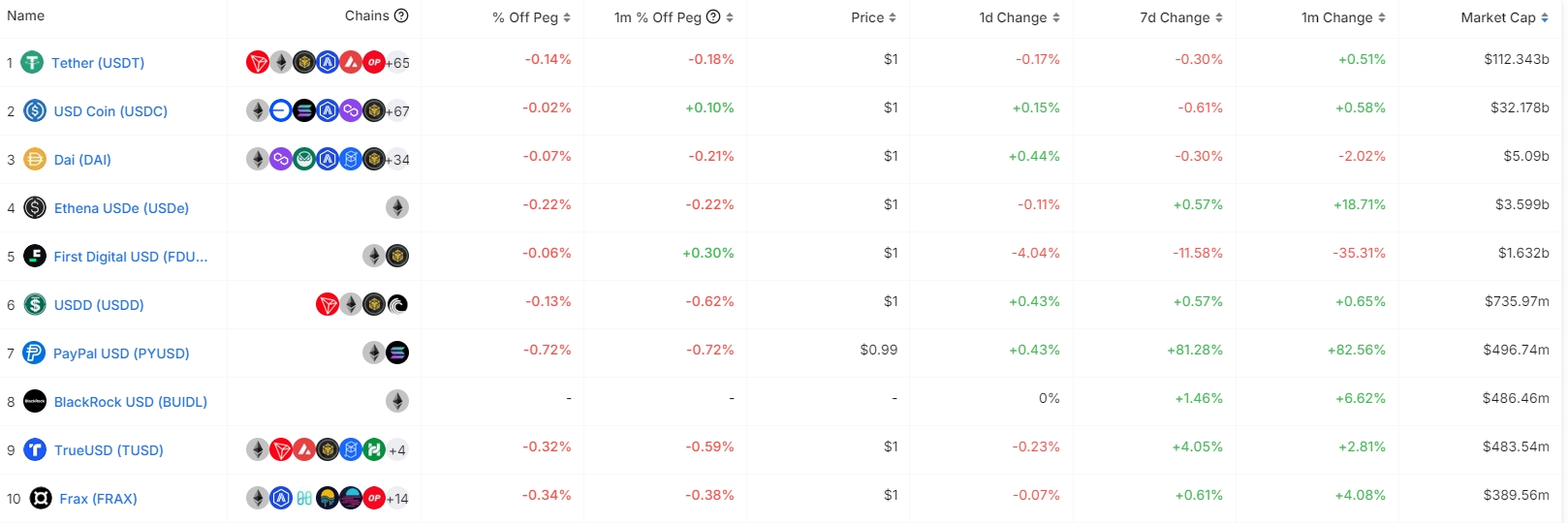
Currently, USDT and USDC dominate the stablecoin market, but emerging stablecoins are gradually rising. According to CoinGecko data, as of July 3, the total market value of stablecoins reached $161.6 billion, with USDT accounting for $112.7 billion (70% market share) and USDC following with approximately 20%.
According to DefiLlama's Top10 stablecoins list, fiat-collateralized stablecoins still dominate, especially in terms of liquidity and market acceptance. However, crypto-collateralized and algorithmic stablecoins are also gaining attention. These new stablecoins provide more diversified choices and higher yield potential through innovative mechanisms. The rapid rise of yield-bearing stablecoins like USDe and BUIDL, which have quickly become the fourth largest stablecoin, demonstrates the significant potential of yield-bearing stablecoins.
II. Main Types of Stablecoins
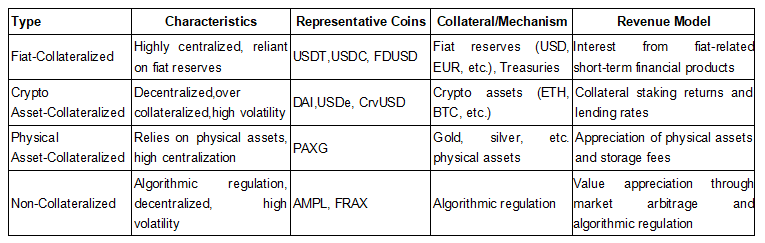
Stablecoins can be broadly categorized into four types based on their collateral: fiat-collateralized, crypto asset-collateralized, other physical asset-collateralized, and non-collateralized stablecoins.
Fiat-Collateralized Stablecoins
These stablecoins are backed by fiat reserves, such as USDT and USDC, and are characterized by high centralization and fiat credit risk. The advantages of fiat-collateralized stablecoins include high security and liquidity, as their value is primarily supported by fiat reserves. The operational mechanism is relatively simple: users mint stablecoins by depositing fiat currency and redeem them when needed. However, the main risks for these stablecoins stem from fiat credit and systemic risks. Financial crises or policy changes in the fiat currency issuing country could impact the value of these stablecoins.
Representative examples include USDT and USDC. USDT is issued by Tether, with reserve assets including cash, short-term US Treasury bonds, and other financial products. USDC is jointly issued by Coinbase and Circle, with reserves primarily consisting of short-term US Treasury bonds and cash. These stablecoins ensure high transparency and security through reserve proof mechanisms, guaranteeing that each stablecoin is backed by corresponding fiat reserves.
Crypto Asset-Collateralized Stablecoins
Examples like DAI and USDe use crypto assets as collateral, offering high decentralization but facing the risk of collateral price volatility. Crypto asset-collateralized stablecoins derive their value support from crypto assets as collateral. These stablecoins are highly decentralized, typically managed and liquidated automatically through smart contracts. However, due to the high volatility of crypto asset prices, these stablecoins require over-collateralization to mitigate the risk of collateral value fluctuations.
For example, DAI, issued by MakerDAO, is a decentralized stablecoin collateralized by ETH and other crypto assets. Users can mint DAI by staking ETH, and the price stability is maintained through stability fees and liquidation mechanisms. USDe, issued by Ethena Labs, uses ETH collateral and derivatives hedging strategies, offering high yields through staking rewards and funding rates.
Other Physical Asset-Collateralized Stablecoins
Examples like PAXG use physical assets such as gold as collateral, providing stable value support. Other physical asset-collateralized stablecoins derive their value support from physical assets (such as gold and silver). These stablecoins offer high value stability because the physical assets themselves have intrinsic value. However, their liquidity and scalability might be limited by the management and storage of the physical assets.
PAXG, issued by Paxos, is a stablecoin collateralized by gold, providing stable value support. Users can purchase PAXG to obtain a corresponding amount of physical gold and redeem it when needed. The main risks for these stablecoins include the storage and management costs of physical assets, as well as the market volatility of these assets.
Non-Collateralized Stablecoins
Examples like AMPL and FRAX achieve price stability through algorithmic regulation and are highly decentralized, but face significant price volatility risks. Non-collateralized stablecoins maintain price stability through algorithmic supply adjustments. These stablecoins do not rely on any form of collateral and entirely use market supply-demand dynamics and algorithmic control to maintain value stability. They are highly decentralized, offering strong resistance to censorship and high transparency.
For example, AMPL uses an elastic supply mechanism to adjust supply based on market demand, maintaining price stability. FRAX employs a combination of partial collateral and algorithmic regulation, maintaining value stability through market arbitrage mechanisms. The main risks for these stablecoins lie in the reliability of their algorithms and market confidence. If the algorithm fails or market confidence wanes, it could lead to severe price fluctuations.
Summary of Stablecoin Types, Characteristics, Representative Coins, and Revenue Models:
III. The Rise of Yield-Bearing Stablecoins
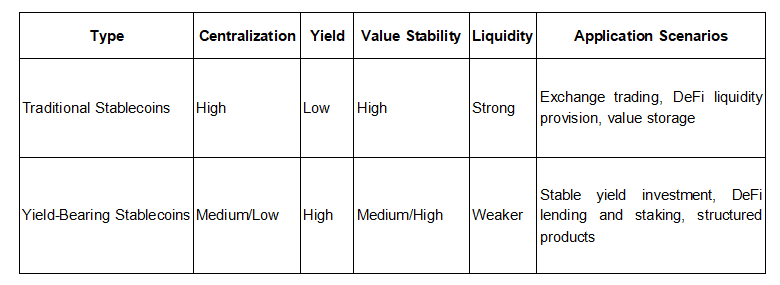
Yield-bearing stablecoins provide holders with investment returns simply by holding the asset. Unlike traditional centralized stablecoins (like Circle's USDC and Tether's USDT), yield-bearing stablecoin protocols offer innovative yield models, such as investments in US Treasuries, blockchain staking returns, or structured strategies. These provide users with tools to combat inflation, achieving the dual goals of asset preservation and appreciation.
Advantages over traditional stablecoins include:
1. Inflation Hedging: Provides effective means for asset preservation under inflationary pressures.
2.Yield Diversification: Different yield models cater to investors with varying risk preferences.
3.Enhanced Market Appeal: Infuses new vitality into the cryptocurrency market, attracting more capital inflows.
Comparison of traditional stablecoins and yield-bearing stablecoins in terms of centralization, yield, value stability, liquidity, and application scenarios:
IV. Overview of Yield-Bearing Stablecoin Income
Returns from Treasury Securities
USDY and USDM: Ondo Finance's USDY and Mountain Protocol's USDM provide stable annual returns (around 5%) by investing in short-term US Treasuries.
BUIDL: BlackRock's tokenized fund invests in cash, US Treasuries, and repurchase agreements, with each token worth $1.
DAI and GHO: MakerDAO's DAI and Aave's GHO, decentralized stablecoins, also invest significantly in US Treasuries and low-risk financial products.
This yield model's advantage is high stability, as US Treasuries and related securities are considered among the lowest-risk assets. However, the returns are relatively low, mainly suitable for risk-averse investors.
Returns from Crypto Asset Staking
eUSD: Lybra Finance's eUSD redistributes staking rewards to stablecoin holders using staked tokens (like stETH) as collateral.
YBX: Marginfi on Solana allows users to mint yield-bearing stablecoins using staked tokens (LST) like stETH and jitoSOL as collateral.
stUSDT: Developed by TRON's Justin Sun, stUSDT allows investors to invest USDT and receive stUSDT tokens, accumulating passive income from RWA investments.
This model leverages the decentralized nature of blockchain technology to earn returns by staking native tokens (like ETH). The advantage is high decentralization, but there is a risk of collateral asset price volatility.
Returns from Structured Strategies
USDe: Ethena's USDe uses structured ETH positions and funding rates to offer 0%-35% floating annual returns.
Structured strategies employ complex financial instruments and derivatives to achieve high yields. This model's advantage is the high potential return, but its complexity and risk are also higher, suitable for investors with high-risk tolerance.
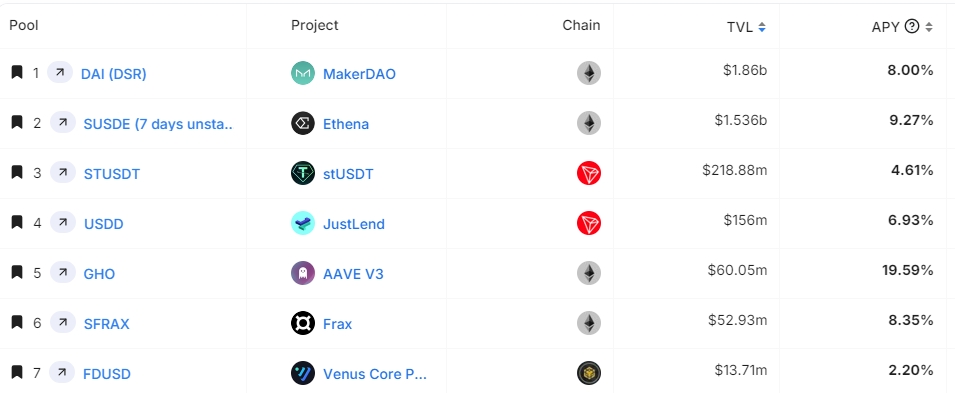
According to the latest DefiLlama data, the yields of major representative yield-bearing stablecoins are shown below:
V. Risks and Challenges of Yield-Bearing Stablecoins
Sustainability of Returns Yield-bearing stablecoins' income sources may be affected by market fluctuations and policy changes. For example, a decrease in Treasury rates and an increase in Ethereum staking ratios could lead to lower yields. Therefore, investors need to closely monitor market dynamics and policy changes to assess the sustainability of returns.
Liquidity and Use Case Scarcity Yield-bearing stablecoins may face challenges in liquidity and use cases due to issues like scalability, liquidation risk, low capital efficiency, or the need for permissioned use cases. This limits their growth potential and may affect investor confidence.
Contract Risks Like all DeFi protocols, yield-bearing stablecoins cannot completely avoid contract risks. Some protocols may also face liquidity risks and composability risks. Therefore, investors must understand the specific risks and adopt appropriate risk management measures when choosing strategies.
VI. Future Trends in the Stablecoin Landscape
Continued Market Expansion The stablecoin market has shown rapid growth in recent years, with a total market value exceeding $160 billion and continuing to expand. As the global cryptocurrency market matures and the demand for stability increases, the stablecoin market is expected to grow further. Fiat-collateralized stablecoins will continue to dominate, while decentralized crypto asset-collateralized and algorithmic stablecoins will gradually increase their market share.
Diversification of Stablecoin Types The trend of diversification in stablecoin types is evident, meeting the needs of different investors. Fiat-collateralized stablecoins offer high stability and liquidity, suitable for most investors; crypto asset-collateralized stablecoins provide higher decentralization and transparency, attracting DeFi community attention; algorithmic stablecoins explore new value stabilization methods through innovative mechanisms. These different types of stablecoins will continue to coexist and complement each other.
Rise of Yield-Bearing Stablecoins Yield-bearing stablecoins provide opportunities for investors to earn additional returns while maintaining asset stability through innovative yield models. As the demand for both yield and stability increases, yield-bearing stablecoins are gradually rising. They provide stable and attractive returns to holders through investments in US Treasuries, blockchain staking, and structured strategies, and are expected to occupy a larger share in the stablecoin market in the future.
Strengthening Global Regulation Global regulatory bodies are gradually increasing their focus on stablecoins, and countries may introduce corresponding policies and regulations to regulate stablecoin issuance and trading. For example, the US Congress has introduced two versions of stablecoin legislation, and the EU's MiCA regulation for crypto assets, including stablecoin rules, came into effect on June 30. Compliant and transparent stablecoins will benefit from this trend, gaining more market recognition and support.
Conclusion
Yield-bearing stablecoins offer investors tools to combat inflation through various innovative yield models and provide relatively stable appreciation methods in volatile markets. As the market develops further, yield-bearing stablecoins are expected to occupy a larger share of the stablecoin market. However, their future development still faces challenges in terms of return sustainability, liquidity, and market acceptance. Investors need to choose appropriate stablecoin types and investment strategies based on their risk preferences and investment needs.
About Us
Hotcoin Research, as the core investment research department of Hotcoin, is dedicated to providing comprehensive and professional analysis of the crypto market. Our goal is to offer clear market insights and practical operational guidance for investors at all levels. Our professional content includes "Play to Earn Web3" tutorial series, in-depth analysis of crypto market trends, detailed analysis of potential projects, and real-time market observations. Whether you are a newcomer exploring the crypto world or a seasoned investor seeking deep insights, Hotcoin is your reliable partner for understanding and seizing market opportunities.
Risk Disclaimer
The crypto market is highly volatile, and investment involves risks. We strongly advise investors to fully understand these risks and operate within a strict risk management framework to ensure the safety of their funds.
Website:https://www.hotcoin.com/
X:x.com/HotcoinAcademy
Mail:labs@hotcoin.com
Medium:medium.com/@hotcoinglobalofficial
読書をお勧めします
もっと見る



Service@hotcoin.com
Product@hotcoin.com
Business@hotcoin.com
Casecn@hotcoin.com