
Explanation of Common Terms in Futures
For newcomers, contract trading is more complex than spot trading and involves more specialized terms. In order to help new users better learn and master contract trading, this article will explain common contract terms one by one.
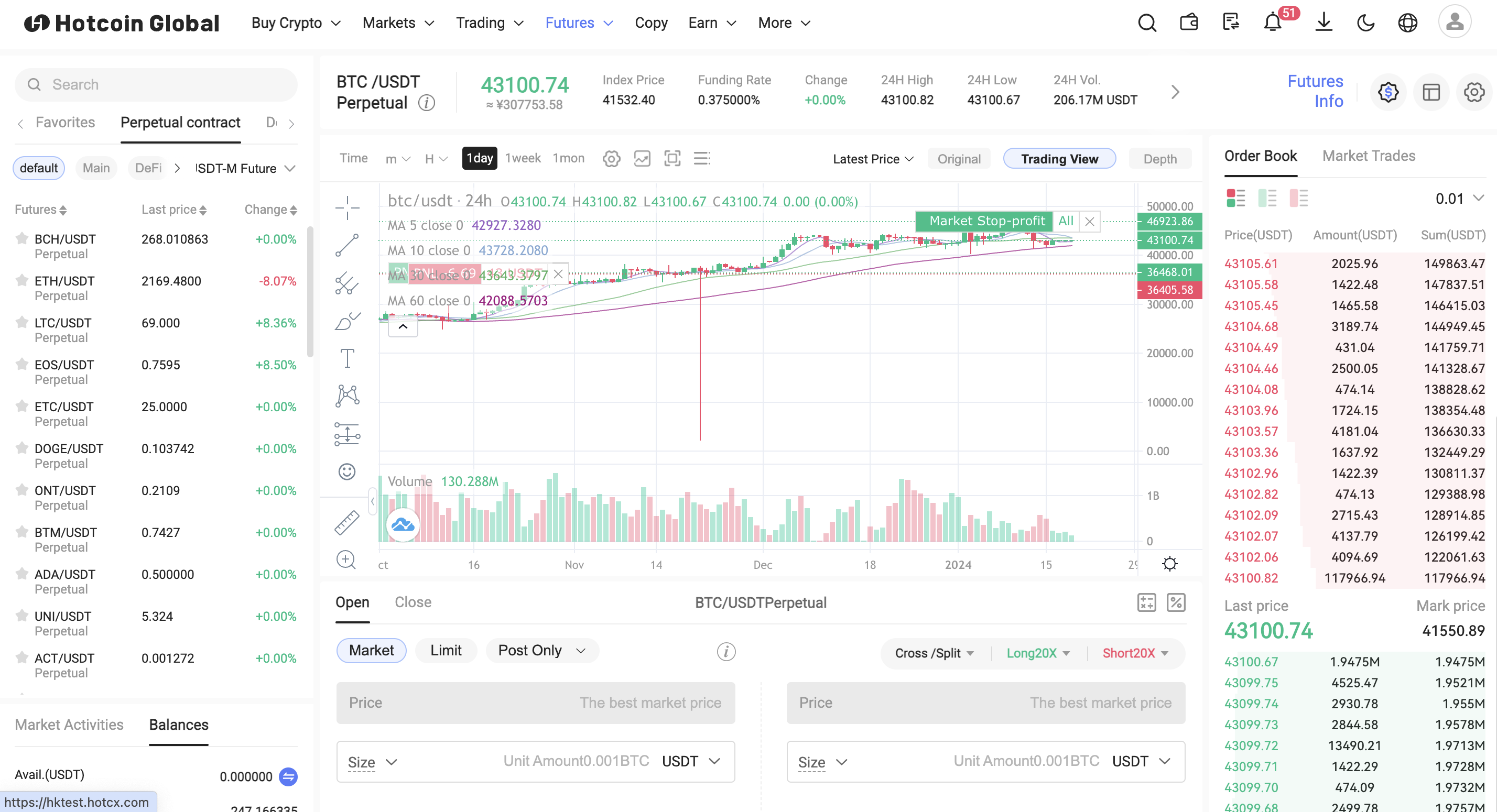
Contract Face Value (Sheet): Indicates the value of one contract, measured in the number of coins per contract for USDT Native Contracts, and in the number of USD per contract for Coin Native Contracts.
Index Price: A composite price index based on a weighted average of prices from major exchanges. The index price shown on the current page is the index price of BTC.
Marked Price: The real-time fair price of the contract, based on a combination of the index price and the market price. It will be used to calculate the floating profit and loss of the position as well as to determine the strong closure of the position, which may deviate from the latest transaction price of the contract, in order to avoid price manipulation and unnecessary positions.
Funding rate: Since perpetual contracts do not have an expiration date, a funding rate mechanism is used to balance the gap between the contract and the spot market price. If the rate is positive, the long position pays for the short position. If the rate is negative, a short position pays for a long position.
Settlement: Funding fees are settled every 8 hours and are paid between users.
Open/Close Position: According to your judgment on the rise and fall of the price and quantity, you can choose to open long or short. If you predict a rise, open a long position; if you predict a fall, open a short position. When you will buy the contract sold, that is to close the position. When you open a position to buy contracts held in the hands of the unsettled stage, that is, the position.
Margin: the user to pay a certain percentage of funds as a financial guarantee can be carried out after the contract transactions, this money is the margin. Margin mode is divided into a position-by-position mode and full position mode.
- Initial margin: the minimum amount of margin required to open a position.
- Initial margin rate: the value of the opening position / position margin. The starting margin ratio shows your leverage.
- Maintenance Margin: The minimum amount of margin required to maintain a position. When the margin balance of a position is less than the maintenance margin, the position will be liquidated or reduced. Maintenance Margin = Notional Value of Position * Maintenance Margin Ratio.
- Maintenance Margin Ratio: Calculated based on the user's position size, the Maintenance Margin Ratio is not affected by leverage.
Full Position / Position by Position: Full Position Margin Mode means that the entire balance of the account is used as margin to secure all full positions and avoid forced liquidation. Under this margin model, forced liquidation will be triggered when the Equity is insufficient to meet the Maintenance Margin Requirement. If a full position is forcibly closed, the user will lose all the assets in the account except for the margin of other position-by-position positions. The maximum loss on a position-by-position basis is limited to the Initial Margin and Position Margin Call used for that position-by-position basis. In the event of a forced liquidation of a position, the user only loses position-by-position margin and the account balance is not called up. By segregating the margin used for a position, you can limit losses on that position.
Entrustment methods: divided into limit, market, plan and Maker only.
- Limit Orders: Limit Orders allow the user to set the commission price and the order will be filled at the commission price or at a better price than the commission price.
- Market Order: The market order will be filled at the best price available in the commission table at that time, without setting the price yourself, which can make the order filled quickly.
- Plan commission: set a trigger price, when the user selected the base price touches the trigger price will be commissioned to the price (support limit price or market price) to place an order.
- Maker Only: When placing an order you have the option to place a Maker Only order so that your order will not be executed in the market immediately. It will be in the order book as a Maker order, but will not be matched with an order already in the order book. Maker-only orders add liquidity to the market. When you execute an order on the take side, you will only pay the Maker Fee and not the Taker Fee.
Take Profit and Stop Loss: A closed position with pre-set trigger conditions (Take Profit or Stop Loss), when the latest price reaches the pre-set trigger price, the system will close the position at the optimal market price according to the pre-set trigger price and quantity, so as to achieve the purpose of Take Profit or Stop Loss, which allows the user to automatically settle the desired profit value or avoid unnecessary losses.
Taker and Maker:
- Taker liquidity extractor: the order is hung out of the initiative with the existing order to close immediately, it extracts the market liquidity.
- Maker liquidity provider: refers to the order is not listed with the existing pending orders, but is placed on the plate waiting for the transaction, it increases the liquidity of the market.
- Automatic Position Reduction: When an investor is forced to close a position, their remaining position will be taken over by Hotcoin's perpetual contract liquidation system. If the position is not closed out in the market, and when the marked-to-market price reaches the bankruptcy price, the automatic position reduction system will reduce the position of the investor who holds a position in the opposite direction. The order in which the positions are reduced will be determined by the leverage and profitability ratios.
Contract Calculator (Note: The results calculated using the Contract Calculator are for reference only, the actual final amount will be based on the real market):
- Yield Calculator: Enter your average opening price, number of open positions and leverage, and set the closing price you want to achieve to calculate the final yield and profitability.
- Close Price: Enter your average opening price, number of open positions, and leverage, set the amount of return or yield you want to earn, and the desired close price can be calculated.
- Close Price: Enter your average opening price, number of open positions, and leverage multiple, set the amount of guarantee you are submitting, and you can calculate your close price.
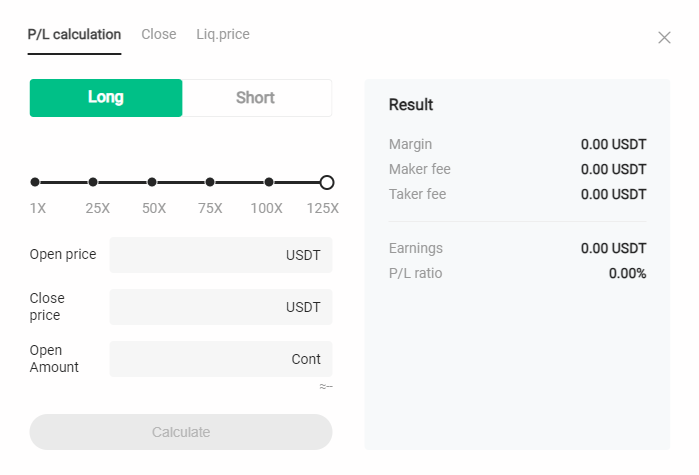
Unrealized P&L: The long/short P&L displayed when a position is opened and not yet closed.
U-based Contracts:
- Buy: Contract Unrealized P&L = (Latest Marked Price - Average Price of Open Positions) * Contract Face Value * Position Size. For example, if a user buys and opens 60 BTC contracts at 5000 BTC/USDT, and now the latest marked price is 6000 BTC/USDT, the unrealized gain/loss on the c5000) * 0.01*60 = 600USDT
- Sell: Unrealized P/L = ( Average Opening Price - Latest Marked Price ) * Contract Face Value * Position Size. For example, if a user sells 10 BTC contracts at 10,000 BTC/USDT and now the latest marked price is 5,000 BTC/USDT, the realized profit/loss on the c5,000) * 0.01*10= 500USDT
Currency-based contract:
- Buy: Unrealized P&L = ( 1/Average Opening Price - 1/Latest Marked Price)*Contract Face Value * Position Size. For example, if a user buys and opens 60 BTC contracts at 5000 BTC/USD, and now the latest marked price is 6000 BTC/USD, the unrealized gain/loss on the c- 1/6000)*100*60 = 0.2BTC
- Sell: Unrealized profit/loss on cmarked price - 1/average price of open positions) * contract denomination * position size. For example, if a user sells 10 BTC contracts at 10,000 BTC/USD and opens a short position, and now the latest marked price is 5,000 BTC/USD, the realized profit/loss on the c- 1/10000)*100*10= 0.1BTC
Realized P&L: Long/Short P&L shown after closing the position.
U-based contract:
- Buy: Contract Realized P&L = (Close Price - Average Open Price) *Contract Face Value *Close Quantity. For example, if a user buys 5000BTC/USDT and opens a long position of 20 BTC contracts, with a nominal value of 0.01BTC, and then sells 10 contracts at a price of 10,000BTC/USDT to close the long position, then: realized gain/loss on the c- 5,000) * 0.01*1 0= 500USDT
- Sell: realized profit/loss on cprice of opening position - price of closing position) * face value of contract * number of closed positions. For example, if a user sells 1,000 BTC contracts at 5,000 BTC/USDT and then buys 10 contracts at 10,000 BTC/USDT to close the position, the realized profit/loss on the c- 10,000) 0.01 10= -500USDT
Currency-based contracts:
- Buy: realized profit/loss = (1/opening average price - 1/closing price)*contract face value*closed quantity. For example, if a user buys 20 BTC contracts at 5000BTC/USD, with a nominal value of 100USD, and then sells 10 contracts at 10000 BTC/USD to close the position, then: realized profit/loss on the c- 1/10000) *100*10= 0.1BTC
- Sell: Contract realized profit/loss = (1/closed price - 1/open average price) *contract face value *closed quantity. For example, if a user sells short 10 BTC contracts at 5000 BTC/USD, and then buys 10 contracts at 10000 BTC/USD to close the position, the realized profit/loss on the c- 1/5000)*100* 10= -0.1BTC
For novice traders, before trading contracts for the first time, you can use Hotcoin's contract simulator for real-world training, and then enter the live market for trading after familiarizing yourself with the various functions.
読書をお勧めします
もっと見る


Service@hotcoin.com
Product@hotcoin.com
Business@hotcoin.com
Casecn@hotcoin.com