
Should You Take Profits From DCA? How to Build an Exit Plan
A dollar-cost averaging strategy should include exit conditions from the start, but reaching a certain return does not mean you must sell the entire position. A more practical approach is to base the plan on your financial goals, portfolio allocation, and asset risk, then exit gradually through staged sales or rebalancing.
Why DCA Still Needs an Exit Plan
DCA determines how funds enter the market in stages; it does not determine when to sell. Its basic rule is to invest a fixed amount at regular intervals, buying more units when the price is lower and fewer when the price is higher. However, DCA cannot guarantee a profit or automatically detect when an asset's risk profile has changed.
Without an exit plan, investors may keep raising their targets during a rally and sell reactively only after prices fall. They may also resist admitting that their original view is no longer valid because they have invested a substantial amount over time. Exit rules are not meant to predict the top. They define in advance when the funds will be needed, what level of concentration is excessive, and which changes mean the asset should no longer be held.
When creating a plan, distinguish among these decisions:
Stop DCA purchases: Stop adding new funds while keeping the existing position for now.
Exit partially: Sell part of the asset to reduce its allocation or withdraw funds for an interim goal.
Exit completely: End the allocation to the asset and retain none of the original position.
Switch assets: Sell and move the proceeds into another asset. This does not necessarily reduce overall investment risk.
These four decisions serve different purposes and should not all be described simply as “taking profits.”
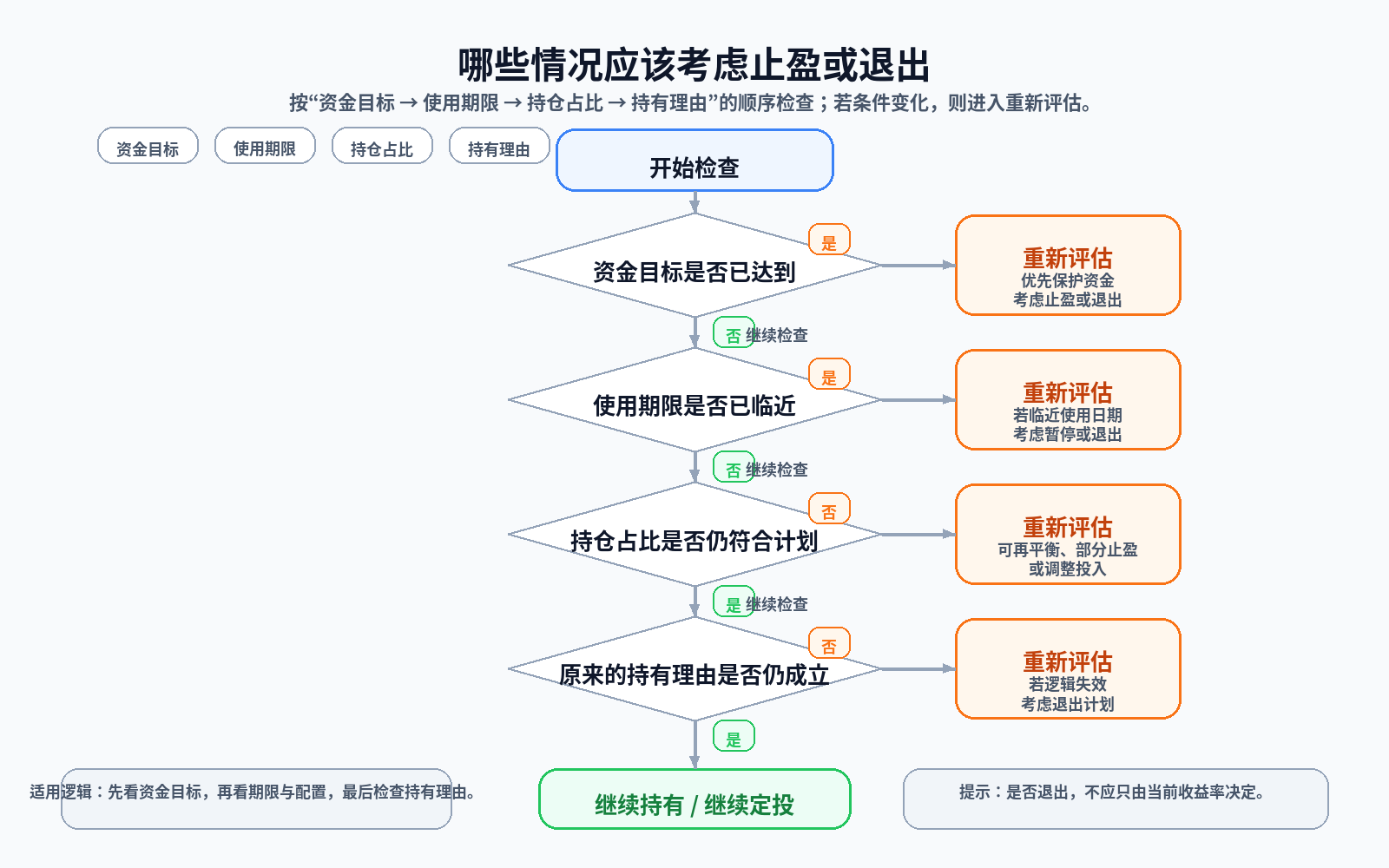
When to Consider Taking Profits or Exiting
The decision to exit should not depend only on the current return. A practical order is to review the financial goal first, then the portfolio allocation and original investment thesis, and only then consider the market price.
The financial goal has been reached. If the DCA plan serves a specific objective, such as a future expense, protecting the funds should become the priority once the required amount has been reached or the spending date is near. The investment horizon determines how long the funds can withstand market fluctuations. As that horizon shortens, the original risk level also needs to be reassessed.
The allocation has grown well beyond the plan. When one asset rises faster than the rest of the portfolio, its share of total assets may keep increasing and push account risk away from the original allocation. Rebalancing restores the portfolio to its target proportions, either by selling an overweight asset or directing new funds toward underweight assets.
The original reason for holding the asset is no longer valid. If there are major changes to project security, liquidity, utility, governance, token mechanics, or market conditions, you should reassess whether to keep holding even if the position is not profitable. An exit plan should define not only the desired return but also the risk changes that would invalidate the original thesis.
Personal cash flow or risk tolerance has changed. If income falls, essential expenses rise, or the funds will soon be needed elsewhere, you may pause DCA purchases, reduce the position, or exit. Continuing to bear unaffordable risk simply to wait for the position to break even is already a departure from the plan.
Three Common Ways to Exit a DCA Position
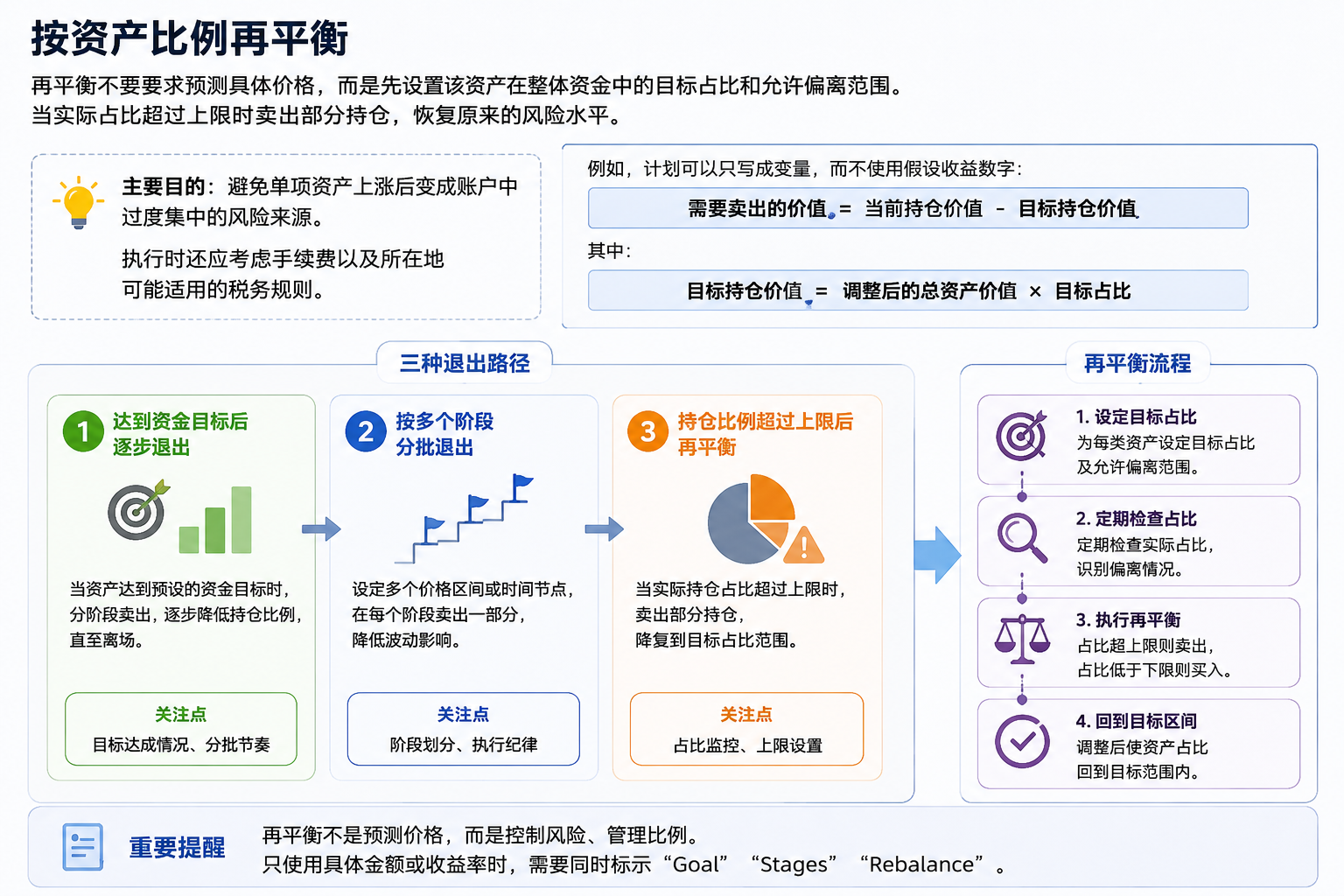
A DCA exit can be based on a financial goal, staged sales, or portfolio rebalancing. These methods can be used separately or together, but each should have defined triggers and a defined sale amount before execution.
Exit Based on a Financial Goal
First define the specific purpose and timeline of the DCA plan. When the account reaches the target value or the funds are about to enter their spending phase, gradually reduce risk and move them into assets better suited to the intended use.
This method has a clear reason for exiting and does not depend on guessing the market top. Its limitation is that prices may decline near the target date, so planning should not wait until the final day. As the spending date approaches, exposure to highly volatile assets can be reduced in stages.
Take Profits in Stages
Staged profit-taking does not mean selling the entire position at one price. Instead, divide the amount you plan to exit into several portions and execute them under different conditions.
Each stage may be triggered when:
The price reaches a predefined target zone;
Total assets reach an interim financial target;
The asset allocation exceeds its preset limit;
Market risk or volatility rises significantly;
The remaining position needs to be managed with a trailing exit rule.
Staged exits reduce the impact of a single poor decision, but they may also cut the position too early during a sustained rally. Too many sale stages increase the number of transactions and associated fees, so the plan should not become overly complex in an attempt to identify the exact top.
Rebalance by Asset Allocation
Rebalancing does not require predicting a specific price. Instead, set the asset's target share of the overall portfolio and an acceptable deviation range. When the actual allocation exceeds the upper limit, sell part of the position to restore the original risk level.
For example, the plan can use variables rather than hypothetical return figures:
Value to sell = Current position value − Target position value
Where:
Target position value = Adjusted total portfolio value × Target allocation
The main purpose of rebalancing is not to decide whether the price has peaked. It is to prevent one appreciating asset from becoming an excessively concentrated source of account risk. Execution should also account for trading fees and any tax rules that may apply in your jurisdiction.
How to Create an Actionable Exit Plan
A complete exit plan should specify at least the reason for exiting, trigger conditions, proportion to sell, destination of the proceeds, and review process. “Sell when the gain feels sufficient” is not actionable because the definition of “sufficient” tends to move with the market.
The planned exit amount can be divided as follows:
Amount to sell at one stage = Total planned exit amount × Sale percentage for that stage
The percentages across all stages should add up to 100% of the portion designated for exit, not necessarily 100% of the entire position. An investor may retain a long-term holding while setting staged exits for only part of it.
The plan should also establish priorities. For example, an invalidated asset-risk condition should take precedence over a price target. Similarly, if the funds are already needed, you should not keep waiting simply because the ideal return has not been reached.
How to Execute an Exit Plan on Hotcoin
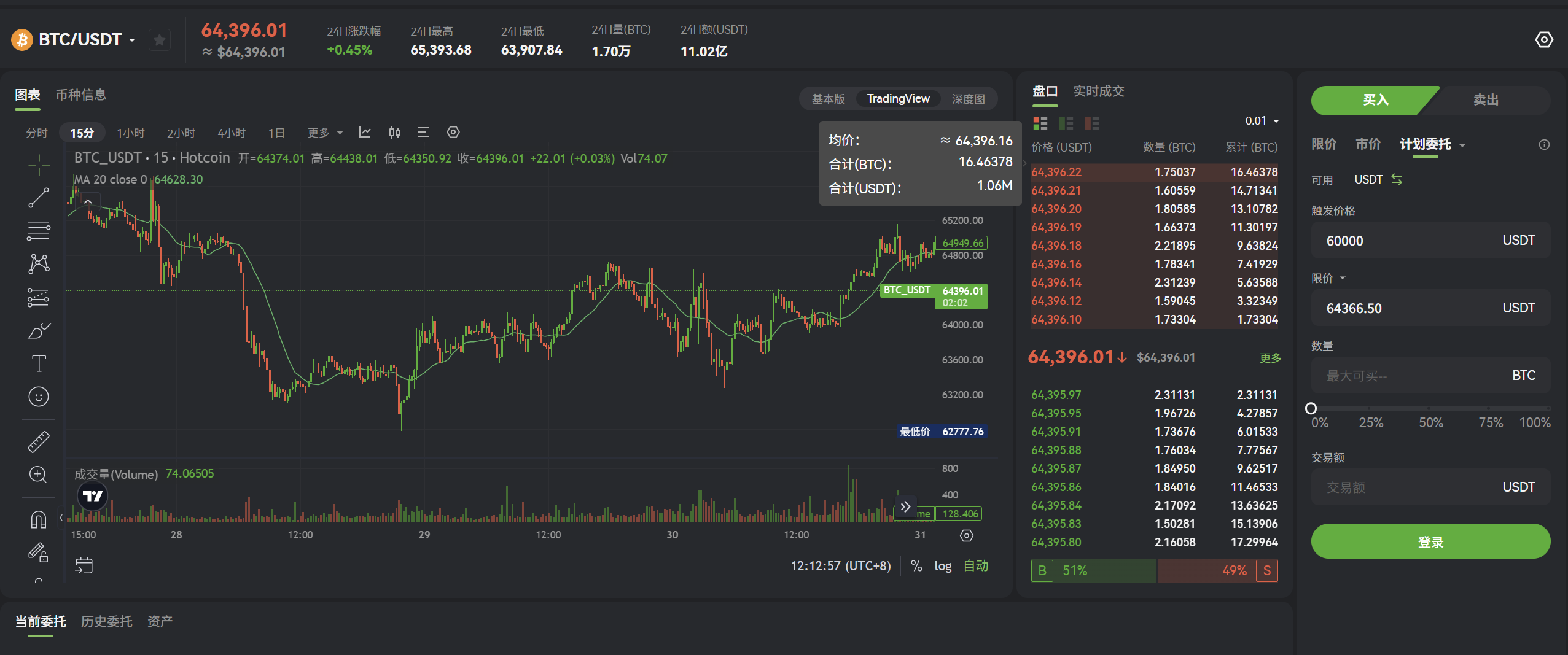
As of July 2026, Hotcoin spot trading supports limit orders, market orders, trigger orders, and trailing orders. Each order type emphasizes a different aspect of execution. Choose based on the exit condition instead of setting only one target price.
Limit order: Lets you set the desired execution price in advance, but the order may not fill immediately if the price is not reached or market depth is insufficient.
Market order: Executes at prices currently available in the market and prioritizes speed. During rapid market moves, the actual average execution price may differ from the price displayed when the order was placed.
Trigger order: Places an order after the price reaches a predefined condition and can be used to implement an exit rule established in advance.
Trailing order: Adjusts its trigger level as the price moves favorably, then executes when the specified pullback condition is met. It can help manage the portion of a position that should retain some upside exposure.
Before using any order type, confirm trading fees, order size, market liquidity, and the actual fill records. Hotcoin's standard spot trading fee for regular users is currently 0.2% per fill. Check the “My Fee Rates” page in your account for the rate that actually applies to you.
Common Mistakes When Building an Exit Plan
Setting a return target without specifying how much to sell. If you still do not know whether to sell part or all of the position after the target is reached, short-term emotions can easily override the plan.
Assuming that “taking out the principal” makes the remaining position risk-free. Selling an amount equal to the initial investment is simply one way of recovering funds. The remaining assets still fluctuate according to their current market value; they are not “zero-cost assets.”
Buying back immediately at a higher price after taking profits. Exiting and re-entering should have separate rules. Repurchasing because of fear of missing out can undo the original objective of reducing risk.
Continuing DCA solely because the price has fallen. A lower price does not necessarily mean better value. If the project or investment thesis has changed, continued purchases may increase risk.
Keeping the entire position in highly volatile assets as the spending date approaches. The time needed for a market recovery cannot be known in advance. The closer the funds are to being used, the earlier the adjustment should begin instead of making the exit depend on the market price on one particular day.
Changing the plan too frequently. FINRA warns that active market timing can increase transaction costs and may cause investors to miss a subsequent recovery after exiting during a sharp decline. Exit rules should change when goals or risk conditions change, not in response to every short-term price move.
Frequently Asked Questions
Can I continue DCA purchases in the same asset after taking profits? Yes, but the purpose of each action should be clear. For example, you might sell the portion above the target allocation while continuing to accumulate for the long term at a smaller amount. If you take profits on the entire position and immediately resume the same contributions, review whether the plan contradicts itself.
Is “sell the principal and keep the profit invested” a reasonable method? It can be used as a staged exit method, but it does not remove risk from the remaining position. The market calculates gains and losses based on the current value of the remaining assets; it does not distinguish between principal and profit.
How often should an exit plan be reviewed? You can review it on a fixed schedule or when there is a major change in cash flow, asset risk, or the financial goal. A review does not mean you must trade every time.
Does selling DCA assets have tax implications? Rules for digital asset sales, exchanges, and capital gains vary by country and region. Check the rules in your jurisdiction when creating the exit plan and consult a qualified tax professional when necessary.
Usage Note
The goal of a DCA exit is not to sell at the highest point. It is to reduce or close the position according to predefined rules when financial goals, asset risk, or portfolio allocation changes.
Risk Warning
Crypto assets are highly volatile. Staged exits, rebalancing, and conditional orders cannot guarantee execution at the expected price. Transactions may also involve fees, slippage, and tax consequences. This article is for user education and informational purposes only and does not constitute investment, financial, legal, or tax advice.
読書をお勧めします
もっと見る



Service@hotcoin.com
Product@hotcoin.com
Business@hotcoin.com
Casecn@hotcoin.com