
Complete Guide to Cryptocurrency Scams: From Pig Butchering to Rug Pulls
Cryptocurrency scams usually exploit trust, fear, or greed to trigger action, then steal login credentials, induce a wallet signature, or demand a transfer. To assess a suspicious situation, trace who ultimately receives the funds or permissions.
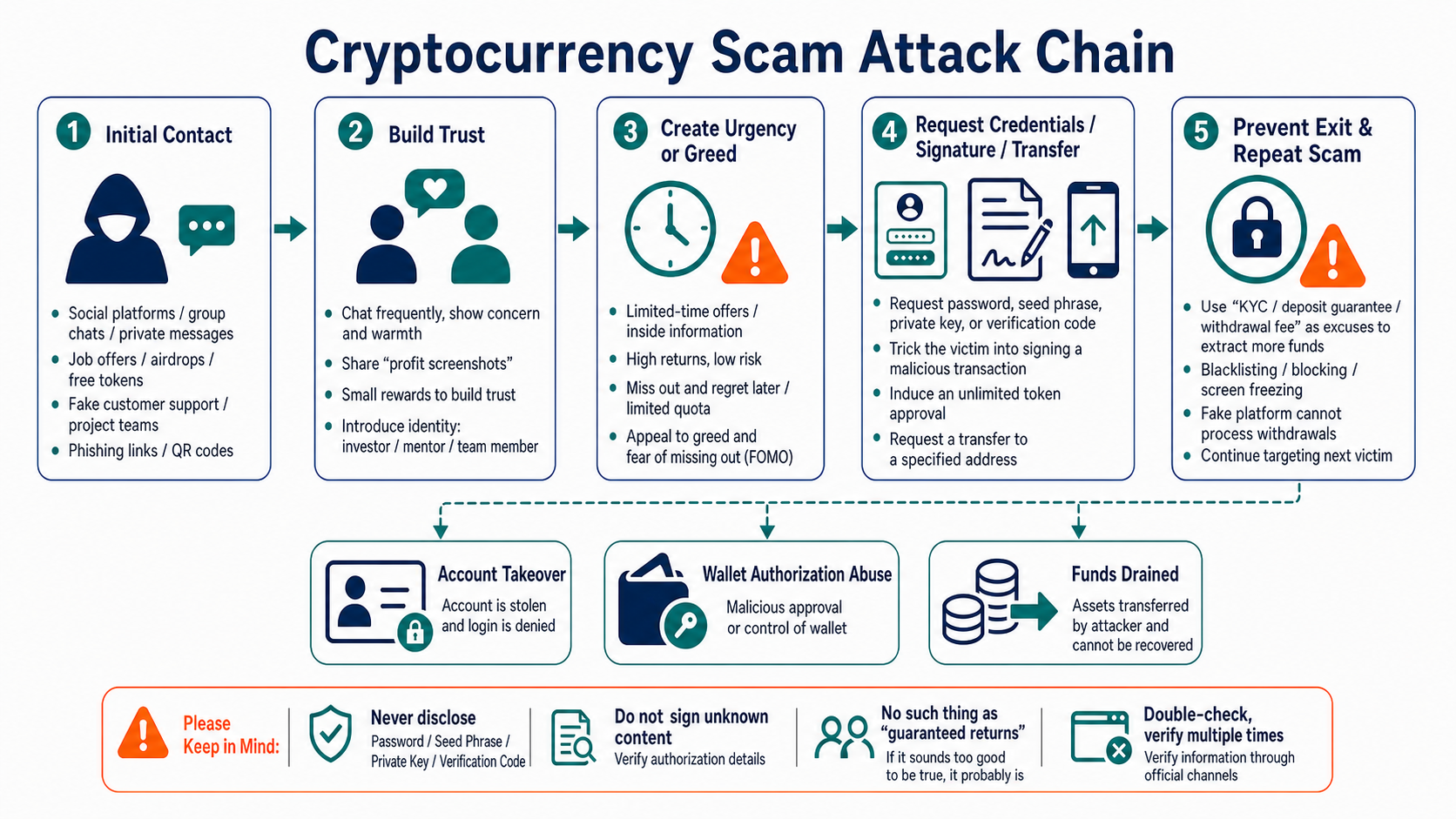
Start by Classifying the Loss Mechanism
Relationship-investment scams and Ponzi schemes mainly persuade victims to transfer funds voluntarily. Phishing sites and fake support agents steal account credentials. Airdrop and wallet scams often induce approvals or signatures. Rug Pulls and fake tokens embed the risk in project control, liquidity, or smart-contract rules.
This classification matters. Changing a password cannot reverse an on-chain transaction after funds have been sent to a scammer. If you only granted a token approval, revoking it may still prevent a loss. If a seed phrase has been exposed, revoking approvals is not enough: every account derived from the old wallet should be treated as compromised.
Quick Reference for Common Scams
| Type | Typical opening | What the scammer wants you to do | Main checks |
|---|---|---|---|
| Pig-butchering scam | Wrong-number message, dating approach, or prolonged conversation | Keep depositing into a fake platform | Platform operator, genuine withdrawals, and independent verification outside the relationship |
| Phishing | Account alert, upgrade notice, airdrop, or search ad | Log in, download an app, or scan a QR code | Full domain name, official app store, and independently accessed official entry point |
| Fake support | Unsolicited contact paired with an urgent problem | Share a code, install remote-control software, or transfer to a “safe” address | Whether you initiated the support request through the official website |
| Airdrop approval scam | Free claim, compensation, or eligibility check | Submit an Approve, Permit, or blind signature | Contract, spender, allowance amount, and actual transaction effect |
| Ponzi scheme | Guaranteed high returns and referral rewards | Deposit funds and recruit others | Source of returns, withdrawal restrictions, and dependence on new deposits |
| Rug Pull | Hype around a new project and promises of deep liquidity | Buy tokens or provide liquidity | Admin privileges, liquidity control, and token concentration |
| Fake token or honeypot | Imitation of a popular token or contract | Buy a token that cannot be sold | Official contract address, sell simulation, taxes, and blacklist privileges |
Why Do Scams Look So Convincing?
Scammers copy official websites, fabricate transaction histories and profit dashboards, and use stolen social accounts, real employees' profile photos, or the names of existing projects. They may even allow a small withdrawal as bait for a much larger deposit, so one successful withdrawal does not prove that a platform is legitimate.
A real blockchain transaction does not prove that the counterparty's business is real. Scammers may first direct victims to buy assets on a legitimate exchange and then transfer them to an address under the scammer's control. The blockchain record only proves that a transfer occurred; it does not validate the claimed investment, support service, or project.
A Pause Rule for Suspicious Requests
Stop immediately when a request combines urgency, secrecy, remote guidance, a designated transfer address, or a demand to “pay first to unlock funds.” Close the chat and webpage, then check the account through an official entry point you saved yourself. Do not use a phone number, search ad, or QR code supplied by the other party.
Ask someone who was not involved in the earlier conversation to review the situation. Scams rely on continuous communication to sustain psychological pressure. A short break makes it easier to reassess the organization, domain, wallet permissions, and destination of funds.
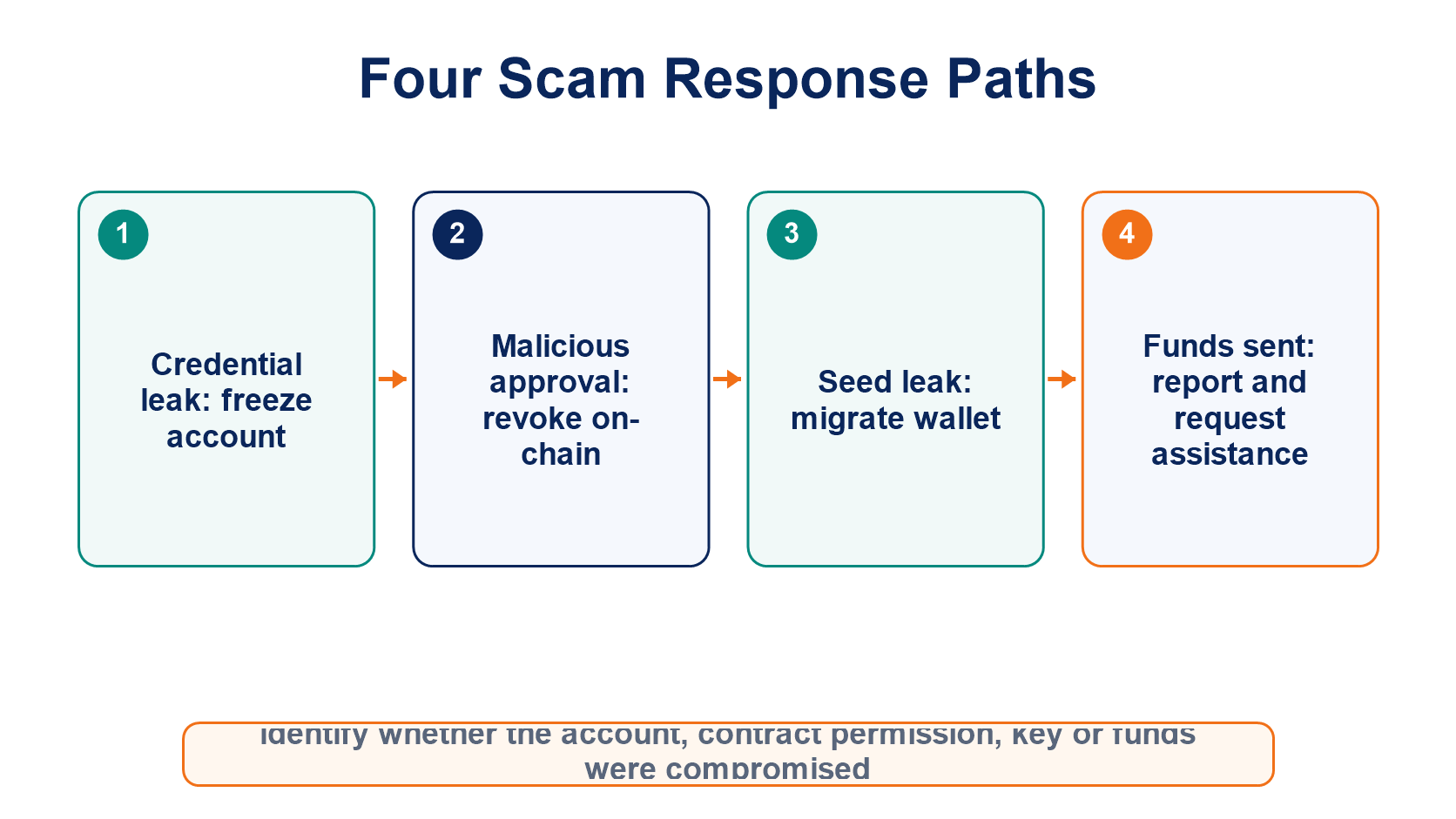
What Should You Do After Taking an Action?
If you entered an account password or verification code, freeze the account, revoke active sessions and API access, and secure the associated email account. If you signed a token approval, inspect and revoke it with a trusted tool. If the signature has already executed an asset transfer, also trace the transaction and preserve evidence.
If you entered a seed phrase or private key into a webpage, chat, or remote-control application, use a clean device to create a new wallet and move any remaining assets. If you already transferred funds to a scammer, promptly contact the relevant exchanges, stablecoin issuers, and local law-enforcement agencies with the transaction hash, addresses, timestamps, and communication records. Do not trust paid services that guarantee recovery.
Continue with guides on pig-butchering scams, phishing detection, Ponzi and pyramid schemes, airdrop approval traps, fake customer support, SIM swapping, Rug Pulls, fake tokens and honeypots, social media scams, the psychology of scams, post-scam damage control, and the 2025 scam alert log.
Frequently Asked Questions
The Other Party Let Me Make a Small Test Investment and Withdraw It. Does That Prove It Is Not a Scam?
No. A fraudulent platform may treat a small payout as a customer-acquisition cost, then block withdrawals after the victim deposits more by demanding taxes, collateral, or additional reviews.
A Block Explorer Shows That the Other Party's Address Holds a Large Balance. Is the Project Trustworthy?
No. The balance may come from temporary transfers, related addresses, or assets whose origin cannot be explained. It also does not prove the controller's identity, liabilities, or ability to honor redemptions.
I Saw the Person on Video. Does That Confirm Their Identity?
Not necessarily. The video may be prerecorded, deepfaked, or played through a stolen account. Even a real appearance does not validate the investment platform or the stated use of funds.
My Wallet Says the Transaction Will Not Cost Gas. Is the Signature Safe?
No. An off-chain signature, Permit, or login signature may not consume Gas immediately, but it can still grant permissions or be submitted for execution later.
読書をお勧めします
もっと見る
service hotcoin.com
producthotcoin.com
businesshotcoin.com
casecnhotcoin.com