
BNB Chain (BSC) Ecosystem: The Secrets Behind Its High Transaction Volume
BNB Smart Chain is an EVM-compatible Layer 1 that uses Proof of Staked Authority (PoSA) to select validators. Low migration costs, short block times, and mature tooling have helped drive substantial on-chain activity.
Calling it the king of transaction volume describes its ecosystem rather than a permanent ranking. Daily transaction counts vary with market conditions, bots, campaigns, and measurement methods, and do not prove a network's value or security on their own.
How Are BNB Chain and BSC Related?
BNB Chain is the ecosystem name covering multiple infrastructure components and on-chain products. BNB Smart Chain, commonly abbreviated as BSC, is its EVM-compatible smart contract mainnet. When users refer to transferring assets on BSC, they usually mean BNB Smart Chain with Chain ID 56.
BSC's execution environment is compatible with Ethereum tooling, so developers can use Solidity, wallets, and common JSON-RPC interfaces. Compatibility makes migration and reuse easier; it does not mean the two chains share the same ledger or security.
An ERC-20 contract at a given address does not automatically exist on BSC. BSC commonly uses the BEP-20 interface, and assets may originate from native issuance, a cross-chain bridge, or a custodial mapping.
How Does PoSA Produce Blocks?
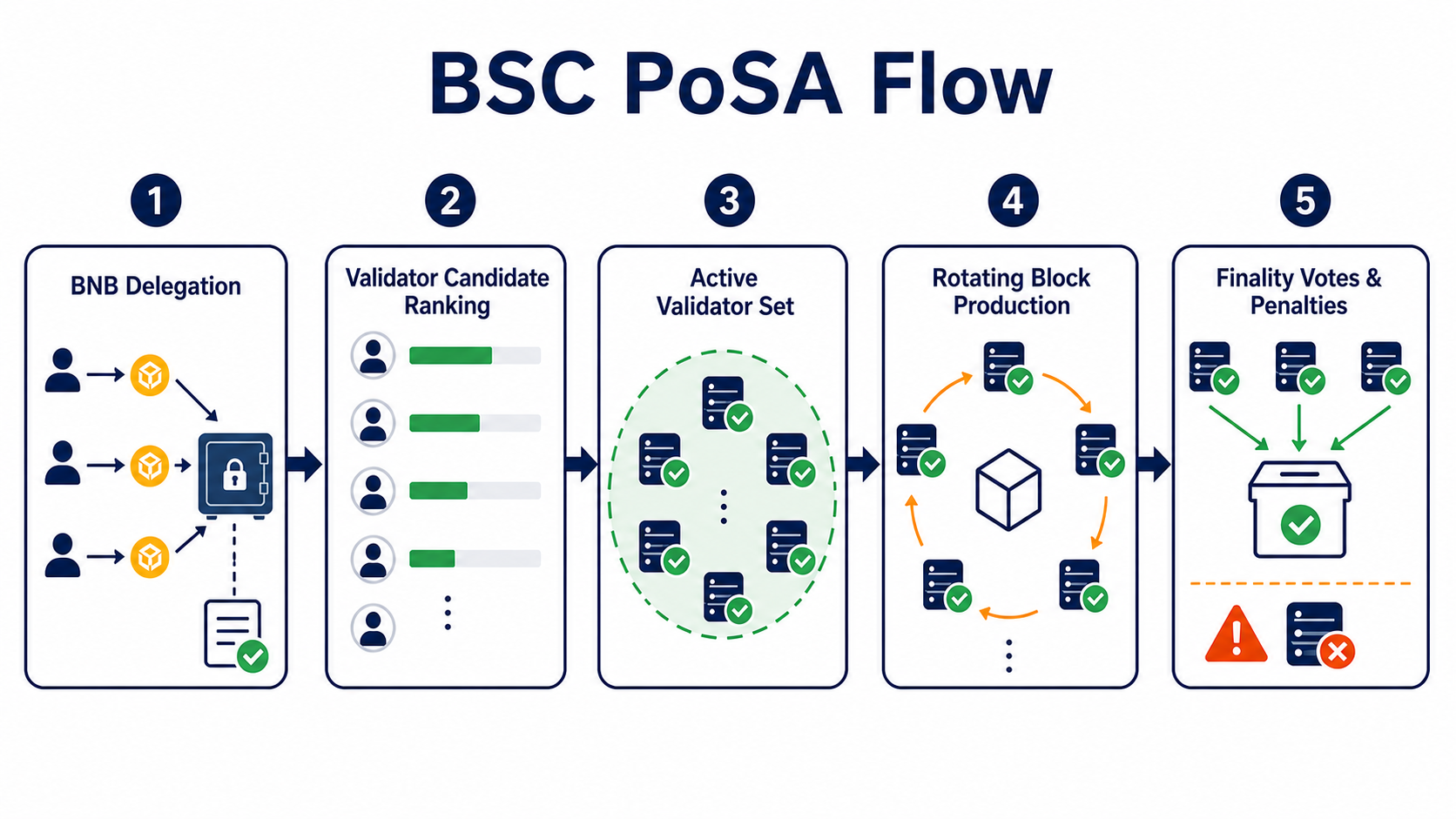
PoSA combines stake-based elections with authorized block production. Validator candidates are ranked by delegated stake to enter the active set, after which a subset takes turns producing blocks and voting on finality during each epoch.
| Participant | Primary role |
|---|---|
| Validator candidate | Runs a node, accepts delegated stake, and competes for a place in the active set |
| Active validator | Produces blocks, validates transactions, and participates in finality voting |
| Delegator | Delegates BNB voting weight to a validator candidate |
| Smart contracts | Manage staking, elections, rewards, and penalty states |
Double-signing, malicious finality votes, or prolonged downtime may result in penalties. A smaller block-producing set can coordinate quickly, but it also makes the distribution of operators and concentration of stake important factors to monitor.
A consensus mechanism cannot be assessed from the PoSA label alone. Validator elections, client implementations, finality, and governance permissions for upgrades must also be examined.
Why Does EVM Compatibility Help Expand the Ecosystem?
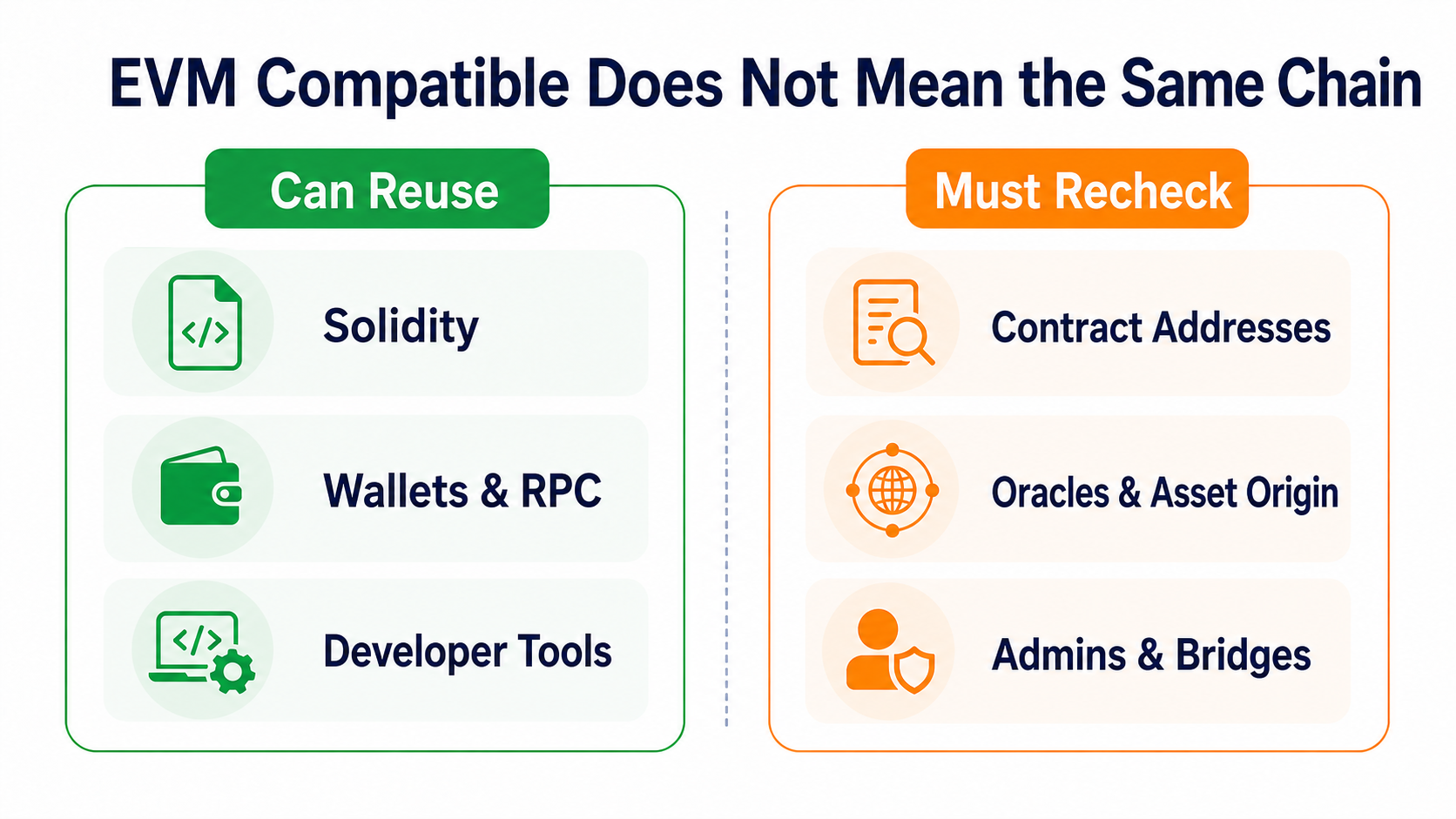
Developers can reuse Solidity contracts, development frameworks, wallet connections, and RPC libraries. Users can also keep familiar 0x addresses and interaction patterns, lowering the engineering barrier for applications entering the market.
However, after deployment on BSC, contract addresses, liquidity, oracles, administrators, and bridged assets may all differ. Similar code does not imply identical risk.
| Can be reused | Must be checked again |
|---|---|
| Solidity and EVM bytecode | The actual contract address on BSC |
| Common wallets and RPC tools | Oracle and stablecoin issuance sources |
| ERC-20-style interfaces | Administrator, upgrade, and pause permissions |
| Development and testing frameworks | Liquidity depth and cross-chain bridge assumptions |
What Is BNB Used for on the Network?
BNB is used to pay BSC gas fees, delegate stake, and participate in certain governance processes. Ecosystem applications may also use it as collateral or a trading asset, though those roles are defined by each application's contracts.
Low gas fees reduce the barrier to small transactions, but they can also encourage bot activity and spam. When evaluating genuine usage, distinguish successful transactions, failed transactions, internal contract calls, and unique fee-paying users.
Before using any BSC application, verify its domain, contract address, and connected Chain ID through official sources. Anyone can create a token with an existing name.
How Does BSC Compare with Other High-Performance Blockchains?
BSC's primary strengths are EVM compatibility and its established tooling ecosystem. Solana uses a different account and program model and enables parallel execution through explicit account access, so the two networks follow different development and performance paths. Learn more in Solana High-Performance Blockchain.
Ethereum focuses its scaling strategy on Layer 2 networks, with Layer 1 providing settlement and data security. BSC is an independent Layer 1 and does not automatically inherit Ethereum's finality. For more on Ethereum's architecture, see Ethereum: An In-Depth Overview.
For a broader comparison of Layer 1 positioning, return to the 2025 Overview of Leading Blockchain Ecosystems.
Frequently Asked Questions
Are BSC and BEP-20 the Same Thing?
No. BSC is a blockchain network, while BEP-20 is a commonly used interface standard for fungible tokens on that network. Many different BEP-20 contracts can operate on one network.
Can I Bridge Directly Because My BSC and Ethereum Addresses Are the Same?
No. The address format and private key derivation may be the same, but balances and contract states are independent on the two chains. Moving assets across chains requires an exchange, bridge, or another explicit transfer channel.
Is BNB Beacon Chain Still a Standalone Entry Point?
BNB Chain's architecture has consolidated functionality into current components such as BSC. If an older tutorial mentions BEP-2, Beacon Chain, or legacy cross-chain steps, consult the latest official migration guidance first.
Do Low Gas Fees Mean Smart Contracts Are Safer?
No. Gas reflects the price of network resources. Smart contract security depends on code, permissions, oracles, asset custody, and deployment configuration.
読書をお勧めします
もっと見る


service hotcoin.com
producthotcoin.com
businesshotcoin.com
casecnhotcoin.com