
What Is the Three-Tier Liquidation System in the Crypto Market?
In the world of crypto trading, the liquidation system is the backbone of market stability — it prevents cascading liquidations and protects both traders and platforms from extreme losses. Given the volatility and leverage common in crypto markets, a well-structured liquidation framework is essential.
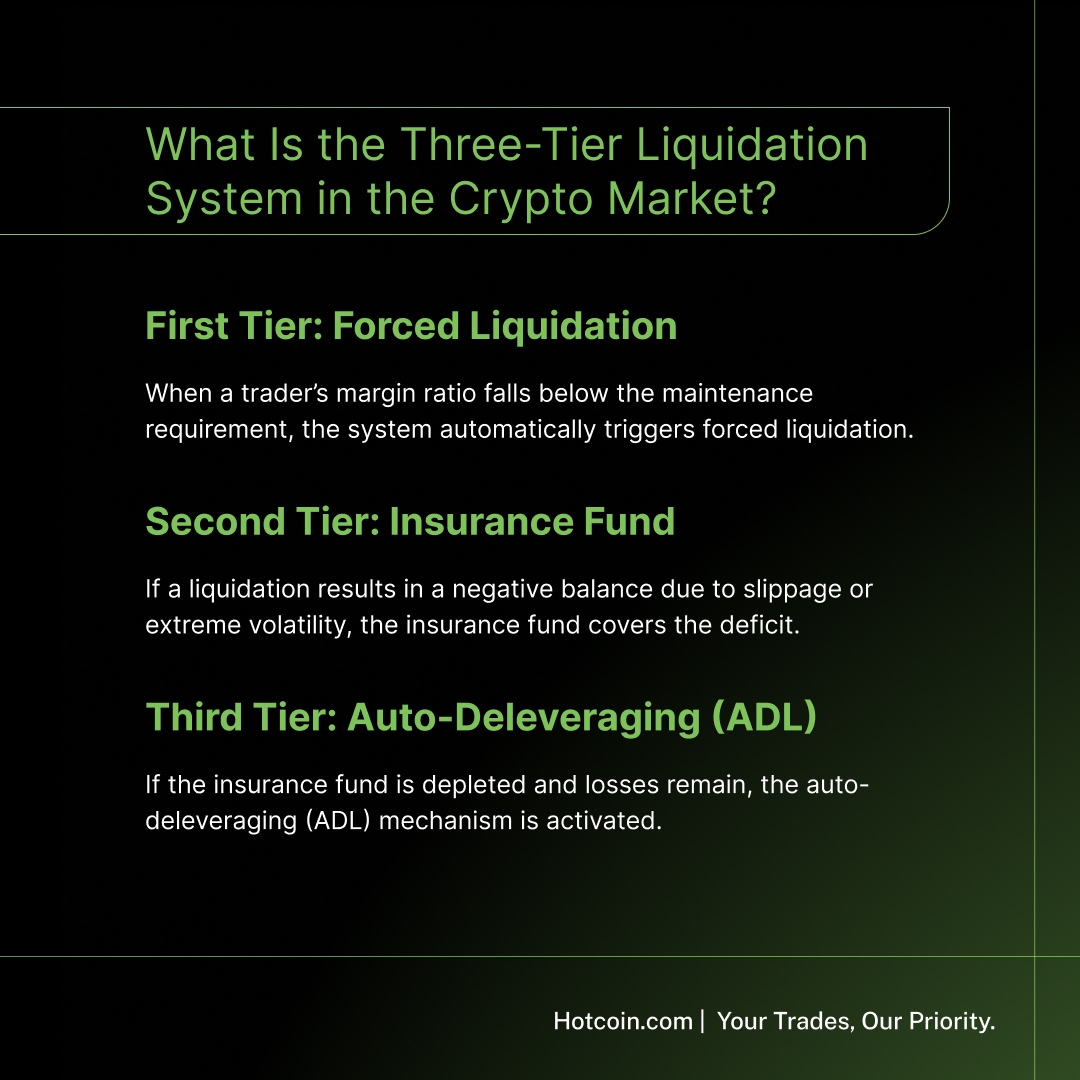
The three-tier liquidation system refers to a layered risk-management mechanism composed of:
-
Forced Liquidation
-
Insurance Funds
-
Auto-Deleveraging (ADL)
1. First Tier: Forced Liquidation
When a trader’s margin ratio falls below the maintenance requirement, the system automatically triggers forced liquidation.
-
Trigger condition: Account equity ≤ maintenance margin
-
Execution: The platform forcibly closes part or all of the position, usually via market orders, to prevent negative balances
-
Purpose: To stop further losses and protect counterparties and the platform’s capital
This is the front-line defense — the system’s first shield against cascading losses during market turbulence.
2. Second Tier: Insurance Fund
If a liquidation still results in a negative balance due to slippage or extreme volatility, the deficit is covered by the insurance fund.
-
Funding sources: Liquidation premiums, platform allocations, or a portion of trading fees
-
Function: Absorbs losses that exceed user margin, ensuring the platform remains solvent
-
Risk meaning: A larger, healthier insurance fund allows the platform to better withstand black-swan events
Major exchanges such as Binance, OKX, and Bybit regularly publish their insurance fund balances — a key indicator of their risk-management strength.
3. Third Tier: Auto-Deleveraging (ADL)
If the insurance fund is depleted and losses remain, the auto-deleveraging (ADL) mechanism is activated.
-
How it works: The system automatically reduces positions of profitable traders, prioritizing accounts with the highest leverage and profit ratios
-
Order of reduction: High-leverage, high-profit accounts are reduced first
-
Transparency: Leading exchanges display an ADL indicator in the trading interface to warn users of potential auto-reductions
ADL acts as the last line of defense. While it may cut profitable positions, it preserves overall market stability and prevents systemic collapse during extreme volatility.
4. Why It Matters: Stability and Trust
The three-tier liquidation system is more than a technical safeguard — it’s the foundation of trust in leveraged crypto trading.
-
For exchanges: It prevents systemic insolvency and preserves liquidity
-
For traders: It ensures fairness and protects capital during volatile markets
-
For the market: It reinforces resilience and limits contagion in times of crisis
In decentralized derivatives protocols like dYdX, GMX, and Hyperliquid, these same principles are implemented on-chain via smart contracts, forming the core of decentralized risk management.
In Summary
The crypto market’s three-tier liquidation system — forced liquidation, insurance fund, and ADL — acts as a multi-layer safety net. Much like an airbag in a car, it cushions the blow when markets crash.
Understanding this structure helps traders appreciate how exchanges maintain stability — and how to survive between leverage and risk.
読書をお勧めします
もっと見る


Service@hotcoin.com
Product@hotcoin.com
Business@hotcoin.com
Casecn@hotcoin.com