
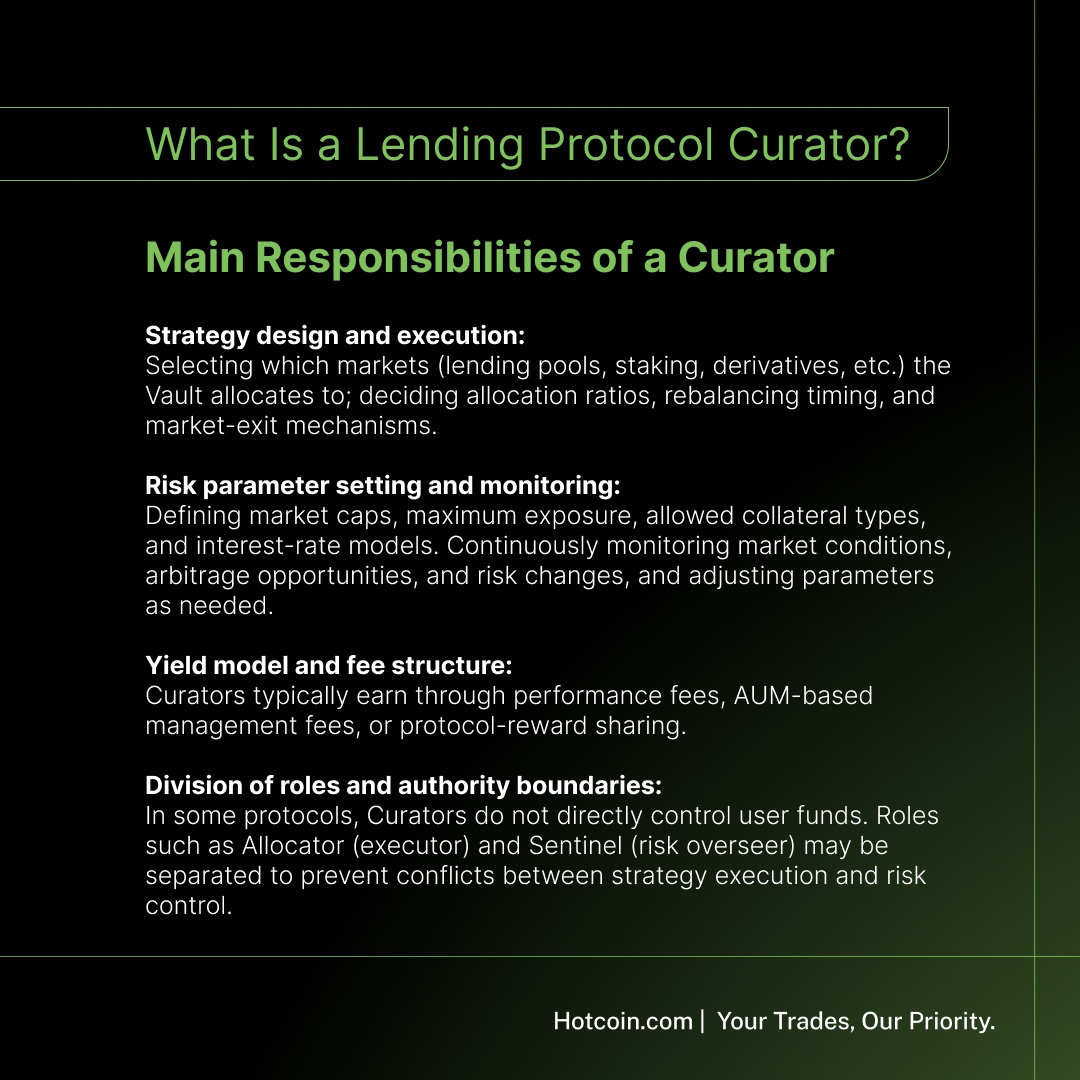
What Is a Lending Protocol Curator?
In decentralized lending protocols, the Curator is an increasingly important yet often overlooked role.
I. What Is a Curator?
A curator refers to the individual, team, or institution responsible for designing, deploying, and managing strategies for lending-related vaults or pool-structured saving-and-lending products.
Once users deposit assets into a vault, the curator sets the asset allocation, risk limits, and withdrawal rules behind the scenes, enabling users to participate with a simple click.
Thus, a curator serves as the bridge that turns complex strategies into user-friendly products.
II. Main Responsibilities of a Curator
Strategy design and execution:
Selecting which markets (lending pools, staking, derivatives, etc.) the Vault allocates to; deciding allocation ratios, rebalancing timing, and market-exit mechanisms.
Risk parameter setting and monitoring:
Defining market caps, maximum exposure, allowed collateral types, and interest-rate models. Continuously monitoring market conditions, arbitrage opportunities, and risk changes, and adjusting parameters as needed.
Yield model and fee structure:
Curators typically earn through performance fees, AUM-based management fees, or protocol-reward sharing.
Division of roles and authority boundaries:
In some protocols, Curators do not directly control user funds. Roles such as Allocator (executor) and Sentinel (risk overseer) may be separated to prevent conflicts between strategy execution and risk control.
III. Why the Curator Model Matters
Ordinary users often struggle with increasingly complex DeFi strategies (liquid staking, RWA, leveraged lending, etc.). The Curator model packages these complexities into simple, one-click participation.
Lending protocols rely on professional strategies to boost TVL, improve capital efficiency, and drive higher revenue.
IV. Potential Risks of the Curator Model
Moral hazard:
As Curators grow more successful, they manage larger AUM and earn more fees. To attract deposits, they may prioritize higher-APY strategies while overlooking underlying risks.
Transparency and control risks:
Even if assets remain in smart contracts, decision-making authority sits with Curators. Without sufficient disclosure or oversight, significant hidden risks can emerge.
Concentration risk:
If many Vaults rely on a small number of Curators using similar strategies, a market shock can trigger systemic risk.
Conclusion
In DeFi lending protocols, Curators play a critical role in transforming complex strategies into accessible Vault products. They design strategies, define risk, and supervise execution — while also introducing trust, transparency, and strategy-related risks.
Users should evaluate a Curator’s reputation, strategy transparency, and permission structure to make informed decisions about risk and return.
読書をお勧めします
もっと見る


Service@hotcoin.com
Product@hotcoin.com
Business@hotcoin.com
Casecn@hotcoin.com