
Hotcoin Research | The Truth About Tokenized Stocks: How a Share Travels from Wall Street to Your Wallet
Introduction
Since the beginning of 2026, the tokenization of traditional financial assets has entered a new phase of rapid expansion. Major centralized exchanges have joined the race, while RWA issuers are accelerating the tokenization of U.S. equities, ETFs, and private equity exposure by bringing them on-chain. Traditional brokerages, custodians, clearing institutions, and financial infrastructure providers are also actively exploring opportunities in tokenized securities. According to RWA.xyz, the market value of tokenized stocks reached approximately $2.16 billion as of July 9, 2026. Tokenized stocks are no longer a niche RWA experiment. They have become a new battleground for CEXs, on-chain platforms, RWA issuers, and traditional financial institutions alike.
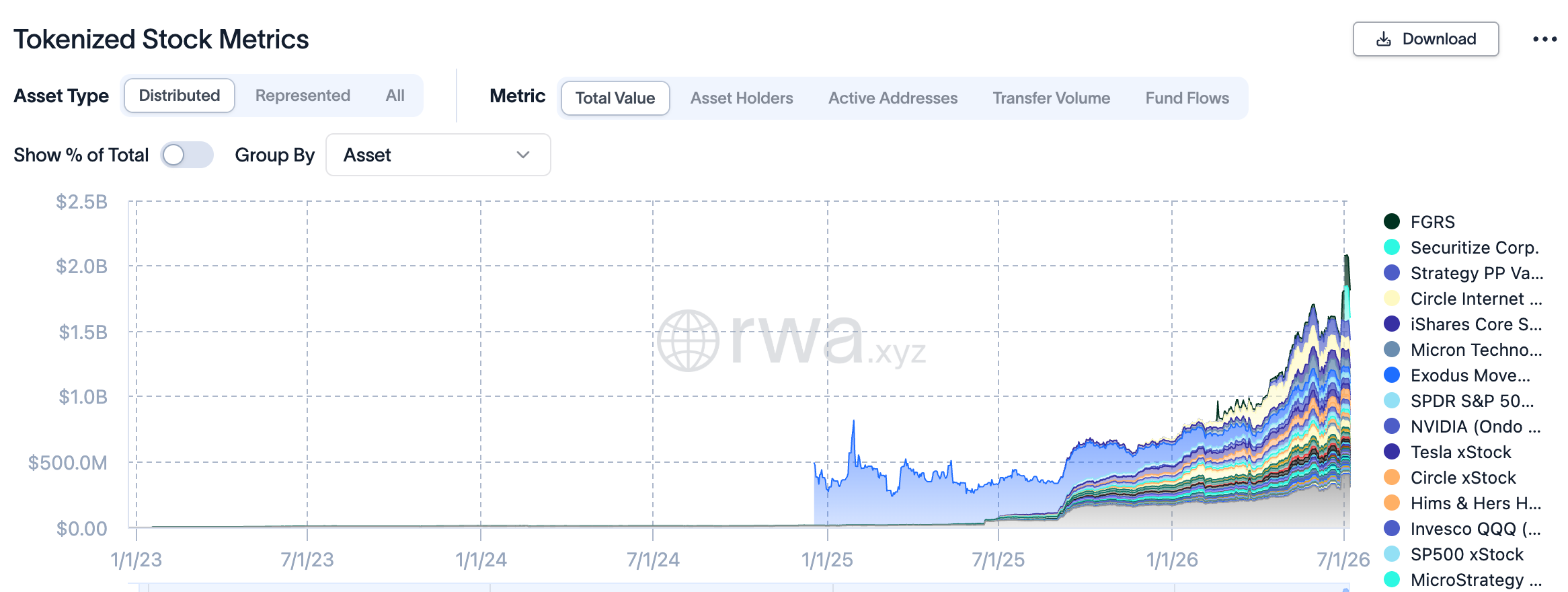
Source: https://app.rwa.xyz/stocks
Yet as the market heats up, a more fundamental question is often overlooked: What are investors actually buying? Seeing NVDA, TSLA, MSFT, or SpaceX on a trading screen does not necessarily mean investors own shares in NVIDIA, Tesla, Microsoft, or SpaceX. A stock perpetual futures contract may simply be tied to a stock price index. A tokenized spot stock may represent a token backed by underlying securities held by an issuer. A pre-IPO token may represent an SPV interest, private equity, beneficial rights, or synthetic exposure. In other words, tokenized stocks make investing in U.S. equities more accessible, but they also make the legal and ownership structure behind those investments significantly more complex.
1. What Are You Actually Buying? Tokenized Stocks Are Not the Same as Traditional Stocks
The biggest misconception surrounding tokenized stocks is that different products may display the same stock name, ticker symbol, or price chart on the trading interface, yet differ fundamentally in their legal structure, asset backing, trading mechanism, and investor rights. What investors ultimately purchase is not necessarily the stock itself, but rather a form of economic exposure structured through token issuers, smart contracts, exchange accounts, price indices, market makers, and redemption mechanisms.
1.1 Tokenized Spot Stocks: Backed by Shares, but Not Shareholder Rights
Tokenized spot stocks are currently the easiest type of tokenized equity product for retail investors to understand. On a CEX or in an on-chain wallet, investors can purchase stock tokens such as AAPLX, TSLAON, or MSFTB using USDT, USDC, or other stablecoins. Because the trading experience closely resembles spot trading, many users naturally assume they are simply buying U.S. stocks on-chain. In reality, however, investors are generally not purchasing the underlying shares themselves. Instead, they are acquiring tokenized assets issued by providers such as xStocks or Ondo, with the tokens backed by underlying securities or related economic interests.
Compared with traditional equity markets, tokenized spot stocks typically offer longer trading hours, whether on-chain or within a trading platform, as well as lower barriers to entry. Their key distinction from traditional stocks, however, lies not in the trading experience but in the legal structure and rights attached to the product. Whether investors are entitled to shareholder rights, whether the underlying assets can be redeemed, how those assets are held, and who ultimately bears the associated risks all depend on the issuer's product documentation, platform rules, and risk disclosures. In short, tokenized spot stocks provide an on-chain gateway to stock price exposure, but they should not be equated with direct ownership of the underlying shares, nor should investors assume they carry all of the rights associated with traditional stock ownership.
1.2 Stock Perpetual Futures: Trading Price, Not Ownership
The "stock" aspect of a stock perpetual futures contract lies primarily in its price reference rather than ownership of the underlying asset. When investors see NVDA, TSLA, or AAPL on the trading interface, those symbols represent the contract's pricing reference rather than indicating that the platform delivers the underlying shares to investors. In practice, what investors buy or sell is neither the stock itself nor a tokenized stock, but a perpetual futures position based on the price performance of a particular stock.
The core value of stock perpetual futures lies in providing exposure to stock price movements rather than ownership of the underlying shares. Whether the contract references the price of an individual stock, a tokenized stock, or a stock price index, investors gain leveraged exposure to price movements rather than shareholder rights. As a result, stock perpetual futures enable 24/7 trading, long and short positions, and leveraged trading, while also introducing derivative-specific risks such as funding fees, forced liquidation, margin requirements, and price deviations.
In essence, investors are trading price exposure, rather than the stock itself.
1.3 Pre-IPO Tokens: Equity Exposure or Event Expectations
Pre-IPO products are among the most heavily promoted segments of the tokenized stock market. Before SpaceX went public in June, pre-IPO products linked to the company attracted widespread market attention, with multiple platforms launching related trading products. The trend also drew greater investor attention to the tokenization of private company equity. Given the market's strong expectations for high-profile unicorns and their growth potential, many investors naturally view these products as an opportunity to buy shares in private companies before they go public.
In reality, however, pre-IPO products do not necessarily give investors direct ownership of private companies. Instead, they may represent interests in private equity, special purpose vehicles (SPVs), economic rights, debt instruments, or synthetic exposure linked to changes in a company's valuation. Because shares in private companies are not publicly traded, the legal structure, liquidity, and exit mechanisms of these products are often significantly more complex than those of publicly listed stocks. The core value of pre-IPO products lies in providing investment exposure to the growth potential of private companies, rather than allowing investors to become shareholders before an IPO.
II. From Wall Street to Your Wallet: The Chain Behind Tokenized Stocks
Whether investors trade tokenized spot stocks, stock futures, or pre-IPO products, none of these assets move directly from a stock exchange into an investor's account. Instead, they pass through a chain of legal and financial relationships built on both traditional financial infrastructure and token issuance frameworks. What ultimately determines what investors own is not the trading interface, but every participant involved in that chain.
2.1 Underlying Asset Layer: What Is the Underlying Asset?
The starting point of the entire chain is not the token itself, but the underlying asset. Although different platforms all offer "stock products," the assets underlying those products can differ significantly, making this the first step in determining a product's structure and the subsequent stages of the issuance pipeline.
For tokenized spot stock products such as xStocks, Ondo Stocks, and Binance bStocks, the underlying assets typically consist of publicly traded securities, including U.S.-listed stocks, ETFs, and ADRs. For example, xStocks currently supports more than 160 stocks and ETFs, with its tokens backed by the underlying securities. By contrast, stock perpetual futures generally reference the price of an individual stock or a stock price index. As financial derivatives, they do not require the underlying shares to enter the trading chain, nor do they involve physical settlement. Pre-IPO products extend even further, with underlying assets that may consist of private equity, interests held through special purpose vehicles (SPVs), economic rights, or other financial arrangements structured around private companies.
The stock name displayed on a trading platform is only the surface layer. What truly determines a product's legal structure, risk profile, and investor rights is the underlying asset to which it is linked. The underlying asset determines not only whether investors ultimately receive shareholder rights, economic exposure, or other financial interests, but also the type of brokerages, custodians, issuers, and clearing infrastructure required to support the product.
2.2 Infrastructure Layer: Who Holds and Settles the Assets?
The most important, yet often overlooked, layer between the underlying assets and on-chain tokens is the traditional financial infrastructure. Underlying securities do not automatically move onto the blockchain simply because a token has been issued. Instead, they must be purchased, held in custody, settled, and safeguarded through brokerages, custodians, securities depositories, and clearing networks. In other words, tokenized stocks do not bypass the traditional financial system; they add an on-chain issuance and trading layer on top of the existing financial infrastructure.
Within this layer, different institutions perform distinct roles. Brokerages provide market access and execute securities transactions. Custodians are responsible for safeguarding the underlying assets. Securities depositories and clearing institutions handle securities registration, settlement, and clearing. Legal structures, such as special purpose vehicles (SPVs) and trusts, are responsible for asset segregation and defining the legal rights associated with the underlying assets.
Among them, Alpaca is one of the leading securities infrastructure providers in today's tokenized stock ecosystem. Its brokerage services are provided through Alpaca Clearing and rely on established market infrastructure, including FINRA, SIPC, DTCC, FICC, and OCC, for securities custody, clearing, and settlement. Similarly, U.S. securities infrastructure providers such as DriveWealth and Apex Clearing provide brokerage, custody, and clearing services for financial institutions and fintech platforms worldwide. Although they do not issue tokenized stocks themselves, they serve as critical infrastructure that connects blockchain-based products to traditional securities markets.
For most investors, these institutions are far less visible than exchanges or token issuers. Yet together they determine whether the underlying assets genuinely exist, whether they are independently safeguarded, how settlement is completed, and whether investors' assets remain protected under extreme circumstances. While they do not directly determine investors' rights, they provide the trusted infrastructure that the entire tokenized stock ecosystem depends on, serving as an essential bridge between traditional capital markets and the blockchain ecosystem.
2.3 Token Issuance Layer: Who Defines Investor Rights?
If brokerages, custodians, and clearing institutions connect the traditional securities market, then token issuers are responsible for transforming underlying assets into on-chain products. They determine not only how tokens are issued, but also what rights investors ultimately receive, what risks they bear, and which legal frameworks and regulatory requirements govern each product. In other words, even for the same underlying stock, different issuers can design fundamentally different tokenized products.
Today, different platforms follow different issuance models. xStocks is issued by Backed Assets (JE) Limited, whose public disclosures state that each token is backed on a one-to-one basis by its underlying security and held by regulated custodians. At the same time, the product documentation makes clear that holders generally do not receive voting rights or other shareholder rights associated with traditional stocks, while corporate actions, such as dividends, are handled in accordance with the product terms. Ondo Stocks is issued by Ondo Global Markets (BVI) Limited, adopting an issuance model that more closely resembles securities-based RWA products and applying different investor eligibility requirements across jurisdictions. Binance bStocks is issued by BTech Holdings Limited in accordance with its issuance documentation and product terms. Bitget rStocks and certain pre-IPO products are developed in partnership with Reality. In this model, the issuer is responsible for issuing the product and structuring the underlying rights, while the exchange is responsible for product distribution and trading.
It is therefore the issuer, together with its legal structure, product terms, and risk disclosures, rather than the exchange, that determines the legal characteristics of a tokenized stock. Even when different platforms offer products linked to the same underlying stock, there may be significant differences in the issuer, underlying assets, redemption mechanisms, investor rights, and regulatory arrangements.
2.4 Distribution and Trading Layer: How Do Tokenized Stocks Reach Investors?
Once issued, tokenized stocks enter the trading environment that investors interact with every day. For most investors, the primary point of contact is not brokerages, custodians, or token issuers, but centralized exchanges (CEXs) such as Binance and Hotcoin, or decentralized trading platforms such as Hyperliquid. From searching ticker symbols and viewing price charts to placing orders and managing positions, the user experience closely resembles traditional stock trading. However, the trading platform represents only the final layer of the entire tokenization chain.
Taking Hotcoin as an example, the platform acts as a distribution and trading venue rather than the holder of the underlying assets or the token issuer. Whether investors trade tokenized spot stocks, stock futures, or pre-IPO products, Hotcoin primarily serves as the gateway connecting investors to the broader tokenized stock ecosystem. On the one hand, a unified trading interface lowers the barrier to entry, allowing investors to trade stock-related products much as they trade crypto assets. On the other hand, the platform provides trading, settlement, and asset management services based on each product's issuance framework and available market liquidity, without determining the product's legal structure or investor rights.
As a result, although investors interact directly with a trading platform, it is not the starting point of the tokenized stock ecosystem, but the final layer through which products reach the market. Trading platforms are gradually evolving from cryptocurrency exchanges into comprehensive distribution channels for tokenized stocks, RWAs, and traditional financial products. The legal structure, investor rights, and underlying asset arrangements, however, are determined by the issuance framework behind each product rather than by the platform itself.
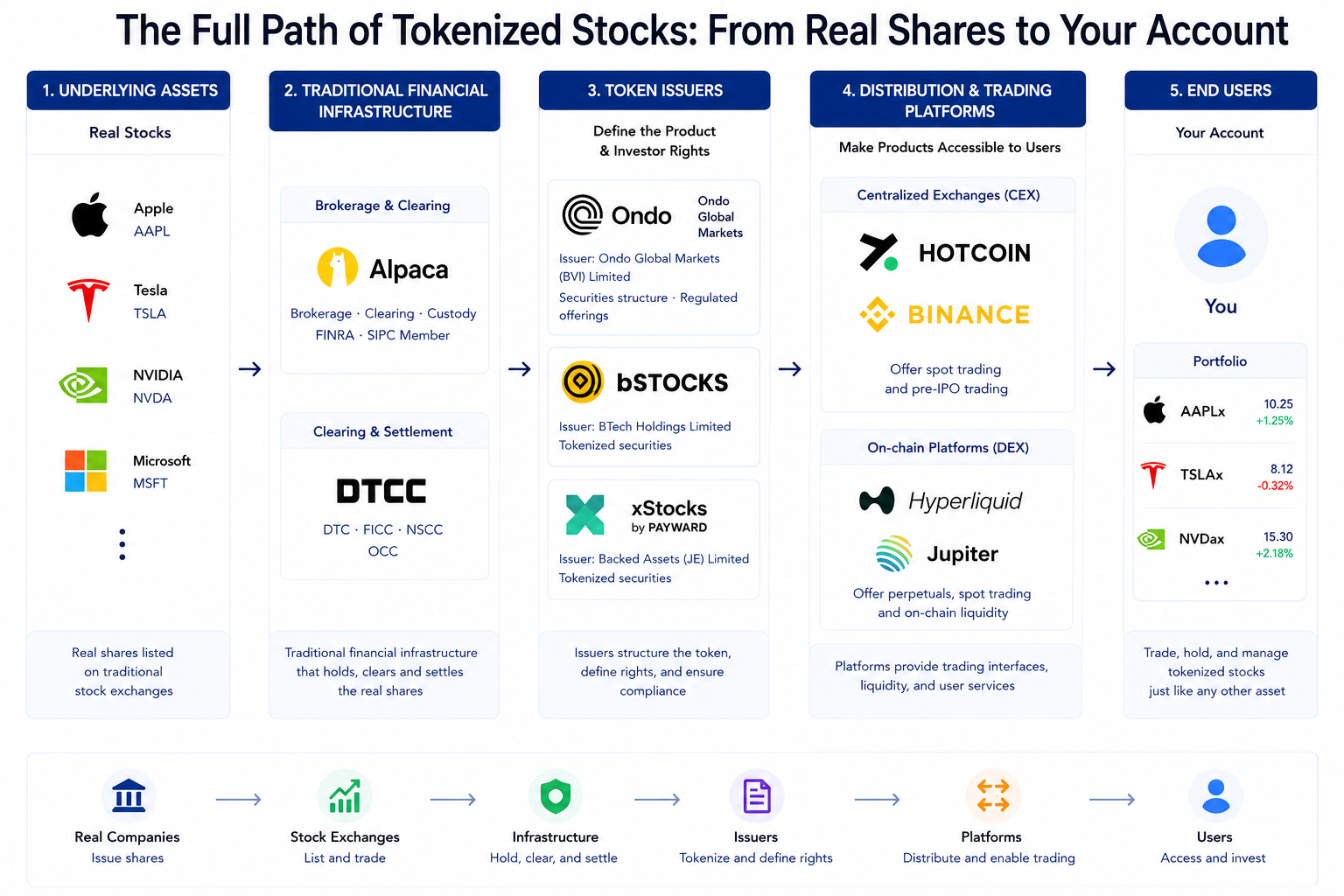
It should be noted that the framework described above primarily applies to tokenized spot stocks. Stock perpetual futures operate differently. Because they are financial derivatives rather than representations of underlying shares, they generally do not require brokerages, custodians, issuers, or the full securities settlement process. Instead, they are built around a price discovery mechanism. The platform obtains reference prices through oracles or price indices, while the perpetual futures engine handles order matching, margin management, and risk control. In other words, tokenized spot stocks are linked to underlying shares, whereas stock perpetual futures are linked to stock prices.
III. The Tokenized Stock Ecosystem: Different Development Models
Once we understand the full chain through which tokenized stocks move from underlying assets to investors, a more important question emerges: Why are platforms pursuing such different approaches to building tokenized stock ecosystems?
The answer lies in who controls the product ecosystem. Some platforms centralize issuance, trading, and user access under the exchange. Others open their issuance networks to multiple trading venues. Still others focus primarily on trading capabilities rather than issuance infrastructure. These different approaches have given rise to three distinct development models for the tokenized stock market.
According to RWA.xyz, as of July 9, 2026, Ondo accounted for approximately 46% of the market by total value, followed by xStocks at 25%, Securitize at 12%, Figure at 11%, and Robinhood at 2%. Together, the leading issuance networks account for more than 90% of the market. Competition is gradually shifting from who can launch tokenized stocks first to who can build the strongest issuance network, trading distribution, and liquidity ecosystem.
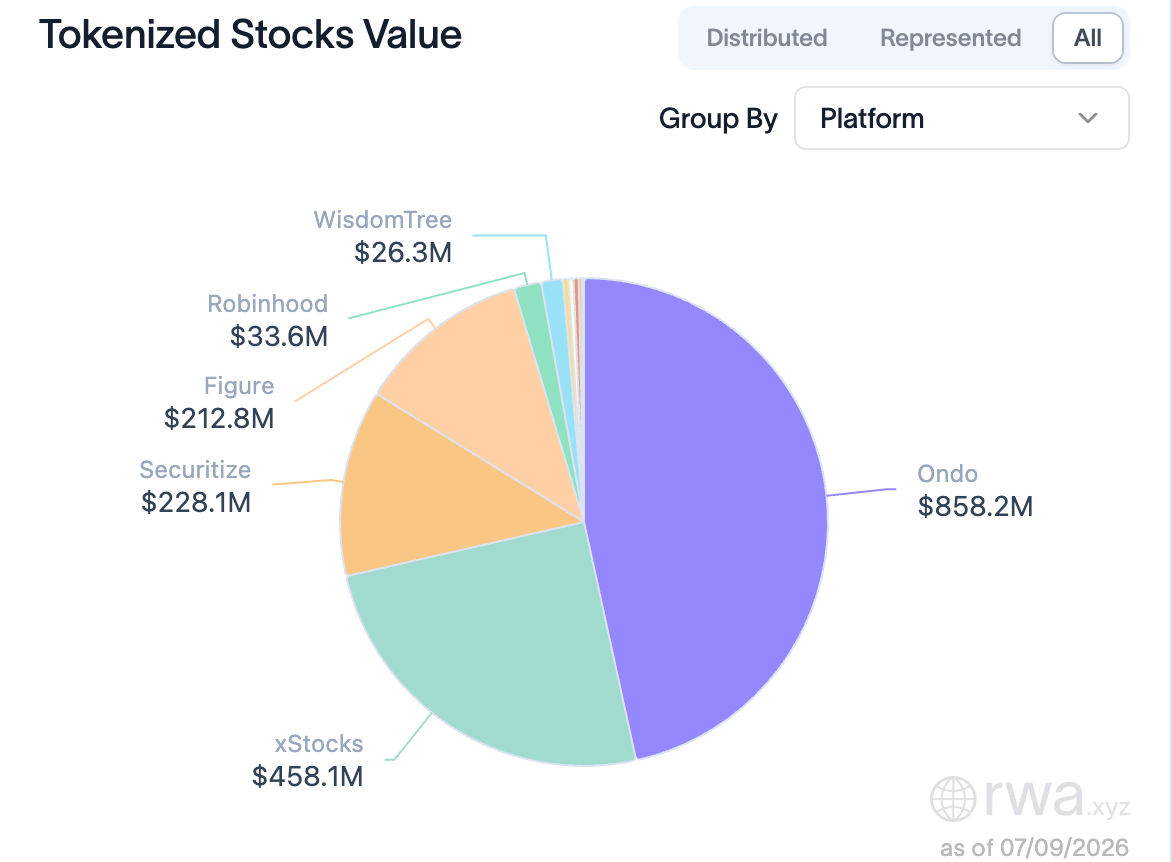
Source: https://app.rwa.xyz/stocks
3.1 Issuance Network-Led Model
xStocks and Ondo represent the issuance network-led approach, following a development path of issuance network → multi-platform distribution → on-chain financial ecosystem.
Both xStocks and Ondo focus primarily on building their issuance networks rather than controlling the trading interface. Taking xStocks as an example, its tokens are issued by Backed Assets (JE) Limited and can be distributed across multiple platforms, including Jupiter, Kraken, Bybit, and Kamino. Ondo Stocks, by contrast, is issued by Ondo Global Markets (BVI) Limited and places greater emphasis on a traditional securities-issuance framework and on institutional investor access. Although the two projects target different user groups, both are fundamentally built around their issuance networks rather than relying on a single trading platform.
The greatest advantage of this model is its scalability. Tokenized stocks are no longer tied to a single platform, allowing them to circulate across multiple trading venues and on-chain protocols and to participate in decentralized financial applications such as lending, staking, and liquidity management. Trading platforms may change over time, but the underlying issuance network remains consistent, making this one of the most scalable models in today's tokenized stock ecosystem.
3.2 Exchange-Led Model
Binance, Bitget, and Hotcoin represent the exchange-led model, following a development path of exchange-led issuance → platform distribution → investor trading.
Under this model, exchanges serve not only as the primary trading venue but also play a central role in product design and the issuance framework. For example, Binance bStocks is issued by BTech Holdings Limited, an affiliated entity of Binance, while Binance is responsible for product distribution, order matching, and user operations. Similarly, Hotcoin has listed a wide range of bStocks tokenized stocks. For most investors, these products are presented primarily under the exchange's own brand.
The defining feature of this model is its fully integrated ecosystem, where issuance, trading, liquidity, and user operations are managed within a unified framework. This allows exchanges to launch products quickly, deliver a consistent user experience, and expand the market through their existing user base and platform traffic. At the same time, however, the close integration of the issuer, product design, and trading platform also means that exchanges assume greater responsibility for product management and regulatory compliance.
3.3 Traditional Finance-Led Model
Unlike the previous two models, the traditional finance-led approach is not built around crypto-native issuance networks or exchanges. Instead, it builds on established securities issuance, registration, custody, settlement, and regulatory frameworks, then gradually brings traditional securities, such as stocks, onto the blockchain. Its development path can be summarized as traditional securities infrastructure → digital securities issuance → on-chain trading and distribution.
Today, institutions such as Robinhood, Securitize, Figure, and Dinari are driving this model forward. For example, Robinhood has introduced tokenized stock products by leveraging its established brokerage infrastructure. Securitize has long focused on compliant digital securities issuance and has partnered with traditional financial institutions such as BlackRock and Apollo to bring securities on-chain. Figure has built an integrated ecosystem for the issuance, trading, and settlement of digital securities, while Dinari's dShares have been integrated with on-chain trading infrastructure such as Hyperliquid HyperCore, providing additional distribution channels for tokenized stocks.
Compared with crypto-native ecosystems, this model places greater emphasis on securities regulation, investor protection, and institutional participation, with product design remaining much closer to traditional capital markets. Although adoption may progress more slowly as more traditional financial institutions enter the tokenization market, this model is well-positioned to attract greater institutional capital and a broader base of traditional investors into the on-chain equity market.
IV. Key Tensions: Easier Access, More Complex Rights
Stock tokenization does not fundamentally change the stocks themselves. What it changes is how investors access them. Investors no longer need to open traditional U.S. brokerage accounts, navigate cross-border brokerage procedures, or wait for regular U.S. market hours to gain exposure to stock prices through stablecoins, CEXs, or on-chain wallets. However, tokenized stocks do not eliminate intermediaries. Instead, they reorganize the traditional securities value chain by combining brokerages, custodians, clearing institutions, issuers, market makers, and trading platforms into a new on-chain ecosystem. The user experience becomes simpler, but the underlying asset relationships become more complex. Access becomes easier, but the chain of legal rights becomes longer.
4.1 Trading Convenience vs. Reduced Ownership Rights
In traditional brokerage accounts, investors know they are purchasing shares, mutual funds, or ETFs. With tokenized stock products, however, investors may instead be acquiring issuer-issued certificates, economic exposure, or price index-based contracts. Holders of xStocks, for example, do not own the underlying shares and generally do not receive shareholder rights, such as voting rights, distribution rights, or legal claims to the underlying company's residual assets in the event of liquidation. Likewise, bStocks do not grant holders direct ownership of the underlying listed shares.
This highlights one of the fundamental trade-offs of tokenized stocks: greater convenience often comes at the cost of reduced ownership rights. Investors gain easier access to stock-related products, but they may not enjoy the full rights associated with traditional share ownership. For traders primarily focused on price movements, this distinction may be of little practical importance. For long-term investors who value dividends, voting rights, and corporate governance, however, it is a critical consideration.
4.2 On-Chain Transparency vs. Off-Chain Asset Opacity
One of the primary value propositions of tokenized stocks is on-chain transparency. Investors can view smart contract addresses, transaction records, the number of token holders, and on-chain circulation. However, on-chain transparency does not necessarily mean transparency of the underlying assets.
On-chain data can only verify that a token exists on a particular blockchain, record its transaction history, and identify the addresses currently holding it. It cannot automatically verify how many underlying shares the issuer actually holds, whether the custody arrangements are independent, whether the brokerage accounts are subject to pledges or other liabilities, or what priority investors would have if the issuer were to become insolvent. Even proof of reserves can only demonstrate the asset position at a specific point in time. It cannot replace continuous audits, independent custody, or legal protections.
What tokenized stocks ultimately require is dual transparency: transparency on-chain and transparency off-chain. The former is provided by blockchain technology, while the latter depends on audits, custody attestations, proof of reserves, legal opinions, prospectuses, risk disclosures, and regulatory filings. Only when both are in place can tokenized stocks evolve from a price-tracking tool into a more reliable infrastructure for asset distribution.
4.3 Greater Liquidity vs. Redemption Constraints
Another key advantage of tokenized stocks is their enhanced liquidity. Investors can trade them 24/7 on crypto exchanges or on-chain platforms, even when traditional U.S. stock markets are closed. However, trading liquidity does not necessarily mean redeemability. The ability to sell a token on a trading platform does not mean it can be redeemed for the underlying shares at any time. Even when redemption is supported, it may be subject to investor eligibility, geographic restrictions, minimum redemption amounts, fees, market trading hours, broker settlement cycles, compliance reviews, and issuer requirements.
This is also one of the key differences between tokenized stocks and stablecoins. Stablecoin holders are primarily concerned with whether their tokens can be redeemed for U.S. dollars. Tokenized stock investors, however, must also consider whether their tokens can be redeemed for the underlying shares, cash equivalents, or whether they can only be sold on the secondary market. If the only exit is through the secondary market, discounts to net asset value, limited liquidity, and the withdrawal of market makers during periods of market stress may become significant risks.
4.4 Pre-IPO Narratives vs. Underlying Equity Authenticity
Pre-IPO products require even greater caution. Their appeal lies in their scarcity: ordinary investors have limited opportunities to invest directly in high-profile private companies such as SpaceX and OpenAI, making any product that offers similar exposure highly attractive.
However, the greatest risk of pre-IPO products is not price volatility, but the authenticity of the underlying equity. Investors should ask a series of fundamental questions: Does the platform actually hold shares in the private company? Through what legal entity are those shares held? Are they held through an SPV? Does the SPV have the legal right to transfer those shares? Does the private company permit such transfers? Are investors acquiring equity interests, economic rights, debt instruments, or merely synthetic exposure? If the company never goes public, how will the product be valued? If the issuer defaults, who is legally responsible to investors?
Unlike tokenized stocks backed by publicly traded companies, pre-IPO products often lack transparent secondary markets, standardized valuation methodologies, and continuous liquidity. As a result, they can easily shift from long-term equity investing to event-driven or valuation-driven trading. This does not mean that pre-IPO products lack value, but they should never be marketed simply as a way to "buy private company shares before an IPO."
V. Outlook and Conclusion
Stock tokenization is still in its early stages, but the industry's direction is becoming increasingly clear. In the future, competition will no longer focus on who can list more tokenized stocks, but on who can build the most trustworthy underlying asset base, the most robust issuance framework, the most transparent custody arrangements, and the most efficient trading network. Exchanges, issuance networks, and traditional financial institutions will continue to coexist, each serving different types of investors.
Regardless of how the industry evolves, one fact remains unchanged: bringing stocks on-chain does not separate them from the traditional financial system. The issuance, registration, custody, clearing, and investor rights associated with stocks remain firmly rooted in traditional securities law and financial infrastructure. What changes is the way investors access those assets. From local brokerages to global trading platforms, from fiat accounts to stablecoin wallets, and from fixed market hours to 24/7 on-chain trading, the assets themselves remain the same. What changes is the way they are distributed.
The future of stock tokenization is therefore not about disintermediation, but about the reorganization of intermediaries. Brokerages, custodians, clearing institutions, issuers, on-chain protocols, and trading platforms have not disappeared. Instead, they have been reorganized for the blockchain era, forming a new asset distribution chain. The real competition is no longer about who can bring stocks on-chain first, but about who can build a tokenized stock ecosystem that is trusted, transparent, and open.
About Us
Hotcoin Research, the core research and investment arm of Hotcoin Exchange, is dedicated to turning professional crypto analysis into actionable strategies. Our three-pillar framework—trend analysis, value discovery, and real-time tracking—combines deep research, multi-dimensional project evaluation, and continuous market monitoring.
Through our Weekly Insights and In-depth Research Reports, we analyze market dynamics and highlight emerging opportunities. With Hotcoin Selects—our exclusive dual-screening process powered by both AI and human expertise, we help identify high-potential assets while minimizing trial-and-error costs.
We also engage with the community through weekly livestreams, decoding market hot topics, and forecasting key trends. Our goal is to empower investors of all levels to navigate cycles with confidence and capture long-term value on Web3.
Risk Disclaimer
The cryptocurrency and tokenized asset market is highly volatile, and all investments carry inherent risks. We strongly encourage investors to remain informed, assess risks thoroughly, and adhere to strict risk management practices to protect their assets.
Contact Us
Website:https://www.hotcoin.com/en_US/learn/index/
X: x.com/HotcoinAcademy
Email: labs@hotcoin.com
読書をお勧めします
もっと見る
Hotcoin Research | Telegram Takes Over TON: Can a Billion-User Gateway Truly Lift the On-Chain Ecosystem?
In-depth Research
Hotcoin Research | An Overview of the Hottest AI Agent Frameworks: Technological Breakthroughs and the Integration of Token Economies
In-depth Research
Hotcoin Research | Play-to-Earn WEB3: PiP World Ecosystem - Revolutionizing Financial Education with AI-Driven Games
In-depth Research

サービス連絡先
Service@hotcoin.com
製品フィードバック
Product@hotcoin.com
ビジネス協力
Business@hotcoin.com
法務連絡先
Casecn@hotcoin.com
©2017-2026