
Hotcoin Research | The AI Revolution Is Still Underway. Why Are AI Stocks Losing Their Premium?
By late July 2026, the global AI investment boom had begun to lose momentum. A market fueled by lofty valuations and high leverage was beginning to show signs of strain. On July 28, South Korea's KOSPI Index plunged more than 10% in a single session, with AI-related heavyweights including Samsung Electronics and SK Hynix leading the sell-off. Around the same time, AI equity-focused hedge fund Situational Awareness unwound its public equity portfolio after suffering significant losses. Notably, this decline did not occur because AI demand had stalled, chip revenue had collapsed, or model capabilities had deteriorated. On the contrary, Microsoft Azure, Google Cloud, and AWS continued to deliver strong growth, while Nvidia's data center revenue reached yet another record high.
This apparent contradiction sits at the heart of the AI investment story. Technological revolutions and asset bubbles are not mutually exclusive. As AI continues to improve productivity and create new product opportunities, capital spending can expand beyond sustainable levels, financing structures can become increasingly imbalanced, and asset prices can move ahead of underlying fundamentals. The key question is no longer whether AI creates real economic value, but whether industry revenue, capital investment, and market valuations remain aligned. When technological progress is measured in months, industry returns unfold over years, while market pricing adjusts in seconds. The growing disconnect between these three timelines is where financial bubbles begin to build.
I. Industry Growth Continues as Financial Risks Build
Assessing whether AI is in a bubble requires first separating industry fundamentals from financial pricing. AI adoption, model capabilities, cloud computing demand, and chip revenue continue to grow, providing strong evidence against the claim that AI lacks genuine demand. Yet strong industry fundamentals do not automatically justify current valuations, nor do they guarantee that every dollar of capital invested will generate an adequate return.
1.1 AI Demand Continues to Grow, Supported by Real Industry Expansion
According to Stanford University's 2026 AI Index Report, AI adoption among surveyed organizations has reached 88%, while generative AI has reached approximately 53% of the global population within just three years. Model capabilities have continued to advance, with several frontier models approaching or surpassing human benchmarks in doctoral-level scientific question answering, multimodal reasoning, and competition-level mathematics.
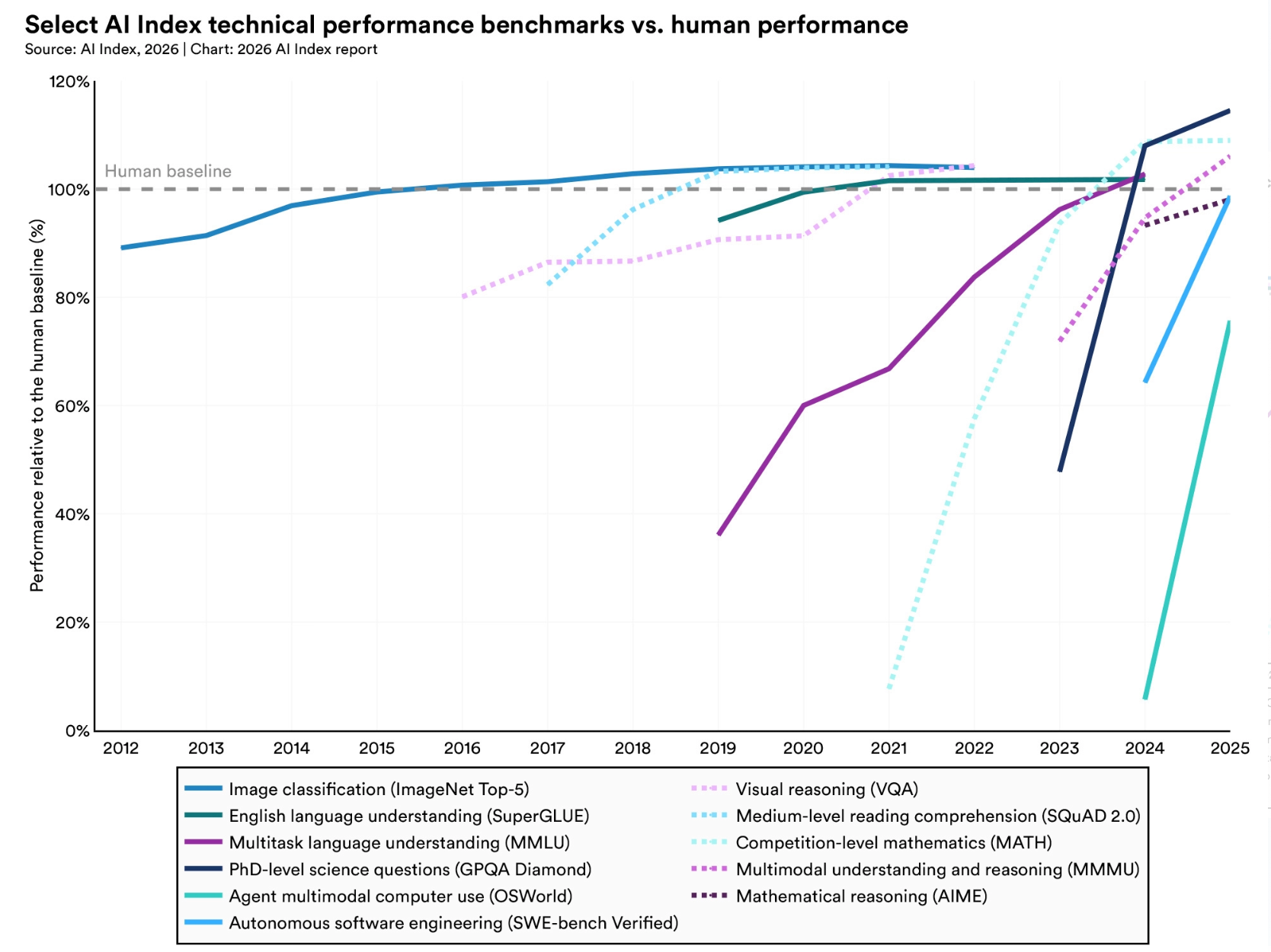
Source: https://hai.stanford.edu/ai-index/2026-ai-index-report
Commercial adoption is also accelerating. As of the second quarter of 2026, Microsoft Azure's annualized revenue surpassed $100 billion for the first time, while Microsoft 365 Copilot exceeded 30 million paid seats. AWS reported a 37% year-over-year increase in quarterly revenue, bringing its annualized revenue to $169 billion. Google Cloud posted 82% year-over-year revenue growth, while its remaining performance obligations reached $514 billion. Nvidia's data center revenue reached $193.7 billion in fiscal year 2026, up 68% from a year earlier. Together, these figures show that enterprises are actively paying for computing power, cloud services, and AI tools. AI is no longer a story driven solely by expectations; it is generating meaningful and measurable revenue.
1.2 The Bubble Forms When Investment Outpaces Returns
An AI bubble is better understood not as a rally driven by fictitious technology, but as the market's excessive capitalization of genuine technological progress. According to MSCI, capital expenditure by U.S. AI-related companies had increased by nearly 60% year over year as of May 2026, roughly ten times the pace of non-AI companies. Revenue, however, has grown much more slowly than capital investment. At the same time, AI-related companies continue to command substantial valuation premiums across major markets. In the United States, South Korea, and Taiwan, AI-related companies trade at price-to-book ratios roughly three times those of their non-AI peers.
Market concentration has further reinforced these valuation dynamics. According to S&P Dow Jones Indices, the top ten constituents of the S&P 500 accounted for approximately 36.4% of the index's total weight as of June 30, 2026. Depending on the index methodology and measurement date, that figure has at times approached 40%. With the exception of JPMorgan Chase, every company among the top ten is a large technology or semiconductor company. As these companies simultaneously account for a significant share of index weight, AI capital expenditure, and earnings growth, AI has evolved from an industry theme into core risk exposure shared by passive funds, pension portfolios, and index products worldwide. Market concentration amplifies gains during bull markets, but it can magnify losses just as quickly when market sentiment reverses.
1.3 The Tech Selloff Exposes Structural Fragility
The correction in AI-related stocks during July 2026 suggests that investors are no longer focused solely on revenue growth. Instead, the market has shifted its attention to whether that growth can generate returns sufficient to justify the scale of capital investment. Samsung Electronics and SK Hynix both reported strong earnings, yet their share prices still declined sharply. By the end of July, the KOSPI Index had fallen more than 10% in a single trading session. The message from the market was clear: once expectations become sufficiently elevated, simply delivering growth is no longer enough. Companies must consistently outperform expectations while demonstrating that today's capacity expansion will not become tomorrow's excess inventory, depreciation expense, or pricing pressure.
According to Axios, Situational Awareness, the AI-focused hedge fund founded by former OpenAI researcher Leopold Aschenbrenner, has exited its entire public equity portfolio. That alone does not prove the AI bubble has burst, but it highlights a more fundamental reality of capital markets: even when the long-term investment thesis is correct, high market concentration and elevated leverage can prevent investors from staying invested long enough for that thesis to play out. More often than not, what breaks investors first is not deteriorating corporate fundamentals, but tightening liquidity and funding constraints.
Industry growth and asset bubbles can coexist. Continued demand confirms that the AI revolution remains firmly underway, while rising capital expenditure, increasing market concentration, and elevated valuation premiums have shifted the market's focus from whether the technology works to whether the returns on capital can ultimately justify today's valuations. The recent correction does not signal the end of the AI cycle, but it does indicate that the financial foundations supporting current valuations are beginning to come under pressure.
II. How the AI Bubble Takes Shape
The AI bubble is not the result of a single company or a single valuation metric. Rather, it is the product of a self-reinforcing cycle. Insufficient computing power drives capital spending; capital spending fuels upstream revenue; rising revenue reinforces the market narrative; higher stock prices lower financing costs; and cheaper financing attracts even more capital. When this cycle accelerates, the market can easily mistake a temporary supply-demand imbalance for unlimited long-term profit growth.
2.1 Capital Spending by the Four Tech Giants Approaches Record Levels
According to their latest guidance for 2026, Microsoft, Alphabet, Amazon, and Meta are expected to spend a combined $720 billion to $745 billion in annual capital expenditure. If Microsoft's lease-financed infrastructure investment, which is excluded from reported capital expenditure due to changes in lease accounting classification, is added back to reflect total economic investment, the four companies' combined AI infrastructure spending rises to approximately $735 billion to $760 billion.
| Company | 2026 Capital Expenditure Guidance | Latest Change | Primary Investment Areas |
| Microsoft | Approx. $175 billion | Reduced from approximately $190 billion following a change in lease classification, while the underlying economic investment plan remains unchanged | GPUs, CPUs, data centers, and networking |
| Alphabet | $195–205 billion | Raised by approximately $15 billion from its previous guidance | Servers, data centers, networking, and AI R&D |
| Amazon | Approx. $220 billion | Increased by $20 billion from its plan at the beginning of the year | AWS, AI chips, robotics, and satellites |
| Meta | $130–145 billion | Lower end of the guidance range raised from $125 billion | AI training, inference clusters, and data centers |
Data source: Company filings and 2026 management guidance. Companies differ in how they classify capital expenditure, finance leases, and other infrastructure investments. The combined figures are intended to illustrate overall investment intensity rather than provide directly comparable accounting measures.
The International Energy Agency (IEA) estimates that capital spending by Microsoft, Amazon, Alphabet, Meta, and Oracle exceeded $400 billion in 2025, driven by rapid data center expansion. This surpassed global investment in oil and gas production. The agency expects that figure to increase by another 75% in 2026 to nearly $700 billion. The surge in investment is already translating into growing pressure on energy infrastructure. Global electricity demand from data centers is projected to rise by 17% in 2025, far outpacing the 3% growth in overall electricity demand, with AI data centers accounting for the fastest-growing share. By 2030, the IEA projects that global data center electricity consumption will double, while electricity demand from AI data centers could triple.
Capital spending, however, is inherently subject to long payback periods. The GPUs, land, and power infrastructure purchased today require years of sustained customer demand to generate an adequate return. Even a modest misjudgment in future demand can quickly turn a perceived shortage of computing capacity into excess capital investment.
2.2 Returns on New Investment Are Becoming Harder to Earn
Meta reported $60.8 billion in revenue for the second quarter, up 28% year over year. Yet capital expenditure reached $31.08 billion, leaving free cash flow at just $784 million. Over the past twelve months, Amazon generated $161.4 billion in operating cash flow, but net purchases of property and equipment rose to $169 billion, pushing free cash flow from a positive $18.2 billion a year earlier to a negative $7.6 billion. Alphabet reported approximately $44.9 billion in second-quarter capital expenditure and raised its full-year guidance to $195 billion to $205 billion.
Microsoft presents a somewhat different picture. Capital expenditure reached $41 billion in the fourth quarter of fiscal 2026, while free cash flow remained strong at $19.6 billion and Azure revenue grew 43%. This suggests that massive AI investment has not pushed every technology giant into a cash flow squeeze. The more important question is not whether these companies will run short of cash, but how much incremental revenue and free cash flow each additional dollar of capital spending can generate over time.
This also marks a key difference between today's AI boom and the dot-com bubble of 2000. The companies making the largest AI investments already benefit from mature cash flow businesses, including advertising, cloud services, software subscriptions, and e-commerce, making them considerably more resilient. However, the fact that these companies are unlikely to fail does not mean their valuations cannot be reset. Nor does it guarantee that suppliers and highly valued startups will be able to withstand a slowdown in capital spending.
2.3 Rapid GPU Upgrades Are Increasing Depreciation Pressure
Microsoft disclosed that roughly two-thirds of its capital expenditure in the fourth quarter of fiscal 2026 was allocated to short-lived assets such as GPUs and CPUs. Alphabet also stated that around 60% of its technology infrastructure investment went toward servers, with the remainder primarily allocated to data centers and networking infrastructure. While land and buildings can remain in service for decades, GPUs, servers, and networking equipment require continuous replacement and have much shorter economic lives than the facilities that house them.
This creates an often overlooked paradox. The faster AI technology advances, the more quickly the economic value of previous-generation hardware declines. New chips significantly reduce the cost of inference and accelerate AI adoption, but they can also force cloud providers to replace existing equipment sooner than expected. Technological progress is deflationary for users, yet it can accelerate depreciation for infrastructure owners.
As a result, assessing whether AI capital spending has become excessive requires looking beyond the number of data centers. Equipment utilization, revenue generated per unit of computing capacity, and the pace at which new chips replace older generations are equally important. If newly deployed capacity cannot be converted into sustained workloads quickly enough, GPU inventories may shift from scarce assets to underutilized equipment that must be depreciated.
2.4 Circular Financing May Overstate the Independence of Demand
The AI industry has developed a unique capital cycle. Cloud providers invest in model developers, model developers use that funding to purchase cloud computing capacity, and cloud providers then record those contracts as order backlog and future revenue. Microsoft disclosed that OpenAI's additional Azure service commitments reached $250 billion. As of the fourth quarter of fiscal 2026, Microsoft's commercial remaining performance obligations had risen to $678 billion, up 84% year over year. Excluding OpenAI, the increase was 25%.
This does not imply revenue manipulation. Model training genuinely consumes computing power, and cloud providers are delivering servers, electricity, and networking services. It does suggest, however, that part of today's demand is supported by model developers' financing capacity rather than by end customers already generating positive cash flow. As long as capital markets remain willing to finance model developers, this cycle can continue to expand. If financing conditions tighten, however, demand for computing power could weaken more quickly than order books alone would suggest.
It is worth noting that Microsoft's latest financial report also shows that quarter-over-quarter growth in its commercial bookings has mainly come from customers outside frontier model companies, with nearly 90% of annual cloud revenue generated by customers outside frontier model companies. This indicates that AI demand is spreading to the enterprise market, and all growth cannot be simply attributed to circular financing. What really needs to be observed is whether external enterprise demand can gradually replace financing-driven demand and become the long-term payer of AI infrastructure.
III. The AI Value Chain: Revenue Grows, Profits Diverge
The AI value chain is not a single ecosystem in which every participant benefits equally. Chipmakers, cloud providers, model developers, and application companies occupy different positions in the value chain, generate cash flow in different ways, and face different risks. The segments delivering the fastest revenue growth today may not ultimately prove to be the most profitable, while those making the largest investments may not capture the greatest share of long-term value.
3.1 Hardware Wins First but Faces Order Risk
AI capital spending has already translated into tangible revenue for upstream suppliers. Nvidia reported $215.9 billion in revenue for fiscal 2026, up 65% year over year, with data center revenue reaching $193.7 billion, an increase of 68%. Broadcom, a supplier of semiconductors and infrastructure software, also maintained strong momentum, reporting $22.2 billion in revenue for the quarter ended May 3, 2026, up 48% from a year earlier. These results indicate that investment in AI infrastructure has generated substantial and measurable demand. Whether today's rapid revenue growth can translate into sustainable long-term profitability, however, will ultimately depend on customers' capital spending, product pricing, and the health of the broader supply chain.
The strength of upstream suppliers, however, remains highly dependent on a concentrated group of customers. When Microsoft, Amazon, Meta, and Alphabet expand their data center investment simultaneously, suppliers of GPUs, HBM memory, advanced packaging, optical modules, and power equipment all benefit. But if even two or three of these companies slow their capital spending, the impact is likely to ripple across the supply chain almost immediately. Chipmakers therefore face not only demand cycles, but also risks from rapid technological iteration, inventory adjustments, and customers developing their own chips.
The greatest risk for AI hardware companies is that the market assumes today's exceptionally high margins will persist indefinitely. Revenue may continue to grow, but no hardware industry can remain permanently constrained by supply shortages, rising prices, and repeated rounds of customer purchasing.
3.2 Cloud Controls the Gateway but Bears the Cost
Cloud providers occupy the closest position to the AI industry's toll road. Microsoft, Google, and Amazon do far more than rent out GPUs. They also provide databases, storage, security, identity management, model deployment, and enterprise software. Once customers migrate their data and business workflows to a cloud platform, switching costs rise significantly, allowing cloud providers to expand from selling computing power to delivering a complete AI technology stack.
Recent results demonstrate the strength of this business model. Azure's annualized revenue has exceeded $100 billion. AWS reported $16.6 billion in operating income for the second quarter, with its operating margin rising to 39.4%. Google Cloud posted 82% year-over-year revenue growth, while its remaining performance obligations reached $514 billion. Compared with standalone model developers, cloud providers benefit from a broader customer base and more diversified revenue streams.
The challenge, however, is that cloud providers must invest ahead of demand. They have to purchase computing infrastructure and power long before customer demand fully materializes. When application demand weakens, model developers can reduce API usage and enterprise customers can scale back AI initiatives, but cloud providers remain responsible for data center leases, depreciation, and energy costs. As a result, cloud platforms enjoy stronger long-term pricing power, but they also carry greater balance sheet risk.
3.3 Models Improve but Become More Replaceable
OpenAI disclosed that its enterprise business now contributes more than 40% of total revenue, while its APIs process over 15 billion tokens per minute. Meanwhile, Stanford University's AI Index shows that the performance gap among leading foundation models has narrowed significantly. Demand for AI models continues to grow, but competition is increasingly shifting from model capability to cost, reliability, and performance in specific use cases.
This trend has two important implications. Lower model prices and higher inference efficiency will accelerate AI adoption, but they will also put pressure on model providers' unit economics. Open models, proprietary models developed by cloud providers, and specialized vertical models are all intensifying competition. At the same time, enterprise customers are increasingly adopting multi-model strategies to avoid dependence on a single provider. Microsoft disclosed that the number of customers using multiple model providers has increased fivefold since 2026, indicating that model substitution has evolved from a technical possibility into an enterprise procurement strategy.
Model developers may continue to build strong brands, proprietary data, and user networks, but sustaining a long-term competitive advantage through model performance alone is becoming increasingly difficult. Over time, the industry's most durable competitive advantages are likely to come from enterprise data, distribution channels, user workflows, and low inference costs rather than leadership in benchmark performance alone.
3.4 Applications Create Value but Must Prove Profitability
AI creates lasting value only when it enables companies to redesign business processes rather than simply adding another AI tool to existing workflows. Measurable improvements have already emerged in customer service, software development, financial analysis, medical documentation, and supply chain management. However, turning gains in individual use cases into company-wide profitability still requires progress in data governance, system integration, employee training, and organizational execution.
The application layer requires less capital investment and stands to benefit the most from declining model costs. At the same time, its barriers to entry may also fall. Many AI applications rely on the same underlying foundation models, making their core features relatively easy to replicate. As competition intensifies, profits may ultimately flow back to established software companies that already possess customer relationships and proprietary business data. The long-term winners in AI may therefore not be the companies with the most powerful models, but those that integrate AI most effectively into paid business workflows.
The AI value chain is already generating meaningful revenue, but profit distribution remains uneven. Hardware suppliers benefit first but are also the first to face order cycles. Cloud providers control the infrastructure gateway but bear the largest capital burden. Model developers continue to grow rapidly while facing intensifying price competition. The application layer sits closest to end-user value, yet its ability to generate sustainable profits at scale remains to be proven.
IV. The Crypto Market Becomes a 24/7 Transmission Layer for AI Risks
Traditional equity markets operate within fixed trading hours, but crypto platforms have transformed exposure to Nvidia, Microsoft, AI indices, leveraged ETFs, and even expectations surrounding AI startups into around-the-clock tradable contracts. Through platforms such as Binance and Hotcoin, investors can gain exposure to global AI-related assets at any time. The crypto market did not create the AI bubble, but it has fundamentally changed how AI-related risks are traded, amplified, and transmitted. It extends AI risk beyond traditional stock market hours into a 24/7 market while adding additional layers of risk through perpetual contracts, leveraged ETF perpetuals, and AI-related tokens. This broadens global participation and accelerates price discovery, but it also allows oracle pricing, funding rates, and forced liquidations to influence asset pricing much more rapidly.
4.1 Equity Perpetuals Extend AI Trading Beyond Market Hours
According to CoinGecko, monthly trading volume in RWA perpetual contracts increased from $230 million in early 2025 to $347.17 billion in May 2026, with cumulative trading volume reaching $1.32 trillion during the first five months of 2026. Over the same period, monthly trading volume in equity perpetual contracts rose from $831 million in July 2025 to $34 billion in May 2026, an increase of nearly 40 times.
The AI sector has become one of the primary drivers of this growth. In May 2026, monthly perpetual trading volume linked to Micron increased from $736 million in the previous month to $13.16 billion, an increase of nearly 17 times. Nvidia, Tesla, and Circle were also among the most actively traded underlying assets. By June 2026, monthly RWA perpetual trading volume had climbed further to nearly $470 billion.
Most of these products are neither tokenized equities nor instruments that represent ownership of the underlying shares. Instead, they are typically synthetic contracts that track stock prices through oracle pricing and are maintained through margin and funding rate mechanisms. Investors trade changes in stock prices rather than voting rights, dividend distributions, or residual claims on a company's assets.
4.2 Leveraged ETF Perpetuals Amplify Path Risk
Equity perpetual futures already incorporate margin leverage. When the underlying asset is a two- or three-times leveraged ETF, the risk structure becomes even more complex. The first layer of leverage comes from the ETF's daily leverage reset, while the second comes from the margin requirements and liquidation mechanism of the perpetual futures market itself.
Leveraged ETFs are not designed to deliver a fixed multiple of an underlying asset's cumulative return over weeks or months. The U.S. Securities and Exchange Commission has illustrated this with real-world examples. In one case, an index gained 2% over four months, while the corresponding 2x leveraged ETF lost 6%. In another, an index rose about 8%, yet its 3x leveraged ETF fell 53%. These outcomes result from the combined effects of daily rebalancing, compounding, and volatility decay.
When investors use perpetual futures to add leverage to leveraged ETFs, they become exposed to multiple sources of risk, including path dependence, funding costs, and liquidation risk. During prolonged market declines, leveraged ETFs are forced to deleverage, while highly leveraged perpetual futures positions may be liquidated at the same time. This can trigger a self-reinforcing cycle in which falling share prices force ETF deleveraging, ETF deleveraging accelerates liquidations in perpetual futures, and those liquidations place further pressure on market liquidity.
4.3 AI Tokens Do Not Capture the Same Cash Flow
Beyond equity perpetual futures, the crypto market has also extended the AI investment narrative through AI tokens, AI agents, and DePIN projects. These assets, however, are fundamentally different from the equity of publicly listed AI companies. Holding Nvidia shares gives investors a claim on the company’s earnings and residual assets, whereas holding an AI token does not necessarily give holders any legal rights to protocol revenue, computing infrastructure, or the underlying model company.
As the same AI growth narrative is translated into crypto assets, it becomes one step further removed from the underlying cash flow. A growing user base does not necessarily mean that value accrues to token holders, and revenue generated by a protocol does not necessarily flow back to its token. For many projects, valuations are driven more by expectations of future adoption, token liquidity, and market sentiment than by observable cash flow.
Ultimately, what matters is not whether a project is positioned as an AI project, but whether its token captures real economic value within the ecosystem. Whether the token is used to pay for computing resources, receive service discounts, secure the network, or share in protocol revenue ultimately determines its long-term value. If a token serves primarily as a vehicle for the AI narrative, it is likely to experience larger drawdowns than publicly listed AI companies with established cash flow when technology stocks come under pressure.
4.4 Oracles and Liquidations Accelerate Risk Transmission
In March 2026, S&P Dow Jones Indices authorized Trade[XYZ] to launch S&P 500 perpetual futures on Hyperliquid, signaling that traditional index providers have begun to recognize the commercial value of crypto perpetual futures as a new distribution channel.
However, 24/7 trading also introduces new pricing challenges. After the U.S. stock market closes, the underlying shares no longer trade, leaving equity perpetual futures to be priced based on index futures, related assets, market maker quotes, and changing market expectations. At that point, contract prices reflect expectations for the next market open rather than spot prices that can be immediately arbitraged. When major events occur over the weekend, contract prices may diverge significantly from the previous market close.
When traditional markets reopen, spot prices, oracle prices, and perpetual futures positions must converge again. If the gap becomes too wide, highly leveraged positions may already have been liquidated before liquidity returns to the spot market. As a result, the crypto market provides a more continuous expression of risk, but not necessarily a more accurate reflection of underlying fundamentals. Above all, it serves as a continuous trading layer for sentiment, leverage, and expectations.
V. Outlook and Conclusion: Returning to Cash Flow
The AI market is currently being shaped by two opposing forces. On one hand, the latest results from Microsoft, AWS, and Google Cloud show that demand for computing power and enterprise AI remains strong. On the other hand, growing cash flow pressure at Meta, Alphabet, and Amazon suggests that capital spending has reached a stage where returns must be demonstrated rather than assumed.
This combination makes the market increasingly prone to situations in which strong earnings coincide with weak share price performance, or heavy investment is followed by sharp rebounds. Investors are no longer debating whether AI demand exists, but how much actual results exceed already elevated expectations. Once expectations become sufficiently high, continued revenue growth alone may no longer be enough to support valuations. Slowing growth or further increases in capital spending can still trigger price corrections. The market's focus is gradually shifting from how many GPUs a company owns to how much cash flow each dollar of investment can generate.
Over the next one to two years, the AI market could follow one of three paths. If enterprise demand grows rapidly enough to absorb newly added computing capacity, capital spending will gradually translate into revenue and profits, allowing the market to work through current valuations in a relatively orderly manner. If demand continues to grow but fails to keep pace with investment, the industry is unlikely to collapse, but valuations may reset and profits may be redistributed across the value chain, leading to greater divergence among chipmakers, cloud providers, model developers, and application companies. If financing conditions tighten, model developers may scale back purchases of computing capacity, cloud providers may reduce capital spending, and upstream orders could weaken in tandem, pushing the market beyond a valuation correction toward downward revisions in earnings expectations.
Whether risks continue to build will depend on five key indicators: whether capital spending continues to outpace AI revenue growth; whether free cash flow continues to deteriorate; whether depreciation pressure continues to rise; whether cloud demand expands beyond model developers to enterprise customers with independent purchasing power; and whether enterprise AI can genuinely improve customer retention, reduce costs, and increase profitability. If these indicators weaken simultaneously, while market concentration, margin financing, and the use of leveraged products continue to increase, relatively modest changes in fundamentals could escalate into much sharper market volatility.
The AI revolution is far from over, yet warnings of an AI bubble have already begun to emerge. The two are not contradictory. Advances in AI technology expand applications, reduce costs, and create new industrial opportunities, while also encouraging repeated investment, accelerating depreciation, and raising market expectations. The faster technology advances, the more readily capital markets price distant future earnings into today's valuations.
The history of railways, the internet, and fiber-optic infrastructure shows that technological revolutions can reshape the world while still causing substantial losses for investors. A correction in technology stocks will not invalidate AI's long-term value, but neither does the industry's long-term potential guarantee that every AI-related asset will emerge as a winner.
The crypto market has further extended this pricing experiment into a 24/7 trading environment. Equity perpetual futures, leveraged ETF perpetual futures, and AI tokens have given more investors access to AI-related assets, while allowing valuations, leverage, and liquidations to interact much faster. Ultimately, what determines whether AI assets can survive the bubble is not how long the narrative can last, but whether cash flow can catch up with investment before capital runs out of patience.
About Us
Hotcoin Research is the research and insights division of Hotcoin, dedicated to turning professional research into actionable market insights.
Through Weekly Insights and In-Depth Research Reports, we help investors understand market trends, underlying dynamics, and emerging opportunities across the digital asset ecosystem. Our Elite Picks series combines AI-assisted screening with analyst-driven research to identify assets worth monitoring and help investors evaluate opportunities more efficiently.
Through regular livestreams, our research team provides timely analysis of market developments and major industry trends. We believe that informed decision-making and a long-term perspective can help investors navigate market cycles and capture lasting value in Web3.
Risk Warning
The cryptocurrency market is highly volatile, and investment inherently carries risk. We strongly recommend that investors fully understand these risks and invest within a strict risk management framework to protect their capital.
Contact Us
Website:https://www.hotcoin.com/en_US/learn/index/
X: x.com/HotcoinAcademy
Email: labs@hotcoin.com
読書をお勧めします
もっと見る
Hotcoin Research | Predicting the Market Surge: The Rise of the 50-Billion-Dollar Prediction Market and Opportunities Through 2026
In-depth Research

Hotcoin Research | Pre-IPO Products Aren’t Always Stocks: What Is the Crypto Market Really Trading?
In-depth Research

Hotcoin Research | BNB Chain Sparks Meme Coin Craze: Analyzing the Traffic Engine and Strategic Layout
In-depth Research

サービス連絡先
Service@hotcoin.com
製品フィードバック
Product@hotcoin.com
ビジネス協力
Business@hotcoin.com
法務連絡先
Casecn@hotcoin.com
©2017-2026