
Hotcoin Research | The 2026 L1 Upgrade Race: Ethereum’s Hard Fork Roadmap vs. Solana’s Consensus Overhaul — Which Chain Will Anchor the Future of Finance?
TL;DR
-
The Big Picture: The Layer 1 battleground has shifted beyond pure narrative. The real test now is who can deliver the speed, stability, cost efficiency, and predictability required for real-world financial activity.
-
Ethereum’s Evolution: Through Glamsterdam and Hegotá, Ethereum is pushing beyond its role as the safest settlement layer and evolving into a higher-performance financial backbone.
-
Solana’s Transformation: With Alpenglow and Firedancer, Solana is strengthening its core architecture and moving from the fastest trading chain toward a more reliable candidate for global-scale settlement.
-
The Strategic Duel: Both chains are racing toward the same goal from opposite directions: Ethereum is proving that the most resilient system can become faster, while Solana is proving that the fastest system can become more resilient.
-
The Bottom Line: 2026 is not the endgame, but a high-stakes qualifying round. The ultimate winner will be determined by where stablecoins, RWAs, and on-chain capital ultimately choose to settle and flow.
Public blockchain competition is moving beyond narrative-driven hype and into a more fundamental test: which networks can sustain real financial demand at scale. As institutional capital increasingly adopts blockchains as rails for clearing and settlement, and as stablecoins, RWAs, and high-frequency trading applications require continuous, round-the-clock operation, expectations for base-layer infrastructure have become more clearly defined. The market is converging on four key requirements: speed, stability, cost efficiency, and predictability. This sets up 2026 as a pivotal year for Ethereum and Solana. Ethereum must prove that it can evolve beyond its role as the industry’s most secure settlement layer and support high-velocity financial activity at scale. Solana, meanwhile, must demonstrate that it has moved beyond being a high-performance experiment or memecoin hub, and can instead serve as a reliable foundation for global financial flows.
I. Why 2026 Matters for Ethereum and Solana
1. Ethereum: From the Safest Settlement Layer to a Higher-Performance Financial Base Layer
Ethereum’s trajectory in 2025, marked by the deployment of Pectra in May and Fusaka in December, signaled a shift in the protocol’s development cadence. Rather than simply adding new features, Ethereum has moved toward more frequent upgrades and faster release cycles, with a continued focus on scaling, data availability, and account abstraction.
By 2026, the emphasis has clearly evolved. Ethereum is no longer content to push complexity entirely to Layer 2. It is also reinforcing the L1 mainnet to handle more meaningful financial load directly. This shift is reflected in two key upgrades expected for 2026, Glamsterdam and Hegotá. Glamsterdam is expected to reshape block production through enshrined proposer-builder separation (ePBS), while laying the groundwork for parallel execution and higher gas throughput. Hegotá is expected to extend this trajectory, with ongoing work around censorship resistance, native account abstraction, and longer-term security considerations, including post-quantum resilience.
Taken together, these changes point to a broader transformation. Ethereum is evolving from a highly secure but relatively conservative settlement layer into a more capable financial base layer. It aims to preserve its security guarantees while supporting increasingly high-velocity on-chain activity.
2. Solana: From the Fastest Trading Chain to a Candidate for Global Settlement
Solana’s trajectory tells a different story. After a strong resurgence in 2024 driven by the memecoin cycle and pump.fun, the ecosystem cooled in 2025 as both on-chain activity and price action came under pressure. The more important shift, however, took place at the infrastructure layer. Solana completed its first full calendar year without downtime while maintaining slot times of roughly 400 milliseconds through the rollout of Agave 3.0. By year-end, Firedancer accounted for approximately 22% of total stake, helping reduce single-client risk and strengthening the network’s credibility as financial infrastructure.
Historically, Solana was not criticized for lacking speed, but for its fragility under congestion. The performance observed in 2025 prompted a meaningful reassessment of its reliability. The Alpenglow proposal, described by Anza as a major change to the core protocol, targets median finality of around 150 milliseconds. Alongside Firedancer, these developments suggest a broader shift. Solana is moving beyond a high-performance environment primarily associated with retail-driven activity toward a more resilient and diversified base layer for global-scale financial use.
Looking ahead to 2026, the key development is not whether Ethereum becomes more like Solana, or whether Solana replaces Ethereum. It is that both networks are moving toward the same destination from different starting points. Ethereum is improving execution efficiency to support larger-scale financial activity, while Solana is strengthening reliability and client diversity to support more persistent capital. The underlying question is which model will ultimately anchor internet-scale finance: a layered settlement network optimized for security, or a high-performance system that achieves reliability at scale.
II. Ethereum’s 2026 Mission: Redefining the Boundaries of L1
For years, Ethereum’s division of labor was relatively clear: L1 handled security, settlement, and decentralization, while L2s handled scale, lower fees, and high-frequency interaction. But as blockchains take on more stablecoin settlement, RWAs, transaction matching, and cross-chain capital flows, L1 can no longer function as a passive settlement layer alone. It must also become faster, smoother, and more predictable as a financial backbone. That is why Ethereum’s 2026 roadmap feels less like “building for L2 scaling” and more like a direct redefinition of what L1 itself can do.
1. Glamsterdam: Making Mainnet More Capable
The importance of Glamsterdam is not just that it aims to make Ethereum faster. It is that it targets two long-standing structural constraints on Ethereum L1: limited throughput for more complex financial activity, and block-production mechanics that still carry meaningful MEV and centralization pressures.
One priority is a significantly higher gas limit. In parallel, Ethereum is pushing toward parallel execution so that non-conflicting transactions can be processed more efficiently within the same block space. If that vision works, the user-facing result should be more stable fees under congestion, smoother handling of complex interactions, and fewer bottlenecks in on-chain application performance.
2. ePBS: Formalizing Transaction Ordering
Another structural change under the Glamsterdam umbrella is enshrined proposer-builder separation, or ePBS. This is not just an efficiency upgrade. It is a deeper reorganization of how block production works. In simple terms, the protocol is moving toward a clearer separation of responsibilities: proposers handle consensus-facing duties and block rights, while builders specialize in transaction ordering and block construction.
That does not mean MEV disappears. What changes is the framework around it. ePBS pushes block building away from an informal, offchain, and partially opaque arrangement toward a more transparent, stable, and protocol-aware model. For institutions and large applications, that matters not because arbitrage vanishes, but because execution becomes easier to reason about and systemic hidden centralization becomes easier to manage.
3. Hegotá: Lighter Infrastructure, Better Usability
If Glamsterdam is centered on speed and structural redesign, Hegotá can be better understood as Ethereum’s second-half push toward lighter infrastructure and improved usability. The key themes associated with this phase include statelessness, censorship resistance, native account abstraction, and longer-term enhancements to node sustainability.
Statelessness reduces the burden of storing and validating ever-growing state data, lowering the requirements for running nodes and supporting decentralization over time. Account abstraction reshapes what wallets can become. Rather than functioning solely as vaults for storing seed phrases, they evolve into full financial accounts with richer permission models, app-sponsored gas, social recovery, multisig support, and more seamless user experiences. If Ethereum aims to retain meaningful capital on-chain from both institutions and everyday users, usability at the account layer becomes just as critical as execution-layer throughput.
Taken together, Glamsterdam and Hegotá point to a broader strategic shift. Ethereum is not focused on a single feature upgrade, but on preserving its security-first foundation while extending execution capacity, coordination efficiency, and account-layer usability.
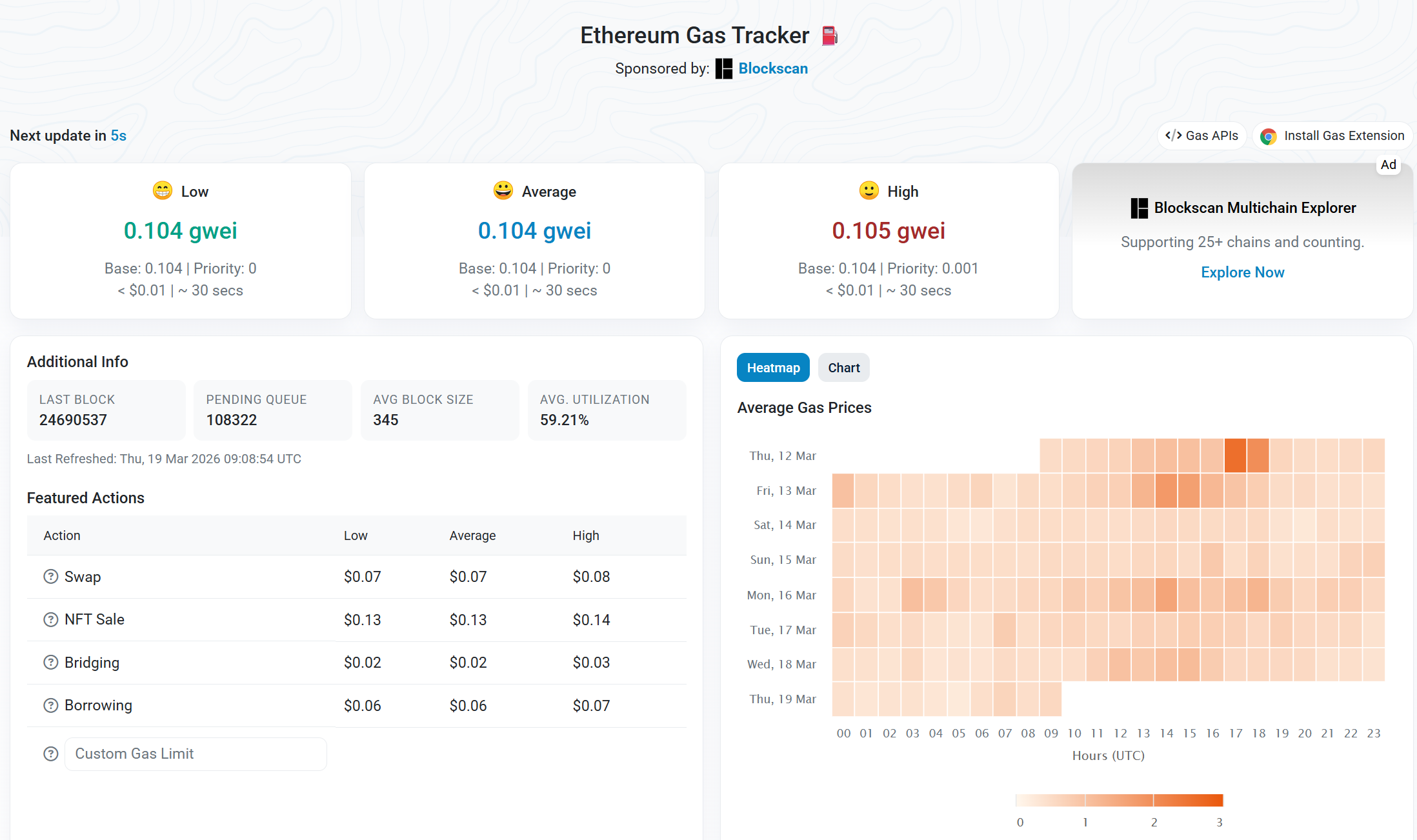
As of March 20, 2026, data from DefiLlama and other Ethereum sources indicates a significantly lower fee environment compared with prior congestion-heavy cycles, suggesting that cost is no longer the primary constraint for the mainnet.
Source: https://etherscan.io/gastracker
Lower fees, however, are not the end state. The more important question is how far Ethereum can continue to expand the capacity of L1 now that cost pressure has eased. Future competitiveness will not be defined solely by being the most secure settlement layer. It will increasingly depend on whether the mainnet itself can support a greater share of real financial activity while preserving security and decentralization. In that sense, the focus is shifting from affordability alone to the ability of L1 to sustain meaningful throughput, rather than relying primarily on external scaling layers to absorb demand.
III. Solana’s 2026 Mission: From Fast Chain to Global Settlement Candidate
After reaching a low point in 2022 following the FTX collapse and a series of network outages, Solana regained market attention in 2024, driven in part by retail activity on platforms such as pump.fun. As the network moves toward 2026, its positioning is gradually shifting beyond memecoin-driven activity toward a broader role in payments, settlement, and on-chain capital markets.
The more meaningful change took place at the infrastructure level. In 2025, Solana completed its first full calendar year without downtime, suggesting that its high-performance architecture is becoming more operationally reliable.
1. Alpenglow: Consensus Layer Redesign
Alpenglow is widely viewed as the most significant protocol-level upgrade in Solana’s roadmap. According to Anza, it represents a major redesign of the core consensus mechanism, with a target median finality of around 150 milliseconds, and potentially lower under optimal conditions.
Its significance can be understood in three dimensions. First, it restructures consensus logic to reduce confirmation latency. Second, it simplifies the path between propagation, verification, and finalization, which may improve reliability while supporting higher throughput. Third, if finality consistently approaches the 100 to 150 millisecond range, Solana’s transaction experience begins to resemble a real-time system rather than a traditional blockchain. This performance profile is particularly relevant for payment rails and latency-sensitive financial applications.
2. Firedancer: Client Diversity and Network Resilience
If Alpenglow addresses how quickly the network can confirm transactions, Firedancer addresses whether that speed can be sustained safely over time. Historically, one of Solana’s key vulnerabilities was its reliance on a single dominant client implementation, which introduced systemic risk.
By late 2025, Firedancer-related deployments, including Frankendancer, were already handling a meaningful share of total stake. This marks the beginning of a transition toward true client diversity, reducing the likelihood that a single implementation failure could impact the entire network.
For use cases such as payments, stablecoin settlement, RWAs, and market making, reliability is more critical than theoretical peak throughput. The key requirement is that the system remains operational under stress and avoids shared points of failure. In this context, Firedancer strengthens Solana’s positioning as a more resilient base layer for financial activity.
Looking ahead to 2026, the key development is not whether Ethereum becomes more like Solana, or whether Solana replaces Ethereum. It is that both networks are moving toward a similar objective from different starting points.
Ethereum is improving execution efficiency and expanding L1 capacity to support larger-scale financial activity, while Solana is strengthening reliability and client diversity to support more persistent capital.
The central question is which architectural model will ultimately anchor internet-scale finance: a layered settlement network optimized for security, or a high-performance system that achieves reliability at scale.
IV. Ethereum vs. Solana: Two Roads to the Financial Base Layer
Ethereum and Solana represent two distinct design philosophies. Ethereum leans toward a modular model that separates security, scaling, and user experience across layers. Solana, by contrast, aims to keep execution, trading, and settlement as unified as possible within a single high-performance chain. They are not simply two answers to the same question. They are closer to two competing visions of what internet finance should look like: a global settlement network, or a real-time financial operating system.
1. Modular Financial Network vs. Monolithic Real-Time System
Ethereum’s model remains institutionally oriented. It prioritizes trust, stability, verifiability, and composability over raw speed. In this design, the mainnet functions as the global settlement layer and security anchor, while high-frequency activity is increasingly handled by Layer 2 systems.
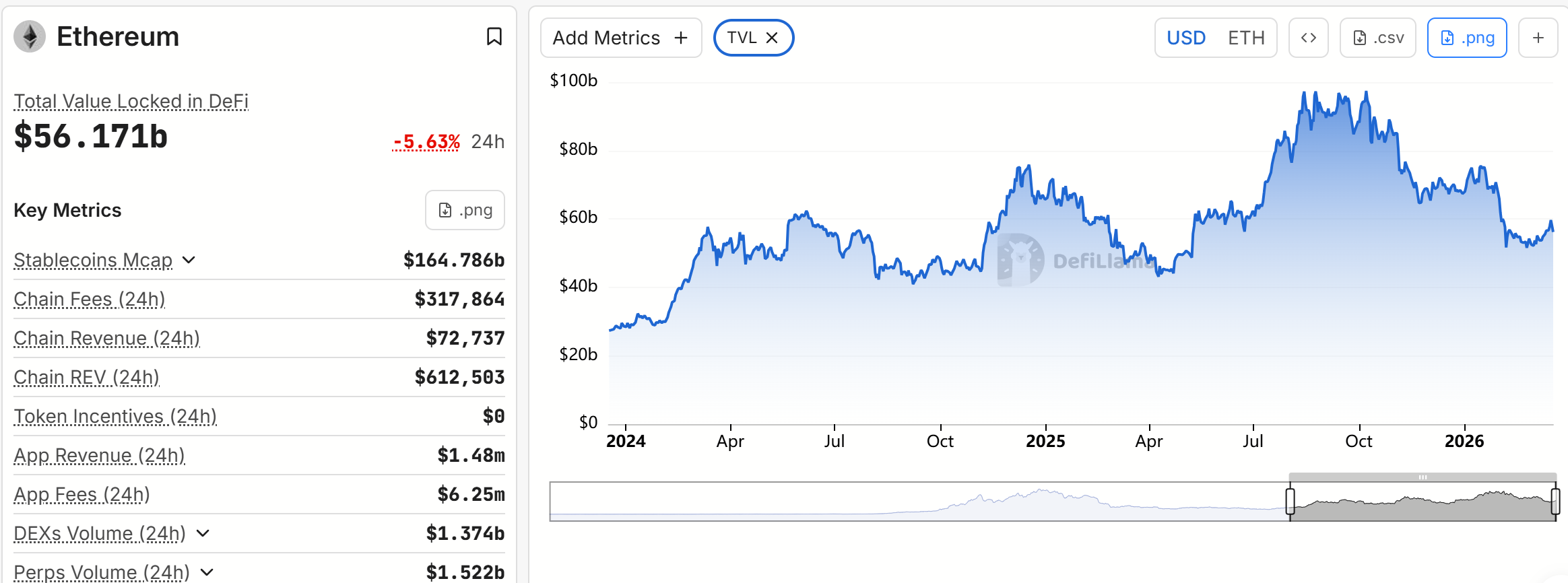
As of March 19, 2026, Ethereum’s DeFi TVL stood at approximately $56.17 billion, with stablecoin supply around $164.78 billion. Meanwhile, the broader L2 ecosystem accounted for roughly $32.53 billion in total value secured, including about $16.32 billion on Arbitrum One and $11.03 billion on Base. This indicates that Ethereum has evolved beyond a single-chain system into a multi-layer financial network anchored by the mainnet
Source: https://defillama.com/chains
Solana reflects a different design philosophy. Rather than distributing execution, liquidity, and settlement across multiple layers, it aims to keep these functions on a single high-performance chain, optimizing for speed, low latency, and cost efficiency.
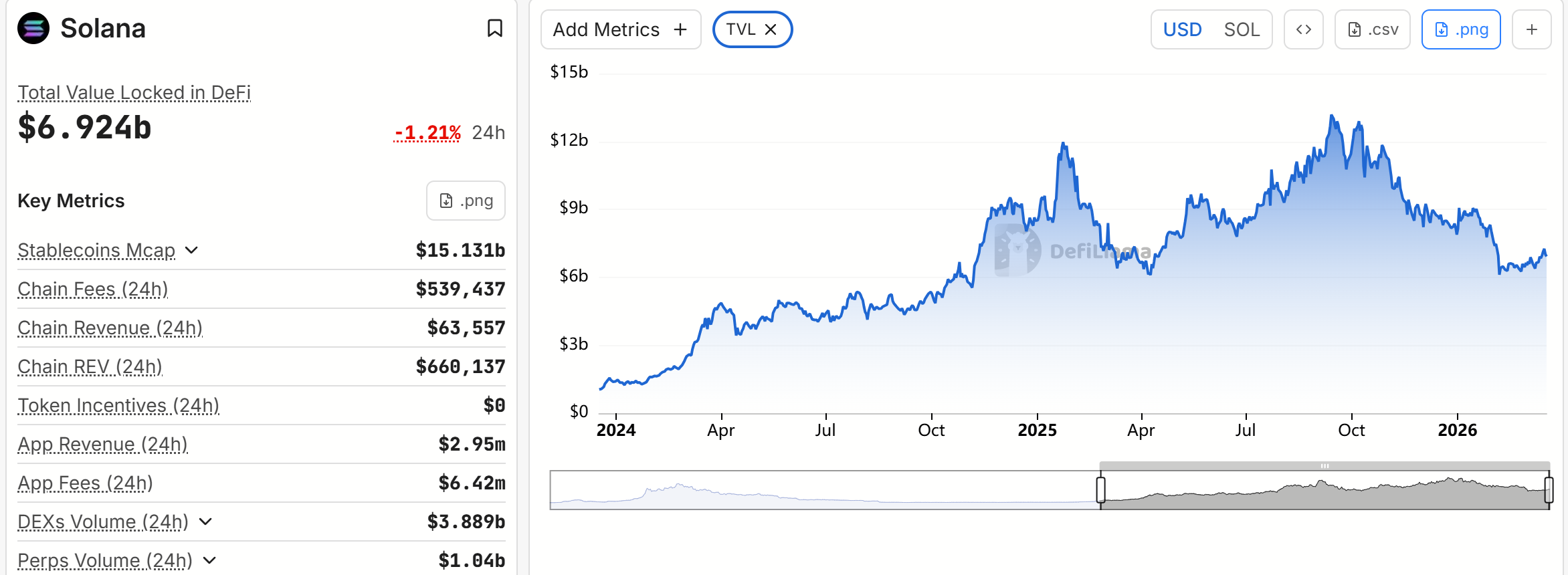
As of March 19, 2026, Solana’s DeFi TVL stood at approximately $6.92 billion, with stablecoin supply around $15.13 billion, significantly lower than Ethereum. However, its 24-hour DEX trading volume reached approximately $3.89 billion, far exceeding Ethereum mainnet’s roughly $1.37 billion over the same period. This suggests that Solana’s strength lies not in asset depth, but in transaction intensity and capital velocity within a single-layer system.
Source: https://defillama.com/chain/Solana
In practical terms, Ethereum increasingly resembles the legal and settlement architecture of a global financial network, while Solana functions more like a real-time execution engine for high-frequency on-chain activity. The distinction is not about which model is superior, but about which role each network is better positioned to fulfill.
2. Which Is Better Positioned for Institutions and RWAs?
Institutions do not care only about fee levels. They care about rule stability, capital security, balance-sheet depth, and compatibility with custody, compliance, audit, and settlement infrastructure. By that standard, Ethereum still holds the stronger position today. Its stablecoin base is dramatically larger, its DeFi stack is more mature, and its institutional integrations are deeper. Ethereum’s 2026 roadmap matters precisely because it attempts to close the historical performance gap without giving up its credibility premium. However, from the standpoint of transaction efficiency and payment-style settlement, Solana is becoming much more compelling. A full year without downtime, stable slot times, and growing client diversity all make Solana look increasingly attractive for flows that depend on speed and low friction. That makes the more useful framing less about “winner and loser” and more about role differentiation: Ethereum remains closer to an asset-retention layer, while Solana is emerging as a capital-flow layer.
3. Which Is Better Positioned for Retail and Consumer Applications?
From the perspective of retail users, Solana still has the more intuitive product experience. Most users care about three things: whether transfers are fast, whether fees are low, and whether the experience feels straightforward. On those dimensions, Solana remains much closer to Web2 expectations: one chain, near-instant confirmation, and transaction costs that are often negligible. Ethereum’s challenge is the opposite. Its ecosystem is powerful, but fragmented from a user perspective: mainnet, L2s, bridges, different gas environments, and multiple wallet abstraction paths. Account abstraction and L1 performance upgrades may improve that experience over time, but for now Solana still feels more like a consumer-grade on-chain product, while Ethereum feels more like a powerful but more complex financial operating system. So if the near-term goal is mass consumer adoption, Solana has a natural advantage. If the priority is high-value capital, complex protocols, and institutional depth, Ethereum remains better positioned.
V. Outlook
Ethereum and Solana are ultimately converging toward the same goal: becoming the most critical and least replaceable base layer for the future of on-chain finance.
Ethereum is taking a more institutional and evolutionary path. It continues to prioritize security, decentralization, and credible settlement as the foundation of the network. What is changing in 2026, however, is that Ethereum is no longer content with being defined solely as the safest settlement layer. Through upgrades such as parallel execution, higher gas limits, ePBS, and continued progress in account abstraction and state optimization, Ethereum is working to demonstrate that the most trusted system can also become significantly more efficient—and that a deeply conservative base layer can still evolve into a stronger financial backbone.
Solana, by contrast, is betting on a different path: that large-scale on-chain finance does not necessarily require a complex, multi-layered architecture. Instead, it is pursuing a model built around single-chain performance, near real-time finality, and extremely low interaction costs. With Alpenglow reshaping consensus and Firedancer strengthening client diversity, Solana is aiming to prove that the fastest system can also be stable and reliable enough to support truly global, institutional-grade financial activity.
Looking ahead, the key variables that will shape the next phase of competition are unlikely to be defined by the traditional bull–bear cycle alone, but by several structural shifts: whether stablecoins continue to expand into global payment and settlement infrastructure, whether RWAs form meaningful on-chain asset pools at scale, whether on-chain capital markets can support more complex and institutionalized trading activity, and whether users are willing to remain on-chain across wallets, payments, and applications over the long term.
In that sense, 2026 is not the final battle, but a public qualification round. Ethereum is trying to prove that the most trusted system can also be fast enough. Solana is trying to prove that the fastest system can also be reliable enough. Both are pushing beyond their historical boundaries and converging toward a higher level of competition. The ultimate outcome will be determined by where stablecoins, RWAs, and global on-chain capital ultimately choose to settle and flow.
About Us
Hotcoin Research, the core research and investment arm of Hotcoin Exchange, is dedicated to turning professional crypto analysis into actionable strategies. Our three-pillar framework—trend analysis, value discovery, and real-time tracking—combines deep research, multi-angle project evaluation, and continuous market monitoring.
Through our Weekly Insights and In-depth Research Reports, we analyze market dynamics and highlight emerging opportunities. With Hotcoin Selects—our exclusive dual-screening process powered by both AI and human expertise, we help identify high-potential assets while minimizing trial-and-error costs.
We also engage with the community through weekly livestreams, decoding market hot topics, and forecasting key trends. Our goal is to empower investors of all levels to navigate cycles with confidence and capture long-term value on Web3.
Risk Disclaimer
The cryptocurrency market is highly volatile, and all investments carry inherent risks. We strongly encourage investors to remain informed, assess risks thoroughly, and adhere to strict risk management practices to protect their assets.
Connect with Us
Website:https://www.hotcoin.com/en_US/learn/index/
X: x.com/HotcoinAcademy
Email: labs@hotcoin.com
読書をお勧めします
もっと見る
How Blockchain Works?
In-depth Research

Hotcoin Research | AI Agents are Redefining the Crypto Economy: Decoding the Latest Dynamics and Trends in the AI Agent Space
In-depth Research
Hotcoin Research | Aave V4 vs. Morpho V2: Two Paths for the Future of DeFi Lending
In-depth Research

サービス連絡先
Service@hotcoin.com
製品フィードバック
Product@hotcoin.com
ビジネス協力
Business@hotcoin.com
法務連絡先
Casecn@hotcoin.com
©2017-2026