
Hotcoin Research | Aave V4 vs. Morpho V2: Two Paths for the Future of DeFi Lending
TL;DR
-
Background: Aave V4 and Morpho V2 mark a new phase of architectural upgrades in DeFi lending.
-
Evolution: Pooled liquidity → Aave V2/V3 (multi-chain expansion & risk segmentation) → Morpho’s curation-driven model.
-
Three Paradigms: Pooled money markets | Isolated markets + curation | RWA lending.
-
Positioning: Aave resembles an on-chain “bank,” while Morpho functions more like an on-chain asset management platform.
-
Risks: Oracle and parameter risks | Governance risks | Vault/Curator risks | Smart contract and execution risks.
-
Opportunities: Composable lending primitives | Institutional adoption | Expansion through RWA and credit layering.
-
Conclusion: DeFi lending is evolving into a modular, institution-ready financial operating system.
DeFi lending is entering a new phase of architectural upgrades. Recently, both Aave and Morpho, two leading DeFi lending protocols, have announced major version updates. Aave V4 launched in late March, while Morpho V2 went live in February. Aave V4’s hub and spoke architecture is designed to unify liquidity and expand further into the RWA space. However, Chaos Labs’ recent withdrawal, the departure of core contributors such as ACI, as well as governance disputes and liquidation anomalies, have raised widespread concerns. Meanwhile, Morpho V2’s non-custodial Vaults significantly improve capital efficiency by 20 to 30 percent through a curator-driven model, but discussions around curator risk management and security trade-offs remain active. The parallel upgrades signal that lending protocols are evolving from simple on-chain borrowing tools into more sophisticated infrastructure for capital allocation and credit layering. At the same time, they serve as a reminder to investors that opportunities and risks coexist, and that this transition represents a critical test of capital efficiency, security, and governance.
I. Understanding DeFi Lending Protocols
1. Core Logic
The underlying logic of DeFi lending can be summarized in one sentence: it brings traditional banking deposit and lending functions on-chain and reimplements them through code.
In this system, lenders deposit assets into protocols to earn interest, while borrowers obtain funds by providing excess collateral. The key difference from traditional finance is that this process does not rely on manual review, credit assessment, or centralized institutional endorsement, but is instead fully automated by smart contracts. The flow of funds, interest rate calculations, and liquidation mechanisms are all governed by predefined rules, offering a high level of transparency and verifiability.
As a result, the barrier to entry for DeFi lending is significantly lowered. Any wallet address holding crypto assets can participate without permission.
2. Key Use Cases
From an investor perspective, lending protocols primarily serve three functions:
-
Borrow without selling assets: Users can use assets such as BTC and ETH as collateral to borrow stablecoins, gaining liquidity without giving up potential upside and avoiding the need to sell prematurely.
-
On-chain yield generation: Users deposit idle assets into lending protocols to earn relatively stable returns, treating them as on-chain equivalents of demand deposits or money market funds. In a crypto market that lacks low-risk yield instruments, this function has long served as a baseline yield source.
-
Capital market infrastructure: The execution of the most complex strategies relies on the liquidity provided by lending protocols. For example, liquidators require immediate access to capital to participate in liquidations and capture rewards; arbitrageurs depend on short-term liquidity to exploit cross-market price differences; and other protocols, such as derivatives platforms, stablecoins, and yield aggregators, rely on composable collateral and borrowing interfaces to build their products.
It is clear that lending protocols not only serve end users, but also act as the liquidity backbone of the entire on-chain financial system.
3. Two Core Capabilities
From the perspective of mechanism design, the complexity of lending protocols can ultimately be attributed to two core capabilities.
-
Pricing capability: This includes interest rate models, collateral requirements, liquidation thresholds, and incentive mechanisms. Together, these parameters determine the supply and demand dynamics of capital and overall capital efficiency, and serve as a direct reflection of a protocol’s competitiveness.
-
Risk isolation capability: In an environment where multiple assets and markets coexist, preventing the volatility or risk events of a single asset from spreading to the broader system is a key challenge in the long term evolution of lending protocols. Mechanisms such as isolated pool design, risk stratification, and independent market structures are all built around this objective.
II. The Evolution of Lending Protocols
The evolution of lending protocols is not simply about adding new features, but about finding a new balance among several core trade-offs, including efficiency and security, decentralization and specialization, as well as open access and controlled risk management. In this sense, the development of DeFi lending can be seen as a continuous process of mechanism redesign around this triangular framework, as well as the growth trajectory of protocols such as Aave and Morpho.
1. Early Stage (2018–2020): The Emergence of Pooled Liquidity Models
In June 2018, Compound introduced the cToken mechanism, widely regarded as the true starting point of DeFi lending. Users deposit assets such as USDC and ETH into a shared liquidity pool, where interest rates are automatically adjusted based on supply and demand. Borrowers can access funds by providing excess collateral of 150 to 200 percent. This is the classic peer-to-pool model, where all liquidity is aggregated, enabling high capital efficiency and allowing users to deposit and withdraw at any time. It marked the first large-scale validation of permissionless lending on blockchain infrastructure.
Aave’s predecessor, ETHLend, attempted a pure peer-to-peer matching model in 2017. However, due to low matching efficiency and severe liquidity fragmentation, adoption remained limited by 2019. Aave V1 launched in January 2020, introducing a pooled liquidity architecture and bringing flash loans into DeFi as a key innovation, which later helped establish its leading position.
2. Expansion and Iteration Phase (2020–2023): Aave V2 and V3 Drive Multi-Chain Growth and Risk Segmentation
Following the DeFi Summer of 2020, liquidity fragmentation and multiple security incidents exposed the limitations of single pool models. Aave V2, launched in December 2020, introduced features such as batch flash loans, debt tokenization, collateral swapping, and direct repayment using collateral, while reducing gas costs by 15 to 20 percent. These upgrades significantly improved capital efficiency, user experience, and developer usability.
Aave V3, launched in March 2022, introduced several key innovations, including isolated markets through E Mode, cross-chain liquidity via Portal, and more advanced liquidation parameters such as LTV, liquidation thresholds, and liquidation bonuses that can be dynamically adjusted. By the end of 2023, Aave’s cumulative lending volume had surpassed the 1 trillion US dollars mark.
3. Optimization and Modularization Phase (2023 to present): Morpho's Curatorial Model
In 2023, Morpho emerged as an interest rate optimization layer built on top of Aave and Compound. By prioritizing direct matching between lenders and borrowers, with excess liquidity routed back to underlying pools, it typically delivers yields that are 0.5 to 2 percent higher.
Morpho V1 introduced isolated markets defined by a single collateral asset and a single borrow asset, with fixed parameters and fully isolated risk. Market creation is permissionless, and risk is contained within each market.
Morpho V2, launched in 2026, further externalizes risk management and pricing. Curators, including institutions such as Gauntlet, Steakhouse, and Bitwise, are responsible for setting key parameters such as interest rates, duration, and LTV. The protocol itself provides infrastructure such as timelock-controlled updates, flash loan-based redemptions, and Sentinel protection mechanisms to ensure a fully non-custodial design.
The goal of Morpho V2 is to allow market participants, rather than the protocol, to determine pricing, while supporting more advanced structures such as fixed-rate and fixed-term lending, improved cross-chain efficiency, and products that more closely resemble traditional credit markets.
III. Three Core Paradigms of DeFi Lending
Lending protocol mechanisms can be understood across three dimensions: how assets are aggregated, how risks are isolated, and how interest rates are determined. Based on these dimensions, current DeFi lending can be broadly categorized into three mainstream paradigms.
1. Multi-asset pooled liquidity model: the standard approach focused on liquidity
The first type is the most established and widely adopted model, commonly known as pooled money markets, represented by Aave and Compound.
In this model, assets are aggregated into shared liquidity pools, and interest rates are automatically adjusted based on supply and demand. All user deposits are pooled together, and borrowers draw liquidity from the pool, with rates dynamically changing according to utilization. This design provides high liquidity and accessibility, including instant deposits and withdrawals, mature liquidation mechanisms, and support for advanced features such as flash loans.
However, this efficiency comes with partially shared risk. Although Aave V3 introduces risk segmentation through Isolation Mode and E Mode, extreme market conditions and large price fluctuations in a single asset can still impact overall system liquidity.
2. Isolated markets with curation: rebalancing efficiency and risk
The second paradigm, which has gained traction in recent years, is the isolated markets with curation model, represented by Morpho.
The core idea is to isolate risk at the market level and then improve efficiency through structural design. In Morpho Markets, each market typically consists of a single collateral asset and a single borrow asset, with fixed and independent parameters. This structure naturally limits risk contagion across assets and improves overall safety compared to pooled models.
However, full isolation can lead to fragmented liquidity and a less efficient user experience. To address this, Morpho introduces Vault and Curator mechanisms. Curators are responsible for selecting underlying markets and configuring parameters, while Vaults aggregate multiple isolated markets to provide a simplified, one-click user experience similar to pooled models. At the same time, capital can be dynamically allocated across markets to improve returns and utilization.
As a result, this model achieves a balance. Yields are typically 0.5 to 2 percent higher than pooled models, and risk is more finely isolated. At the same time, it introduces new variables, particularly curator capability and potential moral hazard.
In essence, Morpho externalizes part of the risk management function from the protocol to specialized actors, representing a shift from fully protocol-driven systems toward more professionalized governance.
3. RWA lending: bridging on-chain finance with the real world
The third paradigm is RWA lending, currently the fastest growing and most structurally significant direction.
The key distinction of this model is that collateral or cash flow sources extend beyond on-chain assets to include real-world assets such as accounts receivable, bonds, real estate, and corporate financing demand. Representative projects include Maple, Goldfinch, and Centrifuge.
Structurally, RWA lending can be divided into two main categories:
-
Over-collateralized models, where tokenized real-world assets are used as collateral
-
Credit-based or under-collateralized models, which rely on off-chain due diligence, on-chain reputation, or partial KYC frameworks
In terms of risk management, these models are closer to traditional finance.
-
Returns are primarily generated from fixed-rate lending, typically in the range of 4 to 8 percent or higher
-
Correlation with crypto market volatility is relatively low, providing a degree of counter-cyclical behavior
From an industry perspective, RWA is becoming a key source of incremental growth in DeFi lending. Its share of total value locked has exceeded 10 percent of the sector, and Aave V4 has explicitly identified RWA as a major area of expansion. Morpho is also collaborating with institutions such as Ondo and Apollo to introduce off-chain assets.
Looking ahead, the development of RWA is expected to move DeFi lending beyond a closed crypto-native system toward a more integrated on-chain and off-chain financial ecosystem.
IV. Aave V4 vs. Morpho V2: Two Paths Forward
If the core theme of DeFi lending over the past few years has been the continuous search for a balance among efficiency, security, and scalability, then Aave V4 and Morpho V2 represent two fundamentally different approaches. Aave focuses on unified liquidity and modular expansion, aiming to become the central hub of on-chain lending, while Morpho adopts a non-custodial, curator-driven model that shifts more pricing and risk management power to the market and professional participants.
1. On-chain data overview
Using total value locked in the lending sector as a reference, Aave accounts for approximately half of the market, while Morpho represents slightly over 10 percent. When measured by total outstanding loans across the network, Aave’s share exceeds 50 percent, reinforcing its position as the primary layer for on-chain leverage and credit demand.
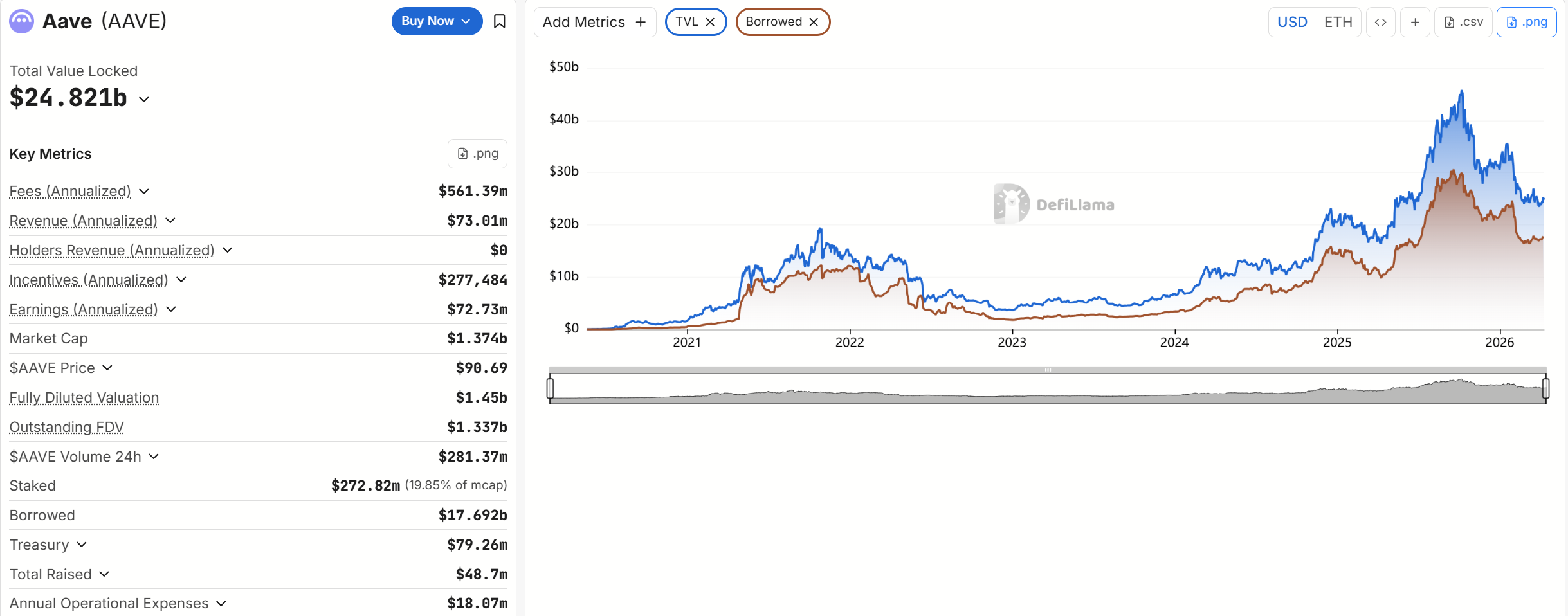
According to DefiLlama data, as of April 9, 2026, total value locked in DeFi lending stands at approximately 51 billion US dollars, with total outstanding loans around 34.4 billion US dollars. Aave’s total value locked is approximately 24.8 billion US dollars, with around 17.6 billion US dollars in outstanding loans. Ethereum accounts for the majority of this liquidity, at roughly 20 billion US dollars, with the remainder distributed across networks such as Arbitrum, Base, Mantle, Avalanche, and others.
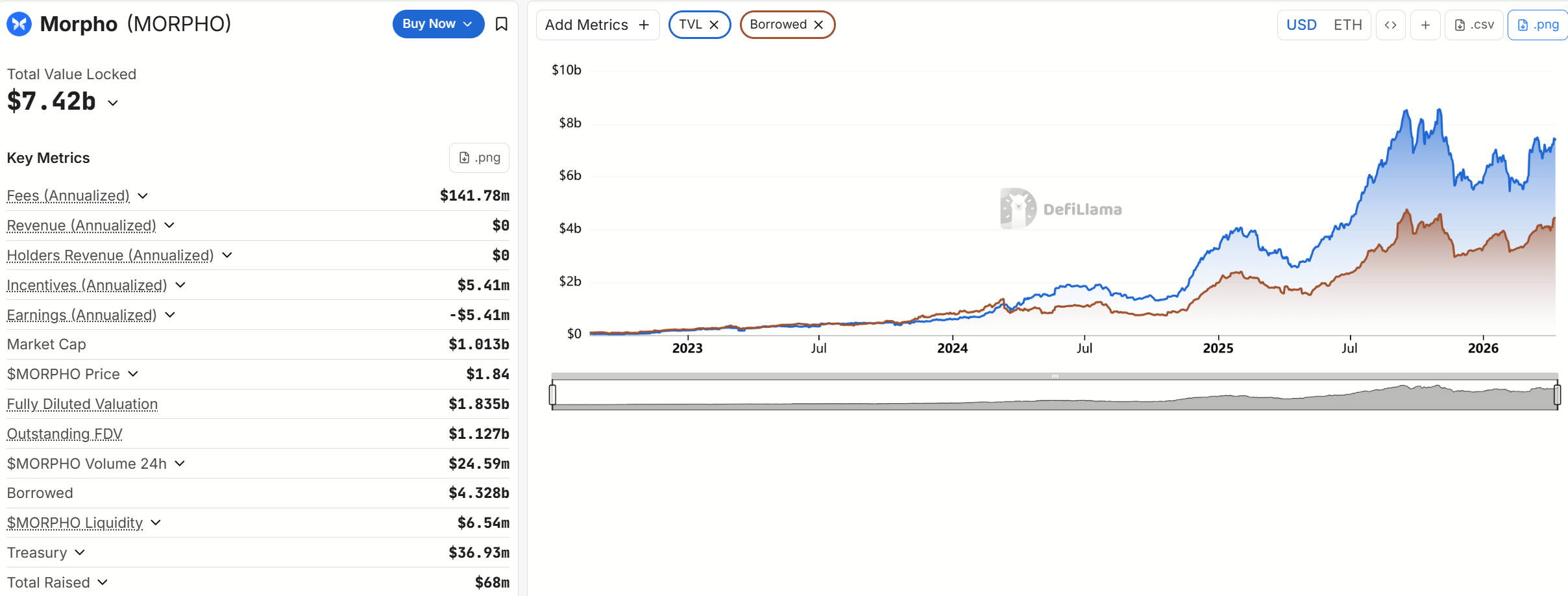
Morpho’s total value locked is approximately 7.4 billion US dollars, with around 4.3 billion US dollars in outstanding loans. Its liquidity is primarily concentrated on Ethereum and Base, with additional presence across other networks.
Source: https://defillama.com/protocol/morpho
2. Aave V4: restructuring liquidity through a hub and spoke architecture
The core objective of Aave V4 is to address a long-standing challenge from the V3 era, namely liquidity fragmentation caused by multi-market and multi-chain expansion. In the V3 model, liquidity is confined to specific markets on specific chains, which limits capital efficiency and requires new markets to bootstrap liquidity independently. Aave V4 introduces a unified liquidity framework, where each network operates a central liquidity hub. Users interact with the system through different entry points, while the hub manages accounting, capital allocation, and core risk parameters. This allows liquidity to be shared across different strategies and asset types while maintaining risk segmentation.
The key features of Aave V4 include:
-
Unified liquidity: reduces fragmentation across markets on the same chain and improves overall capital efficiency.
-
Modular risk isolation: different spokes can be configured with distinct parameters, preventing risk from being shared across all assets.
-
Institutional and RWA readiness: dedicated RWA segments can implement stricter access, custody, and redemption frameworks, laying the groundwork for integrating real-world assets on-chain.
The challenges of Aave V4 also stem from its ambitious design. A more advanced architecture inevitably increases the complexity of governance, risk management, and operations. The initial deployment is expected to include three hubs and ten spokes, with V4 and V3 running in parallel for an estimated 24 to 36 months.
During this transition, governance tensions have become more pronounced. Several core contributors, including BGD, ACI, and Chaos Labs, have announced their departure or ended their involvement. Among them, Chaos Labs stated that the fundamental disagreement centered on how risk should be managed.
3. Morpho V2: turning asset management into a protocol-level function
In contrast, Morpho V2 follows a more measured and modular upgrade path. Rather than a full system overhaul, it introduces Vaults V2 first, followed by Markets V2 in a phased rollout. According to the official plan, Vaults V2 will go live first, while liquidity continues to be allocated to existing Morpho markets in the early stage. Once Markets V2 is fully implemented, it will provide initial deep liquidity for fixed-rate and fixed-term markets.
The focus of Morpho V2 is not on expanding a unified liquidity pool, but on embedding asset management as a protocol-level capability. Its key changes include:
-
More granular role separation: roles such as Owner, Curator, Allocator, and Sentinel are clearly defined, enabling better responsibility segregation and supporting institutional requirements.
-
Curators as the core decision makers: curators are responsible for setting risk parameters, defining allocation boundaries, and appointing allocators for execution.
-
Enhanced non-custodial protections: mechanisms such as timelock controls, flash loan-based in-kind redemptions, and Sentinel intervention are designed to mitigate worst-case scenarios.
The most important shift is that the Morpho protocol no longer makes unified risk management decisions for all users. Instead, users choose their own curators. In practice, users are not selecting a single market, but an on-chain asset manager. This represents the most fundamental difference between Morpho and Aave.
The appeal of Morpho V2 is clear:
-
Users can access professionally managed strategies through Vaults
-
Strategy parameters are transparent and verifiable
-
Yields are often higher than traditional pooled models
-
Exit mechanisms remain non-custodial and flexible, allowing users to withdraw at any time
However, this model also introduces trade-offs. Protocol-level risk is partially replaced by manager risk. If a curator exhibits excessive risk-taking, insufficient capability, or weak governance controls, localized risks may still emerge.
It is also worth noting the growing role of institutional participation. Since 2026, Morpho has expanded its institutional partnerships. Its partnership with Apollo Global Management enables access to the Morpho lending market under defined constraints, while Anchorage Digital and service providers such as Taurus offer pathways for accessing Morpho Vaults within compliant operational frameworks. Bitwise has also joined the ecosystem as a curator, further reinforcing the positioning of Vaults as institutional-grade on-chain investment products.
4. Two Paths, One Fundamental Trade-Off
Ultimately, Aave V4 and Morpho V2 are not direct replacements for each other, but represent two distinct directions for the future of DeFi lending.
-
Aave V4 focuses on unification and expansion: its objective is to build the largest possible liquidity network while supporting institutional participation and RWA integration.
-
Morpho V2 emphasizes modularity and customization: its goal is to shift more control over pricing and asset management to the market.
For investors, a more practical way to evaluate these models is not to ask which is more advanced, but which is better aligned with their capital allocation strategy. Capital that prioritizes stability, lower volatility, and exposure to large scale protocols may be better suited to Aave, while capital seeking higher returns and more active strategy selection may find Morpho more appropriate.
V. Risks, Opportunities, and the Future
If the market’s understanding of lending protocols in the past was largely limited to “earning yield through deposits” or “borrowing against collateral,” then in the era of Aave V4 and Morpho V2, what requires renewed attention is the underlying risk structure itself. At the same time, lending protocols are entering a new phase of opportunity, driven by modular product design, institutional participation, and credit expansion through RWA.
1. Risks and challenges
1) Oracles and parameter configuration risks: The wstETH incident on Aave in March 2026 demonstrated that even in the absence of bad debt, minor deviations in oracle pricing or parameter settings can still trigger large-scale liquidations. In many cases, liquidation profits are captured first by external liquidators, while any potential compensation depends on DAO governance decisions and execution efficiency. For users, this highlights an important distinction: the absence of protocol-level bad debt does not imply the absence of user losses.
2) Governance and organizational risk: In the past, many investors assumed that leading protocols operated with mature governance and stable teams. However, the recent departure of several core service providers from Aave has revealed another dimension. As protocols grow in scale, risk management is no longer purely a technical issue, but also involves budgeting, voting power, accountability structures, and organizational design. For users, this ultimately affects whether parameters are maintained with sufficient rigor, whether coordination is effective during crises, and whether resources are allocated toward security or growth.
3) Vault and curator risk: This risk is particularly relevant within the Morpho ecosystem. Vaults V2 introduces mechanisms such as Owner, Curator, Allocator, Sentinel, timelock, and veto rights, effectively bringing institutional-style asset management structures on-chain. However, the presence of these mechanisms does not eliminate risk. It requires users to evaluate the governance structure behind each Vault, including ownership, multisignature control, timelock duration, guardian permissions, and historical parameter decisions. Without such due diligence, non-custodial design does not equate to risk-free exposure, but instead shifts risk from the protocol layer to the manager layer.
4) Smart contracts and execution risks: These include vulnerabilities in contract code, logical flaws, edge case triggers, and anomalies in cross-contract interactions, as well as network congestion and execution delays under extreme market conditions. Protocols such as Morpho adopt multiple layers of security practices, including formal verification, fuzz testing, audits, and bug bounty programs. However, no system can guarantee complete elimination of risk. In practice, on-chain financial risk can only be distributed, mitigated, and delayed, rather than fully removed.
2. Opportunities and growth potential
Alongside rising complexity, lending protocols are also opening new areas of opportunity.
1) From unified products to modular financial infrastructure: Aave V4’s hub and spoke architecture establishes a shared liquidity foundation, allowing markets with different asset types, risk profiles, and use cases to operate within a unified framework. Morpho V2 further decentralizes pricing by assigning it to the market and curators, while introducing structures such as fixed-rate and fixed-term lending. As a result, lending protocols are evolving from single products into underlying financial engines that support a wide range of applications.
2) Institutional adoption becoming a defined pathway: Institutional participation is no longer a narrative but an emerging product reality. Partnerships with institutions such as Apollo, along with the involvement of firms like Bitwise, Steakhouse, and Gauntlet as curators, indicate that on-chain lending is increasingly integrated into institutional workflows and compliance frameworks. What was once a crypto-native market is now evolving to accommodate larger-scale, more sophisticated capital with stricter operational requirements.
3) RWA and credit layering expanding asset boundaries: Although the total value locked in RWA lending remains smaller than that of crypto collateralized lending, its structural importance is significant. The emergence of products that more closely resemble traditional credit markets, including structured pools, delegated management, off-chain cash flow, and hybrid settlement mechanisms, is reshaping the asset base of lending protocols. Over time, the scope of these protocols is expected to expand from purely crypto collateral to a broader range of income-generating and cash flow-based assets.
Conclusion
DeFi lending in the V4 and V2 era is no longer a simple on-chain deposit and borrowing mechanism, but is evolving into a core engine for the migration of traditional financial infrastructure onto blockchain systems. It reflects a broader transition from early high-yield experimentation toward more professional, modular, and institution-friendly financial systems.
The upgrade paths of Aave and Morpho provide two different answers to the same fundamental question: should on-chain lending evolve toward a unified liquidity network similar to a global bank, or toward an open asset management platform driven by market participants? The answer may lie in convergence. RWA is expected to introduce real-world credit into on-chain systems, cross-chain integration will help overcome fragmented liquidity, and institutional-grade non-custodial frameworks will lower barriers to entry. Together, these developments point toward a broader trajectory in which DeFi evolves beyond a crypto-native ecosystem into a foundational layer for global capital.
In this context, DeFi is no longer a niche environment limited to crypto-native users, but is becoming part of a structural transformation of financial services toward a more open, permissionless, and efficient system.
About Us
Hotcoin Research, the core research and investment arm of Hotcoin Exchange, is dedicated to turning professional crypto analysis into actionable strategies. Our three-pillar framework—trend analysis, value discovery, and real-time tracking—combines deep research, multi-angle project evaluation, and continuous market monitoring.
Through our Weekly Insights and In-depth Research Reports, we analyze market dynamics and highlight emerging opportunities. With Hotcoin Selects—our exclusive dual-screening process powered by both AI and human expertise, we help identify high-potential assets while minimizing trial-and-error costs.
We also engage with the community through weekly livestreams, decoding market hot topics, and forecasting key trends. Our goal is to empower investors of all levels to navigate cycles with confidence and capture long-term value on Web3.
Risk Disclaimer
The cryptocurrency market is highly volatile, and all investments carry inherent risks. We strongly encourage investors to remain informed, assess risks thoroughly, and adhere to strict risk management practices to protect their assets.
Connect with Us
Website:https://www.hotcoin.com/en_US/learn/index/
X: x.com/HotcoinAcademy
Email: labs@hotcoin.com
読書をお勧めします
もっと見る
Hotcoin Research | Detailed Analysis of Ethereum Spot ETF and Related Project Review
In-depth Research
Hotcoin Research | A Review of Leading Perp DEXs: Cool Reflections Behind the Data Frenzy and a Look Ahead to 2026
In-depth Research

Hotcoin Research | Play and Earn in WEB3: Balance - The Al-Driven Blockchain Revolution in Gaming and Social Interaction
In-depth Research

サービス連絡先
Service@hotcoin.com
製品フィードバック
Product@hotcoin.com
ビジネス協力
Business@hotcoin.com
法務連絡先
Casecn@hotcoin.com
©2017-2026