
Hotcoin Research | A Review of Leading Perp DEXs: Cool Reflections Behind the Data Frenzy and a Look Ahead to 2026
Introduction
On December 30, 2025, Layer-2 token issuance entered its fourth year since the launch of early optimistic rollups. At the same time, the on-chain perpetual futures sector continued to expand rapidly. As trading activity increasingly migrates on-chain, Perp DEXs have emerged as a critical component of the derivatives ecosystem, reshaping how leverage, liquidity, and risk are managed in decentralized markets.
Against this backdrop, Perp DEXs are no longer experimental infrastructure. They are becoming core venues for price discovery, high-frequency trading, and professional-grade execution, driven by advances in Layer-2 scalability, novel liquidity mechanisms, and increasingly sophisticated protocol design.
This report reviews the evolution of the Perp DEX sector, examines 2025 performance data, analyzes leading protocols, and outlines key structural trends shaping the market heading into 2026.
I. Background and Evolution of the Perp DEX Sector
In its early stages, the on-chain derivatives market was relatively small. Centralized exchanges (CEXs) long dominated derivatives trading by offering superior user experience, deep liquidity, and integrated services. However, this centralized model also carried inherent structural risks. The industry turmoil of 2022–2023—most notably the collapse of major players such as FTX—heightened awareness of custodial risk and opaque operations, prompting users and capital to seek decentralized alternatives. This shift laid the demand foundation for the subsequent breakout of the Perp DEX sector.
Performance constraints, however, remained a significant bottleneck for on-chain perpetual contracts. On-chain matching and settlement were often constrained by blockchain throughput and latency, leading to high slippage and insufficient liquidity depth. Early projects explored various solutions: dYdX adopted an order book model with off-chain matching (and has since migrated to an independent chain), while GMX employed an on-chain multi-asset liquidity pool model to enable perpetual trading, albeit with liquidity constrained by pool size. While these pioneers demonstrated the feasibility of on-chain perpetuals, they failed to meaningfully challenge CEXs in terms of trading experience and scale.
In recent years, the development of Ethereum Layer 2 solutions and application-specific chains has provided the infrastructure required for high-performance derivatives exchanges, significantly improving latency and throughput. Hyperliquid built an independent Layer 1 blockchain purpose-designed for derivatives trading, while platforms such as EdgeX and Paradex leveraged Layer 2 technologies like StarkWare to deliver on-chain trading experiences with second-level or even sub-second latency. Combined with incentive mechanisms such as trading mining and points-based airdrops, the Perp DEX sector entered a period of rapid iteration in 2024–2025.
In 2024, Hyperliquid rose to prominence, with the HYPE token airdrop and buyback program driving sharp increases in total value locked and trading volume, at one point accounting for nearly 80 percent of the on-chain perpetual market. In 2025, as multiple new platforms launched and adopted aggressive market strategies, Hyperliquid’s dominance was challenged. The Perp DEX sector officially entered a phase of multi-player competition.
II. Sector Landscape and Data Performance in 2025
In 2025, the overall scale of on-chain perpetual trading achieved a step-change increase. Monthly perpetual trading volume exceeded USD 1 trillion, with on-chain perpetuals rapidly gaining share within the broader crypto derivatives market. At peak periods, on-chain perpetual trading volume reached roughly one-tenth of that of centralized exchanges, posing a tangible challenge to CEX incumbents. Notably, during the extreme market conditions on October 11, on-chain DEXs absorbed approximately USD 19 billion in liquidations within a short timeframe while maintaining overall system stability. These figures indicate that Perp DEXs have evolved from niche experiments into a meaningful component of the derivatives market.
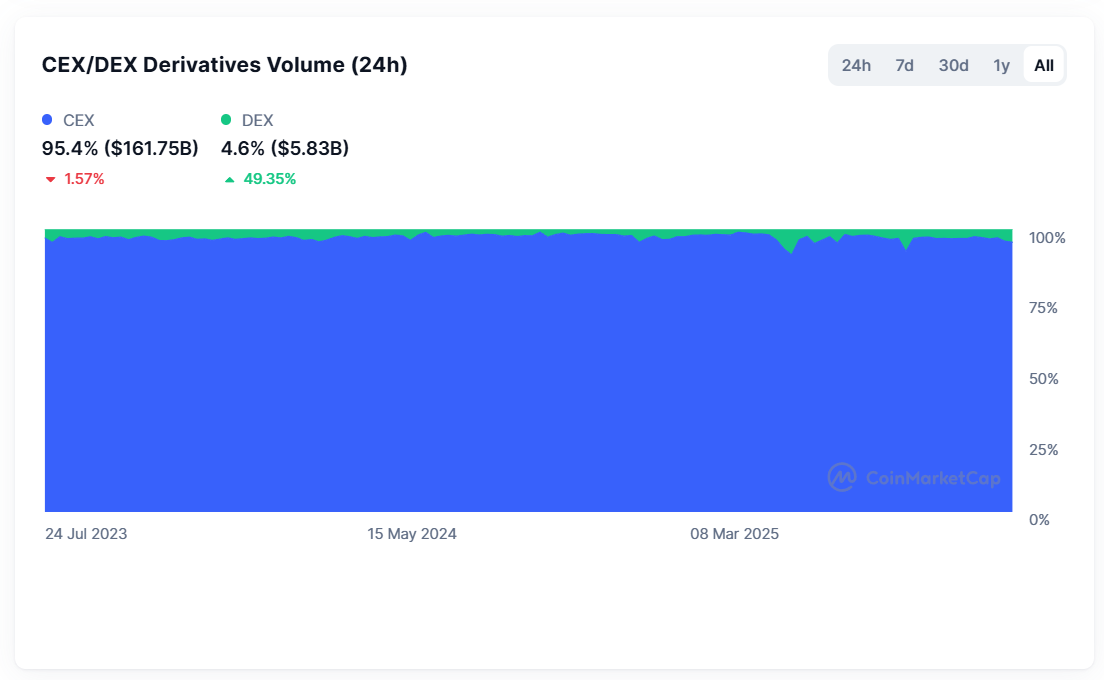
Source: https://coinmarketcap.com/charts/derivatives-market/
From a market-structure perspective, Hyperliquid maintained a dominant position in the first half of the year, accounting for around 70% of on-chain perpetual trading volume. In the second half, however, its share declined steadily as new competitors entered the market. According to Dune Analytics data, by late December Hyperliquid’s share of total trading volume had fallen to approximately 17 percent. In its place, a more fragmented competitive landscape emerged: Lighter rapidly attracted high-frequency traders with its zero-fee strategy, reaching a 20 percent traffic share in December; Aster secured around 15 percent market share through sustained incentives and support from Binance; and EdgeX, positioned as a more conservative and professional platform, captured roughly 10 percent. Other entrants such as Paradex, GRVT, and Pacifica split the remaining share, further eroding the dominance of the former market leader. By the second half of 2025, competition among both incumbent and new Perp DEX platforms for users and liquidity had clearly intensified.
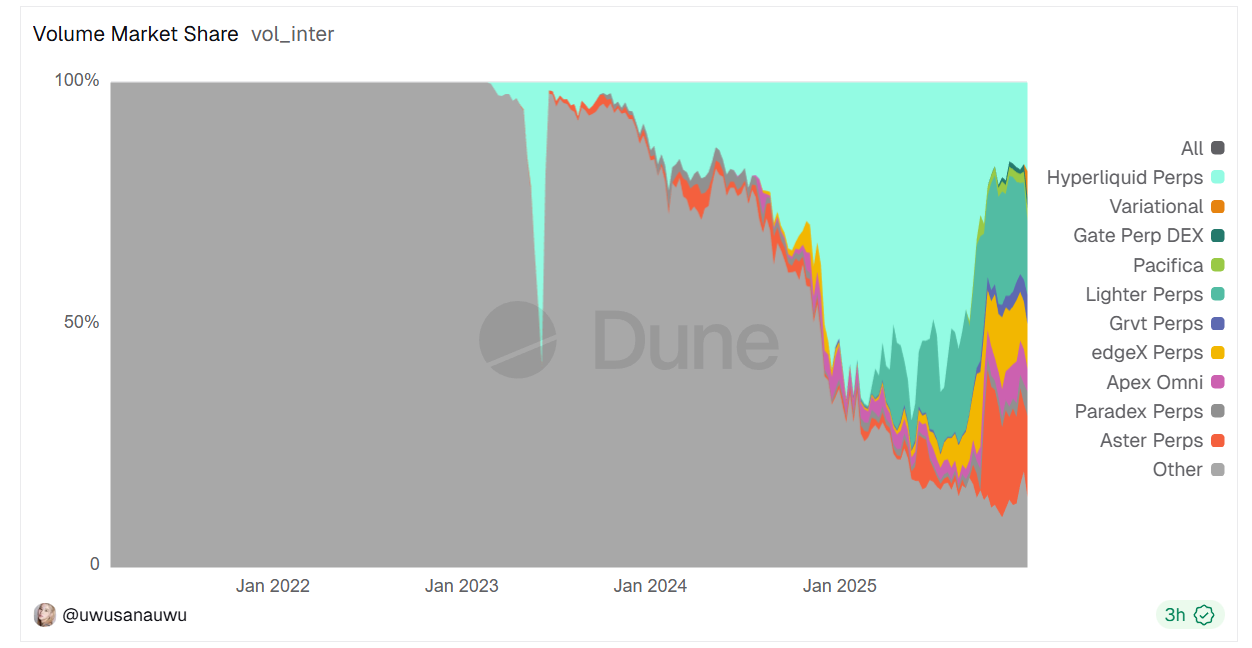
Source: https://dune.com/uwusanauwu/perps
However, a different picture emerges when examining open interest (OI). As of late December, Hyperliquid remained the undisputed leader by this metric, with approximately USD 7.5 billion in open interest, representing 49 percent of the combined OI of the four major platforms. This indicates that nearly half of all on-chain perpetual positions remained concentrated on Hyperliquid. While latecomers such as Aster and Lighter recorded substantial trading volumes, a significant portion of this activity was driven by incentive-fueled high-frequency churn rather than long-term capital deployment.
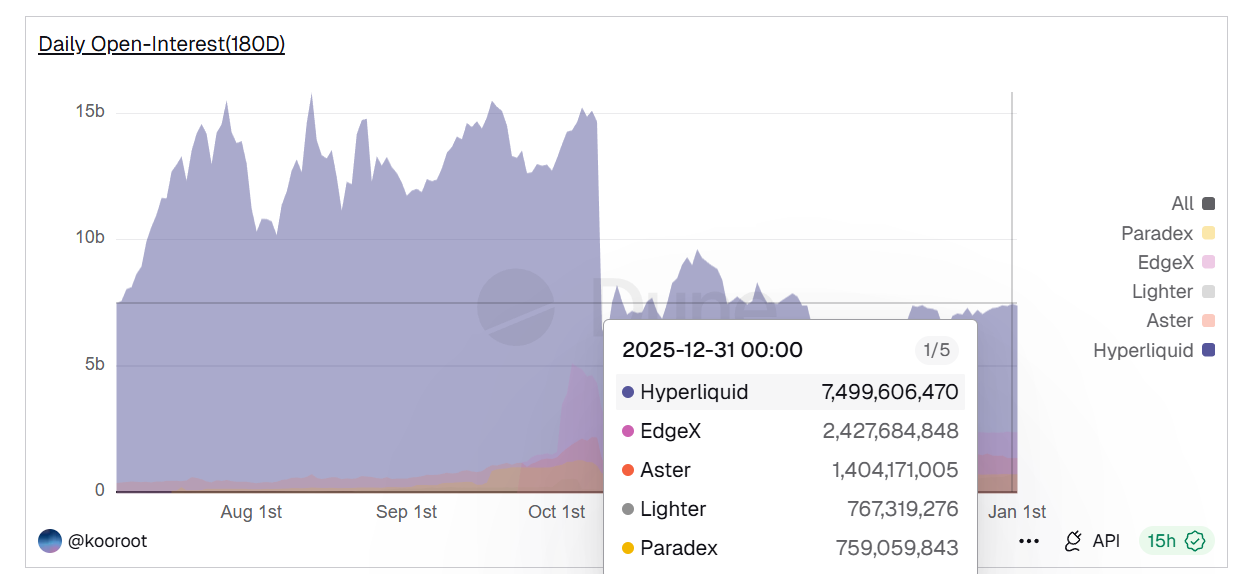
Source: https://dune.com/kooroot/top5-perpdex-comparison
Revenue and profitability data further highlight divergence within the sector. As many new platforms adopted zero-fee or heavy rebate strategies, actual fee revenue provides a clearer measure of sustainable self-sufficiency. Beyond Hyperliquid, EdgeX stands out as one of the few platforms generating consistently high revenue, with monthly fees exceeding USD 20 million and annualized revenue of approximately USD 250 million, second only to Hyperliquid. Platforms such as Paradex and Extended also demonstrated meaningful revenue potential. By contrast, zero-fee market-share-grab models such as Lighter generated virtually no fee income; despite topping volume charts in the short term, protocol revenue remained negligible, leaving post-airdrop sustainability unproven. Overall, while some new platforms are effectively exchanging capital for market share, their ability to establish durable business models remains uncertain.
III. Review of Representative Perp DEX Protocols
Based on rankings by trading volume and open interest, the current Top 5 protocols in the Perp DEX sector are Hyperliquid, Aster, Lighter, EdgeX, and Paradex. Below, we analyze these five representative Perp DEX protocols across multiple dimensions, including team background, technical architecture, product features, token economics, and market data and performance.
1. Hyperliquid — The On-Chain Derivatives Leader
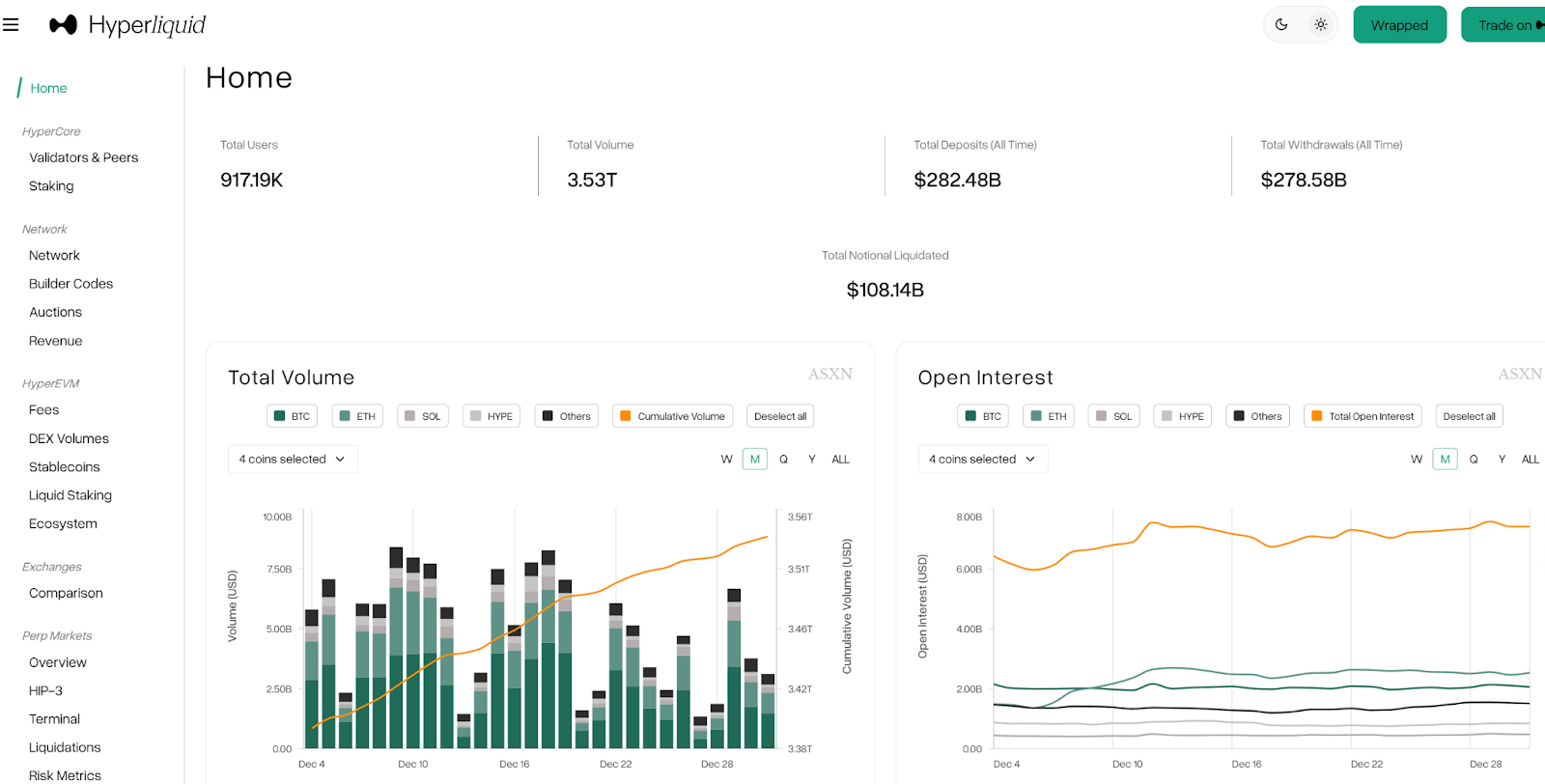
Source: https://wrapped.hyperscreener.asxn.xyz/summary
Background and Team
Hyperliquid was founded in 2023 by Jeff Yan. Starting with a core team of only 11 people, it built a phenomenon-level on-chain derivatives platform in less than two years. Hyperliquid was entirely self-funded from inception and followed a community-driven development path. This self-reliant approach—rare in the crypto industry—earned Hyperliquid a reputation as a truly decentralization-native project. The platform launched in July 2023 with minimal marketing and only gained widespread attention in 2024 following a large-scale airdrop and strong on-chain performance data.
Product and Technology
Hyperliquid’s core differentiation lies in its proprietary, purpose-built blockchain designed specifically for derivatives trading, with theoretical throughput of up to 200,000 transactions per second and sub-second order confirmation latency. Core components such as the central limit order book (CLOB), matching engine, and liquidation logic are fully deployed on this high-performance chain. From a user perspective, the interface and execution closely resemble Binance, yet settlement is fully decentralized and requires no KYC. In addition, Hyperliquid plans to launch HyperEVM, a general-purpose smart contract platform to support a broader application ecosystem.
The flagship HLP Vault plays a market-making role by acting as the counterparty to a large share of trades, earning a portion of trading fees, funding rates, and liquidation income. With TVL exceeding USD 390 million, this model materially enhances liquidity and user stickiness, creating a mutually reinforcing loop between retail traders and market-making capital.
Token Economics and Incentives
Hyperliquid’s governance token, HYPE, was introduced via airdrop in early 2024. Token distribution is heavily skewed toward the community, with 70% allocated to community incentives, such as airdrops and mining. The protocol commits to using 100 percent of trading fee revenue to buy back and burn HYPE, directly linking protocol growth to token value accrual. As a result, HYPE’s market capitalization expanded rapidly after launch; by the end of 2025, its circulating market cap reached approximately USD 8.2 billion, ranking around 15th among all cryptocurrencies.
Market Data and Performance
Despite losing trading volume share in the second half of 2025, Hyperliquid remains firmly in the top tier across quality metrics. Its 24-hour trading volume typically ranges between USD 3–10 billion, while open interest consistently accounts for more than half of total OI across major on-chain platforms. In terms of depth, the BTC perpetual market can absorb approximately USD 5 million within a ±0.01 percent price range. From a stability standpoint, Hyperliquid has experienced no major technical incidents to date, remaining operational even during the October liquidation spike. Overall, while headline volume was challenged by newer entrants, Hyperliquid’s technological robustness, genuine liquidity, and sound economic model continue to underpin its leadership position.
2. Aster — Explosive Growth and a Crisis of Trust

Source: https://www.asterdex.com/
Background and Team
Aster is a multi-chain perpetual trading platform launched in early 2025 following the merger of Asterus and APX Finance. It received early support from YZi Labs, and CZ publicly endorsed the project multiple times, giving Aster strong visibility from inception. Its stated goal is to build a high-speed derivatives platform spanning BNB Chain, Ethereum, Arbitrum, and Solana, enabling cross-chain trading without complex bridging.
Product and Technology
Aster’s multi-chain deployment allows users to trade across multiple networks through a unified account. It supports leverage of up to 1001x and advanced features such as hidden orders, catering to high-risk traders. The planned Aster Chain, a zero-knowledge-based dedicated chain, aims to enhance privacy and efficiency. In addition, Aster allows users to earn yield on a portion of their collateral, enabling margin balances to accrue interest and improving capital efficiency.
Token Economics and Incentives
The ASTER token has a total supply of 8 billion, with 53.5 percent allocated to airdrops, 30 percent to the ecosystem and community, and 5 percent to the team. The original design included monthly ecosystem unlocks, leading to persistent selling pressure. In October, the team announced revisions delaying a large portion of 2025 unlocks to mid-2026 or even 2035. Market response was muted, and ASTER currently trades around USD 0.7, well below its peak.
Market Performance and Controversies
In September 2025, Aster launched its mainnet and ASTER token. The token surged from USD 0.08 to USD 2.42 within a week, and daily trading volume briefly reached USD 70 billion. At its peak, Aster captured over 50 percent market share, emerging as the sector’s breakout dark horse.
However, on October 5, DeFiLlama removed Aster’s data, citing serious anomalies due to volume moving in near-perfect sync with Binance. Aster declined to provide backend trading data. Subsequent analysis showed that 96% of ASTER tokens were concentrated in six wallets, and a Vol/OI ratio of 58, both strongly indicative of wash trading. Following these revelations, ASTER fell more than 10 percent in a single day, and platform credibility was severely damaged.
3. Lighter — A Zero-Fee Technological Disruptor
Source: https://www.coingecko.com/en/exchanges/lighter
Background and Funding
Lighter emerged as a dark horse in 2025. Its team consists of former Citadel hedge fund engineers, backed by investors including Peter Thiel, a16z, and Lightspeed. The project raised USD 68 million at a post-money valuation of USD 1.5 billion. Lighter launched on October 2, 2025, positioning itself as a “lighter and faster” trading platform.
Product and Technology
Lighter is built on a ZK Rollup architecture, leveraging Ethereum security while achieving scalability via Layer 2. Transactions are validated using zero-knowledge proofs, with StarkWare technology accelerating proof generation. Its “escape hatch” mechanism allows users to withdraw funds to Ethereum if Layer 2 fails, preventing prolonged fund lockups. This design reflects a strong emphasis on security-conscious decentralization.
Token Economics and Incentives
The LIT token launched on December 30, 2025. Fifty percent of supply is allocated to the ecosystem, with 25 percent distributed via airdrop, while the remaining half is allocated to the team and investors under vesting. As of January 3, 2026, LIT trades at USD 2.50, with a circulating market cap of USD 650 million and an FDV of USD 2.6 billion.
Market Performance and Risks
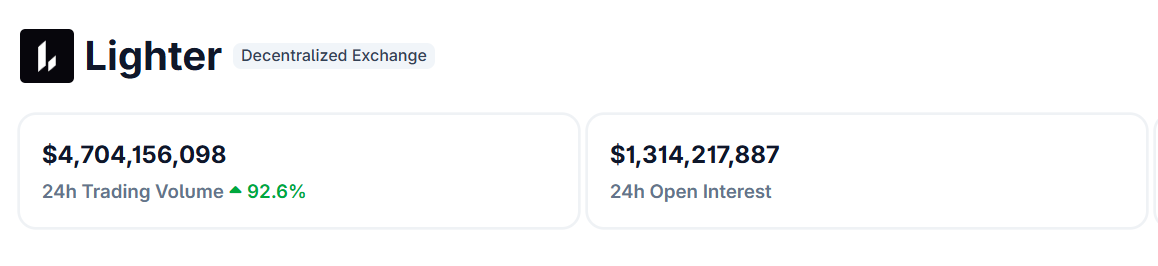
Lighter adopted a zero-fee strategy, driving rapid user growth beyond 56,000 users and a daily volume of USD 7–8 billion. However, its Vol/OI ratio exceeded 8, signaling heavy capital recycling rather than long-term positioning. In mid-October, Lighter experienced a four-hour outage, during which trading and withdrawals were unavailable, and its LLP pool incurred losses of approximately 10 percent. These events exposed operational and risk-management vulnerabilities during rapid expansion.
4. EdgeX — An Institution-Grade, Stability-Focused Exchange
Source: https://www.edgex.exchange/
Background and Team
EdgeX is a professional perpetual-trading platform incubated by Amber Group and launched in September 2024. With strong TradFi DNA and institutional experience, EdgeX benefited from Amber’s deep liquidity, operational expertise, and USD 5 billion AUM scale, enabling rapid traction among professional and Asian market participants.
Product and Technology
EdgeX runs on StarkEx, using centralized matching with decentralized settlement. Fees are competitive at 0.012% maker and 0.038% taker. BTC perpetuals can absorb approximately USD 6 million within a ±0.01 percent price range, exceeding Hyperliquid’s depth. EdgeX also emphasizes mobile trading, offering iOS and Android apps integrated with MPC wallets, significantly lowering onboarding friction.
Token Economics and Incentives
EdgeX has not yet issued its EGX token. Instead, it operates a transparent points system weighted toward real trading activity, explicitly excluding wash trading. Market expectations for EGX remain relatively rational, with community estimates of 20–35 percent allocation to points holders at TGE.
Market Data and Performance
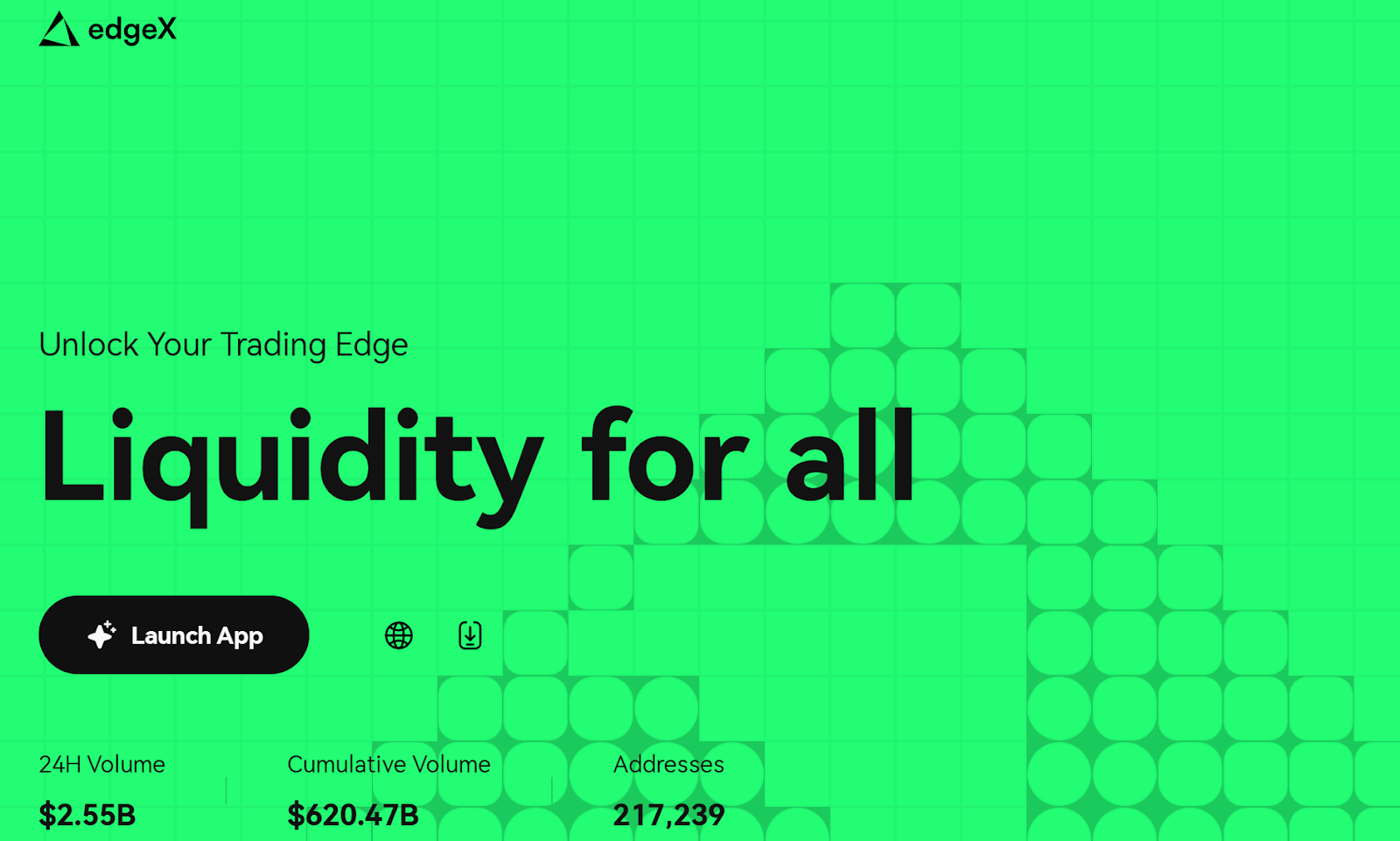
EdgeX’s 24-hour trading volume averages USD 2.5 billion, with open interest around USD 1.3 billion, ranking fourth among Perp DEXs. Despite a modest volume share, EdgeX generates approximately USD 500 million in annualized revenue, second only to Hyperliquid. Professionalism and stability remain its defining strengths.
5. Paradex — A Full-Stack On-Chain Derivatives “Super DEX”
Source: https://www.paradex.trade/
Background and Team
Paradex was incubated by Paradigm and founded in 2019. Initially focused on OTC options, it once captured 30 percent of global crypto options volume. In 2025, Paradex transitioned toward a public on-chain derivatives platform.
Product and Technology
Paradex operates on a custom Ethereum Layer 2 built on Starknet. It plans to offer perpetuals, perpetual options, and spot trading under a unified margin system. Most web trades are fee-free, while API taker fees are capped at 0.02 percent. Paradex prioritizes product breadth and capital efficiency over pure speed or incentives.
Token Plan and Incentives
Paradex’s token, DIME, has disclosed tokenomics with 26.6 percent allocated to community rewards and 20 percent reserved for a genesis airdrop. With a typical Vol/OI ratio of 1–2, Paradex reflects a long-term value-oriented incentive approach.
Market Data and Performance
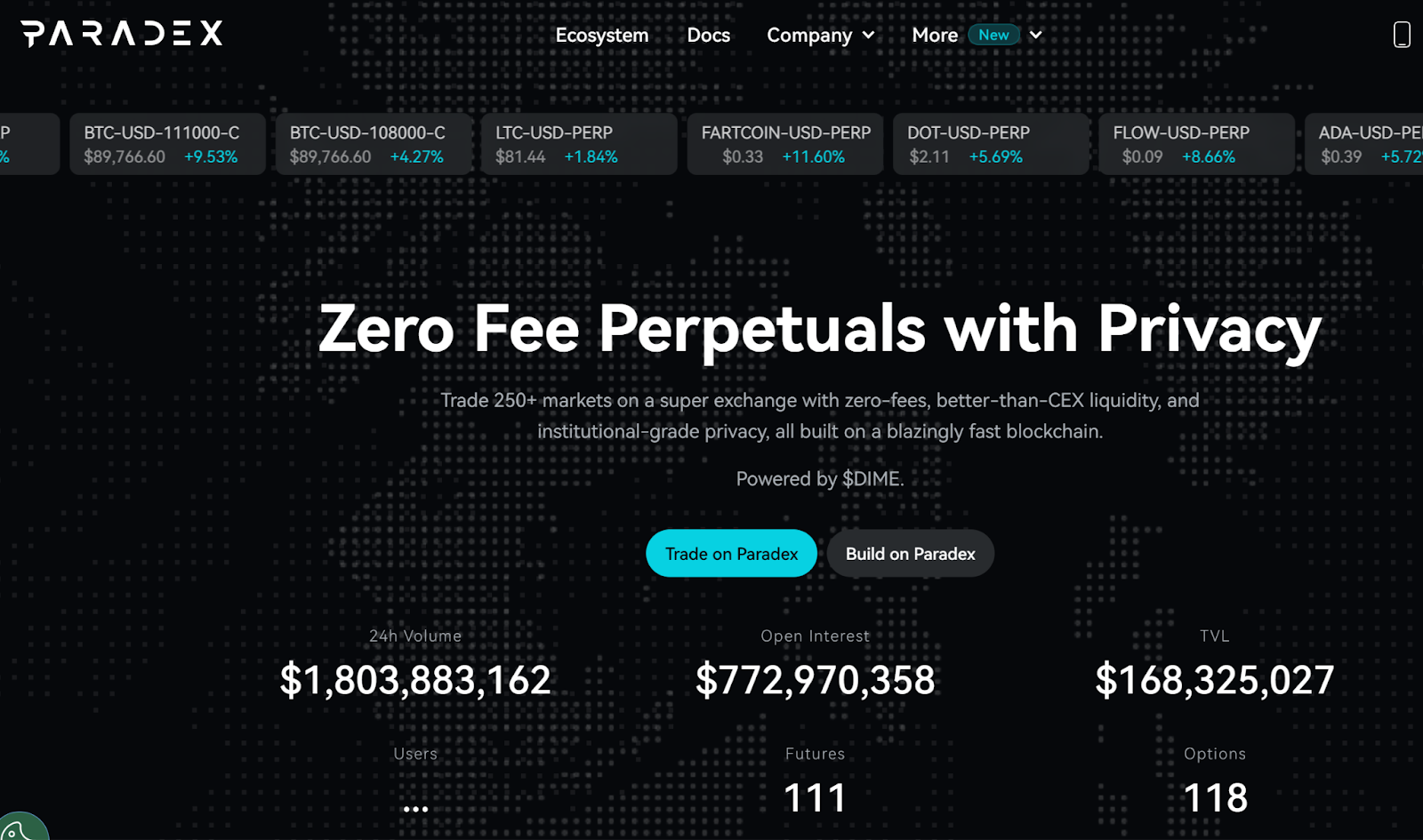
Paradex has approximately USD 170 million TVL, a daily volume of USD 2 billion, and open interest near USD 770 million. Growth has been steady, with strong adoption among professional traders. Upcoming launches—including spot trading and DIME issuance—could further strengthen its differentiated positioning.
IV. Opportunities and Risks in the Perp DEX Sector
1. Key Opportunities Facing the Perp DEX Sector
(1) Significant Room for Market Penetration Growth
Despite the surge in on-chain perpetual trading volume in 2025, its share of the overall crypto derivatives market remains relatively low, estimated at around 5–10 percent. The vast majority of derivatives trading still takes place on centralized platforms, where daily futures volumes on exchanges such as Binance can exceed $1 trillion. As decentralized trading experiences increasingly approach those of CEXs, user demand for self-custody and reduced centralized risk is expected to continue growing. Over the coming years, on-chain derivatives could capture a materially larger share of the market. Even an increase to 20–30 percent penetration would imply several-fold growth in volume for existing Perp DEX platforms.
(2) Technological Advancements as a Structural Tailwind
The maturation of technologies such as zero-knowledge proofs, sharding, and validator or notary networks continues to push the performance ceiling of on-chain systems, reducing costs and expanding product boundaries. Innovations such as Paradex’s planned perpetual options are made possible by infrastructure-level breakthroughs. The compounding effect of technological progress is likely to further narrow the gap between decentralized and centralized exchanges and may even enable entirely new product categories that traditional CEXs cannot easily replicate.
(3) Shifts in User Education and Trading Habits
Following events such as the FTX collapse, a new generation of crypto users has become more receptive to DeFi products. Many traders who previously executed derivatives trades exclusively on platforms like Binance experimented with Hyperliquid and EdgeX in 2025 and reported positive experiences. As word-of-mouth and influencer-driven adoption accelerate, on-chain trading is moving from niche communities toward a broader user base. This expansion of the potential user pool, combined with DeFi-native mechanisms such as community governance and airdrops, is likely to translate into improved long-term user retention.
(4) Capital and Institutional Participation
In 2025, several top-tier institutions entered the Perp DEX space. Examples include the launch of HYPE ETP products by 21Shares, Amber Group’s incubation of EdgeX, and Paradigm’s direct involvement in building Paradex. These developments signal growing confidence among institutional and compliant capital in the future of on-chain derivatives, as well as a willingness to provide liquidity and infrastructure support. As regulatory clarity improves, more traditional financial institutions and crypto funds may participate via DAO investments, liquidity provision, or market-making, injecting additional momentum into the sector.
(5) Ecosystem Synergies Across DeFi
Perp DEX platforms exhibit strong synergies with other DeFi verticals such as lending, yield strategies, and stablecoins. Paradex has already begun exploring integrations that combine perpetual contracts with other DeFi “legos” to create new use cases. More broadly, perpetual DEXs can serve as hedging venues for on-chain assets, while derivatives pricing can feed into lending rates and structured products. These cross-protocol collaborations point to increasingly rich opportunities for ecosystem-level integration.
2. Key Risks Facing the Perp DEX Sector
Despite the apparent prosperity of the Perp DEX sector in 2025, multiple underlying risks warrant close attention.
(1) Wash Trading and Excessive Incentives
Controversies surrounding alleged data manipulation at Aster and overly aggressive incentives at Lighter underscore a core lesson: headline trading volume can be manufactured, but open interest and fee revenue are far more reliable indicators of genuine activity. Investors should remain cautious and avoid being misled by inflated volume figures unsupported by capital commitment or sustainable income.
(2) Technical and Security Risks
In pursuit of high performance, many new platforms adopt complex architectures or develop proprietary chains, increasing the likelihood of bugs and failures. Lighter experienced a significant outage just ten days after the mainnet launch, while proprietary chains such as Hyperliquid’s have faced questions about long-term security and consensus robustness. In addition, smart contract vulnerabilities, matching engine failures, and oracle malfunctions remain persistent risks.
(3) Token Economics Risks
For many Perp DEX platforms, token price performance is treated as a core pillar of ecosystem health, supported by mechanisms such as buybacks and revenue sharing. However, secondary market volatility is unpredictable. A sharp decline in token prices can quickly undermine user confidence and trigger liquidity outflows. For example, if Lighter’s token underperforms expectations post-listing, incentive-driven users may exit rapidly.
(4) Extreme Market Volatility
Relative to CEXs, on-chain derivatives markets remain smaller in scale. During extreme volatility, liquidity can dry up quickly, and slippage may spike. In scenarios resembling the October 2025 market crash, involving tens or hundreds of billions of dollars in liquidations, platforms with weaker risk controls may face severe stress or even insolvency.
(5) Regulatory and Compliance Risks
As on-chain derivatives volumes grow, regulatory scrutiny is intensifying. In many jurisdictions, unauthorized platforms are prohibited from offering high-leverage derivatives to local residents, and decentralized protocols may not be immune to enforcement actions. While fully shutting down decentralized systems is difficult, regulatory pressure can dampen user confidence and capital inflows, posing a material headwind to sector growth.
V. Outlook for 2026: Continued Reshuffling and Structural Upgrades
Looking ahead to 2026, the on-chain perpetual market is likely to enter a more mature yet increasingly competitive phase. Based on current dynamics, several trends appear likely.
1. Market Structure Evolution and Ongoing Consolidation
As the incumbent leader, Hyperliquid is expected to maintain its position in the top tier, supported by deep open interest and a strong community base. If Lighter can sustain user activity, it may remain the strongest challenger in terms of trading volume. With Binance’s backing, Aster could recover part of its market share, while EdgeX is likely to dominate the institutional and risk-averse user segment. Paradex, differentiated by product breadth, may advance from the second tier in 2026. Overall, the market may evolve toward a “one leader, multiple strong contenders” structure, with narrowing gaps among top platforms and intensified shakeouts among smaller players.
2. A Shift Toward Quality-Driven Growth
After the volume-driven incentive arms race of 2025, market participants are likely to become more rational, recognizing that volume rankings alone are of limited significance. Metrics such as open interest, fee revenue, and user retention will increasingly serve as indicators of true platform health. In 2026, average Vol/OI ratios are expected to normalize, user growth to become more organic, and destructive incentive wars to subside. While promotional campaigns and temporary fee discounts will persist, competition is likely to focus more on user experience than on artificially inflating data. As airdrops conclude, speculative participation should decline, leaving a higher proportion of genuinely demand-driven traders.
3. Expansion Toward Multi-Product Platforms
In 2026, Perp DEXs may evolve beyond single-product perpetual trading into full-spectrum exchanges. Paradex’s planned launch of perpetual options and spot trading will serve as an important test case. If successful, competitors are likely to follow with options, dated futures, and other derivative instruments. Additionally, real-world asset (RWA) derivatives—such as contracts linked to gold or equity indices—may emerge. Social trading and algorithmic strategies are also likely to be integrated, accelerating convergence between trading and asset management.
4. Regulatory Experimentation and Compliance Pathways
2026 could mark a year in which regulatory frameworks for DeFi derivatives begin to take shape. Some major jurisdictions may introduce guidance or formal rules governing decentralized derivatives. There are indications that EdgeX is considering a regulated version for institutional access, similar to dYdX’s earlier custodial offering. Hyperliquid, if it seeks deeper penetration into the U.S. market, may also explore registration as a swap execution facility (SEF). The gradual formalization of regulatory gray areas presents both challenges and opportunities: compliance may attract mainstream capital but could also conflict with core decentralization principles. Many platforms are likely to adopt a dual-track approach, maintaining permissionless access while offering compliant gateways for regulated participants.
5. Confrontation Between Incumbents and On-Chain Natives
Finally, 2026 may see direct competition between traditional centralized exchanges and on-chain-native platforms. Major CEXs are unlikely to cede market share passively and may accelerate their entry into DeFi derivatives. Binance and OKX have already begun deploying decentralized products; Binance’s involvement with Aster may only be the beginning. Centralized exchanges could launch integrated “CEX + DEX” offerings, leveraging existing user bases and liquidity. At the same time, new on-chain-native projects will continue to emerge, aiming to challenge incumbents through novel mechanisms and design philosophies.
Conclusion
From Hyperliquid’s early dominance to a multi-player competitive landscape, the Perp DEX sector experienced dramatic shifts throughout 2025. Looking ahead to 2026, on-chain perpetuals are set to transition from rapid, incentive-driven expansion to a phase defined by disciplined execution and sustainable growth. The market is likely to become more mature and resilient, moving away from volume inflation toward competition centered on liquidity quality, risk management, and user experience. Product offerings will diversify, evolving toward comprehensive on-chain derivatives platforms.
The battle for on-chain derivatives is far from over. As the sector continues to iterate and consolidate, new leaders, structures, and narratives will emerge. The next chapter of Perp DEX development promises to be equally compelling, and the market will ultimately determine which platforms can convert early momentum into lasting dominance.
About Us
Hotcoin Research, the core research and investment arm of Hotcoin Exchange, is dedicated to turning professional crypto analysis into actionable strategies. Our three-pillar framework—trend analysis, value discovery, and real-time tracking—combines deep research, multi-angle project evaluation, and continuous market monitoring.
Through our Weekly Insights and In-depth Research Reports, we break down market dynamics and spotlight emerging opportunities. With Hotcoin Selects—our exclusive dual-screening process powered by both AI and human expertise—we help identify high-potential assets while minimizing trial-and-error costs.
We also engage with the community through weekly livestreams, decoding market hot topics, and forecasting key trends. Our goal is to empower investors of all levels to navigate cycles with confidence and capture long-term value in Web3.
Risk Disclaimer
The cryptocurrency market is highly volatile, and all investments carry inherent risks. We strongly encourage investors to stay informed, assess risks thoroughly, and follow strict risk management practices to protect their assets.
Connect with Us
Website: https://lite.hotcoingex.cc/r/Hotcoinresearch
Email: labs@hotcoin.com
読書をお勧めします
もっと見る