
Hotcoin Research | AI Agent Explosion Is Coming: The Scale Window and Industry Chain Map Analysis of AI Agent × Crypto
TL;DR
-
Background: AI agents are evolving from “models that can use tools” into autonomous economic entities
-
Fit Between Crypto and AI Agents: Blockchain is readable, writable, verifiable, and composable
-
AI Agent × Crypto Key Puzzle: x402 = Settlement Layer; ERC-8004 = Trust Layer
-
AI Agent × Crypto Ecosystem Landscape: From applications to protocol stacks, the on-chain machine economy is accelerating
-
Risks: Security attacks | Capital risk | Data risk | Regulatory uncertainty | Operational and maintenance risk
-
Opportunities: Process-driven systems | On-demand billing | Cross-organizational collaboration | Enterprise-level adoption | Open standards
-
Conclusion: The large-scale application breakout window for AI Agent × Crypto has officially opened
The Concept And Development Process Of AI Agents
A practical definition of an “Agentic LLM” in the AI research community is a language model system with reasoning, action, and interaction capabilities, incorporating tools, states, and feedback loops.
From a mechanism perspective, the most common minimal closed loop for an AI Agent is:
Goal decomposition → plan generation → tool invocation / environment interaction → result verification and self-correction → continued execution or delivery.
-
AI Agent's Key Capabilities
In an investment context, the most crucial role of an AI Agent is not to “answer questions,” but to “complete tasks.” It typically has three core capabilities:
Goal:
You provide result-oriented instruction, such as:
“Allocate 30% of the stablecoins in my account to maximize 7-day returns under controllable risk.”
Tools:
An AI Agent can call external tools. In the crypto context, this includes wallet signing, contract interaction, DEX routing, cross-chain execution, lending, clearing, rebalancing, and more.
The AgentKit / “Based Agent” framework launched by Coinbase / Base is built on “on-chain capabilities” as the default toolbox for the agent, enabling it to perform transactions, swaps, staking, domain registrations, and other actions via natural-language instructions.
Closed Loop:
An AI Agent not only suggests what should be done, but also breaks down tasks into steps, executes them, verifies results, and, if necessary, adjusts or rolls back the plan. This is also known as the agentic loop.
-
AI Agent Development History: From “Can Speak” To “Can Do” To “Can Operate”
Over the past two years, there have been three major breakthroughs in the capability boundaries of AI agents, pushing “conversational AI” toward “deliverable digital labor.”
From Text Generation To Tool Invocation: Turning Output Into “Executable Actions”
The value of early models largely remained in “content generation.” The real turning point came when models were integrated into tools and systems—such as retrieval, code execution, browser operations, business API calls, and automated documentation—allowing agents to translate “plans” into real “actions.”
A representative milestone of this stage was OpenAI’s unification of “research (inference) + action (operation)” into a single experience. The ChatGPT agent model emphasizes enabling the system to complete end-to-end tasks using “its own computer,” integrating capabilities such as multi-step reasoning, web navigation, and file generation into structured, usable agent modes.
From Monolithic Agents To Multi-Agent Collaboration: Role Decomposition And Orchestration For Complex Tasks
As tasks evolved from simple “copywriting” to extended chains of “research–decision–execution–review,” it became increasingly difficult for a single agent to simultaneously handle information gathering, risk control verification, compliance constraints, execution, and exception handling.
Two structural shifts emerged:
-
Decomposing complex workflows into multiple specialized “role agents” (researcher, trader, compliance officer, executor, auditor, etc.)
-
Organizing agents and toolchains into observable and controllable processes (queues, callbacks, finite-state machines, retries, approval gates) through orchestration layers
As a result, agent systems quickly moved toward multi-agent architectures, where an AI Agent is no longer a “model answer box” but a composable, orchestrated system.
From Demo To Production Systems: Standardized Connectivity + Enterprise Governance + Continuous Security Confrontation
Once agents enter real production environments, the key question shifts from “Can it be done?” to “Can it be done stably, controllably, and securely?”
Four structural pillars define this phase:
Standardized Connectivity (MCP)
Using a unified protocol to connect models with various tools and data sources reduces integration costs and promotes interoperability, evolving from “de facto standards” toward formal governance standards.
Anthropic donated MCP to the newly established Agentic AI Foundation (AAIF) under the Linux Foundation in December 2025, emphasizing neutrality, openness, and community governance. Its ecosystem components—connectors, registries, SDKs, and related tooling—are gradually taking shape.
Enterprise Governance (Frontier)
OpenAI released OpenAI Frontier on 2026-02-05, focusing on shared context, permission boundaries, operational feedback, deployability, and manageability—directly addressing enterprise requirements such as auditability, isolation, control, and continuous iteration.
Continuous Security Confrontation (Prompt Injection Protection)
As browser- and desktop-based agents gain the ability to read from and write to real-world web pages and enterprise systems, prompt injection becomes a persistent adversarial challenge.
On 2025-12-22, OpenAI publicly disclosed Atlas’ continuous reinforcement framework, combining automated red teaming with reinforcement learning to detect, repair, and iteratively defend against emerging injection attacks.
Systematization Of The Browser Form (Atlas)
OpenAI released ChatGPT Atlas on 2025-10-21, integrating “browser + ChatGPT + agent mode” into a unified product form.
In essence, the execution interface, contextual memory, and permission layers of the agent are pre-configured around users’ most common workflow scenarios—bringing the agent's capabilities closer to operational readiness.
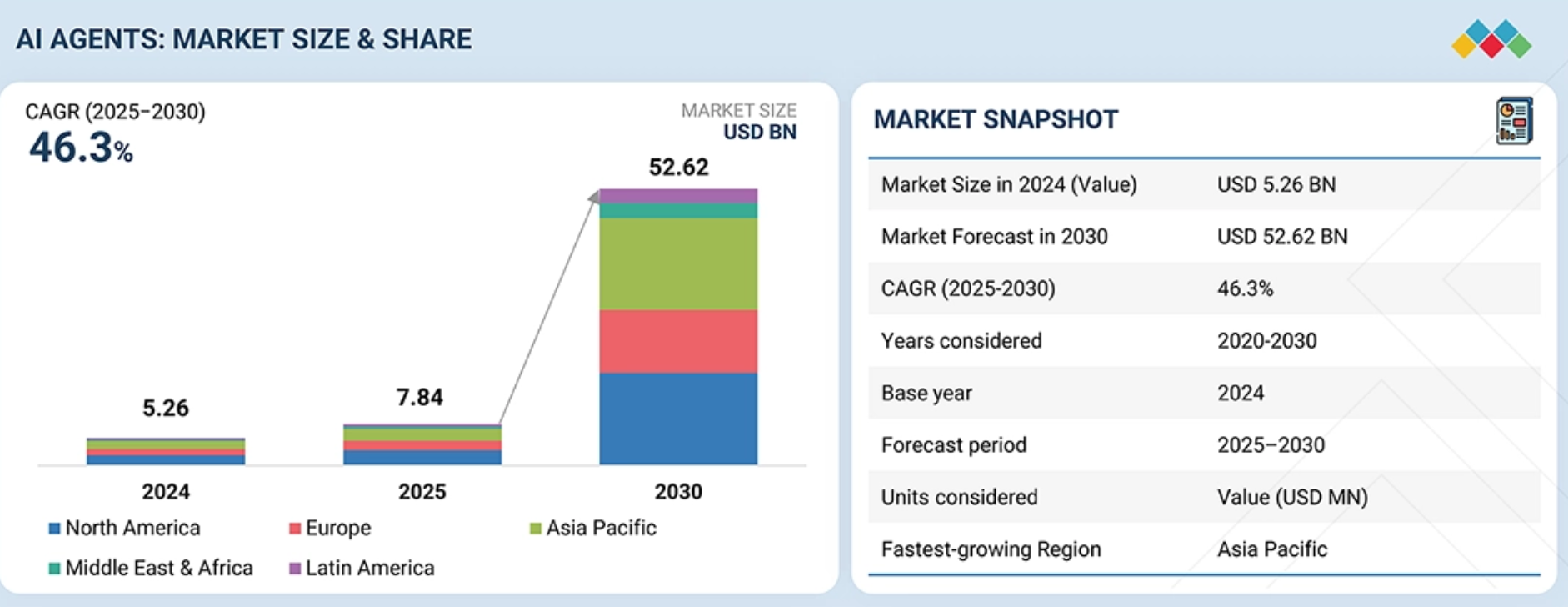
According to a research report by MarketsandMarkets, the global AI Agent market is projected to grow from approximately $7.80 billion in 2025 to $52.60 billion by 2030. AI Agents are expected to achieve rapid adoption across industries such as finance, healthcare, customer service, and supply chain management.
By automating repetitive tasks, analyzing massive volumes of real-time data, and assisting in decision-making, AI Agents can expand service capacity and improve response efficiency without significantly increasing labor costs.
Overall, AI Agents are gradually evolving from early-stage auxiliary tools into critical execution layers within digital operations, becoming a foundational component of the future intelligent economy.
II. The Development Of AI Agents In The Crypto Industry
AI Agents must navigate cross-organizational permissions, integrate with multiple systems, and execute structured workflows to complete tasks—challenges that often encounter significant friction in traditional industries.
The core characteristics of blockchain—openness, programmability, verifiability, and composability—create a natural alignment between AI Agents and the crypto industry.
-
The Compatibility Between The Crypto Industry And AI Agents
The crypto industry naturally provides standardized, “actionable interfaces” that can transform AI from “assistants” into truly “executable entities.”
-
Readable: On-chain state is open and transparent—including balances, positions, interest rates, clearing lines, LP positions, and contract events—allowing agents to make data-driven decisions.
-
Writable: Writing to the blockchain is equivalent to submitting a signature or executing a contract call, with high levels of standardization and orchestration.
-
Verifiable: Transaction receipts, event logs, and fund flows are fully auditable, enabling results to be validated programmatically by machines.
-
Composable: The composability of DeFi allows agents to concatenate multiple protocols like an automated assembly line, building complex workflows from modular components.
For investors, the key question is not whether “agents will replace traders,” but which scenarios will first mature into stable on-chain assembly lines.
The first scenario is intention-driven DeFi operations. Users define goals and constraints, and agents automatically handle routing, execution, rebalancing, clearing protection, and reconciliation. The feasibility of this model depends on a controllable wallet layer, an execution toolbox, and a risk strategy engine—not merely on more powerful models.
The second scenario is on-demand procurement within the machine economy. Agents purchase data, computing power, storage, API calls, and content licenses as needed to complete tasks. This demand structure is naturally more aligned with on-request micropayments rather than traditional account-based subscriptions. The emergence of x402 directly addresses this structural requirement.
The third scenario is the Agent-to-Agent service marketplace. Instead of “users employing agents,” this model evolves toward “agents hiring other agents,” forming a closed loop of on-chain ordering, hosting, delivery, acceptance, and reputation feedback. ERC-8004 (trust layer) and on-chain hosting protocols (such as the ACP system) provide the foundational infrastructure for this model.
-
ERC-8004 And x402 Standard Adoption: Key Accelerators For The Deployment Of On-Chain AI Agents
If we abstract the concept of an “AI Agent in the crypto industry” into a minimal closed loop, it requires at least two foundational infrastructure components:
-
Verifiable Identity And Trust: Who you are, whether you are trustworthy, and whether your identity and actions are recognized within organizational or policy frameworks.
-
Programmable Payment And Settlement: The ability to automatically pay for data, computing power, and API permissions, while supporting multi-chain environments and low-friction execution.
ERC-8004 and x402 address these two foundational layers respectively—ERC-8004 serving as the trust layer, and x402 as the settlement layer. Together, they enable AI Agents in crypto to evolve from “conceptual demonstrations” to truly scalable, production-ready operations.
x402: Turning “Paid Access” Into A Native HTTP Capability
x402 was introduced by Coinbase in May 2025 and is designed for AI agents that use stablecoins to execute autonomous transactions. It leverages HTTP 402 (Payment Required) as a semantic anchor, enabling APIs, content, and services to natively request and verify on-chain payments at the HTTP layer.
This allows clients—including AI Agents—to pay on a per-call or per-request basis without relying on traditional account-based systems. x402 V2 extends the protocol from a “one-time precise payment” model to a more agent-friendly architecture optimized for recurring, high-frequency interactions.
-
Wallet Identity And Session Reuse: After initial verification and payment, subsequent requests do not require repeating the full authentication and settlement process, significantly reducing friction and costs for high-frequency agent calls.
-
Automatic Discovery (API Discovery): Supports dynamic payee identification, multi-chain scalability, and CAIP-related identity standards. This enables a full automated loop in which an agent can discover services, understand pricing, complete payment, and obtain access rights.
The promotional impact of x402 on on-chain AI agents can be summarized as follows:
-
Making “Payment” A Default Agent Action: Agents can invoke paid APIs as naturally as calling tools—data sources, risk control engines, on-chain analytics, MEV protection, KYC/AML queries, pricing and matching services, and more—all of which can be packaged into billable infrastructure components.
-
A More Web-Native Pay-As-You-Go Model: Shifting from subscription or account-based billing to web-native, pay-per-use pricing is particularly important for the agent ecosystem, where calls are fragmented, composable, and long-tail.
-
Enabling “Machine Customers”: When the consumer shifts from “human click behavior” to automated agent calls, the protocol layer must support settlement, authentication, and multi-chain scalability at machine speed.
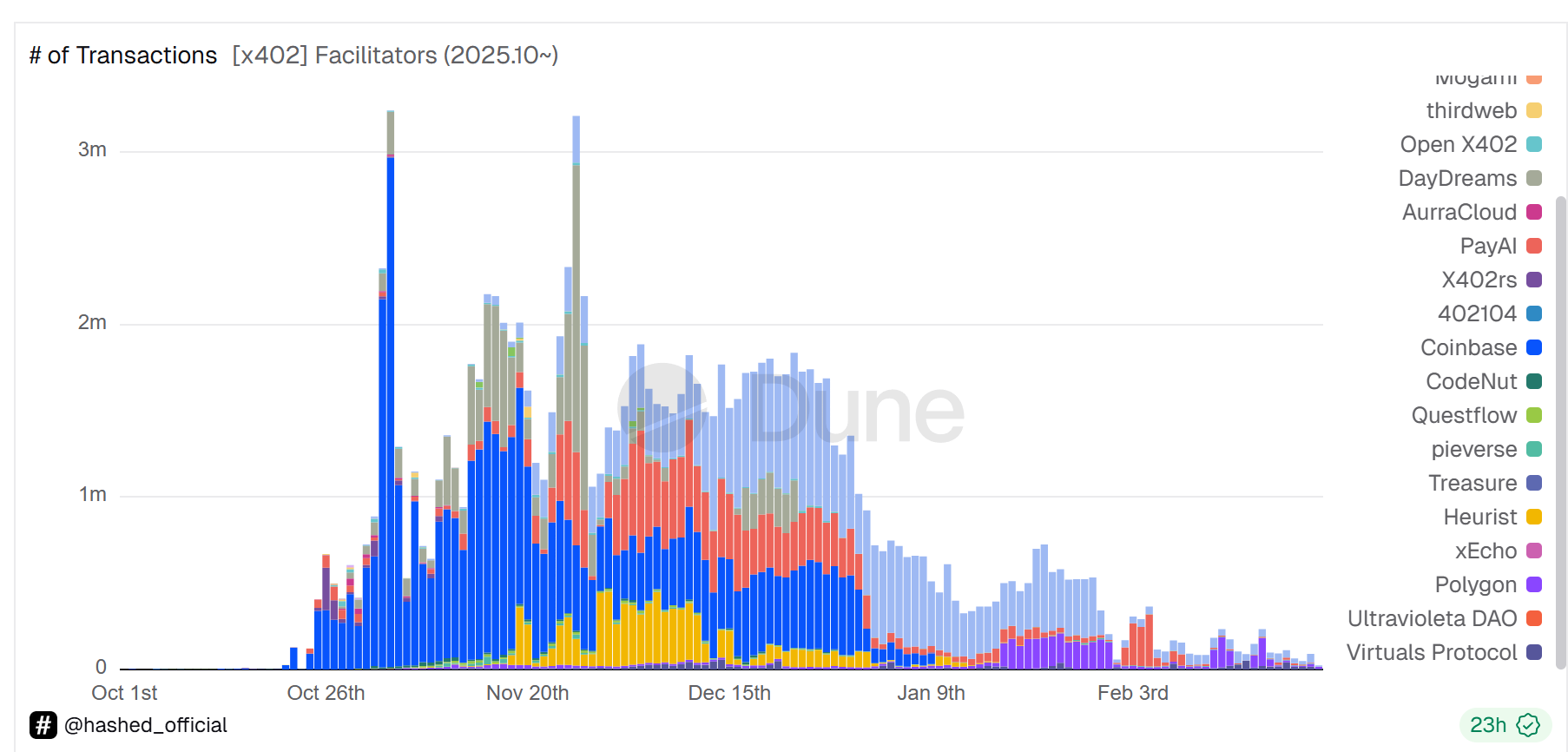
According to Dune Analytics data, x402 adoption surged in the fourth quarter of 2025. Transaction volume began accelerating in October 2025, rising from near-zero daily activity to a peak of approximately 2-3 million transactions per day in mid-November.
From December 2025 through early 2026, although overall transaction volume declined slightly, daily activity remained relatively high. The ecosystem continued to be dominated by Coinbase-related infrastructure and gradually evolved into a multi-platform network.
ERC-8004: Standardizing Identity, Reputation, And Verification
On January 29, 2026, the dAI team of the Ethereum Foundation, together with MetaMask, Google, Coinbase, and other partners, jointly deployed the trustless proxy standard ERC-8004, establishing a unified AI proxy identity and reputation framework.
The core objective of ERC-8004 is to enable agents operating across organizational boundaries to be discovered, selected, and interact without relying on pre-established centralized trust. At its foundation, ERC-8004 modularizes trust into composable components—commonly structured as registry layers for identity, reputation, and verification—allowing the ecosystem to build indexing, aggregation, risk control, and routing layers around a unified interface.
The impact of ERC-8004 on on-chain AI agents can be summarized in three key dimensions:
-
Discoverability (Discovery): DApps, marketplaces, and routing protocols can more easily discover agents on-chain and access standardized metadata and trust signals—similar to an agent’s DID combined with a reputation profile.
-
Risk Control (Risk & Compliance By Design): When an agent has a verifiable identity and traceable reputation, protocols can enforce rule-based governance—defining what actions are permitted and what level of verification is required. For example, only clearing or trading agents registered in specific verification registries may perform high-authority operations.
-
Composable Trust: Different use cases can select distinct validators or reputation systems rather than being constrained to a single platform. This flexibility is particularly critical for cross-protocol, cross-chain, and cross-team collaboration.
In summary, ERC-8004 introduces three foundational on-chain primitives for agents: identity, reputation, and verification—thereby enabling trust composability across protocols.
Combined with x402 and agentic wallets, which integrate machine-native payment semantics (HTTP 402) with wallet execution capabilities, this framework enables agents to natively perform paid API calls, service discovery, and automated settlement at the protocol layer.
III. Representative AI Agents × Crypto Ecosystem
The deployment of AI Agents within the crypto industry is evolving from isolated, single-point applications toward a protocol-based stack architecture.
At the top layer are Agent applications and publishing platforms.
-
The middle layer consists of identity, payment, tool connectivity, and governance infrastructure.
-
The bottom layer includes data, computing, storage, and verifiable execution.
ERC-8004 and x402, as two critical standards and infrastructure layers, are accelerating this structural transition.
1) Agent Publishing And Tokenization Platforms The transformation of agents into on-chain assets that can be published, traded, and shared represents one of the most active and dynamic trends in the ecosystem today.
-
Virtuals Protocol: Built on Base, Virtuals is a leading AI Agent social and publishing platform that emphasizes on-chain tokenization, co-ownership, revenue sharing, and Agent-to-Agent transactions. It aims to establish a complete aGDP (Agent GDP) economic cycle.
-
CLANKER (Tokenbot): An AI-driven autonomous publishing platform with strong launch capabilities on Base. It directly deploys agents and tokens to Uniswap V3 while securing permanent liquidity. CLANKER serves as core infrastructure for DeFAI and Agent-native publishing.
2) Agent Framework, Runtime, And Orchestration Layer This layer determines whether an agent can reliably invoke tools, remain observable and auditable, and operate in a reusable and production-ready manner.
-
OpenClaw (formerly Clawdbot / Moltbot): An open-source, universal AI agent framework that gained significant traction in early 2026. It supports complex tasks such as browser automation, email operations, and code execution. In the crypto context, it enables autonomous payments through ClawRouter integrated with x402. However, it also faces security challenges, including prompt-injection risks and permission-management vulnerabilities.
-
ElizaOS: A full-featured agent operating system that supports persistent agent identity and personality, multi-platform deployment, and autonomous decision-making.
-
AgentKit (Coinbase): Coinbase’s official agent development toolkit, deeply integrated with x402 payments and the Agentic Wallet, significantly simplifies on-chain interaction and agent-based application development.
-
Olas (Autonolas): An orchestration layer focused on sustainable multi-agent services, emphasizing the agent service economy and structured on-chain collaboration.
3) Wallets, Payments, And Service Discovery (Economic Entities) To become an autonomous “economic entity,” an agent must be able to hold assets, make payments, receive payments, and independently discover services.
-
Agentic Wallets (Coinbase): A wallet infrastructure specifically designed for AI agents was launched on February 10, 2026. It supports autonomous transactions, transfers, payments, revenue realization, and programmable risk control. When combined with x402, it enables fully automated payment flows with minimal human intervention.
-
Cross-Chain Routing: Infrastructure such as Chainlink CCIP, LayerZero, and Wormhole provides the foundational layer for multi-chain agent execution, enabling agents to operate seamlessly across different blockchain environments.
4) Identity, Reputation, and Verification (Trust Layer) Large-scale agent collaboration depends fundamentally on discoverability, verifiability, and accountability.
-
DID And Identity Systems: Polygon ID, World ID, Spruce ID, Ceramic/IDX, and related identity infrastructure.
-
Reputation And Anti-Sybil Systems: Gitcoin Passport, BrightID, Galxe Passport, and similar reputation frameworks.
-
Signature And Attestation Protocols: Sign Protocol, Sismo, and zkML-related verification projects that provide cryptographic attestations and programmable trust guarantees.
5) Data, Indexing, Knowledge, And Memory Layer Agent decision-making relies on high-quality, retrievable, and verifiable data, as well as long-term memory infrastructure.
-
Oracles: Chainlink, Pyth, and RedStone provide real-time price feeds and data inputs, supporting x402-based self-payment mechanisms for data access.
-
On-Chain Indexing And Intelligence: The Graph, Arkham, and Nansen provide structured indexing, analytics, and intelligence layers for on-chain activity.
-
Knowledge Graph And Verifiable Data: OriginTrail enables structured knowledge graphs and verifiable data layers suitable for machine-level validation and trust.
-
Decentralized Memory Layer: Unibase provides long-term memory storage tailored for AI agents, supporting cross-platform persistence and interoperability.
6) Decentralized Computing, Inference, And DePIN This layer determines the cost structure, scalability, and degree of decentralization of agent execution.
-
Bittensor: A decentralized model and subnet economy capable of supporting dedicated agent inference capabilities.
-
GPU And Computing Networks: Render, Akash, io.net, Aethir, and Gensyn provide distributed GPU and compute infrastructure, with increasing focus on AI inference workloads.
-
Storage: Filecoin and Arweave support agent long-term memory, model distribution, and persistent data availability.
7) Agent Social, Content, And Network Effect Layer This layer drives network effects and propagation through Agent-to-Agent interaction.
-
Moltbook: An agent-native social and content platform supporting Agent-to-Agent content generation, debate, and interaction. Often integrated with the OpenClaw and CLANKER ecosystem, it has demonstrated strong viral growth within the Base ecosystem.
-
Other Collaboration Projects: Unibase and related initiatives support multi-agent collaboration graph scenarios and coordinated service architectures.
IV. Risks And Opportunities Faced By AI Agents
The risks associated with AI agents are not merely incidental side effects of “AI becoming more powerful,” but structural challenges arising from “AI gaining execution capabilities.” As agents become more capable, their attack surface expands, and the chain of responsibility grows increasingly complex.
However, this does not imply that AI agents are unsuitable for integration into the crypto industry. On the contrary, these structural risks reveal critical opportunities for the next generation of protocols and infrastructure.
-
Main Risks
AI Agents have attracted significant attention in the crypto industry not only because they can “do things for others,” but also because they can access real assets, real permissions, and real counterparties within on-chain environments.
As a result, the core risk is no longer limited to whether an AI model’s “answer is accurate,” but extends to whether it may be induced to execute unintended actions, exceed its authority, or trigger irreversible financial and compliance consequences.
1) Expanded Security Attack Surface Driven By Execution Capability
Once an agent gains execution permissions over browsers, wallets, or system tools, the attack vector shifts from “tricking a user into clicking a link” to “tricking the agent into executing the attack itself.”
Browser-based agents are particularly vulnerable to malicious instruction injection (prompt injection) embedded in web pages, emails, or documents, which can induce actions such as unauthorized transfers, approvals, or key leakage.
OpenAI has explicitly identified prompt injection as a long-term structural challenge, emphasizing continuous security confrontation through automated red teaming and reinforcement learning to detect and mitigate real-world attack vectors.
2) Wallet And Fund Risks
When an agent is granted wallet signing or contract-calling capabilities, the primary risk shifts from information leakage to irreversible asset transfers.
This is precisely why the industry is advancing infrastructure such as Agentic Wallets and x402—modularizing payment, authentication, permission scopes, and audit logging—thereby replacing the unsafe practice of directly exposing master private keys to agents.
3) Data And Model Layer Risks
Agents rely heavily on external data sources—market trends, oracle feeds, on-chain intelligence, and social information—to make execution decisions.
Data poisoning, adversarial inputs, and seemingly credible but outdated or incorrect information can distort strategies. In automated trading, clearing protection, and risk parameter tuning scenarios, such distortions can be amplified into systemic losses.
4) Compliance And Responsibility Boundaries
When an agent operates as a “semi-autonomous economic entity”—executing transactions, performing matchmaking, or paying service fees—the allocation of legal responsibility becomes increasingly complex.
The division of accountability among users, developers, platforms, model providers, and contractual counterparties remains an evolving area.
This explains why enterprises tend to favor auditable, permissioned, and rollback-capable governance platforms over deploying uncontrolled consumer-grade agents directly into production environments.
(5) Maintainability And Operational Complexity
Agent systems often involve long execution chains, multiple tools, and multi-agent orchestration layers.
Without comprehensive logging, metrics, replay mechanisms, and approval gates, it becomes difficult to diagnose anomalies such as misoperations, repeated charges, cross-chain routing failures, or incorrect invocations of paid APIs.
-
Structural Opportunities
The crypto industry inherently provides fertile ground for programmable assets and open protocols. As a result, the opportunity for AI agents is not merely about becoming “smarter,” but about becoming systematically more automated, less frictional, and more monetizable.
1) From “Human-Driven” To “Process-Driven”
The core value of AI agents is not to create another chatbot, but to automate the full loop of “understanding → decision → execution → review.”
This allows complex on-chain operations—such as cross-chain routing, position management, hedging, rebalancing, and reward harvesting—to shift from manual interaction to “goal description → automatic completion.”
Such a transformation significantly lowers the barrier to using crypto products and unlocks scalable automation.
2) A New Business Model Of “On-Demand Billing”
x402 embeds payment directly into HTTP semantics (HTTP 402: Payment Required), enabling agents to access paid resources—including data feeds, intelligence services, risk control engines, execution channels, content, and computing power—on a native pay-per-call basis.
This establishes the foundational business model of “machine customers,” where autonomous agents directly consume and pay for digital services without subscription-based friction.
3) A New Paradigm For Cross-Organizational Collaboration
ERC-8004 introduces a modular “Identity / Reputation / Verification” framework that allows agents to be discovered, evaluated, and selected across organizational boundaries.
By transforming private platform judgments into composable on-chain trust signals, it enables the formation of open agent marketplaces and interoperable routing layers, strengthening trust composability across protocols.
4) Enterprise-Level Production Acceleration
Agents can be managed as “enterprise digital employees” with clearly defined context scopes, permission boundaries, feedback loops, auditing mechanisms, and deployment governance.
This addresses enterprise concerns around controllability, observability, and operational safety—allowing agents to transition from proof-of-concept demos to production-grade systems.
5) Ecosystem Expansion Driven By Open Standards
The donation of MCP to the Agentic AI Foundation under the Linux Foundation reflects a broader push toward neutral governance and interoperability of agent tooling.
Open standards reduce ecosystem fragmentation, lower integration friction, and improve scalability—laying the groundwork for a more composable and sustainable agent infrastructure layer.
V. Prospects For The Application Of AI Agents In The Crypto Industry
As risk boundaries become clearer and infrastructure around wallet permissions and tool connectivity matures, the adoption of AI agents in the crypto industry is likely to follow a path of:
Monetization first → scenario expansion → platformization.
In other words, development will begin with high-frequency, cash-flow-generating use cases (transaction execution, risk control, operations), then expand toward cross-protocol collaboration and service networks, ultimately forming a sustainable agent-driven economic system.
1) DeFi Automation Will Lead The First Wave Of Scaling
Agents will prioritize high-frequency, repeatable processes such as rebalancing, yield aggregation, revolving lending, clearing protection, take-profit and stop-loss strategies.
The core value proposition will not simply be intelligence, but:
-
Strategy verifiability
-
Permission auditability
-
Process transparency
Over time, this may evolve into a “strategy marketplace,” where users select agent services based on historical performance, risk parameters, and cost structure.
2) On-Chain Execution Evolves From “Bots” To Collaborative Execution Agents
Execution capabilities—including quoting, routing, order splitting, slippage control, and MEV protection—will become modularized and integrated with account abstraction mechanisms (session keys, spending limits, multi-signature approvals).
The competitive focus will shift from “smarter execution” to:
-
More controllable
-
More replayable
-
More auditable
This marks the transition from isolated trading bots to structured, governance-compatible execution agents.
3) Data And Intelligence Services Form The Second Growth Curve
Agents will increasingly function as:
Research assistant + trading assistant
Capabilities will include automated due diligence, risk monitoring, address profiling, fund flow analysis, anomaly detection, and structured reporting.
Through pay-per-call data and API monetization models (enabled by x402-style infrastructure), these services can generate recurring and scalable cash flow.
4) The Core Monetization Endpoint: Service Networks With Automatic Settlement
Once agents possess wallet identity and scalable payment infrastructure, data, risk control, execution, and compliance modules can be productized as “tool-as-a-service” components.
This enables a closed-loop system:
Service Discovery → Automatic Payment → Permission Granting → Continuous Invocation
Such architecture lays the foundation for scalable Agent-to-Agent commerce.
Identity And Reputation Define The Upper Bound Of The Open Ecosystem
As frameworks such as ERC-8004 mature, the agent marketplace will move toward:
-
Credentialization
-
Hierarchization
-
Auditability
Transferable reputation, verifiable execution results, and standardized identity signals will reduce the cost of unfamiliar collaborations and provide a foundation for trust in cross-protocol and cross-team networks.
Overall Outlook
The adoption of AI agents will not be driven by a single “super application,” but by parallel growth across multiple infrastructure layers:
-
DeFi automation drives the first wave of scale and revenue
-
Data and execution agents build the second wave of service networks
-
Identity, payment, and reputation standards amplify the third wave of cross-ecosystem collaboration
Together, these layers form the structural pathway toward a sustainable agent-based crypto economy.
Conclusion
AI Agents have now completed a fundamental transition—from “intelligent models that can use tools” to autonomous economic entities with on-chain identities, capable of independent settlement and value creation.
The two major standards, ERC-8004 and x402, serve as identity infrastructure and payment infrastructure for on-chain agents, respectively. ERC-8004 provides standardized and composable identity, reputation, and verification modules, while x402 embeds native micropayments into HTTP semantics, making machine-to-machine settlement a default capability.
Together, these standards establish a closed loop of discoverability, trust, and autonomous settlement—enabling agents to reduce reliance on human intervention, make independent decisions, contract with one another, pay on demand, and form sustainable Agent-to-Agent economic networks.
Although risks such as prompt injection, wallet authority exposure, and evolving compliance responsibilities remain, these structural challenges are accelerating the development of safer, auditable, and governance-compatible infrastructure.
Against the backdrop of rapid growth in agent publishing platforms (particularly on Base) and the ecosystem's increasing maturity, DeFi automation has already taken the lead in commercialization. Data intelligence services, execution agents, and cross-protocol service markets are emerging in parallel.
A highly automated and collaborative on-chain machine economy is beginning to take shape.
The rise of AI Agents will not simply replace human participants; rather, it will significantly lower participation barriers in the crypto ecosystem and reshape paradigms for value creation. The deep integration of blockchain and artificial intelligence is giving birth to a new organizational and economic structure in the digital era.
We are at the beginning of this transformation.
About Us
Hotcoin Research, the core research and investment arm of Hotcoin Exchange, is dedicated to turning professional crypto analysis into actionable strategies. Our three-pillar framework—trend analysis, value discovery, and real-time tracking—combines deep research, multi-angle project evaluation, and continuous market monitoring.
Through our Weekly Insights and In-depth Research Reports, we analyze market dynamics and highlight emerging opportunities. With Hotcoin Selects—our exclusive dual-screening process powered by both AI and human expertise, we help identify high-potential assets while minimizing trial-and-error costs.
We also engage with the community through weekly livestreams, decoding market hot topics, and forecasting key trends. Our goal is to empower investors of all levels to navigate cycles with confidence and capture long-term value on Web3.
Risk Disclaimer
The cryptocurrency market is highly volatile, and all investments carry inherent risks. We strongly encourage investors to remain informed, assess risks thoroughly, and adhere to strict risk management practices to protect their assets.
Connect with Us
Website:https://www.hotcoin.com/en_US/learn/index/
X: x.com/HotcoinAcademy
Email: labs@hotcoin.com
読書をお勧めします
もっと見る
Hotcoin Research | Analyzing Trump’s Crypto Policy: Promises, Progress, and Future Outlook
In-depth Research

Hotcoin Research | Detailed Analysis of Binance’s Investment Landscape: Everything You Need to Know
In-depth Research
Hotcoin Research | "Crypto Dad" Atkins’ First 60 Days: Inside the SEC’s Regulatory Shift and Crypto Policy Outlook
In-depth Research
