What Is Address Poisoning? How to Prevent Fake Address Transfer Scams
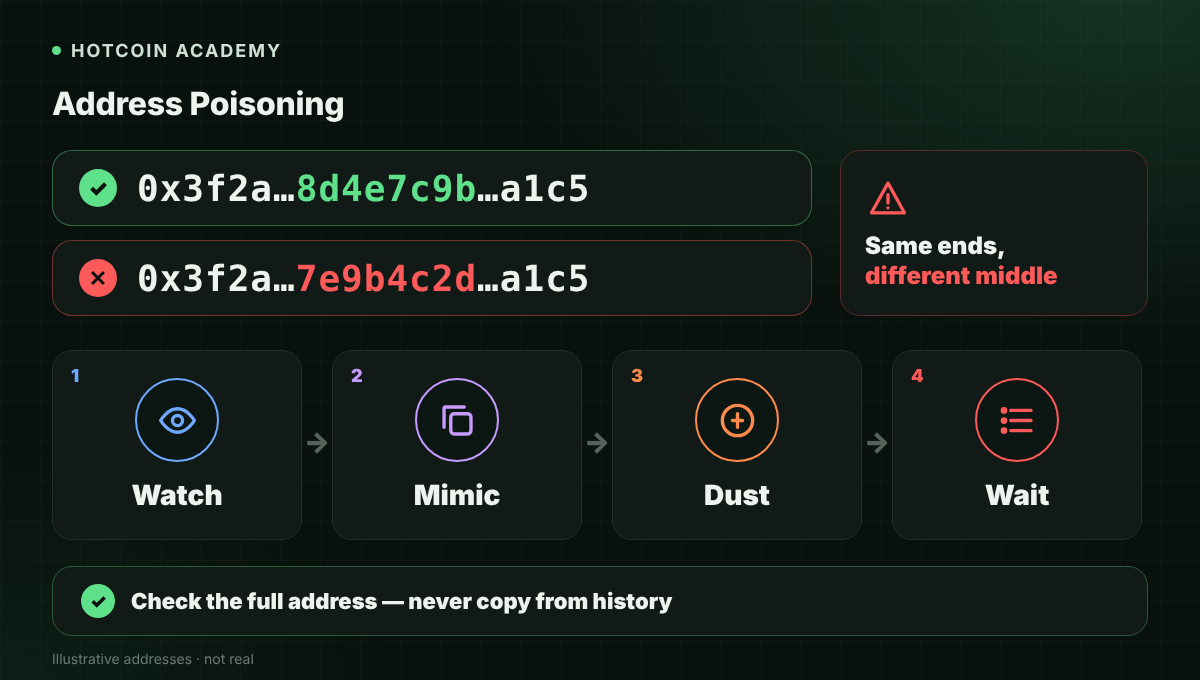
Address poisoning is a transfer scam that exploits addresses that "look very much like your usual address." The attacker first observes your public transaction records, generates a wallet address whose beginning and end closely resemble your frequently used receiving address, and then sends you a very small amount—or even zero—of a token so that this fake address appears in your transaction history. If you habitually copy addresses directly from transaction records or history lists and only check the first and last few characters, it is extremely easy to send your funds into the attacker's pocket. Once an on-chain transfer is confirmed, it usually cannot be reversed on your own.
A public blockchain cannot prevent others from sending funds to your address, so the focus of protection is not "keeping this dust transfer from appearing." What you really need to do is: do not take the lazy route of copying addresses from transaction history; each time, obtain the full information again from the receiver's official entry point, and verify the middle characters rather than only the beginning and end.
Key Takeaways
- Address poisoning does not breach your wallet, nor does it require you to sign an authorization first; it "plants" a similar-looking address into your transaction records and waits for you to copy the wrong one.
- Attackers usually make the first few and last few characters of the fake address match your usual address, with the difference hidden in the middle. If you only look at the truncated display, it is easy to be misled.
- Anyone can send a very small amount of assets to a public address, so "a small incoming transfer suddenly appeared" does not by itself mean your wallet has been hacked, but you should treat it as a warning sign.
- When transferring or withdrawing, re-copy the address from the receiver's official deposit page or an address provided directly by the person and independently verified by you—not from transaction history, chat logs, or search results.
- Save frequently used addresses to your address book and enable withdrawal whitelists on the platform side to reduce the chance of copying the wrong address on the fly; before adding an address to the whitelist, you must still verify the coin, network, and full address item by item.
- If you transfer by mistake, on-chain transactions usually cannot be reversed on your own. Immediately save the transaction hash and both addresses and report to the police; if the funds flow into a centralized exchange, you can submit leads through official channels to help freeze them. Do not trust any third party that claims you can "recover funds by paying a fee."
What Is Address Poisoning
Address poisoning targets your copying habits during transfers, not your private key or login password.
Blockchain addresses are usually 30 to 40 characters long. For layout aesthetics, wallets and websites often display only the first 4 and last 4 characters (e.g., 0x3a8f...9c21), folding the middle with an ellipsis. Many people therefore develop the habit of "check the first few and last few characters and copy." Attackers exploit exactly this by creating similar addresses that are nearly indistinguishable in truncated display.
Unlike phishing sites or fake customer service, address poisoning usually does not ask you to enter your seed phrase, nor does it necessarily pop up an authorization signature. It waits for the next time you voluntarily transfer or withdraw and pick the wrong receiving address yourself. Therefore, if a small incoming transfer of unknown origin suddenly appears in your transaction history, do not copy an address from that record in the future.
How Fake Addresses Enter Transaction History
A typical address poisoning attack roughly goes through the following steps:
- The attacker monitors transfers on the public chain, especially incoming and outgoing transfers of stablecoins or commonly used tokens.
- Based on an address you have sent to before or frequently use yourself, the attacker generates a "lookalike address" with similar first and last characters.
- The attacker sends a very small amount of tokens to you from this lookalike address, or initiates a zero-amount transfer that will still appear in the records.
- Once this record enters the history list of your wallet or a blockchain explorer, the fake address mixes with your real counterparties.
- If you directly copy the "recently appeared, looks familiar" address on your next transfer, the funds may enter an account controlled by the attacker.
For you, when you receive that dust transfer, your wallet usually will not be locked, and your balance will not be directly transferred away. The risk occurs in the transfer you initiate afterward.
There is also a similar technique: airdropping fake tokens with similar names to your address, or making a record that looks like a "refund" or "test deposit" appear in your token list. Clicking links attached to these unfamiliar tokens, or treating addresses in the list as receiving addresses you have used before, may cause additional losses. This technique often appears together with address poisoning, but the handling is still the same: verify against the receiver's official entry point, rather than taking an address from a record that appeared out of nowhere.
A separate issue is clipboard replacement by malware. In that case, the address is changed on the device after copying and before pasting. Address poisoning, by contrast, is a lookalike address already placed in the history list. Both require you to verify the full address on screen once more before confirming the send.
Why Checking Only the Beginning and End Is Not Enough
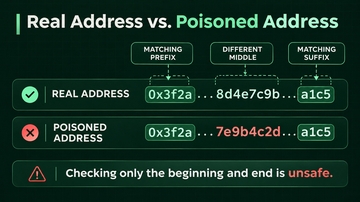
Most wallets, withdrawal pages, and blockchain explorers shorten long addresses. Seeing that "the first four and last four characters match" does not prove that the middle characters are also identical.
A lookalike address is precisely crafted to match at the positions you habitually check, with the difference placed in the middle. Therefore, verification should cover:
- The beginning segment
- Several characters randomly picked from the middle
- The ending segment
- The coin, network, and any Memo, Tag, or note that needs to be filled in
Do not rely solely on the wallet's abbreviated display, or only compare truncated text in a chat app. If the page provides the full address, expand it and check segment by segment. Saving frequently used receiving information to an address book you have verified and using it from there is also safer than searching history records each time.
For how to view a transfer's counterparty address and status in a blockchain explorer, see Wallet Address Lookup. When looking up, also confirm that you have opened the explorer for the corresponding network and that you entered the full address.
How to Prevent It Before Transfers and Withdrawals
A reliable defense is to change where you obtain addresses from, rather than expecting the system to automatically block every dust transfer.
You can verify in the following order; the actual button names depend on the current page:
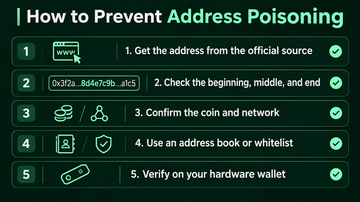
- Return to the receiver's official app or the official website deposit page you typed in yourself, and obtain the address, network, and Memo again. Do not use addresses from old screenshots or chat logs.
- After pasting into the withdrawal or transfer page, compare against the official page and verify the beginning, middle, and end, while confirming that the coin and network match.
- Save the verified address to your address book, writing down the receiver, purpose, and verification date, and avoid confusing labels like "Address 1."
- If the platform offers a withdrawal whitelist, enable it after completing two-factor authentication to restrict withdrawals to approved addresses; before adding a new address, you must still verify it fully, because the whitelist will not automatically determine whether you pasted a lookalike address.
- When using a hardware wallet, confirm the receiving address again on the device screen, not just the abbreviated information in a computer or phone pop-up.
- For the first transfer to a new address, it is advisable to send a very small test amount first. Note: after the test arrives, do not take the lazy route of copying the address directly from the "test record" to send a large amount; you must still return to the saved whitelist or official deposit page and confirm that the address and network match exactly.
If you also need to set up a withdrawal address book and whitelist, you can read on at Withdrawal Whitelist and Address Book. A whitelist can reduce temporary destination changes, but it cannot replace your item-by-item verification when adding an address.
Some wallets will warn you when you transfer to "an address you have never interacted with" or "an address highly similar to a historical address but different in the middle." Such warnings are a signal to pause and verify, not a guarantee that the address is definitely safe or definitely dangerous. In the end, you still need to return to the receiver's official source for a full comparison.
If You Have Already Sent to a Fake Address
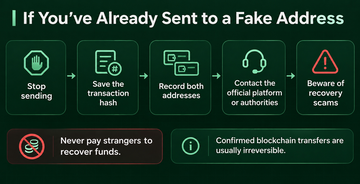
Once an on-chain transfer is confirmed, ordinary users usually cannot reverse it themselves. At this point, you should first stop sending more to the same address and preserve evidence.
It is advisable to record immediately:
- The transaction hash
- The sending address and the mistaken receiving address
- The coin, network, amount, and time
- Where you copied the address from at the time, such as which history record or which page
If the mistaken destination may be the deposit address of a custodial platform, you can submit the transaction hash through the platform's official customer service or local law enforcement and ask whether there is still room for freezing or assistance in the investigation. The result depends on whether the funds remain in an account that can be restricted and on local procedures; it cannot be guaranteed in advance.
You should report through local law enforcement or official anti-fraud channels and keep the original records. Do not transfer money to anyone who proactively messages you, claims they can "recover funds on-chain," or asks for an upfront fee, and do not hand over your seed phrase, verification codes, or new funds to them because of this.
Common Misconceptions
- "A tiny incoming transfer means my wallet has been hacked." — Address poisoning itself usually just writes a lookalike address into your history. A hacked wallet or abused authorization is a different type of problem; you should separately check logins, authorizations, and unknown outgoing transfers, but you do not need to interpret every dust transfer as a leaked private key.
- "If the first and last few characters match, I can just copy it." — This is exactly the verification habit attackers want to exploit. You must verify the middle characters and the complete information.
- "I only copy from my own transaction records, so it must be safe." — Transaction records are public, and attackers can write records into them too. The history list is not a trusted address book.
- "I have already done a small test, so I can just copy from the test record later." — The test only shows that the path may have worked that time. For large transfers, you should still return to the official source or the verified whitelist, rather than copying any address that appears in the test transaction.
- "Once the whitelist is enabled, even if I copy the address wrong, it will be blocked." — The whitelist only restricts withdrawals to approved addresses. If you add a lookalike address, the system may still let it through according to what you saved.
- "If I transfer wrong, I can apply for a reversal in the blockchain explorer." — The explorer is mainly for queries and cannot replace on-chain rollback. Whether it can be intercepted depends on whether the funds enter an account that can still be restricted by a custodian or law enforcement procedures, and on local rules.
Frequently Asked Questions
Q1: Are address poisoning and "dust attacks" the same thing? Not exactly. Dust attacks usually refer to distributing very small amounts of assets to a large number of addresses, sometimes to analyze address associations and sometimes just as harassment. The key to address poisoning is not the amount, but that the incoming address is crafted into a shape highly similar to your usual address, with the purpose of inducing you to copy the wrong one.
Q2: Why can't I prevent these incoming transfers? Because public chain addresses are public; anyone who pays the network fee can initiate a transfer to that address. Wallet service providers cannot prohibit all unknown incoming transfers in advance. What you can control is: where you copy the receiving address for your next transfer.
Q3: If I only transfer to my own other wallet, can I still be poisoned? Yes. Attackers can impersonate your own frequently used deposit address or your own wallet address. When withdrawing from a trading platform to your own wallet, or moving funds between two of your own addresses, likewise do not copy from history records; instead, obtain the address again from the receiving page of the target wallet.
Q4: Can a hardware wallet automatically detect lookalike addresses? It cannot automatically determine whether an address is a fake. The value of a hardware wallet is that before signing, you can see a more complete receiving address on the device screen, adding one more manual verification. If you still only glance at the beginning and end on the device, the risk remains.
Q5: If I have already sent to a fake address by mistake, can the money come back? There is no automatic refund mechanism that applies to all chains and all transactions. If the funds remain in an address that can be restricted by a custodial platform or law enforcement procedures, submitting the hash and evidence as early as possible may increase the chance of assistance, but the result cannot be guaranteed. Do not pay anyone who claims they can recover the funds because of this.
Q6: If I see in a blockchain explorer that the other party's address "has a balance" or "has transaction records," can I trust that it is my usual address? No. Lookalike addresses can also show balances and transactions. Whether it is the correct receiving address can only be determined by character-by-character verification against the receiver's official source, not by whether the address looks active.
Conclusion
Address poisoning does not rely on breaking passwords; it relies on making you copy a fake address that "looks right" from your familiar transaction records. The defense is straightforward: change the source of addresses back to the receiver's official page or an address book you have already verified, and before transferring, verify the middle characters, coin, and network, not just the beginning and end. A dust transfer can remind you to be more vigilant, but it is usually not the step that takes the money away; what really determines the outcome is whether you fully verify before the next time you click send.
If you want to further assess the flow of funds and permissions in common scams, you can first read Crypto Scams: The Complete Guide.
Risk warning: This article is for educational and informational purposes only and does not constitute investment, legal, or security advice or a guarantee, nor does it guarantee that mistakenly transferred funds can be recovered. Blockchain transfers are usually difficult to reverse on your own once confirmed, so please fully verify the receiving information before sending. Do not transfer money to anyone claiming they can recover funds on your behalf, and do not provide verification codes or seed phrases. Wallet interfaces, withdrawal rules, and security prompts may be updated; please refer to the current official pages.
読書をお勧めします
もっと見る