What Is a Cold Wallet? Cold Wallet vs. Hot Wallet and How to Choose
When holding cryptocurrencies such as Bitcoin and Ethereum, price movements are not the only concern—how to safeguard your assets is also important. Cold wallets and hot wallets are two common ways to manage crypto assets, and the main difference lies in whether the private key is isolated from an internet-connected environment.
Cold wallets are generally better suited to long-term asset storage, while hot wallets make daily transfers and on-chain operations more convenient. Understanding the security and usage limitations of both can help you choose a wallet that meets your needs.
Key Takeaways
- Cold Wallet: Keeps the private key offline, reducing the risk of remote attacks.
- Hot Wallet: Usually runs on internet-connected devices. Transactions are convenient, but users should watch out for malware and phishing risks.
- Cold Wallet Recommendations: Ledger, Trezor, and Blockstream all offer hardware wallets with different features.
- Purchase Considerations: Beyond security mechanisms, compare supported coins, device compatibility, and backup methods.
- Security Note: A cold wallet is not absolutely secure. Leaked recovery phrases or incorrect authorizations can still lead to asset losses.
What Is a Cold Wallet and How Does It Work?
A cold wallet is a storage method that isolates cryptocurrency private keys from the internet environment. Common forms include hardware wallets and offline signing devices.
Private keys are important credentials for controlling crypto assets. Cryptocurrencies are actually recorded on the blockchain, not stored inside a hardware wallet. The wallet's main role is to manage private keys and authorize transactions.
How does a cold wallet complete a transaction?
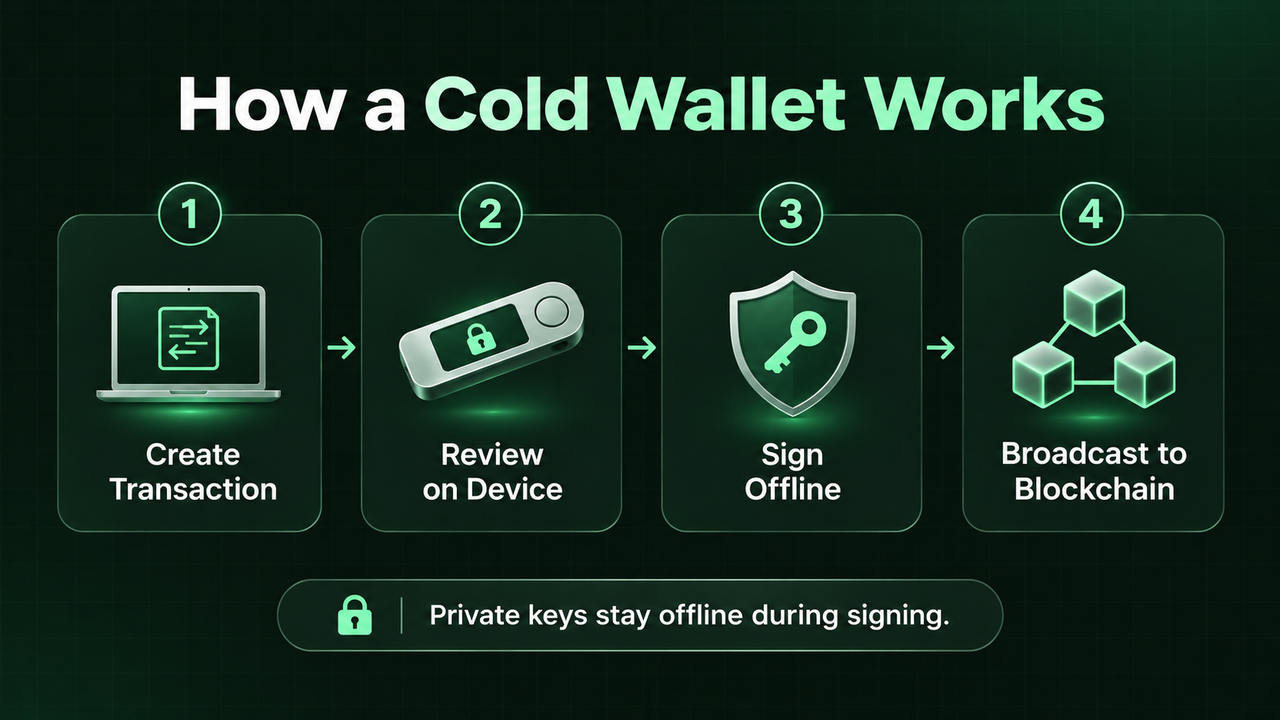
Using a common hardware wallet as an example, the transaction process usually includes:
- Create Transaction: Enter the recipient address and amount in the wallet software on a computer or phone.
- Review on Device: Send the transaction data to the hardware wallet and verify the recipient address and amount.
- Sign Offline: The private key inside the hardware device signs the transaction, and the private key does not need to be sent to an internet-connected device.
- Broadcast to Blockchain: Submit the signed transaction to the blockchain network.
Therefore, a cold wallet does not mean it can never connect to a computer. Rather, it isolates private key storage and signing operations, reducing the risk of direct exposure to network attacks. For further reading, see How to Use Cold Wallets for Crypto Like a Pro (Step-by-Step).
Cold Wallet vs. Hot Wallet: What's the Difference?
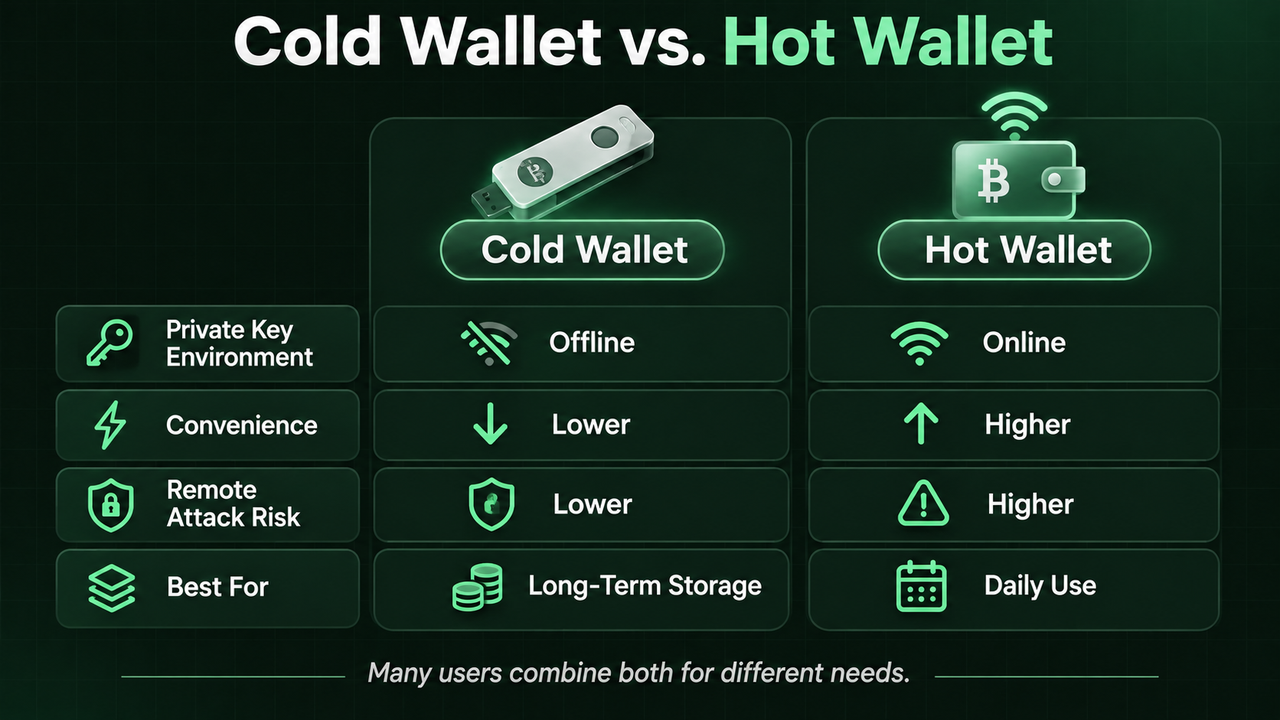
The core difference between a cold wallet and a hot wallet lies in the security environment where the private key is kept and the level of convenience for daily use.
| Comparison Item | Cold Wallet | Hot Wallet |
|---|---|---|
| Private Key Management | Kept offline and isolated | Usually on internet-connected devices |
| Common Forms | Hardware wallets, offline signing devices | Mobile apps, browser extension wallets |
| Convenience | Requires extra confirmation or device connection | Usually more convenient |
| Remote Attack Risk | Relatively lower | Relatively higher |
| Usage Cost | Hardware devices usually need to be purchased | Most software wallets are free to use |
| Best For | Long-term storage, infrequent transfers | Daily payments, frequent on-chain operations |
For example, users who frequently use DeFi applications or make transfers may value the convenience of a hot wallet more, while users who want to store more assets for the long term may prefer a cold wallet.
The two can also be used together: manage the assets needed for daily use with a hot wallet, and keep the portion that does not need frequent access in a cold wallet.
Note that exchange accounts are usually custodial services and are not equivalent to a hot wallet where users control their own private keys.
Cold Wallet Recommendations: Common Hardware Wallets
There are many hardware wallets on the market. Below, three representative products are selected for comparison to help beginners understand the positioning of different devices.
| Hardware Wallet | Main Features | Suitable Needs |
|---|---|---|
| Ledger Nano S Plus | Secure chip, multi-coin support, USB connection | Managing multiple crypto assets |
| Trezor Safe 3 | Open-source design, secure chip, device confirmation | Valuing open-source transparency and basic security features |
| Blockstream Jade | Bitcoin-focused, offline private key management | Users who mainly hold BTC |
Ledger Nano S Plus uses a secure chip to protect private keys and confirms transactions through the device screen. It supports a variety of cryptocurrencies and tokens.
It primarily connects to a computer or compatible Android device via USB, making it suitable for users who do not need wireless connectivity and want to manage multiple assets.
Trezor Safe 3 features an open-source design, is equipped with a secure chip, and supports PIN, passphrase, and multiple wallet backup methods.
It can manage supported crypto assets through Trezor Suite, but compatibility with different coins, networks, and device versions still needs to be confirmed individually.
Blockstream Jade is a hardware wallet centered on Bitcoin self-custody, offering features such as offline private key storage, transaction confirmation, and watch-only mode.
For users who mainly hold BTC and rarely need to manage other blockchain assets, Jade is one device worth comparing.
The above is only an introduction to representative products and does not represent a security ranking or investment recommendation. Before purchasing, you should still check the latest official specifications, supported coins, and device compatibility.
| Selection Focus | Questions to Confirm |
|---|---|
| Supported Assets | Does it support the coins and blockchain networks you need to store? |
| Security Design | Does it provide device confirmation, PIN, and reliable security mechanisms? |
| Usage Compatibility | Can it work with your computer, phone, and wallet software? |
| Backup and Recovery | Do you clearly understand the recovery phrase and the recovery process after device loss? |
How to Choose a Cold Wallet: What Should Beginners Consider?
When choosing a cold wallet, you should not look only at the brand or price. What matters more is whether it can manage your assets safely and conveniently.
It is recommended to confirm the following four conditions first:
If you mainly hold BTC, you can prioritize devices focused on Bitcoin. If you hold multiple crypto assets, you need to check the support for each coin and its network.
When purchasing, prioritize official websites or authorized sales channels, and avoid devices from unknown sources or devices that have already been initialized.
What Security Precautions Should You Take When Using a Cold Wallet?
A cold wallet can reduce some network attack risks, but asset security still depends on how users store recovery phrases and confirm transactions.
The most important part is the recovery phrase, which is usually used to restore the wallet if the device is lost or damaged.
When using a cold wallet, pay attention to:
- Back Up the Recovery Phrase Offline: Avoid screenshots, photos, or cloud uploads, and do not send it to others via messages.
- Confirm Recipient Information: Before signing a transaction, verify the address, amount, and necessary transaction details on the hardware device.
- Protect Devices and Software: Set an appropriate PIN and install applications and firmware updates from official sources.
- Test with a Small Amount First: When transferring assets for the first time, confirm that the coin, network, and recipient address are correct.
Common Misconceptions
- "A cold wallet can never be stolen": Leaked recovery phrases, malicious transaction authorizations, or physical attacks on the device can still cause losses.
- "If a cold wallet is lost, the assets cannot be recovered": If the backup is complete and has not been leaked, access can usually be restored through a compatible wallet.
- "It is safer to give the recovery phrase to customer service for safekeeping": Anyone who asks for the full recovery phrase should be treated as a major security risk. Never provide it to customer service or strangers.
Cold Wallet FAQ
Q1: Does a cold wallet need to be connected to the internet all the time?
No. The core of a cold wallet is keeping the private key offline. Some hardware wallets can connect to a computer to transmit transaction data, but the signing operation is still performed inside the device.
Q2: Is a cold wallet always safer than a hot wallet?
A cold wallet can generally reduce the risk of private keys being remotely attacked, but it does not mean there is no risk at all. Recovery phrase storage, transaction confirmation, and device security are equally important.
Q3: Can a cold wallet store USDT?
Some hardware wallets support USDT, but you need to confirm the compatibility of the specific blockchain network and wallet software. Even for the same USDT, transfer and management methods may differ across networks.
Q4: What should I do if my cold wallet breaks or is lost?
If you have kept a valid and complete wallet backup, you can usually restore access to your assets using a compatible new device. If the recovery phrase is also lost, recovery may not be possible.
Conclusion
There is no single choice between cold wallets and hot wallets that suits everyone. Cold wallets emphasize private key isolation and long-term storage, while hot wallets offer greater convenience for daily operations.
When choosing, consider the asset types, usage frequency, device compatibility, and backup capability. Whichever wallet you use, properly safeguarding private keys and recovery phrases is always an important foundation for crypto asset security.
Risk Warning: This article is for informational and educational purposes only and does not constitute product purchase or investment advice. Self-custody of crypto assets may involve risks such as loss of private keys, transaction errors, device damage, and network security.
Lettura consigliata
Visualizza altro