Market Order vs Limit Order: How to Choose Your Order Type
A market order suits traders who care most about execution speed, while a limit order suits traders who care most about the fill price. Put simply, a market order means "fill as soon as possible" and a limit order means "fill once the price condition is met", so beginners can choose based on whether they care more about speed or price control.
If you are not yet familiar with spot trading, start with What Is Spot Trading? The Simplest Way to Buy Crypto to learn the basic flow of buying and selling digital assets. This article focuses on the most common question when placing an order: what exactly is the difference between a market order and a limit order, and how should you choose in practice.
What is the difference between a market order and a limit order?
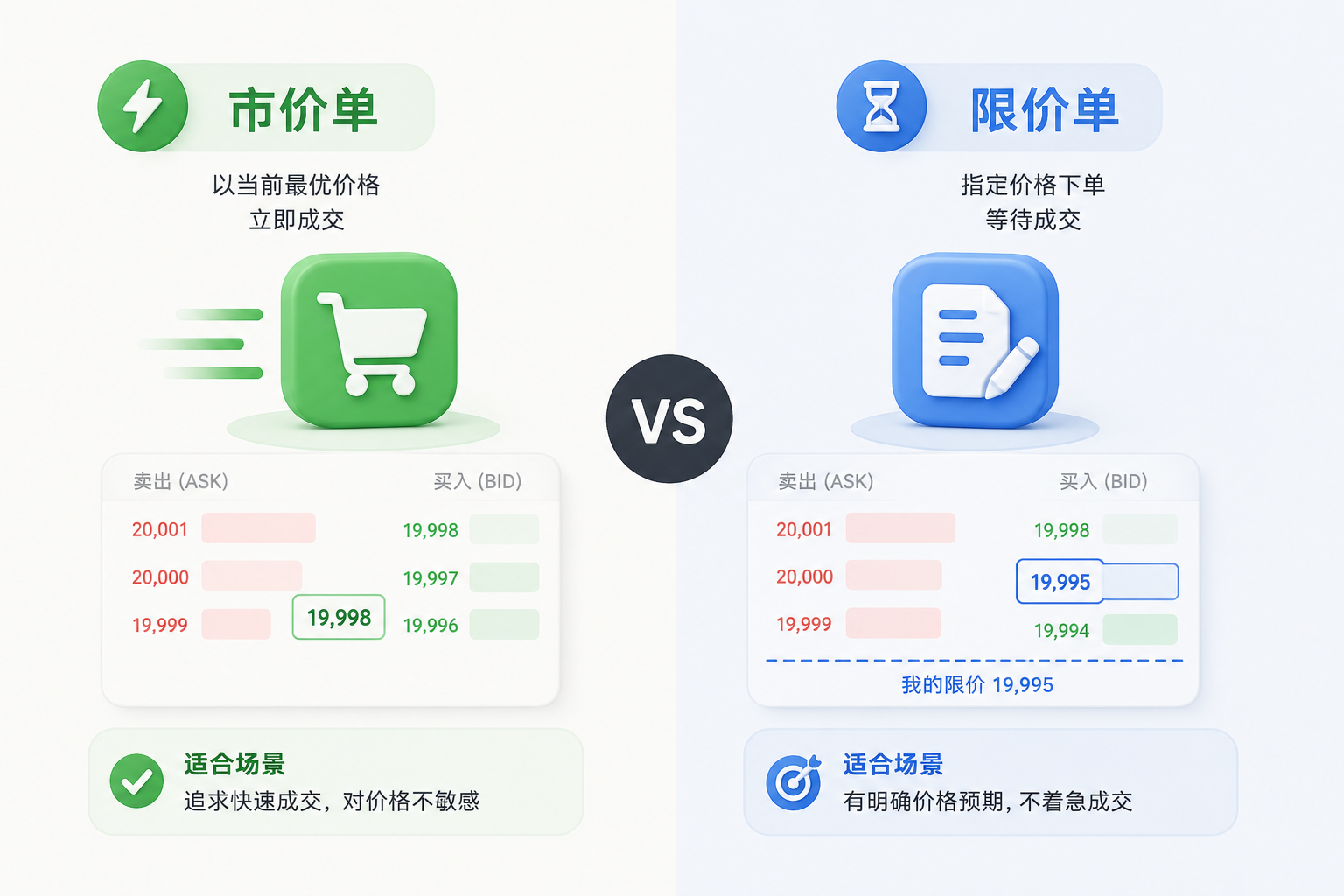
The biggest difference between the two is which one gets priority: speed or price. A market order chases execution speed first: as long as there is enough liquidity on the other side, the order fills step by step at whatever prices the market offers at that moment. A limit order controls price first: it can only fill when the market price meets the condition you set.
For example, BTC is trading at around 100,000 USDT and you want to buy immediately. You can use a market order and let the system match it against the prices available in the order book at that time. If you are only willing to buy when BTC falls to 98,000 USDT or lower, you can place a limit buy order instead, but it may never fill if the market never reaches your price.
So start with the simplest rule of thumb:
Want to fill quickly → market order; want to control the price → limit order.
How does a market order fill?
A market order does not let you pre-set a single execution price. Instead, it sends the market an instruction to "fill at the prices currently available". The system matches it against the sell orders or buy orders in the order book at that moment, starting from the closest price.
For example, you use USDT to buy BTC and the order book may hold BTC sell orders at several different prices. If your order is small, it may only need to take part of the sell order closest to the market price. If the order is large, it may keep filling against sell orders at higher prices.
That is why a market order, although simple to use, does not mean "every unit fills at the latest price you saw". The faster the market moves, the larger the order and the thinner the order book, the more the actual fill price can differ from the price on screen when you placed the order.
What is slippage, and why does it matter more for market orders?
Slippage is the gap between the price you expected and the price you actually got, and it deserves particular attention when you use market orders. It does not necessarily mean the trading system made a mistake; it is the combined result of price movement and order book liquidity.
For example, you see BTC's latest trade at 100,000 USDT and decide to buy a larger amount immediately. If there are not enough sell orders near 100,000 USDT, your order keeps filling against sell orders at higher prices, and the final average fill price may end up above the price you first saw.
So a market order is not "whatever the size, it fills at the current price". Checking order book depth, the size of your trade and current volatility before you place the order helps you judge the potential execution cost.
How does a limit order fill?
A limit order lets you set the price you are willing to accept in advance. With a limit buy order you usually set the highest price you are willing to pay; with a limit sell order you usually set the lowest price you are willing to accept.
For example, BTC is at 100,000 USDT and you only want to buy if it falls to 98,000 USDT, so you place a limit buy order at 98,000 USDT. The order can only start filling if the market later drops and meets your condition; if BTC stays near 100,000 USDT, the order may simply remain unfilled.
The advantage of a limit order is clearer price control, but the trade-off is that a fill is never guaranteed. Your price being met is only one condition; there also has to be a counterparty in the market that can match your order.
Market order vs limit order: how do you choose?
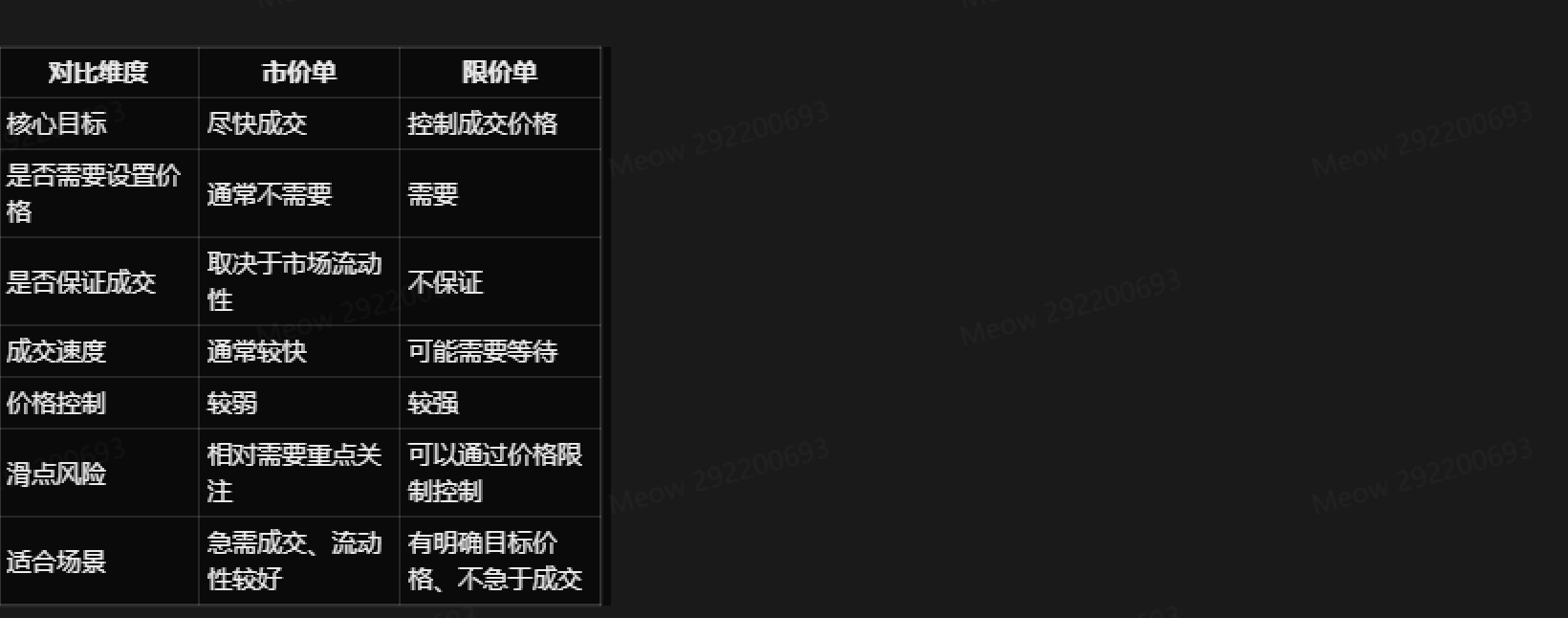
Here is a distinction that is easy to overlook: a market order is not "safer", and a limit order is not "more profitable". They are simply different ways of executing an order, and the outcome still depends on market price, liquidity and your own trading decision.
When is a market order the right choice?
If your main goal is to open or close a spot position immediately, and the trading pair you are targeting has decent liquidity, a market order is worth considering. For example, you have already decided to buy BTC and do not want to miss the trade while waiting for a particular price, so a market order usually fits that need.
Market orders also suit situations that call for fast execution, such as when you have clearly decided to sell an asset and do not want the order sitting in the market for a long time. Even so, keep an eye on trade size and volatility even in a liquid pair, because a large order can still move the price.
For beginners, if you use market orders, start with a smaller amount, watch the actual fill price and your trade history, and get familiar with how this order type executes step by step.
When is a limit order the right choice?
If you have already settled on a fill price you find acceptable and there is no requirement to fill immediately, a limit order is usually the better fit. For example, you think BTC is currently expensive and are only willing to buy after the price falls back to a certain level, so you can set a limit buy order in advance and wait for the market.
Limit orders also suit situations where you want to control your selling price. For example, you already hold BTC and want to sell only after the price reaches your target, so you can place a matching limit sell order.
The biggest risk of a limit order, however, is not a bad fill price but no fill at all. If the market price never reaches your set price, the order may stay unfilled, so you need to keep track of its status after placing it.
Why might a limit order still not fill?
Many beginners assume that a limit order must fill as soon as the market price "touches" their set price. In reality, whether an order fills also depends on the other orders in the order book, on price movement and on liquidity at that moment.
For example, you place a BTC limit buy order and the market briefly touches your price before rebounding quickly; that does not mean your whole order has necessarily filled. Your queue position in the order book and the number of counterparties available at that moment can both affect the final result.
So after submitting a limit order, do not look only at the "current price" — also check your open orders and the filled quantity. If the order has not filled completely, you can decide whether to keep waiting or cancel it based on how the market develops.
The 5 mistakes beginners make most often
First, treating a market order as a fixed-price purchase. A market order fills at the prices available at that moment; it does not guarantee a fill at the latest price shown on the page.
Second, assuming a limit order will definitely fill. A limit order only sets a price condition; if the market never meets it, or there is not enough matching liquidity, the order may not fill.
Third, watching only the latest price and ignoring the order book. The latest price is just the result of the most recent trade; to actually execute an order you also need the current bid and ask quotes and their sizes.
Fourth, ignoring order status. After submitting a limit order, if you do not check your open orders, it is easy to assume your assets have already been bought or sold.
Fifth, using a large market order on your first trade. Without knowing the order book depth of the market you are trading, a large market order can produce noticeable slippage, so beginners are better off starting with a smaller amount to get familiar with actual fills.

A simple way to choose
If you hesitate on the order page, ask yourself three questions first.
First, do I have to fill right now? If the answer is "yes", a market order usually fits better; if you are not in a hurry, consider a limit order. Second, do I have a clear maximum buying price or minimum selling price? If so, a limit order gives you better price control. Third, can I accept some variation in the actual fill price? If not, use market orders more carefully and pay attention to the order book and market liquidity.
You can also remember it as a very simple decision framework:
Speed first → market order. Price first → limit order. Want both price control and an immediate fill → there is no "perfect order" between the two; you have to trade off fill probability against price.
That last point matters a great deal. No order type is absolutely better; the real choice is what you are willing to give up. A market order gives up some price certainty for execution speed, while a limit order gives up fill certainty for price control.
What should you watch out for when placing orders on Hotcoin?
On Hotcoin's spot trading page, users can pick the order type that fits their trading need. Before placing an order, confirm the trading pair, the buy or sell direction, the order type, the price and the quantity, then check your available balance and the estimated order value.
If you use a market order, focus on order size and market liquidity; if you use a limit order, focus on whether your price is reasonable and on the order's status after submission. Whichever you choose, do not treat the order type itself as a profit tool — it is only a tool for carrying out your trading plan.
Once you have learned the order types, the next step is to combine the trading pair, price, order book and order panel on the trading page. If you are just getting started, you can go back to Exchange Interface Explained: Understand the Trading Page in 5 Minutes to tie the whole ordering flow together.
FAQ
Which is better, a market order or a limit order?
Neither order type is absolutely better; they solve different problems. A market order suits situations where execution speed matters most, while a limit order suits situations where you want price control and can wait.
Will a market order fill at the price currently displayed?
Not necessarily. A market order executes against the available quotes in the order book when it is submitted, so the actual fill price can differ from the latest price you saw at the moment of ordering, especially in a fast-moving or thin market.
Why has my limit order not filled?
Because a limit order needs its price condition to be met and also needs enough counterparty orders to match against. If the market price never reaches your condition, or the liquidity at that level is not enough, the order may stay unfilled.
Should a limit buy order be set above or below the current price?
If your goal is to buy at a lower price, you would normally set the limit buy price below the current market price. The lower you set it, the better the potential fill price, but the chance that the order never fills also increases.
Can a market order cause slippage?
It can. Slippage is mainly related to market volatility, order size and order book depth; the thinner the liquidity, or the larger your order relative to market depth, the more likely the actual fill price is to deviate from the price you expected.
Risk warning
Neither market orders nor limit orders reduce the price risk of crypto assets themselves. Market orders can be affected by slippage and market impact, while limit orders may fail to fill; in a highly volatile market, both order types can produce results that differ from your trading plan.
This article is only intended to help users understand basic order types and does not constitute investment or trading advice. Before trading, confirm the trading rules, fees, order status and market liquidity, and decide your trade size based on your own risk tolerance.
Speed first → market order. Price first → limit order. Want both price control and an immediate fill → there is no "perfect order" between the two; you have to trade off fill probability against price.
Lettura consigliata
Visualizza altro