Loss Aversion and Anchoring Bias: Behavioral Economics Traps in Trading
Loss aversion and anchoring bias are the two cognitive biases that most affect trading decisions in behavioral economics. Loss aversion pushes traders to hold losing positions instead of cutting losses, because they want to avoid locking in a loss; anchoring bias makes traders cling to the belief that a certain price is "reasonable", so they miss the best moment to exit or enter. Understanding how these two biases quietly sway your judgement is an important step towards rational trading.
Loss Aversion: Why Is It So Hard to "Cut Your Losses"?
Loss aversion was proposed by psychologists Daniel Kahneman and Amos Tversky in 1979. Its core finding is that when people face gains and losses of the same size, the pain of a loss is roughly 2 to 2.5 times the pleasure of an equivalent gain.
In crypto leveraged trading this bias is significantly amplified. When a position is underwater, the brain switches into "loss avoidance" mode first. A common pattern: the price falls far enough that the investor knows they should stop out, yet they always choose to "wait a little longer" in the hope that price will bounce back to break even. That wait often turns a small, manageable loss into a large one, or a straight liquidation.
This is the classic expression of loss aversion: locking in a loss means turning a paper loss into a realised loss, and human instinct does everything it can to avoid that pain. So the trader keeps holding the losing position and pins their hopes on "getting back to even".
From a mathematical point of view, this behaviour inverts the underlying logic of trading: you should stop out before a loss grows and hold while a profit runs. But loss aversion makes you hold when you should stop out, and take profit too early when you should hold — because the satisfaction of locking in a profit feels much stronger than letting it keep running.

Anchoring Bias: Why Can't You Let Go of a Certain Price?
Anchoring bias means that when making decisions, people rely too heavily on (anchor to) the first piece of information they receive, such as a price, and use it as the reference point for later judgements.
In crypto markets, anchoring bias usually shows up in the following ways:
Anchoring to a previous high: when BTC falls from 78,000 to 69,000, you feel that "69,000 is cheap" because "the high was 78,000". But if the trend has already reversed, 69,000 may still be a high price. Investors who bought Bitcoin in 2021 and refused to sell because they were anchored to the $69,000 peak ended up riding a huge drawdown — a textbook example of this bias.
Anchoring to your entry price: this is the most stubborn trap in trading. You insist on "waiting until I break even before I sell", yet the market does not care what your cost basis is. When the trend is confirmed downward, you should exit decisively even if price has not returned to your entry.
Anchoring to price predictions on social media: a KOL says "ETH hits 5,000 next month", and many investors make $5,000 their psychological anchor. When price falls from 4,000 to 3,000 they still refuse to sell, and eventually miss the exit window.
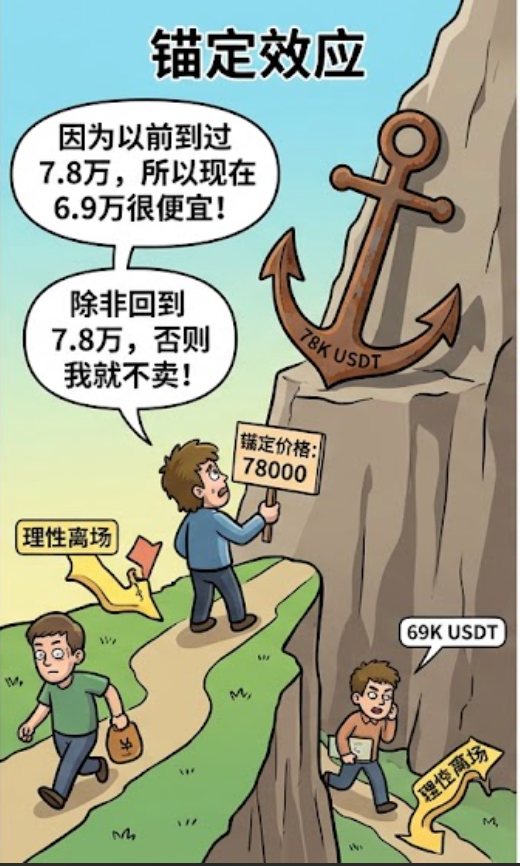
In Practice: How Do You Tell Whether a Bias Is Driving You?
Anchoring bias self-check: you hold an asset and price is down 20% from your entry. You tell yourself: "As soon as it gets back to my cost price I'll sell and never trade again." You are already anchored to your entry price.
Loss aversion self-check: you know a position no longer fits any logic in your trading plan, but when you see the "confirm sell" button your finger just will not press it. You are anchored to the paper loss, and loss aversion is in control.
When these self-check reactions appear, pause, step away from the screen, turn your attention back to your trading plan and ask yourself: "If I did not hold this position right now, would I buy it at this price?" If the answer is no, you should sell — and that decision has nothing to do with your cost basis or a previous high.
How Do You Counter These Two Biases?
Set your stop loss before you open the position, not after: this is the most effective way to overcome loss aversion. The stop order should be placed before you enter, rather than waiting until price falls and panic sets in to wonder whether you should stop out.
Use the "change places" test: before every position you hold, ask yourself: "If I did not hold it now, would I buy at this price?" If the answer is no, close it out regardless of profit or loss.
Build systematic rules: move decisions from "emotion-driven instant reactions" to "data-based systematic rules". For example, "close any position unconditionally when its loss reaches 8% of entry price", and switch on the exchange's stop-loss order function to cap your maximum loss by force.
Review regularly and log the emotion behind each decision: in your trading journal, note specifically whether anchoring bias or loss aversion affected each trade, and track how the bias was triggered and amplified.

FAQ
Q1: Loss aversion is a human instinct — can it never be eliminated?
That is right: it is rooted in the brain's evolutionary wiring and cannot be eradicated. But that does not mean you are helpless against it. By presetting stop orders, writing a trading plan and following it strictly, you can build a firewall between "the emotion appearing" and "the action being taken" — let the emotion stay in your head while your finger (or your system) executes a rule that was set in advance.
Q2: What should a stop loss be based on so that a fake breakout does not stop me out?
Stop levels are usually based on technical analysis — key support and resistance, moving averages, the lower Bollinger Band and so on. It helps to combine ATR (Average True Range) so that price has room for normal fluctuation and you are not swept out early by market noise. At the same time, the stop must be set in advance rather than decided on the spot.
Q3: Does anchoring bias affect taking profit as well?
Yes. For example, you see a KOL predict "BTC to 100K", so at 80K you keep postponing taking profit in expectation of a "higher anchor", and price then falls sharply. Profit taking should be based on your trading system (technical resistance, risk-reward targets), not on outside predictions or emotion. When price reaches the take-profit level you set, or a trend-weakening signal appears, act decisively instead of agonising over an anchor at some higher price.
Q4: How do you log behavioural bias in a trading journal?
Add a "psychological bias" field to every trade record, noting whether loss aversion or anchoring bias was involved. Tracking this over time helps you identify your most common decision patterns and adjust your trading rules and reminders accordingly.
Related tutorials:
Crypto Trading Psychology: From Emotional Management to Discipline
Trading Journal Template: How to Review Every Trade Properly
A Guide to Setting Stop Loss and Take Profit on Futures: A Must-Learn for Protecting Profits
Recommended reading:
Lettura consigliata
Visualizza altro