Complete Grid Trading Guide: Automating Profits in Range-Bound Markets
Grid trading is a strategy that automatically buys low and sells high within a preset price range. It is best suited to range-bound markets where prices fluctuate repeatedly without a clear one-way direction. The strategy divides the range into multiple grids, buys progressively as the price falls, and sells progressively as it rises, seeking spreads from completed price swings. This does not mean that profits are guaranteed.
What Is Grid Trading?
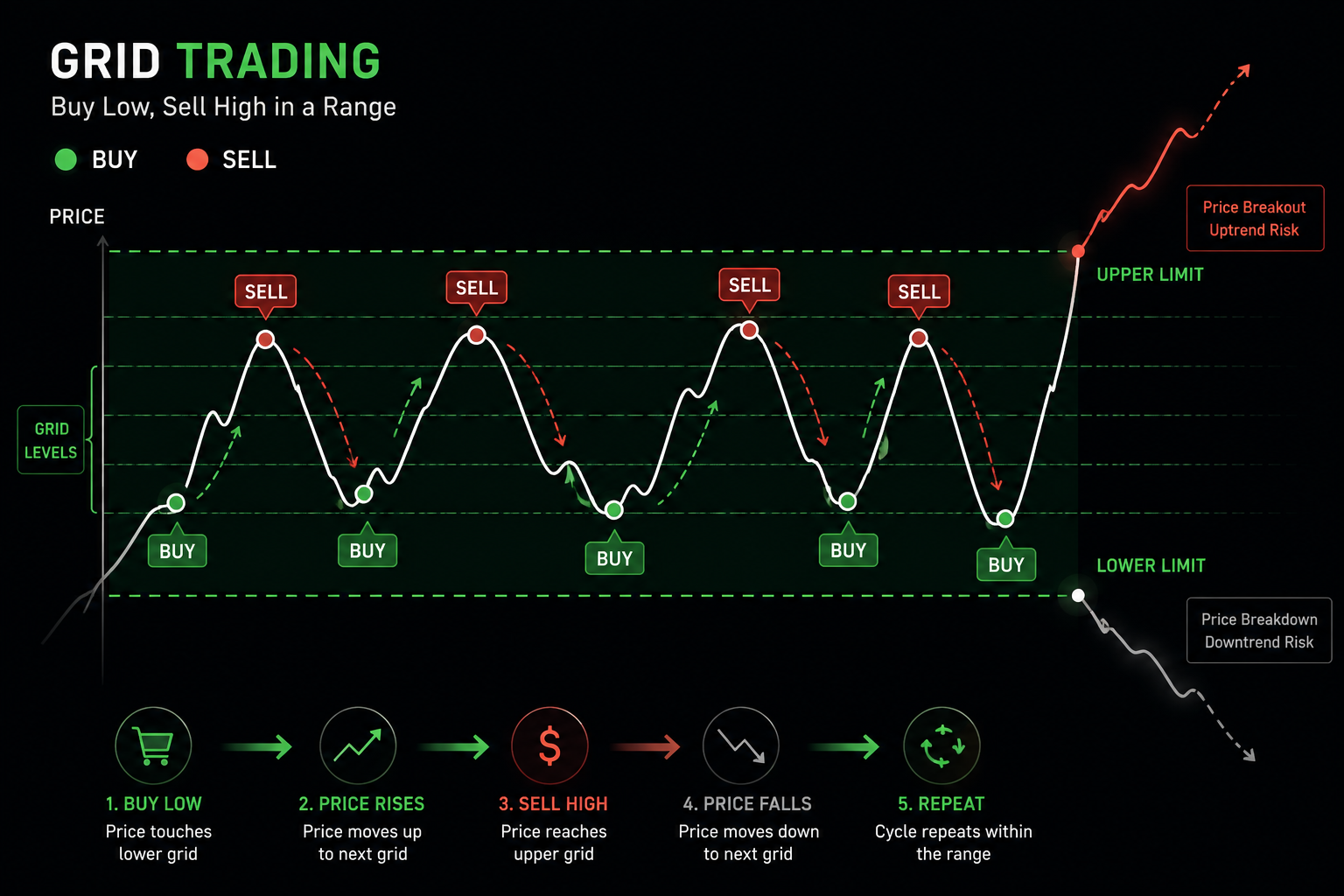
The core of grid trading is to define a price range, divide it into several price levels, and place buy and sell orders at different levels. As the price moves up and down within the range, the system executes trades according to preset rules, turning “buy low, sell high” into a consistent process.
For example, suppose an asset is fluctuating within a relatively stable range. You can divide the space between the upper and lower limits into multiple grids. When the price falls to a lower grid, the strategy buys. If the price then rebounds to a higher grid, it sells. If the price falls again, it continues buying according to the rules. As long as the price keeps moving back and forth within the selected range, the strategy may complete trades repeatedly.
Grid trading does not truly depend on predicting that the price will rise. It depends on the assumption that the price will continue to fluctuate. This is the main difference from trend trading: trend strategies focus more on direction, while grid strategies focus on repeated price movements within a range.
Why Is Grid Trading Suited to Range-Bound Markets?
Range-bound markets usually have relatively clear upper and lower price boundaries, with prices repeatedly rising and falling inside them. This matches the grid trading logic of buying at lower levels and selling at higher levels. In such a market, traders do not need to predict the next move precisely. Instead, preset grids capture recurring price fluctuations.
There is one critical condition: the market must remain within a reasonable trading range. If the price suddenly breaks above the range and begins a sustained rally, the grid may keep selling existing holdings and miss further upside. If the price continues falling, buy orders may keep triggering, gradually converting capital into inventory and creating increasingly large unrealized losses.
Therefore, deciding whether a grid is suitable requires more than observing that “recent volatility is high.” It is more important to determine whether the volatility has a range-bound structure and whether the price is beginning a new one-way trend.
How Does Grid Trading Make Money?
Grid trading returns mainly come from the price difference between grid levels, not from accurately predicting the market’s direction. Put simply, if a buy order fills at a lower price and the price later rises to the adjacent sell grid, completing the sale creates one spread-capturing trade.
The following is only a calculation example and does not represent Hotcoin’s current rules. Suppose an asset’s range is set at 90–110 USDT and divided into several grids. If one grid buys at 98 USDT and the next level sells at 100 USDT, a completed “buy at 98 → sell at 100” cycle has a theoretical gross spread of 2 USDT.
Actual returns cannot be assessed using only that 2 USDT, because trading fees on both the buy and sell sides, as well as potential slippage, must be deducted. A more useful test is:
Theoretical spread per grid > round-trip trading costs + expected slippage
If the grids are too dense, the spread between levels becomes small. Even if more trades are completed, fees may continually erode the profit from each trade. Conversely, if the grids are too wide, the potential spread per trade may be larger, but the price may take a long time to trigger the next order, reducing capital efficiency.
What Are the Three Most Important Grid Trading Parameters?
The most important grid trading parameters are usually the price range, number of grids, and grid spacing. Together, they determine how much market movement the strategy covers and how frequently orders may be triggered.
The price range determines where the grid operates. If the upper limit is too low, the price may quickly leave the grid after rising. If the lower limit is too high, the strategy may accumulate inventory too early as the market continues to fall. The range should not be entered arbitrarily based only on the current price. It should reflect recent price fluctuations and the amount of risk you can bear.
The number of grids determines how many levels divide the price range. A denser grid may trigger orders more often, but the spread per grid becomes smaller. Fewer grids may offer a larger spread per trade, but there will be fewer opportunities to execute. More grids are not automatically better; the goal is to balance execution frequency, profit per grid, and trading costs.
Are Denser Grids Always Better?
A higher grid count does not necessarily improve the strategy, because denser grids generally mean a smaller spread per grid and a higher potential execution frequency. When trading costs are high, frequent trading can reduce actual results if the spread from a completed buy-and-sell cycle does not cover fees and slippage.
When setting a grid, do not focus only on the estimated number of daily executions. Calculate how much room each grid actually leaves. One simple approach is to estimate the percentage spread per grid and compare it with the combined costs on both sides of the trade. If the profit margin is already very limited, making the grid excessively dense merely to increase execution frequency is unnecessary.
When Should You Avoid Grid Trading?
A persistent one-way market is the environment that requires the greatest caution in grid trading. Grid strategies assume that prices will fluctuate repeatedly within a preset range. That assumption can fail when the market enters a sustained uptrend or downtrend.
During a sustained rally, the price repeatedly triggers upper sell orders, gradually reducing the grid’s holdings. If the price then continues rising sharply, the strategy may have completed profitable trades but still miss much of the rally because it sold too early. A prolonged decline requires even greater caution: buy orders keep triggering, the position grows, and further declines can create substantial unrealized losses.
A practical grid assessment framework is therefore more nuanced than “turn it on in a range and off in a trend.” Continue monitoring three signals: whether the price persistently breaks the range, whether the position keeps accumulating in one direction after executions, and whether the current market structure has changed. If all three appear, reassess whether the original grid remains valid.
What Is the Difference Between Spot and Futures Grids?
A spot grid generally trades the underlying spot asset directly, seeking spreads through repeated buying and selling within a range. It does not involve the liquidation mechanism created by futures leverage. Its primary risks include a decline in the asset price, an incorrect range, capital lockup, and trading costs.
A futures grid runs the strategy in a derivatives market. In addition to the range and grid parameters, it requires consideration of leverage, margin, funding rates, and liquidation. Leverage can increase capital efficiency, but it also magnifies the risks of an incorrect judgment. A futures grid should not be treated simply as an upgraded version of a spot grid.
Users who are new to grid trading should first understand how spot grids work before studying futures grids and their additional risks.
How Do You Set Up a Grid Trading Strategy?
When setting up a grid, assess the parameters in this order: trading asset → price range → number of grids → spread per grid → capital allocation → risk boundaries. Select the asset and intended operating range first, then determine grid density based on volatility instead of choosing a grid count first and working backward.
After selecting the parameters, decide what to do if the price breaks either boundary. Consider whether the strategy should stop after a break below the lower limit, whether to reset the range after a break above the upper limit, and when to close the grid proactively. These decisions should be made before the strategy starts.
This is also the main difference between grid trading and simply leaving a bot to run on its own. Automated execution can reduce screen time and emotional interference, but it cannot replace strategic judgment. If market conditions change, the original parameters may also need to be reassessed.
Common Grid Trading Misconceptions
The most common misconception is that grid trading means “automatic profits.” A bot can execute buys and sells automatically, but it cannot guarantee that prices will remain within the expected range or prevent the market from entering a sustained uptrend or downtrend.
The second misconception is focusing only on “grid profit” while ignoring the performance of the overall position. A grid may complete many profitable buy-and-sell cycles, but if the underlying asset continues to fall, unrealized losses in the account may exceed realized grid profits. The strategy’s success cannot be judged only by the number of executions or the profit from individual grids.
The third misconception is that denser grids are always better. In practice, grid count should be evaluated alongside volatility and trading costs. An excessively dense grid may create many small trades whose costs continually compress actual returns.
Who Is Grid Trading Suitable For?
Grid trading is more suitable for users who accept range-trading logic and are willing to monitor changes in market structure. It may appeal to those who want to reduce frequent manual order placement and can accept that the strategy may fail under certain conditions. It is not suitable for anyone who treats it as a fully unattended “automatic profit tool.”
Once you understand the basic principles of grid trading, you still need to decide whether the current market is truly suitable. For different market conditions, refer to the complete guide to cryptocurrency trading strategies to compare trend, breakout, pullback, and other strategies before deciding whether to use a grid.
Frequently Asked Questions
Does Grid Trading Guarantee Profits?
No. Grid trading fits its intended logic only when the price continues to produce sufficient range-bound fluctuations. A persistent one-way market, high trading costs, or an unsuitable range can all lead to losses.
Is Grid Trading Suitable for a Bull Market?
Suitability cannot be determined simply by labeling the market “bullish” or “bearish.” A slowly rising market with repeated pullbacks may still offer grid opportunities. However, if the price rises rapidly and continuously, a grid may keep selling the asset and fail to participate fully in the subsequent rally. Watch for a shift from a range into a strong trend.
Does Grid Trading Require Constant Monitoring?
An automated grid reduces the need for constant manual order placement, but it does not eliminate management. Users should still monitor whether the price has broken the range, whether the market trend has changed, whether holdings are accumulating in one direction, and whether the strategy continues to match its original assumptions.
How Many Grids Should I Set?
There is no fixed grid count suitable for every market. The number should be evaluated together with the price range, asset volatility, spread per grid, and trading costs. The priority is not to maximize executions but to leave enough spread for each completed trade.
What Is the Difference Between Grid Trading and DCA?
DCA addresses how to invest capital in stages, buying at different times to reduce the pressure of choosing a single entry point. Grid trading uses price movements within a range to capture spreads through repeated buying and selling. Both may involve staged purchases, but their objectives and exit logic are different.
Risk Warning
Grid trading does not guarantee profits and is not a risk-free arbitrage strategy. Cryptocurrency prices can move rapidly outside a preset range, while persistent one-way markets can invalidate the strategy. Fees, slippage, capital lockup, and declines in the asset price also affect final results. Futures grids additionally involve leverage, margin, funding rates, and liquidation risk. Understand the strategy fully before use and size your capital according to your own risk tolerance.
Lettura consigliata
Visualizza altro