Futures Insurance Funds and the ADL Mechanism: Your Last Line of Defense
Futures insurance funds and auto-deleveraging (ADL) are the "last two lines of defense" in centralized exchange risk management. The insurance fund is a dedicated reserve pool used to absorb the bankruptcy losses of liquidated positions, so that losses do not exceed a trader's margin; when the insurance fund is depleted, the ADL mechanism force-closes the opposing positions with the highest profits and the highest leverage on the market, using their profits to cover the system's losses. Understanding how these two lines of defense work is basic literacy for anyone trading futures — they determine whether your account comes out intact in an extreme market, or is forced to "pay someone else's bill".
First Line of Defense: The Futures Insurance Fund
A futures insurance fund is a dedicated reserve pool held and managed by the trading platform. Its core function is to absorb bankruptcy losses beyond the margin range when a trader is force-liquidated.

How the Insurance Fund Works
When a position is liquidated, the system settles it at the bankruptcy price no matter what the current market price is — that is, the price at which the trader's initial margin is fully exhausted.
The actual execution result falls into two cases:
Close price better than the bankruptcy price: if the position is closed above the bankruptcy price, the remaining margin (the difference) is injected into the insurance fund to replenish the reserve.
Close price worse than the bankruptcy price: if the actual fill is below the bankruptcy price, the loss exceeds the trader's initial margin, and the insurance fund covers the excess to prevent bad debt on the platform.
Example: A trader holds a BTC/USDT long position with a liquidation price of 65,000 USDT and a bankruptcy price of 64,000 USDT. If it finally closes at 64,500 USDT (better than the bankruptcy price), the remaining 500 USDT is injected into the insurance fund; if the actual fill is only 63,500 USDT (worse than the bankruptcy price), the insurance fund covers the 500 USDT excess.

Sources of Insurance Fund Capital
Remaining margin on liquidation orders filled better than the bankruptcy price: the main source
Possible platform contributions: some platforms periodically inject their own funds into the insurance fund to maintain the reserve level during sharp market volatility
The Risk of Insurance Fund Depletion
When a large-scale, severe extreme market event causes multiple positions to go bankrupt at the same time, and the total bankruptcy loss exceeds the insurance fund balance, the insurance fund is depleted. At that point, the system activates the second line of defense — auto-deleveraging (ADL).
Second Line of Defense: Auto-Deleveraging (ADL)
ADL is the final tool of risk management. In essence it is "forced closure of counterparty positions" — when the insurance fund is insufficient to cover bankruptcy losses, the system forcibly closes the positions of traders on the opposite side of the bankrupt positions that have the highest profits and the highest leverage, using their profits to fill the system's loss.
ADL Trigger Conditions
Platforms may differ slightly in their specific execution parameters, but the core logic is the same. Taking Bybit as an example, ADL is triggered by the following two conditions:
Condition one: the insurance fund drawdown of a single trading pair exceeds the threshold. ADL is triggered when the drawdown ratio of a trading pair's insurance fund over the past 8 hours reaches a preset threshold (such as 30%).
Example: An insurance fund's highest balance over the past 8 hours was 20,000 USDC, with a trigger line of 30%. Current total position loss is 8,000 USDC and total margin is 1,000 USDC, so the drawdown ratio = (8,000 − 1,000) ÷ 20,000 = 35%. It exceeds 30%, so ADL is triggered.
Condition two: the total balance of multiple independent insurance funds is negative. ADL is triggered when the total insurance fund balance of multiple trading pairs with independent fund pools is less than or equal to 0. The system reallocates the pools with a positive balance to fill the shortfall of the loss-making pools.
Who Gets "Selected" by ADL?
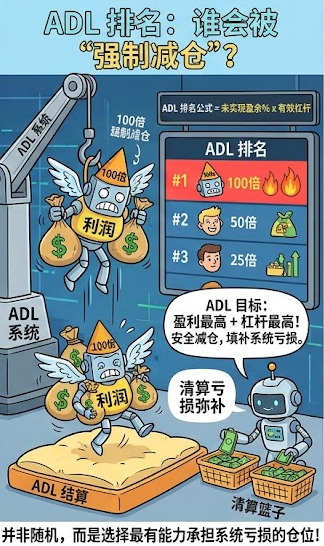
ADL is not a random choice; it is precisely calculated according to the ADL ranking. The positions selected for deleveraging first are usually:
Traders with the highest profits + the highest leverage + the largest positions have the highest priority.
The ranking formula provided by Binance is:
If the profit and loss percentage ≥ 0 (in profit): ranking = profit and loss percentage × effective leverage, profit and loss percentage = unrealized profit / |position notional value|, effective leverage = |notional position| / (wallet balance + unrealized profit)
Simply put: the more profit a trader has and the higher their leverage, the first they are "forced off the bus" in an extreme market.
ADL Stop Conditions
The system continuously monitors the insurance fund's drawdown ratio or total balance changes. Once conditions return to a safe range (such as drawdown falling below the stop line, or the total fund balance returning to positive), the ADL process stops.
Practical Impact on Traders
ADL is not discrimination, but a "system survival mechanism". In an extreme market, without the insurance fund as a "public capital pool" buffer, losing positions cannot be liquidated, and the entire platform's settlement system would collapse.
For ordinary traders, the direct risks of ADL are:
Even if you judge the direction correctly and are in profit, you can still be force-liquidated in an extreme market
Positions closed by ADL are settled at the bankruptcy price, and trading fees are usually waived
Most mainstream trading platforms display an ADL risk indicator in the position interface to help traders monitor the probability of being deleveraged in real time
Who Ultimately Owns the Core Responsibility for Risk Management?
The platform provides the insurance fund and the ADL mechanism as a guarantee of the system's bottom line, but the ultimate responsibility for risk management always lies with the trader. These two lines of defense are not your "insurance policy", but the platform's "public firewall" for keeping its settlement system stable.
Traders are advised to do three things:
Set stop losses proactively: do not rely on liquidation as your "final stop loss"
Watch the ADL risk indicator: pay close attention to changes in your position's risk level during sharp market volatility
Choose your leverage multiple prudently: high-leverage positions are more likely to be selected by ADL in extreme markets
Frequently Asked Questions (FAQ)
Q1: What does the insurance fund have to do with my futures position?
When your position is liquidated, if the final fill is worse than the bankruptcy price (that is, the loss exceeds your initial margin), the excess is covered by the insurance fund, so you do not fall into negative equity. But if the insurance fund is not enough to cover those excess losses, the system starts ADL and forcibly closes profitable positions on the opposite side to make up the difference.
Q2: How is ADL different from an ordinary liquidation?
An ordinary liquidation happens when the margin in your personal account is insufficient, and it affects your own position. ADL happens in extreme conditions after the insurance fund is also depleted, and it affects counterparty positions on the market that are on the opposite side, highly profitable and highly leveraged — even if those traders have done nothing wrong, their positions are force-closed by the system to "replenish" the insurance fund pool.
Q3: How can traders avoid the risk of being selected by ADL?
Avoid using excessive leverage — high-leverage positions rank higher in the ADL ranking;
Avoid holding high leverage for a long time when a position is very profitable;
Watch the ADL risk indicator on the platform interface and reduce leverage or close the position in time.
Q4: Is all profit confiscated after being force-closed by ADL?
No. A position closed by ADL is settled at the bankruptcy price of the bankrupt position. This follows the same logic as an ordinary liquidation — the losing side has already lost down to the bankruptcy price, and the profitable side closes at that price, with the profit used to fill the system's loss. Traders closed by ADL are usually not charged a trading fee.
Related Tutorials
What Is Futures Liquidation? Liquidation Mechanism and Liquidation Price Calculation
Stop-Loss and Take-Profit Guide for Futures: A Must for Protecting Profits
Futures Position Management: Kelly Criterion and Pyramid Scaling
Recommended Reading
Lettura consigliata
Visualizza altro