The History of DeFi: From MakerDAO to a Trillion-Dollar Ecosystem
DeFi has moved through several stages: from decentralized stablecoins, on-chain trading, and lending, to liquidity mining and multi-chain expansion, and now to an emphasis on real demand and risk management. MakerDAO explored on-chain stablecoins and collateralized lending in 2017, DEXs and lending protocols matured afterwards, and DeFi Summer in 2020 pushed the whole ecosystem into rapid expansion.
Think of DeFi as a new set of financial infrastructure, and its history becomes a story of filling in financial functions one by one: first assets and stablecoins, then trading and lending, then liquidity and composability, and finally a complete on-chain financial ecosystem.
1. Why Did DeFi Appear?
Before tracing DeFi's history, it helps to understand the problem it set out to solve.
Services such as deposits, loans, trading, and asset custody in traditional finance usually require banks, brokers, and exchanges. Users rely on the account systems and services these institutions provide, while the institutions handle identity checks, asset custody, trade execution, and risk management.
DeFi tries to move part of that work onto blockchains and smart contracts.
DeFi, therefore, is not simply putting a bank on a blockchain. It tries to reorganize part of financial services around blockchains, smart contracts, and on-chain assets.
If you first want to know how DeFi and traditional finance differ in control of funds, trade execution, and access to services, start with What Is DeFi? Traditional Finance vs DeFi.
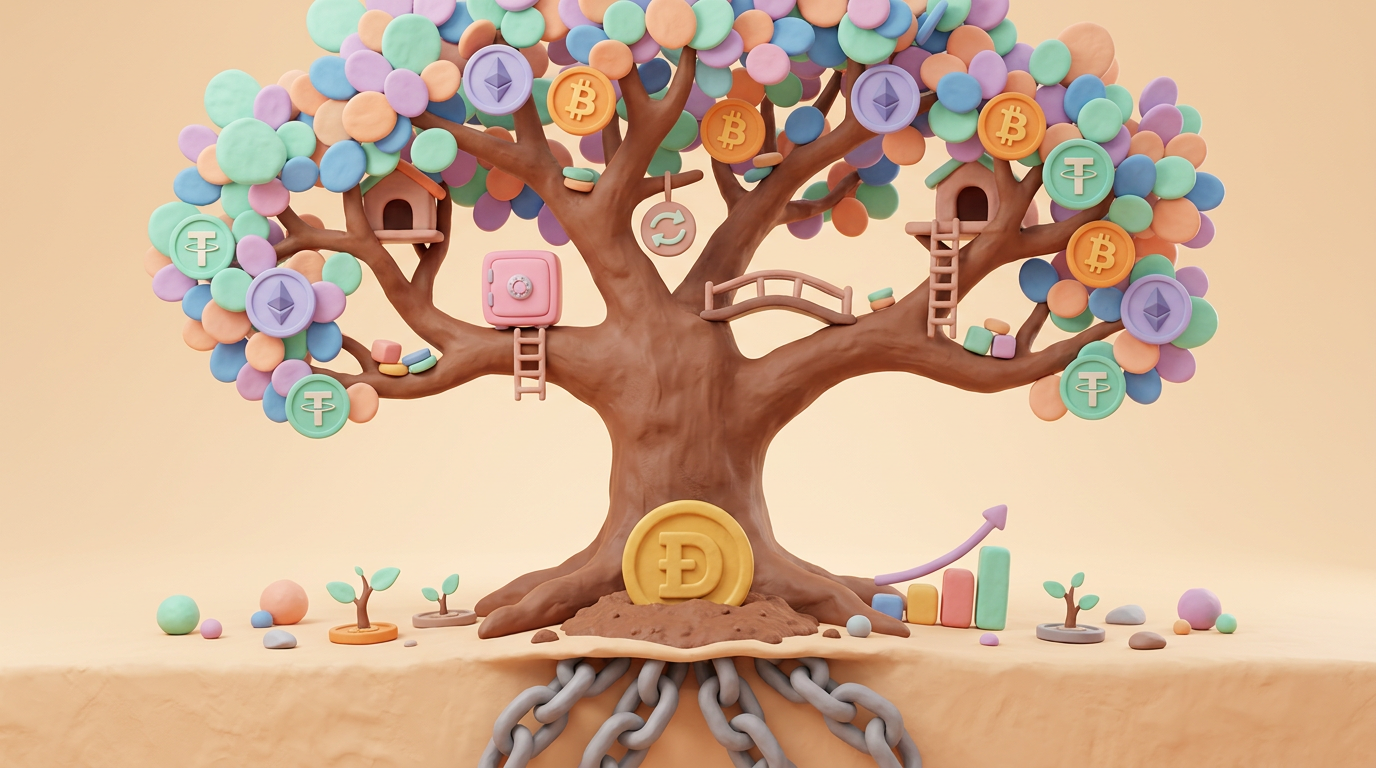
2. 2017: Why Is MakerDAO a Key Milestone in DeFi?
In 2017, MakerDAO began advancing decentralized stablecoins and collateralized lending, one of the most important early experiments in modern DeFi history.
MakerDAO initially built its system around Dai. Users could lock eligible digital assets as collateral and generate Dai through smart contracts. Unlike bank loans that depend on manual review and institutional credit, this on-chain lending mechanism runs mainly on collateral, smart contracts, and preset rules.
The model answered a very basic question:
Without traditional banks, can digital assets form a lending system of their own?
MakerDAO offered an early answer.
The 2017 system centered on ETH collateral. As the mechanism evolved, MakerDAO introduced Multi-Collateral Dai in 2019, allowing the system to support more types of collateral assets.
The significance was not just one more stablecoin, but a proof:
Smart contracts can carry part of the financial rules that financial institutions used to enforce.
That provided an important foundation for the DeFi protocols that followed.
3. 2018-2019: DEXs and Lending Protocols Fill In the Infrastructure
Stablecoins and collateralized lending alone still could not form a complete on-chain financial system.
Users faced another question:
How should digital assets be traded and exchanged?
Around 2018, decentralized trading protocols developed rapidly, and Uniswap later became a leading example of the AMM model.
Traditional exchanges match buyers and sellers through an order book, while AMMs complete swaps through liquidity pools and preset algorithms. Users do not need to wait for a specific counterparty and can trade directly against a liquidity pool.
At the same time, lending protocols such as Compound kept improving on-chain lending mechanisms.
Users can deposit assets into a protocol to earn a return, or borrow other assets against collateral. This is how several essential DeFi building blocks emerged:
Stablecoins handle on-chain pricing and asset circulation; DEXs handle asset swaps; lending protocols handle the allocation of funds.
If MakerDAO proved that on-chain financial mechanisms can work, the arrival of DEXs and lending protocols turned DeFi from a single financial application into an ecosystem.
4. 2020: Why Was DeFi Summer a Turning Point?
If 2017-2019 was the infrastructure-building phase, 2020 was when DeFi truly took off.
One of the most important changes in this period was liquidity mining.
After Compound launched the COMP governance token incentive, users could earn not only the economic return the protocol itself offered, but also governance tokens for lending or providing liquidity.
This changed how DeFi attracted users and liquidity.
Previously, a new protocol had to accumulate users and capital slowly; liquidity incentives could draw large amounts of capital into a protocol within a short time.
Curve, Yearn, SushiSwap, and other protocols followed, and different types of financial products began to be combined.
This is the background against which the term "DeFi Summer" took shape.
Total value locked across the DeFi ecosystem grew rapidly in 2020, and DEX trading volume rose sharply. DeFi was no longer a niche experiment in the blockchain industry but an independent financial application ecosystem.
More importantly, this period made the market realize for the first time:
Different smart contract protocols can be combined with one another to form on-chain financial products outside the traditional financial system.
5. 2021: Why Did DeFi Move From a Single Chain to Many?
As DeFi grew quickly, Ethereum's own limitations became more visible.
When large numbers of users trade, lend, and manage liquidity at the same time, network congestion and rising transaction fees directly affect the experience of ordinary users.
DeFi therefore began to expand to more blockchain networks and Layer 2 networks.
Different public chains gradually built their own DEXs, lending protocols, stablecoins, and yield products, and DeFi evolved from a set of applications on a single network into a multi-chain ecosystem.
The core change of this stage can be summarized as:
DeFi is no longer "a few protocols" but a set of financial infrastructure that can run across different networks.
At the same time, DeFi product types became increasingly diverse.
Beyond the original stablecoins, DEXs, and lending, yield aggregation, derivatives, leveraged trading, and more complex financial products gradually appeared.
Protocols can be combined through smart contracts, letting users call on the assets or liquidity of one application from within another.
This "composability" became one of the clearest differences between DeFi and the traditional financial system.
6. After 2022: Why Did DeFi Enter a Rebuilding Phase?
DeFi did not keep growing in a straight line.
Market cycles, protocol exploits, liquidity risk, excessive leverage, and the failure of some projects made the market re-examine how DeFi should develop.
One very obvious question was this:
If a protocol mainly relies on large token rewards to attract capital, will users and liquidity stay once those rewards shrink?
This gradually changed how DeFi is judged.
Earlier, the market focused on:
how much TVL a protocol had;
how high the APY was;
how much the token price had risen;
how much liquidity the protocol attracted.
Later, the market paid more attention to:
whether a protocol has real usage demand;
whether its revenue model is sustainable;
whether liquidity is genuine;
whether smart contracts have been thoroughly audited;
whether risk controls are sound;
whether users actually need these financial services.
The period after 2022 can therefore be seen as a "rebuilding phase" for DeFi.
The market began to move from chasing scale and yield alone toward efficiency, security, real demand, and sustainability.
7. How Did DeFi Build a Complete Ecosystem Step by Step?
Looking back, DeFi did not appear suddenly because of one project.
It is more like pieces of financial infrastructure assembled gradually.
Stage 1: Solving "assets and stablecoins"
Protocols such as MakerDAO explored decentralized stablecoins and collateral mechanisms, giving on-chain assets more stable financial use cases.
Stage 2: Solving "how assets are traded"
DEXs and AMMs let users swap assets directly on-chain and gave ordinary users a way to provide liquidity.
Stage 3: Solving "how funds are used"
Lending protocols let idle assets enter the lending market and let users obtain liquidity by pledging assets.
Stage 4: Solving "where liquidity comes from"
Liquidity mining attracted capital quickly through token incentives, driving large-scale growth in 2020.
Stage 5: Solving "how different financial products are combined"
As protocols multiplied, DEXs, stablecoins, lending, yield aggregation, and derivatives began calling on one another, and DeFi gradually became a composable financial ecosystem.
This is why DeFi today should not be understood as a single product but as an ecosystem of many protocols and financial functions.
8. Why Could DeFi Grow Into a Trillion-Dollar Ecosystem?
DeFi's growth comes from several factors working together.
First, blockchains give digital assets a unified settlement environment, and smart contracts can write financial rules into code.
Second, protocols are highly composable. An asset generated by one protocol can become collateral, a tradable asset, or a source of liquidity in another.
Finally, liquidity incentives played a very visible role in DeFi's early development, letting large amounts of capital enter new protocols within a short time.
The phrase "trillion-dollar ecosystem" therefore does not mean one DeFi project reaching a trillion in scale. It describes the huge base of assets, protocols, and applications that the whole DeFi ecosystem accumulated across different stages.
Note that ecosystem scale and ecosystem quality are not the same thing.
TVL can show how many assets a protocol or ecosystem has locked at a given point in time, but a high TVL does not prove that a protocol is safe, nor does it mean users will earn higher returns.
If you want to understand the most widely used scale metric in DeFi's development, read What Is TVL? A Key Metric for DeFi Protocol Value.
9. What Single Thread Summarizes DeFi's History?
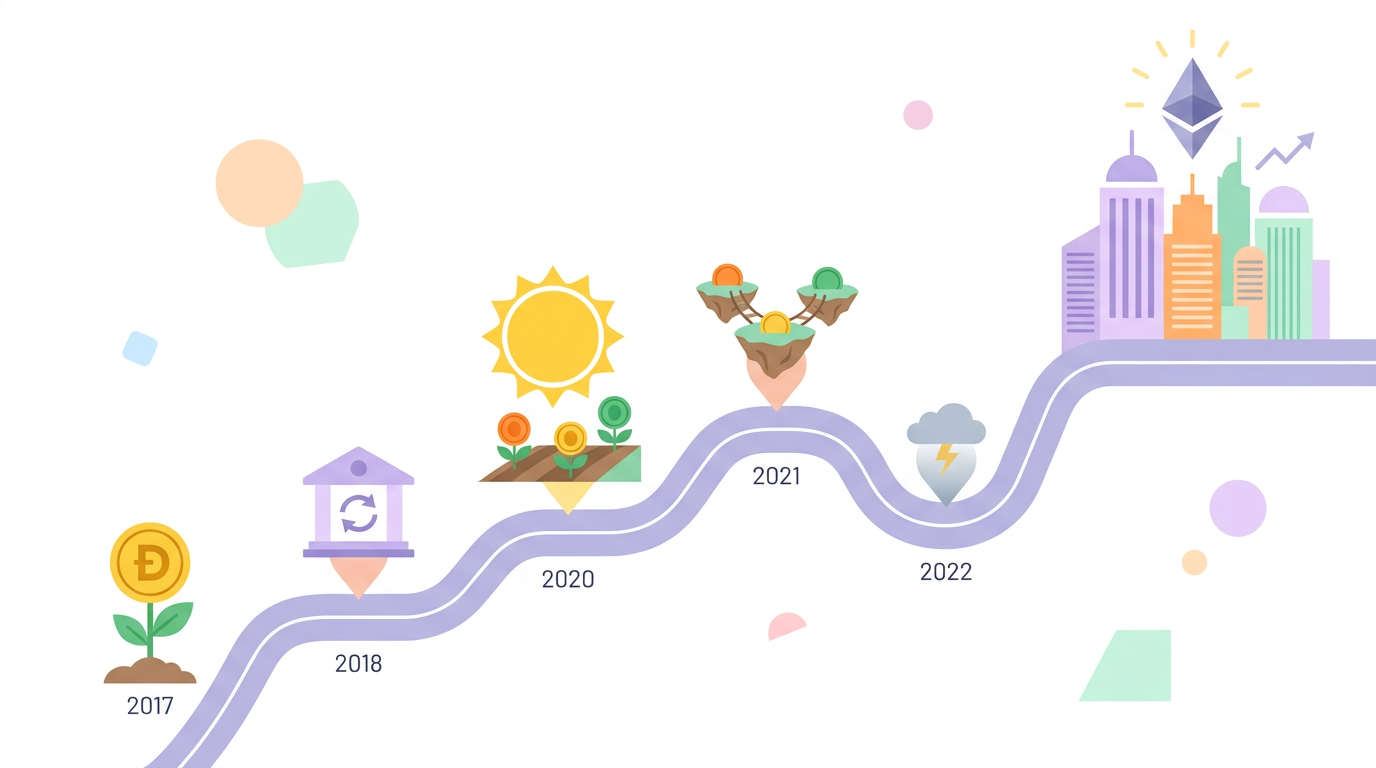
If you do not want to memorize many projects and years, DeFi's history can be compressed into this one thread:
2017: MakerDAO - exploring decentralized stablecoins and on-chain lending
↓
2018-2019: DEXs + lending - filling in on-chain trading and use of funds
↓
2020: DeFi Summer - liquidity mining drives an ecosystem boom
↓
2021: multi-chain expansion - DeFi moves from one chain to many
↓
After 2022: rebuilding - from high incentives and high growth to real demand, security, and sustainability
The core logic behind this path is clear:
First let assets exist and circulate, then let them be traded and lent, then let different protocols be combined, and finally form a complete on-chain financial ecosystem.
FAQ: Common Questions About DeFi History
When did DeFi begin?
The modern DeFi ecosystem is generally traced back to around 2017. Projects such as MakerDAO began exploring decentralized stablecoins and collateralized lending, laying an important foundation for later DeFi growth.
Why is MakerDAO considered an important early DeFi project?
MakerDAO explored on-chain stablecoins and lending through smart contracts and collateral mechanisms, allowing some financial rules to run without direct participation from traditional financial institutions.
What year was DeFi Summer?
DeFi Summer usually refers to the rapid growth phase of the DeFi ecosystem in 2020. Token incentives such as liquidity mining pushed large amounts of capital into protocols, and applications such as DEXs, lending, and yield aggregation developed quickly.
Why did DeFi expand from Ethereum to multiple blockchains?
One main reason is that as users and trading volume grew, congestion and fee problems on the Ethereum network became more obvious. Other public chains and Layer 2 networks gave DeFi more trading environments and room to scale.
Has DeFi always been growing?
No. DeFi has gone through rapid growth as well as market downturns, protocol exploits, liquidity risk, and project failures. In recent years, the market's focus has shifted from TVL and high yields alone toward real demand, security, and sustainability.
What does the "trillion-dollar DeFi ecosystem" mean?
It usually describes the assets and market size of the entire DeFi ecosystem rather than a single protocol holding a trillion in assets. Judging the scale of DeFi requires looking at TVL, trading volume, user activity, protocol revenue, and other metrics together.
Risk Notice
DeFi is a high-risk area of digital asset applications. Past ecosystem growth does not mean it will continue. Individual protocols may face smart contract vulnerabilities, oracle failures, severe market volatility, insufficient liquidity, liquidation, governance, and infrastructure risks.
Historical data such as TVL, trading volume, token incentives, and yields only reflects market conditions in a specific period and does not represent future performance. Before using any protocol, make sure you fully understand its mechanism, asset risks, and the possible range of losses.
Lettura consigliata
Visualizza altro