Crypto Swing Trading: Strategies, Trade Setups and Risk Management
Crypto swing trading is a medium-term approach that captures price moves lasting from a few days to a few weeks. It uses technical analysis to identify trends and reversals, and pairs that with strict risk management to take profit from each swing.
Unlike ultra-short-term high-frequency trading, swing trading does not demand screen time every day, and unlike long-term holding it does not ignore intermediate fluctuations. It sits between the two, and suits traders who already have some grounding in technical analysis and can stay disciplined. This guide covers what crypto swing trading is, the strategies traders use, how to build a trade setup, and the core risk management rules.
What Is Crypto Swing Trading
Swing trading is a style in which positions are typically held for days to weeks, with the goal of capturing one clear price swing.
Key characteristics:
- Holding periods shorter than long-term investing but longer than day trading
- Reliance on technical analysis (trends, support and resistance, patterns, indicators)
- No need to watch the market all day, but the market must be checked regularly
- Emphasis on risk-to-reward ratio and position sizing
In crypto markets, high volatility and near 24/7 trading mean swing trading brings opportunity along with elevated risk.
Common Swing Trading Strategies
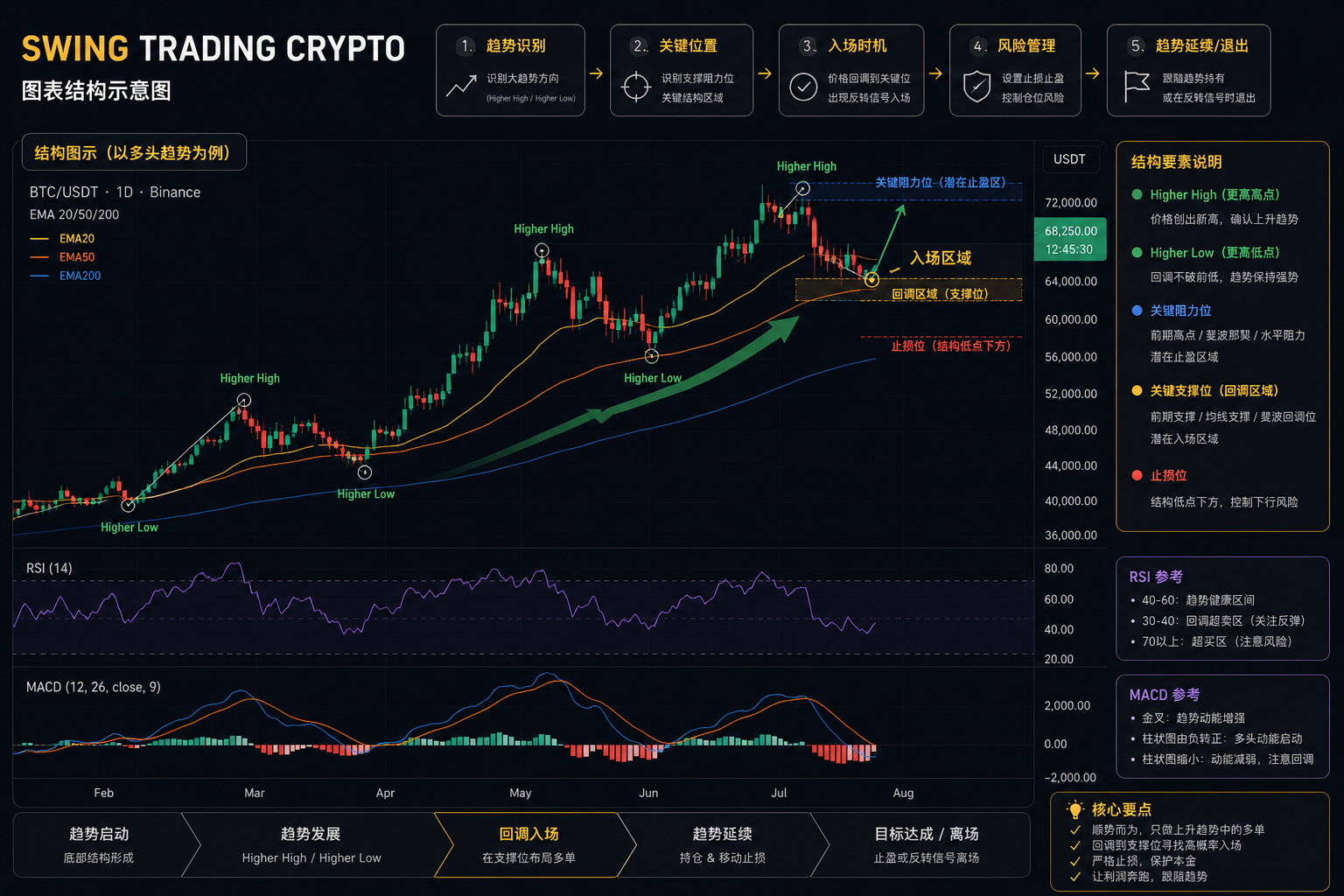
- Trend following — Trade in the direction of a clear uptrend or downtrend. Common tools: moving averages (such as the 20/50-day MA), trendlines, and higher-high/higher-low structure.
- Breakout trading — Enter when price breaks a key resistance or support level with expanding volume. Watch for: range breakouts, cup-and-handle and flag patterns.
- Buying pullbacks / selling bounces — When a healthy pullback appears inside a trend, look for an entry near support. Common references: Fibonacci retracement levels, prior highs and lows, moving-average support.
- Pattern reversals — Identify reversal patterns such as double tops, double bottoms and head-and-shoulders tops or bottoms, and enter on a confirmation signal.
Whichever strategy you use, you need explicit entry, stop-loss and take-profit rules so that decisions never become arbitrary.
Anatomy of a Typical Trade Setup
A complete swing trade setup usually includes:
- Market structure: whether the market is trending or ranging right now
- Entry trigger: a breakout, a completed pullback, pattern confirmation and so on
- Stop-loss level: placed beyond a key structure so normal volatility does not take you out
- Profit target: prior high or low, and a risk-to-reward ratio (at least 1:2 is recommended)
- Position size: calculated from the stop distance to control risk on each trade
Example workflow:
- Confirm the trend on a higher timeframe (the daily chart, for example)
- Find the specific entry point on the 4-hour or 1-hour chart
- Set the stop-loss and the target
- Execute the plan and do not move the stop arbitrarily
Risk Management: The Lifeline of Swing Trading
Crypto is volatile, and swing trading without strict risk control easily ends in losses. The core principles:
- Risk per trade: a single loss should normally stay within 1%–2% of the account
- Position sizing: position = acceptable loss amount ÷ stop distance per coin
- Risk-to-reward ratio: prefer trades whose potential profit exceeds the risk
- Total exposure: with several positions open at once, overall risk needs a ceiling
- No revenge trading: do not increase size after a loss
Also keep in mind:
- Avoid opening positions blindly around major news or data releases
- High leverage significantly magnifies drawdowns; swing trading is better served by low or moderate leverage
- Review your trades regularly and record the reasoning and how the plan was executed
Timeframes and Tools That Suit Swing Trading
- Common timeframes: the daily chart for direction, the 4-hour or 1-hour chart for entries
- Common indicators: moving averages, RSI, MACD, volume, support and resistance
- Supporting tools: market structure fractals, order blocks, funding rates (futures), long/short ratio
Tools are only aids; the final decision should rest on clear price structure and risk-to-reward.
Advantages and Challenges
Advantages:
- No need to watch the market all day
- Captures relatively clear medium-term moves
- More active risk management than long-term holding
Challenges:
- False breakouts and false signals are common
- Overnight and weekend exposure still carries volatility risk
- Emotions easily lead to taking profit early or delaying a stop-loss
Risk warning: Crypto swing trading carries high risk and can lead to loss of principal. Past price action and strategy examples do not guarantee future returns and are not investment advice. Trade according to your own risk tolerance and protect your capital first.
FAQ
Q1: What is the difference between swing trading and day trading?
A: Day trading closes positions the same day, while swing trading usually holds for days to weeks and focuses on medium-term structure rather than short-term noise.
Q2: Can beginners start swing trading crypto right away?
A: Practise on a demo account or with a small amount of capital first, and only scale up once you are familiar with the strategy and the risk controls.
Q3: Do you have to use leverage for swing trading?
A: No. You can swing trade spot as well. Leverage magnifies both gains and losses, and requires stricter position management.
Q4: How do you judge whether a swing setup is worth taking?
A: Check whether the trend is clear, whether the stop-loss is reasonable, whether the risk-to-reward ratio is adequate, and whether you can actually follow the plan.
Q5: What is the most important factor for success?
A: Not how accurate your predictions are, but risk management and execution discipline. Traders who keep losses under control are the ones with a chance of profiting over the long run.
Lettura consigliata
Visualizza altro