
What Is the Metaverse? The Economy and Technology Behind Virtual Worlds
What Is the Metaverse?
The metaverse is a persistent digital space where many people participate in real time through systems for identity, content, social interaction, and economic activity. Users can enter through phones, computers, game consoles, or XR devices to communicate, create, play, work, and trade as virtual identities. It is not a single company, game, or VR headset, but an ecosystem of interconnected, immersive virtual worlds and the technologies that support them.
The European Commission describes virtual worlds as persistent, three-dimensional, real-time, immersive environments used for socializing, work, learning, design, simulation, commerce, and entertainment. Source: European Commission FAQ on virtual worlds This definition neither requires blockchain nor says that users must wear a headset.
Understanding the metaverse therefore requires examining three things together: whether users receive a persistent spatial experience, whether creators and platforms can produce content, and whether a digital economy can operate under enforceable rules. VR, blockchain, NFTs, and artificial intelligence may all be components, but none of them alone is the metaverse.
What Are the Core Characteristics of the Metaverse?
Whether a digital product resembles a metaverse cannot be judged solely by its 3D graphics. A conventional single-player game can have beautiful scenes, but its world may pause when the player leaves, while identity and assets may not persist. The metaverse places greater emphasis on persistence, co-presence, content creation, economic activity, and connections between systems.
Persistent operation: The world, markets, events, and other users continue operating even when one user is offline.
Real-time multiplayer: Users can see one another in a shared space and communicate, cooperate, or compete synchronously.
Virtual identity: Avatars, usernames, social connections, reputation, and achievements form a user's identity in the digital world.
Creatable content: Platforms, studios, and ordinary users can build spaces, clothing, games, performances, or tools.
Working economy: Digital goods, services, land, tickets, and labor can be priced, bought, or exchanged.
Enforceable rules: Platform terms, software code, community governance, and law jointly determine what users may do.
Cross-device access: Phones, computers, consoles, VR, and AR devices provide different levels of access.
Interoperability vision: Identities, assets, and content may eventually move between spaces, although this is not yet fully realized.
How Does the Metaverse Differ from VR, AR, Web3, and GameFi?
The metaverse is often discussed alongside VR, AR, Web3, and GameFi, but these concepts operate at different layers. VR and AR provide presentation and interaction; Web3 provides open identity, assets, and programmable rules; GameFi combines games with digital economies; and the metaverse describes the persistent virtual spaces and social systems where people participate.
3.1 The Metaverse Is Not the Same as VR
VR is a way to interact with computer-generated environments, and headsets, controllers, and spatial tracking can make the experience more immersive. Users can also enter virtual worlds through ordinary screens. A single-user VR application without persistent identity, a multiplayer community, or a content economy does not automatically become a metaverse simply because it uses a headset.
3.2 The Metaverse Is Not the Same as AR
AR overlays digital content on the physical environment, such as navigation arrows, virtual furniture, or spatial information. It can be an entry point connecting the metaverse to the real world, but an AR app may also be a one-off utility. Whether it belongs to the metaverse still depends on persistent spaces, identity, social interaction, and an economic system.
3.3 The Metaverse Is Not the Same as Web3
Web3 emphasizes user control, wallet-based identity, open protocols, and decentralized applications. Blockchain can provide public ownership records for virtual assets and let users manage NFTs outside a platform. However, many virtual worlds use centralized accounts and databases while still exhibiting metaverse characteristics. Blockchain is an optional foundation, not a definitional requirement.
3.4 The Metaverse Is Not the Same as GameFi
GameFi primarily centers on gameplay, token rewards, and on-chain assets. The metaverse can also include meetings, education, industrial simulation, exhibitions, shopping, and public services. A GameFi title may be only one experience inside a virtual world, while a large metaverse may offer no financial rewards at all.
Is the Metaverse One World or Many Virtual Worlds?
The ideal open metaverse resembles the internet: different teams build different spaces, and users carry their identities, friends, items, and content among them. In reality, today's metaverse is closer to a collection of isolated platforms. Each has its own accounts, engine, asset formats, economic rules, and content moderation, and users generally cannot take an item directly into another world.
Interoperability means more than displaying the same 3D model in different environments. An item also contains dimensions, skeletons, animations, collision behavior, rarity, combat statistics, copyright, and security permissions. A very powerful weapon imported from one game cannot automatically retain its abilities in another without disrupting the destination world's balance.
A more realistic path is therefore layered interoperability: first standardize 3D files and device interfaces, then gradually enable the portability of avatar appearance, identity credentials, social connections, and certain digital rights, instead of immediately building a single world without boundaries.
What Technologies Form the Foundation of the Metaverse?
The metaverse is not one technology, but a combination of devices, graphics, networking, cloud computing, identity, economics, and governance systems. A problem at any layer affects the user experience. Beautiful graphics with excessive latency prevent real-time interaction; assets may exist on-chain, but an NFT can lose its practical use if the game server shuts down.
Hotcoin Learn divides the metaverse technology stack into seven layers: devices and spatial interaction, 3D content and engines, networks and computing, identity and social relationships, economics and assets, governance and security, and standards and interoperability. These layers depend on one another, so the system cannot be reduced to “VR plus blockchain.”
Layer One: Devices and Spatial Interaction
The device layer determines how users see and operate a virtual world. Phones and computers have the broadest reach, consoles offer consistent performance, VR headsets improve spatial immersion, and AR glasses overlay digital content on the physical environment. Cameras, microphones, controllers, eye tracking, and motion sensors capture user input.
Display devices: Phones, monitors, projectors, VR headsets, and AR glasses present virtual scenes.
Spatial tracking: Cameras, inertial sensors, and positioning systems determine the location of the head, hands, and body.
Natural interaction: Voice, gestures, gaze, facial expressions, and haptic feedback reduce reliance on keyboards and mice.
Environmental understanding: Depth sensing and spatial maps let virtual objects recognize walls, surfaces, and real distances.
The W3C WebXR Device API gives websites access to VR and AR devices, sensors, and headsets so immersive applications can operate across different hardware. Source: W3C WebXR Device API Standards like this can reduce the need for users to install a dedicated client.
Layer Two: 3D Content, Rendering Engines, and Physics
The 3D content layer builds environments, characters, items, lighting, and animation. Game engines render these assets in real time and calculate collision, gravity, particles, sound, and character behavior. Because the metaverse must support many users and user-generated content at once, it must balance visual quality with loading speed, device performance, and content safety.
Modeling and materials: Create buildings, avatars, clothing, props, terrain, and surface appearance.
Real-time rendering: Generate continuous images based on the user's viewpoint and device performance.
Animation systems: Handle skeletons, expressions, motion capture, and virtual-character behavior.
Physics simulation: Calculate collisions, gravity, cloth, fluids, and object interaction.
User-generated content: Let nonprofessional developers create experiences with editors and templates.
3D asset formats are foundational to interoperability. The Khronos Group defines glTF as a royalty-free specification for efficiently transmitting and loading 3D scenes and models. It aims to reduce file size and runtime processing while allowing different tools and applications to use the same content. Source: Khronos glTF
Layer Three: Networks, Cloud Computing, and Edge Computing
Multiplayer virtual worlds must continuously synchronize locations, voice, movement, items, and environmental changes. High latency can cause character drift, desynchronized audio, and motion sickness; insufficient server capacity can lead to queues, disconnections, or limits on the number of people in a scene. Cloud computing runs world logic, databases, and content delivery, while edge nodes can place some computation closer to users.
Broadband and mobile networks: Supply connectivity for scene downloads, voice, video, and state synchronization.
Real-time servers: Process rooms, characters, physics, trades, and multiplayer state.
Cloud rendering: Render high-quality images on remote servers and stream them as video to lightweight devices.
Edge computing: Shorten data round trips and reduce latency for movement, voice, and spatial interaction.
Content delivery networks: Cache models, textures, and updates on nodes near users.
Blockchain generally does not process every frame of character movement or rendering because the throughput, cost, and confirmation time of public networks are unsuitable for most high-frequency operations. A more common design keeps game and social state off-chain, recording important assets, transactions, or governance outcomes on-chain when needed.
Layer Four: Digital Identity, Avatars, and Social Relationships
The identity layer determines who acts in a virtual world. Centralized platforms typically use email addresses, phone numbers, or platform accounts and control usernames, friends, achievements, and banning rules. Web3 virtual worlds may also use wallet addresses, decentralized identities, and verifiable credentials, allowing users to retain some identity information outside the platform.
A virtual identity includes more than an avatar's appearance. It also includes relationships, reputation, permissions, assets, creator history, and community contributions. A sustainable metaverse must address account recovery, impersonation, harassment, child protection, and privacy controls. Fully public on-chain identity may expose assets and activity records, so open identity also needs selective disclosure and separation mechanisms.
Avatar interoperability also presents technical and policy challenges. Platforms use different body proportions, skeletons, clothing systems, and content rules. Even when an avatar can be imported, its animation, collision behavior, and compliance with moderation standards may need to be adapted.
Layer Five: Digital Assets, Payments, and Economic Systems
The economic layer lets users produce, exchange, and consume digital value. Virtual goods may be recorded in a platform database or represented by blockchain tokens and NFTs. The health of a digital economy depends not merely on whether items can be traded, but on whether production, demand, scarcity, consumption, income, and rules can remain balanced over time.
Means of payment: Fiat currency, platform credits, stablecoins, or ecosystem tokens purchase goods and services.
Digital goods: Avatar clothing, land, buildings, props, pets, art, and tickets can be priced.
Creator income: Designers, developers, streamers, and event organizers earn money through sales or services.
Marketplaces: Platform or on-chain markets support issuance, pricing, transfers, settlement, and disputes.
Economic sinks: Crafting, upgrades, tickets, rent, and service fees absorb continuously produced resources.
Public funding: Platform taxes, transaction fees, or community treasuries can fund operations, incentives, and ecosystem growth.
Ethereum's ERC-721 standard provides a common interface for tracking and transferring unique digital assets, allowing a smart contract to record which wallet owns a particular NFT. Source: Ethereum.org's NFT guide On-chain ownership only proves ownership of the token record; it does not automatically grant rights to game code, artwork copyright, or permanent use. Specific rights still depend on project terms and continued operation.
How Does a Virtual-World Economy Work?
A virtual economy can be understood as a cycle of production, distribution, trade, consumption, and reinvestment. Platforms and creators produce environments, items, and services. Users acquire resources through purchases, tasks, or creation; markets enable exchange; upgrades, events, and social needs generate consumption; and income supports further development.
11.1 Where Does Value Come From?
The value of a digital asset can come from utility, aesthetics, scarcity, self-expression, social status, access rights, and the creator's brand. Virtual land might host an event or store, clothing may express identity, tickets may unlock a performance, and game items may improve efficiency. Merely limiting supply does not create genuine demand.
11.2 How Do Creators Earn Income?
Creators can sell models, clothing, animation, game experiences, and tickets, or provide design, tours, education, performances, and advertising services. Platforms typically charge sales or trading fees while providing editors, distribution, payments, and user traffic. Open economies may use smart contracts to distribute some revenue automatically, although actual royalty and platform policies can still change.
11.3 How Do Platforms Earn Revenue?
Metaverse platforms can earn revenue from virtual goods, transaction fees, subscriptions, advertising, events, enterprise services, cloud computing, and tool licensing. If a platform depends only on initial land or token sales without ongoing content, user spending, and service income, its economy can become dependent on new buyers.
11.4 Why Are Economic Sinks Necessary?
If virtual resources can be produced without limit and there is no demand for crafting, upgrading, wear, renting, or events, supply keeps expanding. Falling prices can then reduce both creator and player income. A healthy economy aligns item production with genuine use rather than relying on artificial scarcity to sustain short-term prices.
How Do Centralized and Open Virtual Economies Differ?
In a centralized virtual economy, the platform manages accounts, databases, stores, currency, and user rules. Its advantages include fast transactions, easier account recovery, consistent moderation, and the ability to handle refunds and fraud. Its limitation is that user assets depend on platform permission: the platform can change prices, restrict transfers, or discontinue the service.
An open virtual economy uses wallets, blockchain, NFTs, and open protocols so users can verify and manage some assets outside the platform. Benefits include public verification, composability with other applications, and less dependence on one platform's asset ledger. Downsides include greater complexity, irreversible transactions, higher scam and smart-contract risk, and no guarantee that an asset works across worlds.
The models are not mutually exclusive. Real projects often use hybrid architectures: accounts and game state remain platform-managed, while selected rare items or payment rights are recorded on-chain. The platform provides recovery and moderation, while users can transfer assets through markets that follow its rules.
Why Is Blockchain Used in the Metaverse?
Blockchain can provide open virtual worlds with a shared ledger, wallet identities, smart contracts, and verifiable asset records. Multiple applications can read tokens or NFTs on the same chain, reducing the need for every platform to build a separate ownership database. Smart contracts can also execute transactions, distribute revenue, or implement governance votes according to code.
Public ownership records: Users can verify the current holder of tokens and NFTs through wallets and block explorers.
Asset transfers: Standards-compliant digital assets can be recognized by wallets, marketplaces, and multiple applications.
Composable rules: Developers can call existing smart contracts and combine marketplaces, memberships, identity, and financial functions.
Community governance: Tokens, NFTs, or identity credentials can support proposals, voting, and public-fund management.
Cross-platform settlement: Different applications can transfer value using the same blockchain or stablecoin.
Blockchain also has clear limits. It cannot guarantee that a virtual world will continue operating, automatically confirm artwork copyright, or make different games accept the same item. Lost private keys, malicious approvals, cross-chain bridge exploits, and token volatility add risks that conventional game platforms may not have.
How Do Decentraland and The Sandbox Design Virtual Economies?
Decentraland and The Sandbox are prominent blockchain virtual worlds. They use digital land, avatar items, creator tools, ecosystem tokens, and marketplaces to connect content production and trade. Users can build scenes, attend events, or buy digital goods, but market-determined land and token prices do not guarantee stable income.
Decentraland's official documentation describes it as a community-owned and shaped virtual world where creators can make experiences, Wearables, and Emotes, and some marketplace fees support DAO community projects. Source: Decentraland documentation
The Sandbox uses elements such as LAND, ASSET, and SAND to build a creator economy. Its official documentation describes SAND as the ecosystem's medium of exchange, enabling players, creators, and landowners to participate in the economy for content, assets, and experiences. Source: The Sandbox's SAND guide
To compare specific projects, continue with Top Metaverse Projects Explained: Decentraland, The Sandbox, and Otherside.
Layer Six: Governance, Content Moderation, and Security
Virtual worlds are multiplayer social spaces and must address harassment, scams, copyright, child protection, privacy, and disputes over virtual property. Governance cannot rely only on token voting; platform policies, community moderators, technical protections, and real-world law must work together. No moderation can harm ordinary users, while excessive control can restrict creativity and openness.
Identity and access control: Manage account permissions, age restrictions, device logins, and abnormal behavior.
Content moderation: Address violence, hate, harassment, infringement, fraud, and inappropriate material.
Transaction security: Identify counterfeit assets, malicious contracts, wash trading, and suspicious fund flows.
Privacy protection: Limit collection of voice, eye movement, motion, spatial maps, and biometric data.
Community governance: Define who can submit and vote on proposals, how results are implemented, and how emergencies are handled.
Dispute resolution: Provide appeals for bans, asset trades, creator revenue, and copyright complaints.
Immersive devices may collect highly sensitive information such as head movement, gaze, sound, room layouts, and body behavior. NIST notes that immersive technologies introduce new cybersecurity and privacy risks and that design must consider usability, security, reliability, and user trust together. Source: NIST research on immersive technology security and privacy
Layer Seven: Standards and Interoperability
If every virtual world uses closed files, device interfaces, and identity systems, developers must repeatedly adapt their products and users cannot carry content between them. Open standards allow devices, 3D tools, websites, and applications to share basic formats, but full interoperability still requires solutions for asset meaning, permissions, copyright, economic rules, and content safety.
WebXR: Lets web applications access VR and AR devices and sensors.
OpenXR: Provides a common application interface for different VR and AR devices.
glTF: Efficiently transmits and loads 3D models, materials, and scenes.
OpenUSD: Supports the description, collaboration, and production workflow of complex 3D scenes.
Blockchain standards: Interfaces such as ERC-20, ERC-721, and ERC-1155 help wallets and applications recognize different assets.
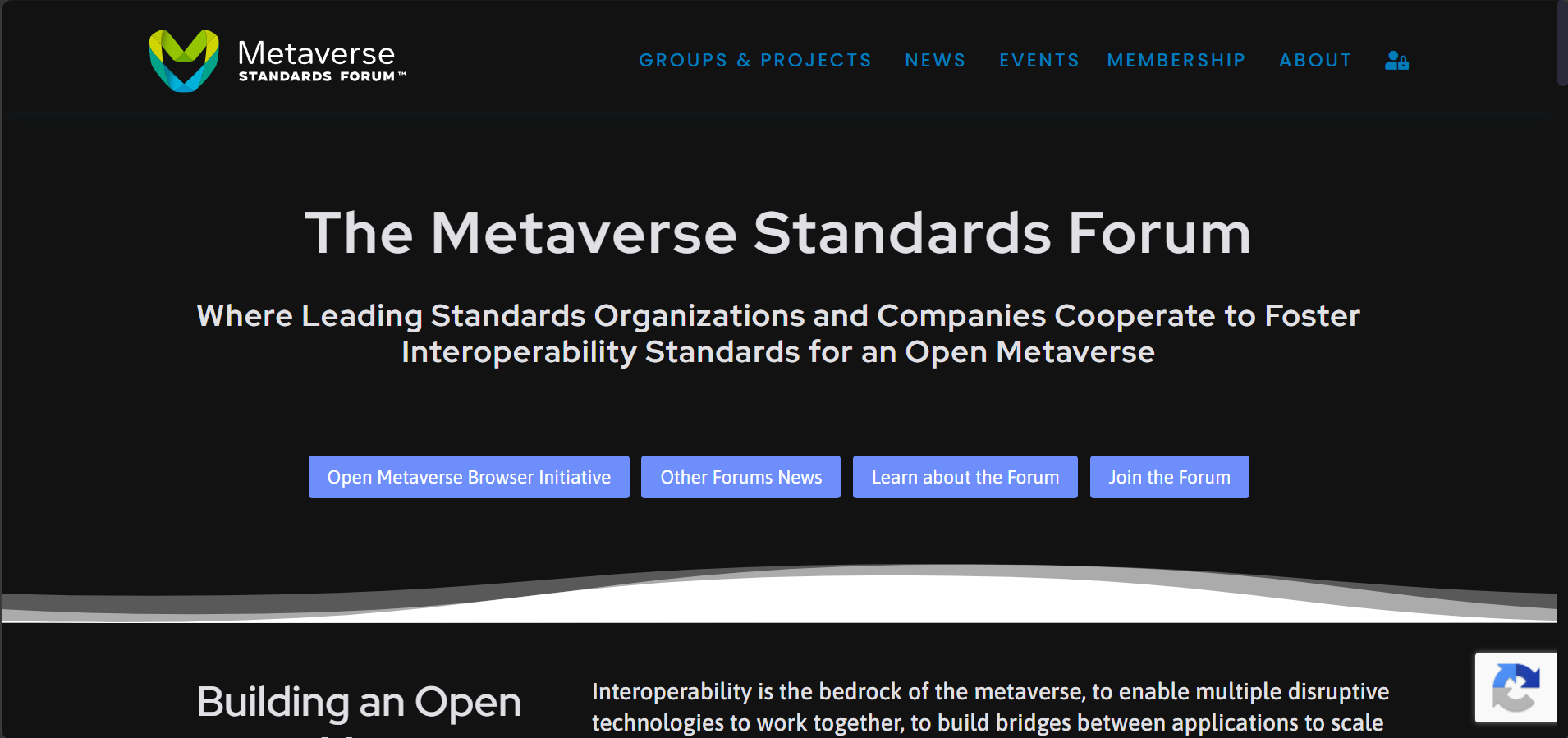
Khronos defines OpenXR as a royalty-free open standard for multiple AR and VR devices, reducing the need for developers to support each hardware platform separately. Source: Khronos OpenXR The Metaverse Standards Forum coordinates standards organizations and companies to advance interoperability in 3D assets, XR, safety, and spatial computing. Source: Metaverse Standards Forum
What Are the Practical Applications of the Metaverse?
The metaverse offers value beyond entertainment. Persistent three-dimensional spaces, real-time collaboration, and digital identity can support games, performances, education, industrial design, remote meetings, medical training, cultural exhibitions, and digital twins. Each use case has different requirements for immersion, data security, and economic systems.
Gaming and social activity: Players explore, compete, build, host events, and form long-term communities together.
Virtual performances: Musicians and brands can host interactive events unconstrained by physical venue capacity.
Education and training: Learners can complete experiments, maintenance, medical, and safety training in 3D environments.
Design and manufacturing: Engineering teams use digital twins to observe equipment, factories, and cities.
Remote collaboration: People in different locations can discuss and manipulate shared 3D models.
Culture and exhibitions: Museums, artists, and communities can build persistently accessible digital galleries.
Retail and marketing: Users can try on virtual goods, inspect 3D products, and participate in branded interactive experiences.
Not every application needs a token or NFT. Industrial simulation prioritizes data accuracy, permissions, and system integration, while games and creator platforms focus more on content, social activity, and digital goods. Technology choices should serve specific needs rather than add complexity merely to adopt a popular concept.
What Major Problems Does the Metaverse Face Today?
The metaverse remains in an era of multiple platforms and evolving standards. Hardware cost, motion sickness, insufficient content, network latency, and closed ecosystems all constrain adoption. Blockchain virtual worlds must also address asset speculation, low liquidity, wallet scams, and economic imbalance. Users should not equate a technology vision with the capabilities of today's products.
Weak user retention: People attracted by land sales, airdrops, or one-off events may not return over the long term.
Device barriers: High-performance computers, VR headsets, and stable networks raise participation costs.
Expensive content production: High-quality 3D scenes, animation, and multiplayer systems require long-term development and maintenance.
Isolated ecosystems: Accounts, avatars, assets, and social relationships are difficult to move across platforms.
Economic speculation: Land and token prices may detach from real demand, creating bubbles and risk of loss.
Privacy risk: Gaze, body movement, voice, and spatial maps may reveal more information than ordinary websites collect.
Complex governance: Platforms, communities, creators, and asset holders may have conflicting interests.
Legal uncertainty: Rules for digital assets, tax, copyright, labor, and child protection vary by jurisdiction.
How Can You Decide Whether a Metaverse Project Is Worth Trying?
Evaluate a metaverse project by entering and using the product before looking at land or token prices. A sustainable virtual world needs a reliable entry point, ongoing content, real users, creation tools, and clear rules. On-chain assets can improve openness but cannot replace product quality and community governance.
Check product status: Determine whether it is launched, in open or closed testing, or only a concept demonstration.
Try the core activity: Ask whether its social, gaming, creative, or collaborative activity remains valuable without rewards.
Observe the real community: See whether users keep creating, communicating, and returning after events end.
Study creator tools: Confirm whether ordinary creators can make, publish, price, and earn from content.
Verify the economic loop: Analyze asset use, supply, consumption, platform revenue, and creator shares.
Review governance rules: Learn whether the platform can ban accounts, change item uses, or restrict trading.
Confirm security boundaries: Review wallets, contracts, marketplaces, cross-chain bridges, and privacy policies.
Start small: Do not buy expensive land or virtual assets before understanding their practical use and exit liquidity.
What Is Hotcoin's Seven-Layer Metaverse Analysis Model?
Hotcoin Learn's seven-layer metaverse analysis model turns an expansive concept into a product structure that can be examined. Users can work downward from the entry layer and ask whether devices are usable, content is sustainable, networking is stable, identity is trustworthy, the economy is balanced, governance is clear, and standards are open.
Entry layer: Devices, displays, tracking, and natural interaction determine how easily users can enter.
Content layer: 3D scenes, game engines, physics, and creation tools determine whether a world is worth staying in.
Computing layer: Networks, cloud computing, servers, and edge nodes determine whether multiplayer experiences remain stable.
Identity layer: Accounts, avatars, relationships, reputation, and credentials determine who a user is.
Economic layer: Payments, assets, markets, income, and sinks determine how value flows.
Governance layer: Platform rules, community decisions, security, privacy, and dispute resolution determine how the world is managed.
Standards layer: Device interfaces, 3D formats, identity, and asset protocols determine whether different worlds can connect.
A project with only land and tokens but no content or user retention is closer to a digital-asset market. One with many users and abundant content but entirely closed identities and assets is a centralized virtual world. The long-term goal of an open metaverse is to gradually increase user control and interoperability on top of a usable product, not to skip the first six layers and emphasize only on-chain assets.
Metaverse FAQ
21.1 Do I Need a VR Headset to Enter the Metaverse?
No. Many virtual worlds support phones, computers, and game consoles; VR is only one way to increase spatial immersion. The need for a headset depends on the product. Beginners should first explore content and communities with devices they already own, then decide whether dedicated hardware is worthwhile.
21.2 Must the Metaverse Use Blockchain?
No. Centralized databases can support persistence, real-time multiplayer, identity, creation, and economic systems. Blockchain is mainly used for open assets, wallet identity, smart contracts, and community governance. A project should use it only when it genuinely needs public ownership records and cross-application composability.
21.3 How Does the Metaverse Differ from an Online Game?
Online games usually revolve around victory conditions, missions, and content loops established by developers. The metaverse emphasizes persistent social spaces, user creation, diverse activities, and long-term economies. The boundary is not absolute, however, and a large online game may gradually develop metaverse characteristics.
21.4 Can Buying Metaverse Land Make Money?
There is no guarantee. Virtual land's value depends on platform users, location and utility, the owner's ability to build, event traffic, and market liquidity. Supply policies, platform popularity, and broader market changes can all reduce its price. Buying land does not automatically produce rent, traffic, or business income.
21.5 Can an NFT Be Used in Every Metaverse?
Usually not today. NFT standards can prove token ownership but do not automatically solve model formats, skeletal animation, combat statistics, copyright, or moderation. The destination platform must recognize the NFT and design a use for it before the asset can meaningfully appear in another world.
21.6 Do Users Own Their Digital Assets in the Metaverse?
Check both the asset record and platform terms. An on-chain NFT can be held in a user's wallet, while the related model, brand, copyright, and game functionality may remain under the project's control. Centralized items normally depend entirely on the platform account. Owning a token does not mean owning its intellectual property or receiving a promise of permanent service.
21.7 Will the Metaverse Replace the Real World?
It is more likely to supplement and connect real-world activity than replace it. Games, remote collaboration, education, design, and digital twins can reduce some spatial constraints, but physical production, legal relationships, human contact, and public services still depend on real society.
How Can You Manage Metaverse Assets with a Web3 Wallet?
Before managing metaverse NFTs, tokens, and identity credentials, verify the project's network, official contracts, and marketplace entry points. Check the domain, signature message, and approval scope before connecting to a virtual world. Never give anyone your seed phrase, private key, or recovery password. It is safer to separate long-term holdings from everyday interactions with different wallets.
You can use Hotcoin Web3 Wallet to manage multichain assets and DApp approvals, or download the Hotcoin App to explore related Web3 services.
Conclusion
The metaverse is not a new world that appeared overnight. It is the result of the long-term convergence of gaming, social platforms, 3D graphics, XR, cloud computing, digital economies, and Web3. Its essence is not wearing a headset or buying virtual land, but enabling users to build identities, create content together, and form functioning social and economic relationships in persistent digital spaces.
A sustainable metaverse needs all seven foundational layers to work together: devices provide access, 3D content gives people a reason to stay, networks enable real-time interaction, identity makes relationships persistent, economics rewards creation, governance keeps communities safe, and open standards gradually connect separate worlds.
To learn more about specific projects, continue with Top Metaverse Projects Explained: Decentraland, The Sandbox, and Otherside.
Visit the Hotcoin website for more educational content about GameFi, the metaverse, NFTs, and Web3.
Risk warning: This article is for education and information only and does not constitute investment, legal, or tax advice. Metaverse tokens, NFTs, and virtual land can be highly volatile and involve risks including limited liquidity, platform shutdown, rule changes, smart contracts, wallets, privacy, intellectual property, and regional compliance. Conduct independent research and make decisions carefully before participating.
Lettura consigliata
Visualizza altro
service hotcoin.com
producthotcoin.com
businesshotcoin.com
casecnhotcoin.com