
GameFi Models: Play-to-Earn vs Play-and-Earn
What Is the Difference Between Play-to-Earn and Play-and-Earn?
Play-to-Earn puts tradable rewards at the center of the experience, while Play-and-Earn puts gameplay first and treats earnings as an additional outcome. Both models may use tokens, NFTs, and smart contracts, but their design priorities differ: P2E first asks how players can earn, whereas P&E first asks why the game is worth playing over the long term. Neither model guarantees that a player will make a profit.
Play-to-Earn and Play-and-Earn are common product concepts in GameFi, not two mandatory blockchain standards. The same game can also change its positioning over time—for example, using rewards to attract early users, then gradually reducing token emissions while investing more in gameplay, seasons, competitions, and content updates.
If you are new to GameFi, on-chain assets, and token economies, start with GameFi Blockchain Games: A New Play-and-Earn Economy.
What Is Play-to-Earn?
Play-to-Earn, or P2E, is a model in which players earn tokens, NFTs, or other tradable assets by completing tasks, joining battles, improving their rankings, or contributing in-game resources. Players usually connect a Web3 wallet, and some games require them to buy characters, cards, or land first. Whether rewards become real returns depends on market prices, liquidity, and exit costs.
Ethereum describes blockchain games as decentralized applications that let users play and earn rewards, noting that in-game currencies, characters, equipment, and pets can be represented by tokens or NFTs. Source: Ethereum gaming apps directory On-chain records allow rewards to move from a game interface into a wallet, but they do not guarantee that buyers will always exist.
How Does Play-to-Earn Work?
P2E generally follows five stages: investment, gameplay, reward generation, on-chain claiming, and market trading. A player may first invest time or buy assets, then earn in-game points through tasks, competitions, and rankings. After the required conditions are met, those points may be redeemed or minted as on-chain tokens and ultimately transferred or traded through a wallet, marketplace, or exchange.
3.1 What Do Players Need to Invest?
Time: Daily tasks, seasonal objectives, resource gathering, and competitive matches often require sustained activity.
Skill: Ranked play, esports events, and strategy games may distribute rewards according to performance rather than equally.
Assets: Some projects require NFT characters, equipment, or land, while others provide free starter characters.
Capital: Players may pay gas fees, marketplace fees, cross-chain fees, and bid-ask spreads when buying or selling assets.
3.2 Where Do Rewards Come From?
Rewards may come from reserved project tokens, ongoing issuance, player fees, tournament pools, marketplace fees, or ecosystem revenue. These sources differ greatly in sustainability. If rewards depend mainly on newly issued tokens while the game lacks spending, burning, and external income, continuous selling by players can create persistent downward pressure.
3.3 How Do Rewards Reach a Wallet?
Some games send tokens directly to a player's address. Others first record points on a server and allow the player to claim them on-chain after certain conditions are met. The second approach can reduce frequent transactions and gas costs, but players must check review requirements, lock periods, minimum claim amounts, and withdrawal fees. A balance shown in a game interface should not automatically be treated as an asset already received in a wallet.
What Is Play-and-Earn?
Play-and-Earn, or P&E, is a model that prioritizes playability, content, and player retention while adding optional on-chain rewards to the game loop. Players should still receive a complete or nearly complete experience even if they never trade a token or NFT. Earnings are not the sole reason to enter the game; they are additional value created by competitive results, long-term participation, or content contributions.
P&E does not eliminate the game economy. Instead, it returns tokens and NFTs to a role that serves gameplay. On-chain assets may represent skins, characters, achievements, event tickets, or user-generated content, but the project does not need to promise continuously high returns. When ordinary players are willing to pay for entertainment, identity, and social experiences, the economy can depend less on new speculative capital.
Where Do P2E and P&E Differ Most?
The biggest difference is not whether rewards exist, but where rewards sit in a player's decision-making. A P2E user may calculate the payback period before deciding whether to enter. A P&E user usually asks whether the game is worth playing before deciding whether to trade assets. The first model can acquire yield-seeking users quickly; the second emphasizes long-term content and organic demand for in-game spending.
Motivation to enter: P2E highlights obtainable tokens or NFTs; P&E highlights gameplay, content, social interaction, and competition.
Role of rewards: P2E places rewards in the core loop; P&E makes them a supplement to progress, performance, or contribution.
User mix: P2E more readily attracts yield-focused players; P&E aims to serve both ordinary players and users of on-chain assets.
Economic dependence: P2E may depend on token prices and new users; P&E places more weight on in-game spending and retention.
Product evaluation: P2E is often judged by reward efficiency; P&E is more often judged by gameplay quality, content depth, and sustained updates.
Why Did Early GameFi Commonly Use P2E?
Early GameFi projects adopted P2E because tradable rewards could quickly create a user-growth loop. Projects distributed tokens, rising token prices attracted more users, and purchases of characters or equipment by those users increased demand for assets. This model spread efficiently during market expansion, but when user growth slowed, reward selling could exceed in-game demand and reverse the cycle.
P2E also showed players in different regions that game time might be converted into digital income, and it encouraged NFT rental, guild, and scholarship models. Yet early success stories do not prove that every blockchain game can reproduce the same outcome. Entry costs, player skill, local income levels, and token-market cycles all affect the actual experience.
Why Are P2E Economies Prone to Inflation?
P2E inflation usually occurs when reward tokens are produced faster than they are consumed for an extended period. Daily tasks continually create new tokens, and players tend to sell what they earn. If character upgrades, crafting, tickets, and other forms of spending cannot absorb supply, sell-side pressure keeps growing. When token prices fall, projects may raise rewards to remain attractive, amplifying inflation further.
7.1 What Is Token Production?
Token production includes daily tasks, competitive rankings, seasonal rewards, staking, airdrops, and guild incentives. Researchers should examine daily issuance, claim restrictions, team unlocks, and authority to change rewards—not only maximum supply. A game can impose a cap or dynamic emissions, but if the team has complete control over rule changes, players still bear policy-change risk.
7.2 What Is Token Consumption?
Token consumption includes character development, equipment crafting, attribute upgrades, event tickets, repairs, combining assets, and burns. Effective sinks should come from gameplay that players genuinely want, not compulsory payments made only to continue earning rewards. If the only purpose of spending is still to produce more tokens, the economic model may merely postpone rather than resolve the supply-demand imbalance.
7.3 Why Can New Players Not Be the Only Source of Demand?
If returns to existing players come mainly from new players buying entry NFTs or tokens, the economy becomes highly dependent on continuous growth. When user growth slows, entry demand falls while existing players continue to produce and sell rewards, placing rapid pressure on asset prices. A sustainable game needs demand from entertainment, competition, social interaction, and content consumption—not only expectations of recovering an initial investment.
What Does Axie Infinity's Dual-Token Model Show?
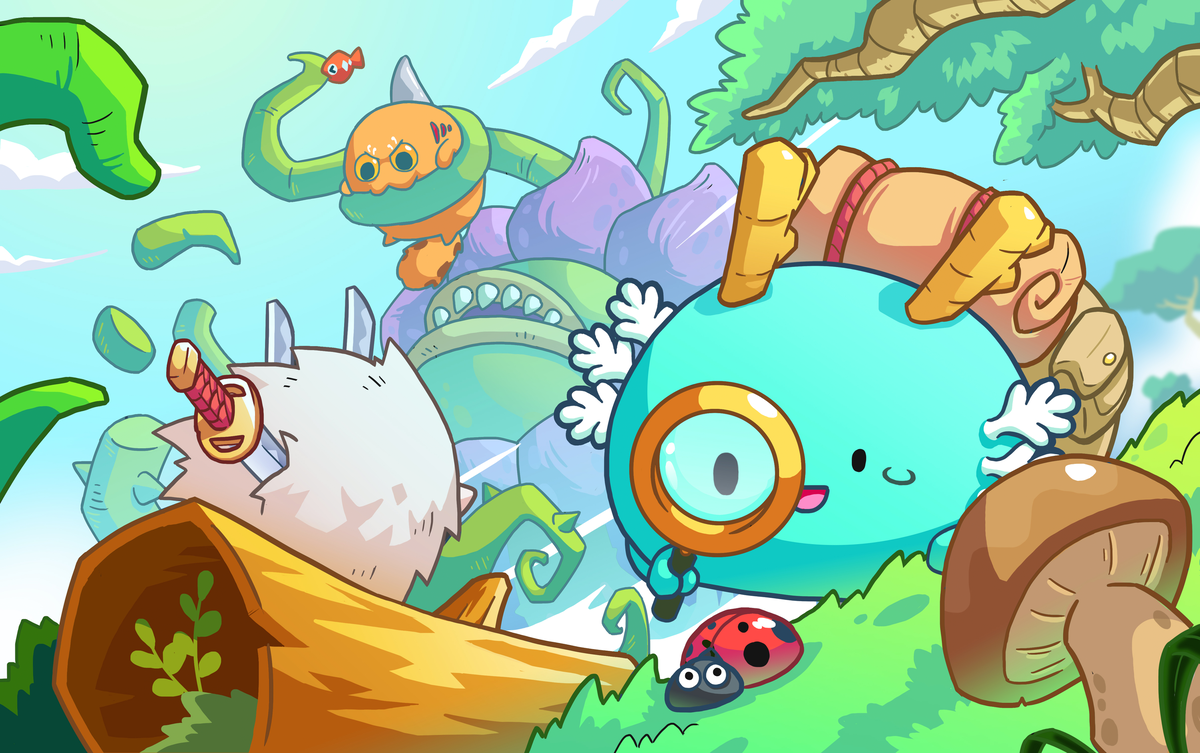
Axie Infinity uses AXS for ecosystem and governance-related functions, while SLP has long been used for game rewards and activities such as breeding Axies. A dual-token design can separate governance value from frequently used game resources, but it does not automatically remove economic risk. Reward tokens still need sufficient sinks, while governance tokens remain exposed to market prices, unlocks, and ecosystem demand.
Axie Infinity's official whitepaper explicitly discusses SLP and AXS supply and demand in its explanation of economic sustainability. It notes that game features and resource consumption are needed to manage the Axie population and token economy. Source: Axie economy and long-term sustainability
How Should Play-to-Earn Returns Be Calculated?
P2E returns should be based on realizable sale value, not simply the number of tokens displayed in a game. From the value of claimed and tradable rewards, a player must subtract entry assets, gas fees, marketplace fees, cross-chain fees, equipment consumption, and exit discounts. To calculate returns on time, the player should also account for hours spent and opportunity cost.
Suppose a player buys an entry asset worth 100 USDT and earns rewards quoted at 30 USDT in one month. Claiming and selling cost 5 USDT, while the NFT falls by 20 USDT over the same period. The net change on paper is only 5 USDT, before accounting for time. If the reward lacks buyers, the displayed price may not represent the amount that can actually be realized.
9.1 Why Is Token Quantity Alone Insufficient?
Receiving 1,000 tokens does not represent a fixed amount of value. Real value depends on price, liquidity, and sell-side depth. When a project changes rewards or many players sell at once, token quantities may increase while their fiat value falls. A return record should include the number of tokens, claim time, price at the time, trading costs, and final execution value.
9.2 Why Must Changes in NFT Value Be Included?
Some P2E games require players to purchase NFT characters or equipment. Even if reward income is positive, a decline in the entry NFT's market price can leave the overall position at a loss. Players should also inspect the gap between the floor price and the highest bid: the lowest listing does not mean the asset can be sold immediately, and exit discounts may widen sharply when buyer demand is weak.
How Can Play-and-Earn Improve Economic Sustainability?
P&E reduces the weight of rewards in player motivation, making the token economy more dependent on genuine demand for the game. A project can offer free play, non-tradable starter characters, and low-friction embedded wallets, then reserve limited rewards for competitive performance, rare achievements, content creation, or community contributions. This approach cannot eliminate market risk, but it can reduce the pressure to maintain daily activity through continuously high issuance.
Free entry: Let users try the core game before requiring every new player to buy an expensive NFT.
Skill-based rewards: Allocate limited rewards to competitions, rankings, and difficult challenges instead of repetitive tasks.
Content rewards: Encourage maps, skins, mods, streams, and tutorials that bring external value into the ecosystem.
Non-financial progression: Use levels, titles, bound achievements, and story content to provide growth that cannot be sold directly.
Selective use of blockchain: Put only assets that need ownership, trading, or composability on-chain, reducing unnecessary signatures and transaction costs.
Does Putting Game Assets On-Chain Make Rewards More Valuable?
Moving assets on-chain can make ownership records, supply, and transaction history more verifiable, but it does not automatically create market demand. An NFT can prove which wallet owns an item and support external marketplaces and third-party tools. If the game is not enjoyable, the project stops operating, or other players do not need the item, the on-chain asset may still have little utility or liquidity.
Players must also distinguish token ownership from game services. Owning a character NFT does not guarantee permanent access to servers, matchmaking, story content, or updates, nor does it grant copyright in the artwork. For the legal and technical boundaries of on-chain items, read On-Chain Game Assets: Why Your Game Items Should Be On-Chain.
Why Are GameFi Projects Shifting from P2E to P&E?
More GameFi projects emphasize P&E because acquiring users solely through high returns tends to create short-term participation and heavy token selling. Long-term value in games comes from content, community, competition, and player relationships—not perpetual subsidies. Treating earnings as an extra feature helps teams change their product metric from “How quickly can I break even?” to “Is this fun, and would players keep spending over time?”
This shift is also supported by better wallet experiences and more mature game infrastructure. Embedded wallets, sponsored gas, account abstraction, and mobile SDKs can move complex on-chain actions into the background so players unfamiliar with cryptocurrency can enter the game first. Blockchain functions then appear only when ownership, trading, or open composability adds real value, which better matches the habits of mainstream players.
How Can You Judge Whether a Reward Model Is Healthy?
A healthy reward model must answer three questions: What value supports the rewards? Why are players willing to spend? Would they continue playing if rewards decline? If a project can only display token appreciation and high annualized returns but cannot explain its content, retention, and token sinks, it may be placing financial incentives ahead of product demand and have a less stable economy.
13.1 Hotcoin's Five-Point P&E Checklist
Gameplay retention: After rewards fall, do core players still want to battle, socialize, collect, or create?
Reward source: Do rewards come from new issuance, player fees, tournament revenue, or genuine product income, and are the rules transparent?
Demand for spending: Can tokens be used for upgrades, tickets, crafting, and content that players genuinely need, rather than circular mining?
Exit liquidity: Are there real bids for the tokens and NFTs, and are market depth and transaction costs reasonable?
Authority to adjust: Can the team change production, consumption, withdrawals, and lockups at any time, or is governance meaningfully constrained?
Of the five points, gameplay retention determines whether demand can persist without rewards. Reward sources and spending demand determine whether the economy closes its loop. Exit liquidity determines whether paper gains can be realized, while adjustment authority determines how much rule-change risk players bear. If public information is missing for even one item, users should lower return expectations and limit their exposure.
How Should Beginners Participate in Play-to-Earn Games?
Beginners should start with a free or low-cost model, test both the gameplay and claim process, and only then decide whether to buy an NFT. Do not estimate payback periods from the highest returns shown on social media, and do not download clients or connect wallets through private-message links. For a first attempt, use a separate wallet with a small balance so game interactions remain separate from long-term asset storage.
Confirm the official entry point: Enter through the game's official site and verified accounts, and check the domain and contract addresses.
Check entry conditions: Confirm whether the game is free, whether an NFT is required, and which network and gas token it uses.
Read the reward rules: Review production caps, season dates, claim conditions, lock periods, and withdrawal fees.
Try the core gameplay: First determine whether the game is stable, genuinely live, and receiving continued content updates.
Calculate full costs: Include entry assets, gas fees, other fees, time, and possible exit discounts.
Test a small claim: Complete one small claim and sale to verify the wallet, network, and market process.
Review approvals regularly: Revoke smart contract permissions that are no longer needed after you stop using a game.
What Are the Main Risks of Play-to-Earn?
P2E combines game-operation, token-price, NFT-liquidity, and smart-contract risks. A project can change reward and withdrawal rules, while tokens may fall rapidly because of inflation or broader market conditions. Even if players keep receiving rewards, balances on a screen cannot become real returns when assets cannot be sold or transaction costs exceed income.
Token inflation: Rewards issued too quickly without enough consumption may keep token prices under pressure.
Misleading payback claims: Estimates may use historical highs for future returns while ignoring reward changes and asset-price movements.
NFT depreciation: Falling prices for entry characters or equipment may offset all in-game rewards.
Insufficient liquidity: A floor price is not the highest bid, and unpopular assets may remain unsold for a long time.
Rule changes: Teams may change output, withdrawals, seasonal rewards, and the range of usable assets.
Wallet security: Malicious clients, phishing sites, or unlimited approvals may put other on-chain assets at risk.
Axie Infinity's current SLP documentation shows that game resources and on-chain tokens pass through distinct claiming, depositing, and use stages. This illustrates why an “in-game balance” and “wallet assets” should not be treated as the same state. Source: Sky Mavis SLP guide

Play-to-Earn and Play-and-Earn FAQ
16.1 Can Play-to-Earn Really Make Money?
P2E may generate token or NFT rewards, but it cannot guarantee a net profit. Real returns must subtract entry assets, gas fees, marketplace fees, time costs, and asset depreciation, while also confirming that rewards can be claimed and sold into genuine bids. Any payback period calculated from fixed prices and fixed rewards can fail as rules and markets change.
16.2 Does Play-and-Earn Avoid Issuing Tokens?
Not necessarily. P&E can also distribute tokens or NFTs; rewards simply are not the game's only focus. A project may concentrate rewards in seasonal rankings, competitions, rare achievements, and user-created content, while ordinary players can still experience the main game without connecting a wallet or trading assets. The details depend on each game.
16.3 Is a Dual-Token Model Always Safer Than a Single Token?
No. Two tokens can separate governance from frequently distributed rewards, but they cannot automatically create demand. If a reward token keeps expanding while sinks remain insufficient, its price can still fall. A governance token may also face team unlocks and market volatility. Risk assessment should examine the supply, utility, and holder distribution of each token.
16.4 Is a Free-to-Play GameFi Project Risk-Free?
Free entry can reduce financial loss, but it may still involve time costs, wallet approvals, privacy concerns, and phishing. Some games require asset purchases, bridging, or fees at later stages. Players should download clients through official channels and test with a separate wallet rather than relaxing signature and contract checks just because entry is free.
16.5 Is P2E or P&E Better for Long-Term Development?
Long-term success depends more on gameplay, content, player retention, and a healthy economy than on the label itself. P&E generally emphasizes the game first, but using the term does not make a product sustainable. Whatever its positioning, a project should be evaluated through reward sources, token sinks, active players, development progress, asset liquidity, and team control.
How Can You Use a Web3 Wallet for GameFi?
Before connecting to a GameFi project, confirm which networks and wallets it supports and enter through an official page. Signing a login message usually does not transfer assets, but claiming rewards, buying NFTs, or approving a marketplace may trigger on-chain transactions. Check the contract, token amount, and approval scope for every action, and never give anyone your private key, seed phrase, or recovery password.
You can use Hotcoin Web3 Wallet to manage multichain assets and interact with DApps, or download the Hotcoin App to explore related Web3 services.
Conclusion
Play-to-Earn demonstrated that game time and on-chain assets can form a new economic relationship, but it also exposed problems such as inflation, dependence on user growth, and insufficient liquidity. Play-and-Earn does not abandon earnings entirely. It makes gameplay, content, and player demand the economic foundation again, then places tradable rewards where they add suitable value.
When evaluating a GameFi model, do not focus only on its label. Examine why players enter, where rewards come from, how tokens are consumed, and whether assets can be exited. For beginners, trying the game for free, testing a claim, and only then deciding whether to invest is safer than buying an expensive NFT based on advertised returns.
Visit the Hotcoin website for more educational content about GameFi, NFTs, and Web3.
Risk warning: This article is for educational and informational purposes only and does not constitute investment, legal, or tax advice. GameFi tokens and NFTs may be highly volatile and involve insufficient liquidity, changing reward rules, project shutdowns, smart contract vulnerabilities, and phishing. Conduct independent research and make decisions cautiously before participating.
Lettura consigliata
Visualizza altro


Service@hotcoin.com
Product@hotcoin.com
Business@hotcoin.com
Casecn@hotcoin.com