
Everything You Need to Know About the CLARITY Act and Digital Assets
The CLARITY Act is a proposed U.S. legislative framework intended to provide clearer rules for regulating digital assets and cryptocurrency markets. For years, blockchain companies, cryptocurrency exchanges, developers, and investors have faced uncertainty over which federal regulator oversees different types of digital assets. The legislation aims to establish a more predictable market structure by clarifying regulatory responsibilities while promoting innovation and strengthening investor protection. Although the bill remains subject to the legislative process, it represents one of the most significant efforts to modernize digital asset regulation in the United States.
Why Was the CLARITY Act Introduced?
The rapid growth of cryptocurrencies has exposed gaps in the United States' existing financial regulatory framework. Traditional securities and commodities laws were developed long before decentralized blockchain networks and tokenized assets became part of the global financial system. As a result, many cryptocurrency businesses have struggled to determine which regulations apply to their products and services.
One of the biggest sources of uncertainty has been the differing interpretations of digital assets by federal regulators. In some situations, the U.S. Securities and Exchange Commission (SEC) has viewed certain digital tokens as securities, while the Commodity Futures Trading Commission (CFTC) has asserted jurisdiction over digital assets considered commodities. This overlapping authority has led to legal disputes, inconsistent enforcement actions, and uncertainty for companies attempting to operate within the law.
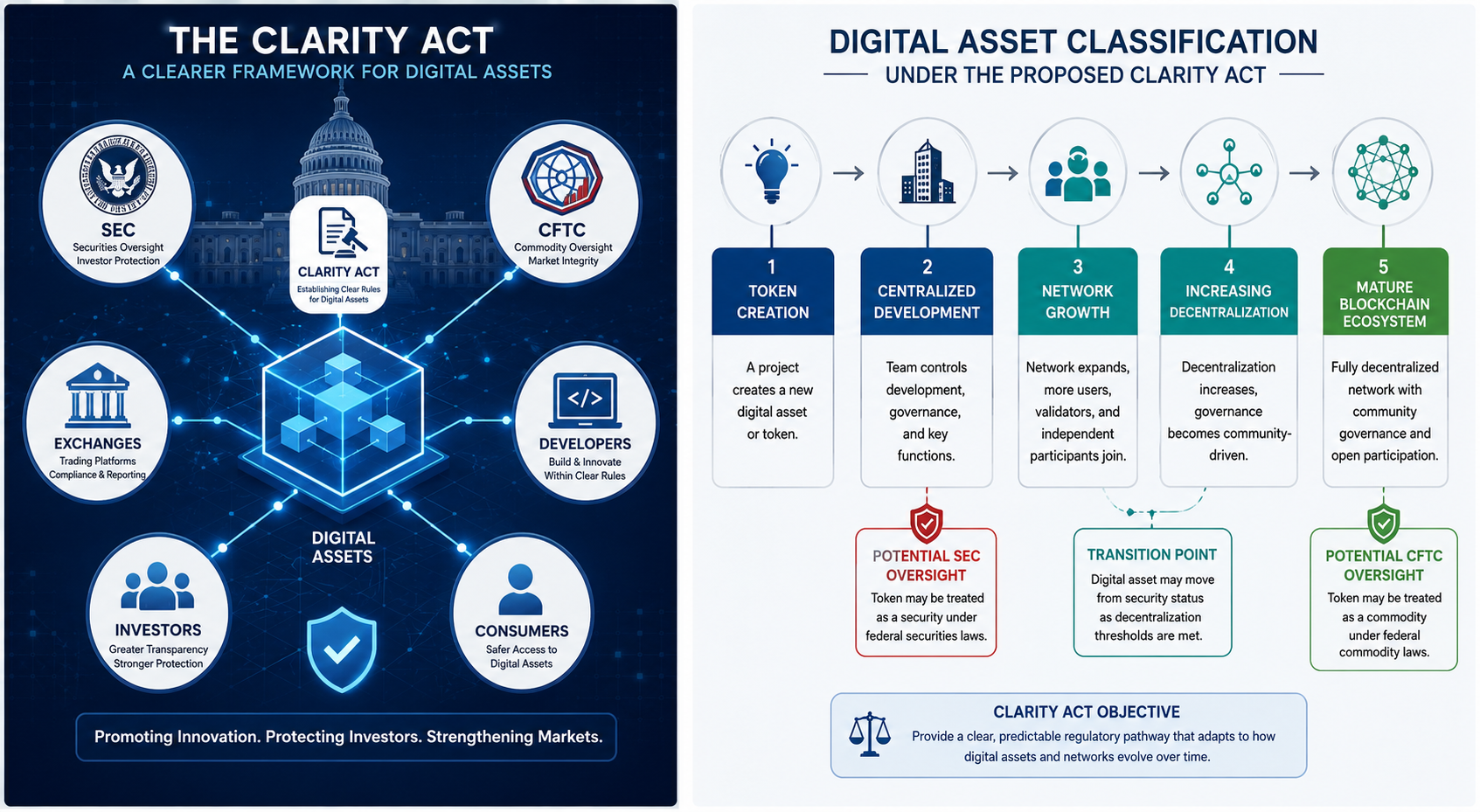
The CLARITY Act was introduced to address these long-standing issues by creating a clearer digital asset market structure. Rather than replacing existing securities laws, the proposal seeks to define how digital assets should be regulated throughout their lifecycle, particularly as blockchain networks become more decentralized. Supporters argue that clearer regulations could encourage responsible innovation while improving market integrity and investor confidence.
How Does the CLARITY Act Regulate Digital Assets?
The central purpose of the CLARITY Act is to establish a more consistent framework for digital asset laws in the United States. Instead of leaving regulatory decisions to case-by-case enforcement, the legislation attempts to provide objective criteria for determining how digital assets should be treated under federal law.
As blockchain projects evolve, many begin as centrally managed initiatives before gradually becoming decentralized networks supported by independent participants. Existing regulations have not always accounted for this transition, creating uncertainty regarding whether a token should continue to be regulated as a security or fall under a different regulatory category. The CLARITY Act seeks to introduce a structured approach that recognizes these changes while maintaining investor protections.
The proposal also emphasizes greater transparency and accountability. By establishing clearer disclosure expectations and regulatory responsibilities, lawmakers hope to reduce compliance uncertainty for blockchain companies while improving public confidence in digital asset markets. This approach reflects a broader effort to modernize cryptocurrency legislation without discouraging technological innovation.
SEC vs. CFTC: Clarifying Regulatory Responsibilities
One of the most widely discussed aspects of the CLARITY Act is its attempt to define the respective roles of the SEC and the CFTC. For years, the lack of clear jurisdiction has created confusion throughout the cryptocurrency industry, particularly for exchanges and token issuers seeking regulatory certainty.
The SEC traditionally oversees securities offerings and enforces investor protection laws. When a digital asset is marketed as an investment contract or represents an ownership interest, it may fall within the SEC's jurisdiction. The CFTC, by contrast, regulates commodity derivatives markets and has historically treated certain cryptocurrencies, including Bitcoin, as commodities under federal law.
The CLARITY Act seeks to reduce this ambiguity by establishing clearer criteria for determining which regulator has primary oversight. Rather than creating an entirely new regulatory authority, the proposal attempts to improve coordination between existing agencies while reducing overlapping enforcement. If implemented successfully, this framework could provide blockchain developers and cryptocurrency exchanges with greater confidence when launching new products and services.
Why the CLARITY Act Matters for Crypto Investors
For individual investors, regulatory uncertainty often translates into increased market risk. When businesses are unsure which laws apply, product launches may be delayed, legal disputes may increase, and investment decisions become more difficult. The CLARITY Act attempts to address these concerns by creating a more transparent regulatory environment.
A clearer framework could also encourage greater institutional participation in cryptocurrency markets. Large financial institutions generally require well-defined regulatory standards before introducing new investment products or expanding digital asset services. Increased institutional involvement could improve market liquidity and encourage broader adoption of blockchain technology.
The legislation is not intended to eliminate cryptocurrency volatility or guarantee investment success. Digital assets remain subject to significant market risks, technological challenges, and macroeconomic factors. However, supporters believe that more predictable regulations may reduce legal uncertainty and create a healthier environment for long-term market development.
How the CLARITY Act Could Impact Blockchain Companies
Blockchain startups frequently encounter regulatory uncertainty during product development, fundraising, and token issuance. Without clear guidelines, companies often devote substantial resources to legal analysis before introducing innovative technologies.
The CLARITY Act seeks to improve this environment by establishing clearer compliance expectations. Developers may gain greater confidence in understanding when registration, disclosure, or reporting obligations apply throughout the development of a blockchain network. Cryptocurrency exchanges could also benefit from more consistent listing standards if regulatory classifications become easier to determine.
For established financial institutions, the legislation could reduce barriers to entering digital asset markets. Banks, investment firms, and payment providers generally prefer operating within clearly defined legal frameworks. Greater regulatory clarity may therefore encourage broader participation while strengthening overall market stability.
The Real Value of Regulatory Clarity
Many discussions about the CLARITY Act focus almost entirely on whether the SEC or the CFTC will oversee digital assets. While jurisdiction is important, the legislation's broader significance lies in its potential to reduce regulatory uncertainty across the entire blockchain ecosystem.
Innovation often slows when legal expectations remain unclear. Entrepreneurs hesitate to launch new products, investors delay funding decisions, and established companies postpone expansion until regulatory obligations become more predictable. In this context, the CLARITY Act is less about choosing a winning regulator and more about creating a framework that allows innovation and compliance to develop together.
Another overlooked aspect is the international impact of U.S. regulation. Because many blockchain companies operate globally, clearer American regulations could influence how other jurisdictions approach digital asset oversight. Although countries will continue developing their own legal frameworks, comprehensive U.S. legislation may contribute to greater international consistency over time.
The Future of Digital Asset Regulation
The CLARITY Act represents only one component of the broader conversation surrounding cryptocurrency regulation in the United States. Future legislation will likely address additional topics such as stablecoins, decentralized finance (DeFi), digital asset custody, tokenized securities, and cross-border compliance.
Regardless of the final legislative outcome, the direction is becoming increasingly clear. Governments worldwide are moving toward more comprehensive oversight of digital asset markets while attempting to preserve technological innovation. Businesses that prioritize compliance, transparency, and responsible governance are likely to be better positioned as regulatory frameworks continue to mature.
Related Article: Quick Guide to the Highly-Controlled Tokens
Frequently Asked Questions
1. Could the CLARITY Act encourage more institutional investment in digital assets?
Potentially, yes. Institutional investors often seek clear regulatory frameworks before entering emerging markets. By reducing uncertainty around how digital assets are classified and regulated, the CLARITY Act could make it easier for banks, asset managers, and other financial institutions to develop cryptocurrency-related products and services. However, investment decisions will still depend on market conditions, risk management, and the final version of the legislation.
2. Does the CLARITY Act apply to decentralized finance (DeFi) platforms?
The CLARITY Act is intended to provide a broader regulatory framework for digital assets, but its application to decentralized finance (DeFi) platforms will depend on the final legislative language and subsequent regulatory guidance. Because many DeFi protocols operate without centralized intermediaries, regulators may evaluate them differently from traditional cryptocurrency exchanges or token issuers.
3. What should cryptocurrency businesses do while the CLARITY Act is still under consideration?
Until the legislation is finalized, cryptocurrency businesses should continue complying with existing federal and state regulations, monitor updates from Congress and regulatory agencies, and seek qualified legal advice when launching new products or issuing digital assets. Preparing for evolving compliance requirements can help organizations adapt more efficiently if new regulatory standards are enacted.
References (Chicago Style)
Congressional Research Service. Digital Assets and SEC Regulation. Washington, DC: Congressional Research Service.
U.S. Securities and Exchange Commission. Crypto Assets and Investor Resources. Washington, DC: SEC.
U.S. Commodity Futures Trading Commission. Digital Assets. Washington, DC: CFTC.
National Conference of State Legislatures. Cryptocurrency and Digital Assets. Washington, DC: NCSL.
The Brookings Institution. The Future of Digital Asset Regulation in the United States. Washington, DC: Brookings Institution.
Disclaimer: This article provides an educational overview of the proposed CLARITY Act. Legislative provisions may change as the bill progresses through Congress, and readers should consult the latest official congressional text and regulatory guidance before relying on any specific legal interpretation.
Lettura consigliata
Visualizza altro
What is a Custodial Wallet and a Non-Custodial Wallet?
Basic Concepts

What is Digital Asset Treasury mNAV?
Basic Concepts

A Quick Overview of the SEC's Regulatory Responsibilities and Policy Developments on Crypto Assets
Basic Concepts

E-mail del servizio clienti
Service@hotcoin.com
feedback sul prodotto
Product@hotcoin.com
cooperazione commerciale
Business@hotcoin.com
Casella di posta giudiziaria
Casecn@hotcoin.com
chi siamo
prodotto
Servire
supporto
©2017-2026