
Decentralized AI: Bittensor (TAO) and the AI Agent Ecosystem
Decentralized AI aims to separate models, inference, data, computing power, and evaluation from a single platform, allowing different participants to provide intelligent services and earn rewards through an open network. Bittensor is a leading example of this direction. Rather than being one unified large model, it is a blockchain that coordinates multiple independent subnets. These subnets can produce inference, computing, storage, forecasting, or other digital commodities. Miners provide results, validators assess quality, and the network distributes rewards according to its mechanisms.
Bittensor's central question is not “how can AI run on-chain?” but “how can open competition continually discover valuable intelligence?” Most model computation still happens off-chain, while the blockchain handles registration, staking, weights, consensus, and incentives. Understanding Bittensor therefore requires examining both its technical service market and token market, without treating subnet prices as a direct measure of AI quality.
As of 2026, Bittensor uses the dynamic TAO mechanism. Every non-root subnet has its own alpha asset and TAO/alpha pool. Participating in a subnet involves more than choosing a validator: users also face subnet asset prices, liquidity, slippage, and mechanism changes. This guide examines network roles, Yuma Consensus, TAO and alpha, AI Agent access, and risk step by step.
For a broader view of AI Agent wallets, machine payments, decentralized computing, and verifiable AI, read AI + Crypto: Where Artificial Intelligence Meets Blockchain.
What Is Decentralized AI?
Decentralized AI describes a group of open-network designs rather than one fixed product. It may distribute model training across nodes, organize GPU and storage capacity into markets, record data permissions and revenue on-chain, or let multiple models compete to answer a request before validators evaluate them and allocate rewards.
Traditional AI platforms usually control models, servers, accounts, and billing under one provider. This can deliver a stable experience and clear responsibility, but service rules, pricing, and access remain dependent on that platform. Decentralized AI attempts to let more providers participate, reduce permanent dependence on one company, and make contributions and settlement more transparent.
“Decentralized” does not mean every component runs on-chain. It is not economical to repeat large-model computation on every blockchain node, and raw data is generally unsuitable for public storage. Practical architectures usually compute off-chain and record identity, stake, evaluation, fees, and result commitments on-chain. To compare decentralized AI with other emerging fields, use the 2025 Web3 Frontier Landscape as a starting point.
What Is Bittensor?
Bittensor is a blockchain built with Substrate technology, and its chain is commonly called Subtensor. It coordinates many subnets, each of which defines a digital commodity and an independent evaluation method. Official documentation lists computing, inference, storage, and prediction as representative commodities, but the network does not require every subnet to provide the same kind of AI service.
Bittensor can be viewed as a “market of intelligence markets.” The base chain supplies registration, wallet, staking, issuance, and consensus tools. Subnet creators determine tasks and scoring methods, miners compete to produce services, validators measure contributions, and stakers use capital to support validators or subnets.
This design allows different experiments to coexist. Text generation, image understanding, and financial forecasting do not need to share one scoring standard, and a failed mechanism does not define the whole network. The more open a subnet is, however, the more carefully users must examine its product, validation method, team permissions, and customer demand.
Why Are Subnets Central to Bittensor?
A subnet is an independent incentive market identified by a netuid. It has a creator, miners, validators, stake, and its own alpha asset. The creator defines what miners should deliver, how validators score it, and certain adjustable parameters. The blockchain does not know what a “good answer” is; it calculates rewards from the submitted weights and network consensus.
A subnet may resemble an open API marketplace. Miners expose service endpoints, validators regularly issue tasks and compare responses, and applications call results through gateways or custom clients. It may also work more like a competition in which participants receive weight based on forecasting, retrieval, or ranking performance.
Subnet capacity and participant slots are not permanent property. Miners and validators register hotkeys and must maintain their positions through ranking, activity, and staking competition. Registration costs, capacity, immunity periods, and validator counts may be affected by chain or subnet parameters, so fixed numbers from older tutorials should not be assumed to remain valid.
Who Creates a Subnet?
Subnet creators define the market rules, including the task, communication protocol, validation logic, and parameters. A sound design must answer what miners produce, how results are measured, how copying, collusion, and metric gaming are resisted, and why end users would want the service.
A creator is not a direct equivalent of a traditional company. Network services may be delivered jointly by open-source contributors, miners, and independent frontends, and creators cannot freely override base-chain rules. However, they still have substantial influence over reward functions and parameters, making code repositories, update histories, permissions, and conflicts of interest important to review.
The most dangerous designs reward metrics that are easy to measure but have little customer value. If speed is the only target, miners may return low-quality answers. If scoring compares only with one centralized model, the network may become an expensive replica. If it relies solely on validator agreement, it may reward shared bias.
What Do Miners Do in Bittensor?
Bittensor miners are not conventional proof-of-work mining machines. They are hotkeys registered on subnets that provide digital commodities. Depending on the subnet, a miner might run model inference, retrieve data, provide storage, generate forecasts, route requests, or complete computation.
Miners must follow the subnet protocol, keep services available, and optimize results for the validation standard. Operators pay for hardware, model licenses, bandwidth, and data. High incentives do not depend on computing power alone: task understanding, model selection, caching, response quality, and anti-cheating capabilities can all affect performance.
Miners also face mechanism risk. A model may lose competitiveness when validation criteria change, low-ranked participants may be deregistered when slots are full, and both reward-asset prices and operating costs can fluctuate. Running a node is a continuously competitive service business, not a fixed-yield product.
How Do Validators Evaluate Miners?
Validators send tasks to miners, collect responses, calculate scores under subnet rules, and submit weights on-chain. A validator needs sufficient effective stake and permission; simply running the software does not grant equal influence.
Evaluation methods determine network behavior. Tasks with clear answers can compare accuracy, speed, and availability. Open-ended generation may rely on reference models, human preferences, several metrics, or consensus among validators. Predictable evaluation data can encourage miners to overfit test sets, while closed validation programs make fairness difficult for outsiders to assess.
Validators are not oracles of truth. Agreement among several validators only shows that they reached consensus using their methods; it does not guarantee that a real-world answer is correct. If validators share the same API, dataset, or code, they can inherit the same source of error.
What Is Yuma Consensus?
Yuma Consensus is the Bittensor mechanism that converts validator weights into miner incentives and validator returns. In simplified terms, validators score miners independently, the system combines those assessments with validator stake to find consensus, weights materially above consensus are limited, and rewards are distributed from the adjusted ranking.
Constraining outlier weights reduces the ability of one validator to exaggerate a miner's score. If a validator identifies a strong miner before it later gains broad recognition, historical relationships represented through bonds may affect future returns. This encourages independent discovery rather than mechanical copying of the majority.
Every consensus system still depends on its inputs. If stake is highly concentrated, validators copy one another, or task metrics are flawed, consensus may consistently reproduce bias. Yuma coordinates distributed evaluation; it does not provide proof of absolute truth.
Subnets may also enable different versions or parameters, including Yuma3 and dynamic bond settings. Anyone researching a specific subnet should inspect current on-chain parameters and official code rather than treating a network-wide description as a fixed configuration for every subnet.
What Role Does TAO Play in the Network?
TAO is the native asset of the Bittensor chain. It is used for transfers, registration-related fees, root-network staking, and entry into subnet asset pools. The network continually issues TAO according to its issuance rules and allocates it to eligible subnets and participants.
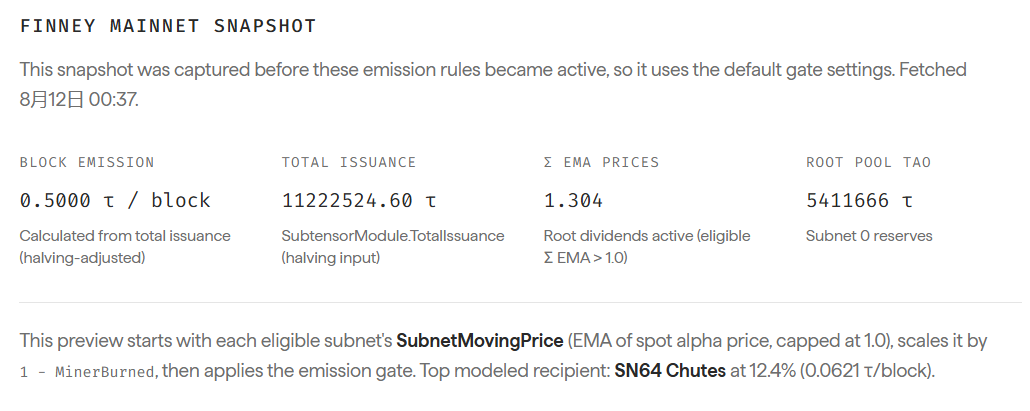
Current official documentation states that TAO has a maximum supply of 21 million. Issuance halves when total-issuance thresholds are reached rather than simply at fixed block heights. The first halving occurred in December 2025, and base issuance is currently 0.5 TAO per block. Recycle mechanisms affect when later thresholds are reached.
A supply cap and halving do not establish value by themselves. Demand for TAO still depends on subnet services, staking, registration, liquidity, and market expectations. Users should distinguish total issuance, circulating supply, pool reserves, and staked positions instead of treating every figure as tokens immediately available for sale.
What Are Dynamic TAO and Alpha?
Dynamic TAO is commonly abbreviated as dTAO. Since the 2025 upgrade, every non-root subnet has its own alpha asset paired with TAO in a subnet pool. Alpha from one subnet is not the same asset as alpha from another, and their quantities cannot be added or compared directly.
When a user stakes TAO in a non-root subnet, the underlying process swaps TAO through the pool for that subnet's alpha and delegates the alpha to a validator. Unstaking reverses the conversion. Pool conditions determine price, large operations create price impact, and additional slippage can occur between transactions.
A subnet's alpha price and smoothed price indicator affect its share of TAO issuance, linking capital allocation with network incentives. The intention is to let markets express demand for different subnets, but prices can also reflect speculation, liquidity, and manipulation rather than objective service quality.
“Staking TAO to a subnet” therefore cannot be understood as exposure only to validator operating risk. The user also holds price exposure to a particular subnet's alpha, and the amount of TAO received on exit depends on the conversion price, fees, and liquidity.
How Does Root-Network Staking Differ from Subnet Staking?
Netuid 0 is the root network. It has no miners, alpha asset, or ordinary validation work. TAO can be staked directly on the root network without passing through a TAO/alpha pool. Under current network rules, root stake may count toward a validator's effective stake across subnets and earn corresponding returns.
Staking in a non-root subnet instead converts TAO into the corresponding alpha while the user chooses both a subnet and a validator. Potential returns relate to subnet issuance, validator performance, validator take, and alpha price, and exiting also carries conversion effects from the pool.
Neither form of staking is a deposit. On-chain rules, returns, validator performance, and asset prices can change, and the protocol has no customer service capable of recovering a lost private key. Users should simulate a transaction, set acceptable price limits, and learn the process with a small amount first.
Why Separate Coldkeys and Hotkeys?
Bittensor wallets separate control of assets from daily operations. A coldkey holds funds and controls staking, transfers, registration, and subnet ownership. A hotkey handles higher-frequency work such as mining, validation, and weight submission.
This separation limits potential losses if an operating server is compromised. Miners and validators need to remain online, so a hotkey may reside in a server environment. The coldkey should generally remain offline and should not be uploaded to cloud storage, messaging tools, or node scripts.
Different names do not create security automatically. Malware can replace payment addresses, fake CLI tools can steal seed phrases, and phishing sites can induce users to transfer or stake incorrectly. Verifying software, checking versions, and backing up keys remain the user's responsibility.
What Role Do AI Agents Play in Bittensor?
The “AI Agent ecosystem” has at least three meanings in Bittensor. First, an Agent can be the commodity offered by a subnet, such as an intelligent service specialized in research, coding, trading analysis, or task planning. Second, an Agent can act as a consumer that discovers subnets or miners and selects services according to quality, latency, and price.
Third, an Agent can operate the Bittensor chain. Current official SDK and CLI tools expose machine-readable operation catalogs, parameter structures, previews, error codes, and Policy restrictions. These features let an Agent check balances, inspect subnets, simulate fees, and execute operations within explicit amount and netuid limits.
The ability to perform on-chain operations should not be confused with model autonomy. An Agent may prepare staking or transfer plans, but the signing layer should still verify amounts, destinations, fees, and permitted subnets. The preview and Policy concepts in official documentation are intended to limit the impact of a single mistake.
How Does Bittensor Differ from a Regular AI API Platform?
A conventional platform provides models, pricing, accounts, and service levels through one company, giving users a clearly identified supplier. Bittensor separates supply and evaluation among subnets, miners, and validators, allows multiple participants to compete, and coordinates them with on-chain incentives.
An open market may increase choice and resistance to single points of failure, but it also adds complexity. Users must determine which subnet, gateway, miners, and validation standard they are using, while the final service may still be delivered through a centralized frontend. Decentralization should be assessed separately across models, computing, validation, access points, and governance.
The two models can coexist. A miner may use a commercial model as one component, and a traditional application may use a Bittensor subnet as its backend. The relevant question is not the label but whether the system genuinely improves quality, lowers cost, or reduces dependence on a single provider.
How Are Bittensor and DePIN Related?
Bittensor primarily coordinates digital commodities and their evaluation, while DePIN focuses more on real-world devices and physical infrastructure. The fields can intersect in GPU capacity, storage, and edge inference: device networks supply computing resources, Bittensor subnets organize model or service competition, and applications purchase results at the upper layer.
A Bittensor subnet is not automatically DePIN. If miners merely call the same centralized API, the network has not created distributed hardware supply. Conversely, owning many GPU nodes does not guarantee high-quality intelligence. Computing availability and model value need separate verification.
For a full framework covering device contributions, proofs, customer payments, and token rewards, read What Is DePIN? Decentralized Physical Infrastructure Networks.
Can Bittensor Make AI Results Verifiable?
Bittensor validator scoring provides economic evaluation, but it is generally not a cryptographic proof of computation. Multiple evaluators can compare outputs and reduce the power of one platform to decide results, but this does not prove that a model used promised weights or that data was not altered.
Applications needing stronger guarantees may combine zero-knowledge proofs, trusted execution environments, multiparty computation, remote attestation, or repeated execution. Zero-knowledge machine learning may prove that a specified model produced an output for a specified input while hiding some information, but proof cost for large models, model conversion, and data provenance remain difficult.
Economic consensus and cryptographic proof answer different questions. The former asks whom the market believes contributed more; the latter asks whether a specified computation followed the rules. For more on provers, verifiers, and privacy-preserving computation, read Zero-Knowledge Proofs: The Ultimate Solution for Privacy and Scaling.
What Core Challenges Does Bittensor Face?
The first challenge is evaluation attacks. Miners may game benchmarks, copy other responses, or infer validation tasks. Validators may collude, copy weights, or favor related miners. Reward functions need continual updates, but each update also changes participant returns.
The second is concentration of stake and validation. Capital weighting helps resist inexpensive Sybil attacks, but it can give large participants greater influence. Delegators who chase short-term returns can further reinforce popular validators and subnets.
The third is separation between products and tokens. A subnet's alpha price may rise because of expectations and liquidity rather than customer use, while high issuance rewards may temporarily conceal insufficient service revenue. Call volume, external customers, retention, costs, and market price should be examined independently.
The fourth is complexity. TAO, multiple alpha assets, root staking, subnet pools, validator take, registration, and layered keys create a high barrier for new users. Complexity itself increases the risk of mistakes, fake websites, and outdated tutorials.
The fifth is privacy and compliance. Miners may process prompts, code, company data, or personal information. Whether data is retained, where it resides, who can access it, and who bears responsibility for model licensing and outputs cannot be resolved by on-chain incentives alone.
Hotcoin's Six-Dimension SUBNET Framework
The SUBNET checklist can help evaluate a particular subnet. It is not an investment rating.
17.1 S: Service — What Is the Service?
Identify whether miners produce inference, data, storage, or forecasts, who the final customer is, and whether real demand exists without token subsidies.
17.2 U: Utility — Are the Results Useful?
Examine accuracy, latency, reliability, APIs, and application integrations, and distinguish test scores from the actual user experience.
17.3 B: Benchmark — Can Evaluation Be Manipulated?
Understand validation tasks, data sources, weight updates, and anti-cheating measures to determine whether miners solve the problem or merely optimize for the metric.
17.4 N: Network — Is Participation Distributed?
Review the concentration of miners, validators, stake, and gateways, and determine whether multiple addresses genuinely represent independent operators.
17.5 E: Economics — Are Incentives Sustainable?
Compare customer fees, operating costs, alpha issuance, validator take, and liquidity to assess whether supply can persist as subsidies decline.
17.6 T: Trust — Where Are the Permissions and Risks?
Check creator parameters, code updates, data privacy, keys, frontends, and model dependencies, and understand how the system can pause and recover after a failure.
How Can Regular Users Explore TAO and Subnets Safely?
First, verify wallets, networks, and subnets only through Bittensor's current official website, documentation, and explorer. The official SDK underwent substantial version changes by 2026, so older commands, domains, and staking instructions may no longer apply.
Second, distinguish TAO from alpha. Every subnet's alpha is a different asset, and equal displayed quantities do not imply equal value. Before staking, unstaking, or moving between subnets, review the simulation result, fees, price impact, and minimum acceptable conversion conditions.
Third, research the subnet before selecting a validator. High returns can come from high issuance, low liquidity, or price volatility, so an annualized figure on an interface is not sufficient. A validator's historical performance does not guarantee future returns.
Fourth, isolate wallets. Keep the coldkey and primary assets offline where possible, use only the necessary hotkey on a node, start with a small amount, and never enter a seed phrase into a website, chatbot, or supposed customer-support tool.
Fifth, understand the exit. Alpha must be converted through a pool back into TAO, and market volatility and large transactions can affect the outcome. On-chain staking does not protect principal and carries no platform-promised fixed redemption price.
Frequently Asked Questions
19.1 Is Bittensor an AI Large Language Model?
No. It is a blockchain network that coordinates multiple subnets. Different subnets and miners provide the models, data, and services, so their quality and purpose must be assessed individually.
19.2 Are TAO and Subnet Alpha the Same Token?
No. TAO is the chain's native asset, while every non-root subnet has a distinct alpha asset. Staking in a subnet involves conversion between TAO and that alpha, so price, fees, and slippage can all affect the result.
19.3 Do Miners Need GPUs?
It depends on the subnet task. Large-model inference may require GPUs, while retrieval, data, routing, or lightweight prediction may use other resources. Operating costs should be calculated for the specific subnet.
19.4 Can Validator Scores Guarantee That AI Answers Are True?
No. Scoring can create economic consensus and compare performance, but it still depends on tasks, data, and validation logic. Real-world facts may require external data, human review, or cryptographic proofs.
19.5 Does Staking TAO Guarantee a Fixed Return?
No. Reward rules, validator performance, subnet issuance, alpha prices, liquidity, and fees can all change. Exiting a non-root subnet also carries conversion-price risk.
19.6 Can an AI Agent Manage a Bittensor Wallet Automatically?
It can perform supported actions through SDKs or tools, but permissions should be restricted with previews, amount limits, permitted-subnet scopes, and human confirmation. An Agent should never receive the main wallet's seed phrase.
19.7 Does Having More Bittensor Subnets Make the Network More Valuable?
Not necessarily. More subnets mean more experiments, but they can also create duplicate services and competition for subsidies. Effective users, service quality, independent supply, and sustainable payment matter more.
Conclusion: Bittensor Is an Intelligence-Market Experiment, Not an Automatic Truth Machine
Bittensor divides decentralized AI into competitive subnet markets. Creators define commodities and rules, miners supply services, validators evaluate contributions, stakers support the network with capital, and Subtensor records weights and allocates incentives. Dynamic TAO further connects each subnet's alpha, market demand, and share of issuance.
The design is innovative because it lets different intelligent commodities compete in parallel, while exposing difficult questions more clearly: who defines quality, how collusion can be prevented, whether prices represent use, and who continues supplying services when subsidies fall. Yuma Consensus can coordinate evaluation, but it cannot replace real customers, independent data, or cryptographic proofs.
For developers, Bittensor offers tools for building open intelligence-service markets. For users, it combines AI product risk, validation-mechanism risk, and multi-asset market risk. A prudent research order is to examine subnet services and evaluation first, participants and customers second, and TAO, alpha, and returns last.
Return to the 2025 Web3 Frontier Landscape to place Bittensor, AI + Crypto, DePIN, oracles, and verifiable computation within one framework.
To connect to Web3 applications with a standalone wallet, use Hotcoin Web3 Wallet. For mobile market data and trading tools, download the Hotcoin App. For more educational content, visit Hotcoin.
Risk warning: This article is for education and information only and does not constitute investment, legal, node-operation, or tax advice. Bittensor SDKs, subnets, parameters, TAO and alpha issuance, staking pools, validators, fees, and project status can change rapidly. Verify the latest official documentation, on-chain parameters, wallet signature details, and local rules before participating, and commit only funds you can afford to lose.
Lettura consigliata
Visualizza altro

Service@hotcoin.com
Product@hotcoin.com
Business@hotcoin.com
Casecn@hotcoin.com