
DAO Types: Protocol DAOs, Investment DAOs, Social DAOs, and Service DAOs
A DAO is not a single, fixed product. Some DAOs manage DeFi protocols and public-chain parameters; some pool capital to invest in projects; some build communities around culture and membership; and others operate like distributed studios that deliver development, design, and research services. They may all use wallets, proposals, voting, or on-chain treasuries, but their goals and risks are fundamentally different.
The central question for a protocol DAO is “who may change public software?” An investment DAO asks “who may allocate shared capital?” A social DAO addresses “why do members gather, and how do they create a culture together?” A service DAO must answer “who delivers the work, how is it priced, and how is revenue distributed?” Looking only at whether an organization issues a governance token makes it easy to confuse these four types.
These names are widely used functional categories, not mutually exclusive legal definitions. One DAO may govern a protocol, distribute ecosystem grants, and organize professional services at the same time, or it may change its focus as it develops. Before reading further, see the Complete Guide to Decentralized Autonomous Organizations for an introduction to members, proposals, voting, treasuries, and execution.
Why Distinguish Between DAO Types?
A DAO’s governance design must serve the work it actually performs. An organization managing billions of dollars in protocol assets needs strict proposal thresholds, timelocks, and emergency controls. A fifty-person cultural community cares more about admission, events, and the member experience. A service team needs quick quotes and a clearly accountable project lead. Copying the same “one token, one vote” rule into every organization often creates inefficiency or loss of control.
Distinguishing between types helps answer five questions: what qualifies someone to join, where the organization’s money comes from, which matters require a vote, who executes decisions, and who bears responsibility when something fails. It also helps users identify a token’s real function. Governance tokens, investment interests, membership credentials, and contribution points should not be treated as the same asset.
Classification is not about attaching a marketing label. It is about identifying the organization’s primary trust boundary. A project calling itself a protocol DAO may still leave core upgrades under a company-controlled multisig. A social DAO may earn most of its income from token trading. Judge the organization by its actual permissions, cash flows, and historical behavior.
What Is a Protocol DAO?
A protocol DAO is a governance organization built around a blockchain, DeFi application, Layer 2 network, or other form of public software. Members use governance tokens, delegation, or representative systems to decide protocol upgrades, risk parameters, fees, treasury policy, and ecosystem incentives.
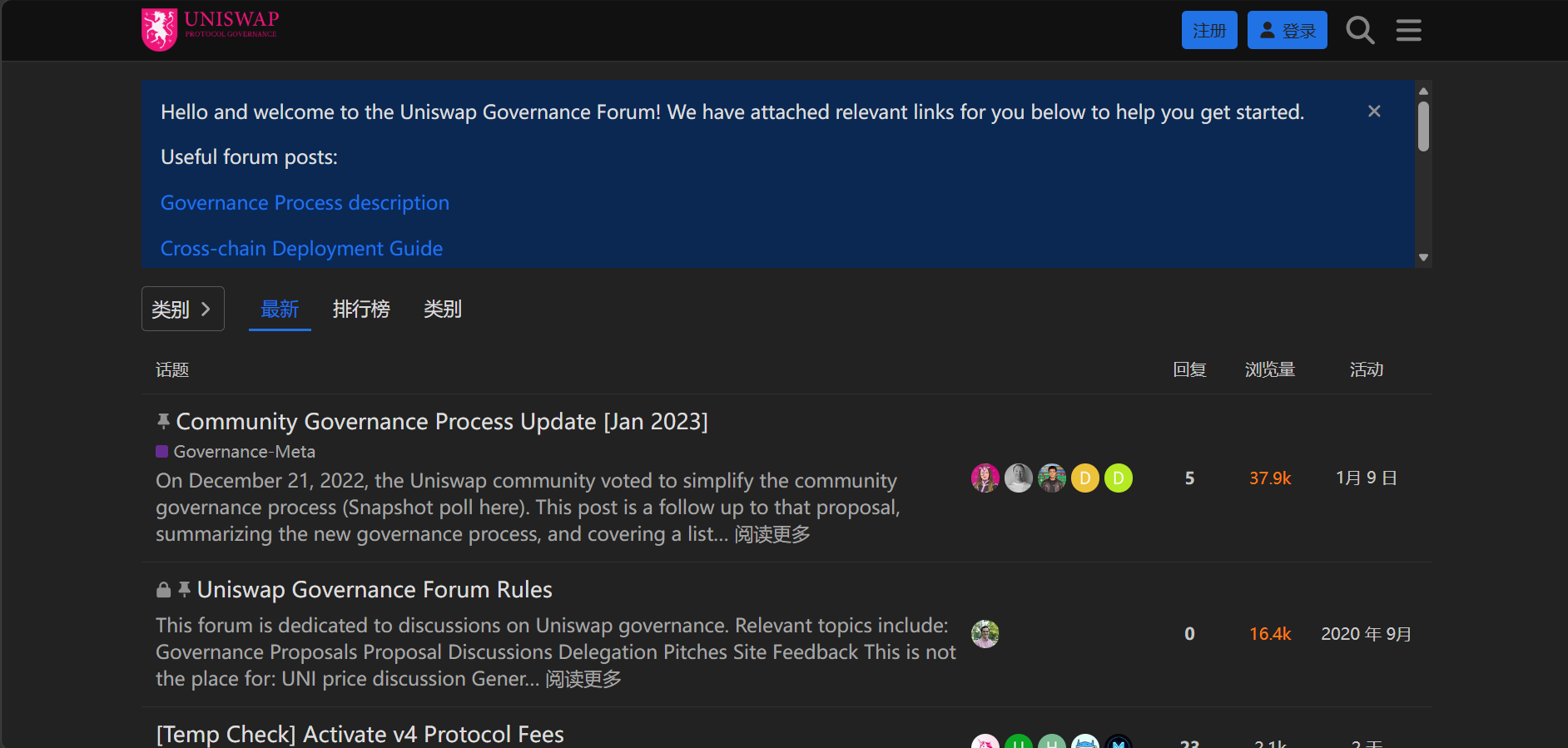
Uniswap DAO governs matters related to the protocol and ecosystem funding. Arbitrum DAO uses its constitution and AIPs to govern the chain, treasury, and Security Council. MakerDAO was an early example of stablecoin governance and has since evolved into the Sky Ecosystem. These examples show that the object of a protocol DAO is not an ordinary community activity but public infrastructure that can affect large numbers of users and substantial assets.
2.1 What Does a Protocol DAO Govern?
Common responsibilities include smart-contract upgrades, collateral and risk parameters, protocol fees, chain deployments, oracles, ecosystem grants, and treasury allocation. Tokenholders do not need to vote on every parameter. Mature organizations delegate routine operations to committees or specialist teams while reserving core upgrades for formal governance.
2.2 Who Can Participate?
Tokenholders can usually vote directly or delegate voting power to representatives. Forum participants, developers, and researchers without large token positions can still influence governance through discussion, proposals, and working groups. Final on-chain authority, however, depends on the contract rules and the distribution of delegated power.
2.3 Where Does the Funding Come From?
A protocol DAO treasury may be funded through an initial token allocation, protocol revenue, fees, unclaimed airdrops, or ecosystem reserves. When the treasury is heavily concentrated in the project’s own token, a market decline can weaken both its budget and its governance security.
2.4 What Is the Greatest Risk?
Protocol DAOs face governance attacks, concentrated token ownership, incorrect decisions about complex parameters, and slow emergency responses. A malicious proposal may directly alter contract permissions, so voting delays, timelocks, audits, and narrowly authorized security councils are important safeguards.
A Protocol DAO Is Not the Entire Protocol Organization
A Web3 project often involves several distinct entities. A DAO may control some contracts and treasury accounts; a foundation may handle grants and legal matters; a development company may write the software; a laboratory may operate the front end; and vendors may provide marketing, research, or security services.
For example, a DAO may approve an official deployment on a chain without being able to order an independent company to add it to a commercial front end. Tokenholders may decide an ecosystem budget without owning the trademarks, corporate bank accounts, or employment authority. To assess decentralization, examine upgrade keys, treasuries, domains, front ends, intellectual property, and emergency permissions separately.
The advantage of a protocol DAO is that key rules and funds can be more readily verified in public. The tradeoff is slower decision-making and a higher participation burden. A governance process suitable for high-impact changes is not suitable for every operational purchase.
What Is an Investment DAO?
An investment DAO is an organization whose members pool capital, evaluate opportunities, and manage a portfolio. Its targets may include tokens, startups, NFTs, real-world assets, or other on-chain opportunities. The LAO describes itself as a for-profit investment DAO supporting the Ethereum ecosystem, while MetaCartel Ventures is jointly managed by founders, developers, community builders, and investors.
Investment DAOs combine fundraising, investment decisions, and portfolio management familiar from traditional funds with an on-chain treasury. Using a DAO does not eliminate investment regulation. Membership, KYC, investor restrictions, securities issuance, profit distribution, tax, and management liability must still be addressed under the organization’s legal structure and relevant jurisdictions.
4.1 How Do Members Join?
Common paths include contributing capital, nomination by existing members, professional screening, or verification of legal eligibility. Fully open, anonymous entry may work for some community pools, but it may be inappropriate for organizations dealing with equity, securities, or restricted investments.
4.2 How Are Investment Decisions Made?
Members or an investment committee source projects, conduct due diligence, perform valuation, negotiate terms, and submit a proposal, which is then approved through voting or a multisig. An on-chain vote can record an outcome, but it cannot automatically verify business data, founder backgrounds, or contract quality.
4.3 How Can Capital Be Withdrawn?
Some Moloch-style structures let members exit under defined rules and receive their share of assets. Other organizations use fixed terms, nonredeemable interests, or legally restricted shares. Users should not assume that a “DAO share” is a fund net asset value that can be sold or redeemed at any time.
4.4 What Is the Greatest Risk?
In addition to investment losses, an investment DAO faces liquidity, valuation, related-party transaction, inside-information, and member-liability risks. Large capital contributors may hold greater voting power, while managers may have access to information unavailable to ordinary members.
What Is a Social DAO?
A social DAO builds a member network around a shared interest, identity, culture, or location. Its principal product is not a financial protocol but relationships, events, content, reputation, and opportunities for collaboration. Friends With Benefits (FWB), which describes itself as a membership club for builders of internet culture, is a commonly cited example.
Members may join a social DAO by applying, receiving an invitation, or holding a token or NFT. A token may function as an access credential, governance tool, or reward, but it should not be the community’s only reason to exist. If members continue to communicate, organize events, and create together when the token price falls, the organization is more likely to possess genuine social value.
5.1 What Does a Social DAO Govern?
Common matters include member admission, community rules, event budgets, content projects, brand partnerships, local chapters, and shared spaces. Many decisions depend on culture and human relationships and cannot be executed automatically from wallet balances alone.
5.2 Where Does Revenue Come From?
Revenue may come from membership fees, event tickets, sponsorships, digital goods, brand partnerships, or treasury grants. If most revenue depends on a rising membership-token price or purchases by new members, the community remains highly exposed to market sentiment.
5.3 What Is the Greatest Risk?
Social DAOs are vulnerable to insider circles, opaque admission, low governance participation, and wealth determining a member’s voice. Public wallets can also expose holdings and social relationships, requiring administrators to address privacy, harassment, and content moderation.
What Is a Service DAO?
A service DAO is a distributed service organization formed by developers, designers, researchers, marketers, operators, or other professionals. It resembles a cooperative, talent network, or digital studio: members win projects together, share a brand and resources, and distribute revenue according to contribution.
Since 2019, RaidGuild has operated as a decentralized builder collective providing smart contracts, DApps, DAO tools, and public-goods development, making it a representative service DAO. Customers pay for actual delivery, not the future price of a governance token.
6.1 How Does a Service DAO Win Work?
After a client submits requirements, members assess scope, budget, and schedule, then form a temporary squad to deliver the project. A coordinator may match talent, or members may assemble their own team. Fast estimates and a clearly accountable lead are generally more important than an organization-wide vote.
6.2 How Is Revenue Distributed?
Project revenue may be allocated by hours, role, fixed quote, or milestone. A portion may enter a shared treasury for branding, training, and internal tools. The rules must also account for contributions such as sales, project management, and maintenance that are difficult to quantify.
6.3 Who Is Accountable to the Client?
The DAO must identify the contracting entity, acceptance criteria, intellectual-property terms, confidentiality obligations, after-sales support, and dispute-resolution process. On-chain payment cannot replace contracts or quality management, and anonymous collaboration should not make accountability disappear.
6.4 What Is the Greatest Risk?
Common problems include unstable member availability, inconsistent delivery standards, dependence on a few people for client relationships, and disputes over revenue allocation. Bringing excellent professionals together does not automatically give the organization mature management capabilities.
What Fundamentally Distinguishes the Four DAO Types?
The core assets of a protocol DAO are its software, network, and protocol treasury, and members mainly decide rules and parameters. An investment DAO’s core assets are pooled capital and its portfolio, and members focus on returns, risk, and exit. A social DAO’s core assets are identity, relationships, and culture, and members focus on admission and shared experiences. A service DAO’s core assets are talent, brand, and delivery capability, and members focus on clients and revenue distribution.
Membership differs as well. Protocol DAOs often measure power through governance tokens and delegation. Investment DAOs may require capital and legal eligibility. Social DAOs emphasize applications and cultural fit. Service DAOs give greater weight to professional skill and prior contribution.
The required speed of decision-making is also different. Protocol upgrades demand caution and delay; investment opportunities may have short windows; social communities require continuous interaction; and client projects must be delivered on schedule. Voting thresholds, committee authority, and execution methods therefore cannot be identical.
What Other DAO Types Are Common?
8.1 Grant DAOs
Grant DAOs allocate funds to open-source software, education, research, and ecosystem public goods. Members use proposals, review committees, or retroactive rewards to judge value. Their main challenges are measuring long-term impact and preventing duplicate claims.
8.2 Collector DAOs
Members jointly acquire art, NFTs, or cultural assets and decide how to custody, exhibit, license, or sell them. Collector DAOs overlap with investment DAOs, but collecting, curation, and cultural objectives may matter more than financial return.
8.3 Media and Creator DAOs
Writers, researchers, video producers, and community members create content together and earn revenue through subscriptions, sponsorships, NFTs, or licensing. These organizations combine the collaboration of a service DAO with the cultural relationships of a social DAO.
8.4 Network States and City DAOs
Members organize resources around a physical place, online identity, or long-term social experiment. When these projects involve real estate, resident services, or public rules, legal and real-world execution becomes far more complex than in an ordinary online community.
8.5 Governance and Infrastructure DAOs
Some organizations specialize in providing oracles, domains, public protocols, delegate services, or security coordination. They resemble protocol DAOs but may also perform an ecosystem public-goods role.
Can a DAO Belong to More Than One Type?
Yes. A protocol DAO may fund developers through a grant program and organize social events. A social DAO may create an investment group. A service DAO may develop and govern its own public protocol. Classification should follow the organization’s primary goal, use of funds, and objects of decision-making.
Hybrid structures become risky when one token carries too many responsibilities. Service members may expect revenue based on labor, investment members may demand capital returns, and social members may prioritize an open culture. Those goals can conflict directly. A better design separates sub-DAOs, working groups, budgets, and permissions, and uses different credentials when necessary to express membership, governance, and economic rights.
Projects may also transform throughout their lifecycle. An early development team may move quickly with a multisig and later form a protocol DAO as the product matures. A cultural community may build a grant program after accumulating funds. A service network may develop a public tool and then open its governance. The name matters less than the actual transfer of power.
How Should Different DAOs Choose a Governance Model?
A protocol DAO can combine Governor, a timelock, delegated representatives, and a security council. High-risk upgrades go to an on-chain vote, while specialists may receive bounded authority over routine risk parameters and must report their work.
An investment DAO often needs controlled admission, an investment committee, due-diligence procedures, a multisig treasury, and exit rules. When regulated assets are involved, legal eligibility may be more important than a public token vote.
A social DAO may use application-based membership, nontransferable contribution credentials, Snapshot, and community committees. If a tradable token determines every voice, wealthy members can effectively buy cultural influence.
A service DAO benefits from project leads, role-based permissions, payment approvals, and member reputation. Not every client request needs an organization-wide vote; major decisions about the brand, treasury, and membership rules can still enter collective governance.
Snapshot can calculate voting power from tokens, NFTs, allowlists, and other strategies. Governor supports on-chain proposals and automatic execution. A Safe multisig suits smaller treasuries and operating accounts. For a complete comparison, read DAO Governance Tools: Snapshot, Tally, and Governor.
How Should the Four DAO Types Manage Their Treasuries?
A protocol DAO should prioritize security and operational continuity, avoid concentrating its treasury excessively in its own token, and reserve funds for core development, audits, and vulnerability response.
An investment DAO must record cost basis, valuation, custody, profit, and exit. Publicly visible assets do not mean accounting and tax obligations have been resolved. Illiquid holdings also require off-chain contracts and responsible managers.
A social DAO’s budget should support events, content, and the member experience. If its treasury only rewards voting and recruitment, the community may optimize for task farming rather than genuine relationships.
A service DAO must separate client funds, member compensation, tax obligations, and the shared treasury. Project receipts should not be distributed in full before acceptance and dispute handling are complete.
Every type should establish signature thresholds, budget limits, payment review, recipient-address verification, and periodic reporting. Treasury transparency is only a starting point; appropriate delegation and accountability determine whether funds are actually safe.
How Should Membership Be Designed?
Membership should correspond to the organization’s contribution model. Protocol DAO voting power may come from tokens and delegation, but researchers and developers also need noncapital participation routes. Investment DAOs should verify capital and legal eligibility. Social DAOs may assess cultural fit. Service DAOs need skill evaluations and trial assignments.
Transferable tokens make open entry and exit easier, but they also allow governance power to be purchased. Nontransferable credentials are better suited to reputation, roles, and contribution records, but they need issuance, revocation, and appeals processes. Many organizations combine both: tokens express economic rights or broad governance, while contribution credentials determine access to specialist committees and working groups.
Entry rules also need matching exit rules. Members should know how to withdraw a delegation, leave a project, collect compensation, handle unfinished work, and whether confidentiality or legal obligations continue after departure.
What Risks Do All Four DAO Types Share?
The first risk is a gap between name and reality. A project may claim community governance while a small group of founders controls the core contracts, domains, and treasury.
The second is insufficient participation. Holding a token does not mean a member will read proposals, and complex governance may ultimately be controlled by a small number of representatives.
The third is concentrated power. Protocol DAOs have whales, investment DAOs have major capital contributors, social DAOs have inner circles, and service DAOs have coordinators who control client relationships.
The fourth is an execution gap. A passed vote does not mean that development is finished, an investment closes, an event takes place, or a client is satisfied. Every decision needs an accountable owner and acceptance criteria.
The fifth is contract and wallet security. Malicious proposals, compromised private keys, fake voting websites, and incorrect addresses can cause an immediate loss of treasury assets.
The sixth is legal liability. Fundraising, investing, employment, tax, intellectual property, and consumer protection do not disappear because an organization calls itself a DAO.
How Can You Determine Which Type a DAO Is?
Start with its principal output. An organization maintaining a protocol and its parameters is closer to a protocol DAO. One that allocates capital to external assets is an investment DAO. One mainly providing relationships and cultural experiences is a social DAO. One delivering work to customers is a service DAO.
Then examine where its money comes from. Protocol fees and ecosystem reserves, member capital, dues and event income, and client-project revenue point to different organizational models. Token sales can occur in any type and are not enough to classify an organization.
Third, identify the core decisions. Upgrading contracts, selecting investments, approving members, and managing projects are the characteristic areas of authority for the four types.
Finally, ask what remains when members leave. A protocol DAO may leave functioning contracts; an investment DAO leaves a portfolio; a social DAO leaves relationships and a brand; and a service DAO leaves clients, work products, and a professional network. This answer is often more revealing than the project’s marketing label.
The Hotcoin TYPES Five-Dimension Framework
The TYPES framework offers a quick way to classify a DAO. It is an organizational checklist, not an investment rating.
15.1 T: Task—What Does the Organization Do?
Determine whether the DAO’s main output is a protocol, investment, community, or client service. The more specific the task, the easier it is to select the right governance process.
15.2 Y: Yield—Where Is Value Created?
Distinguish protocol revenue, investment returns, member spending, and service fees. If value depends only on a rising token price, both the classification and the business model are unstable.
15.3 P: Power—Who Holds Real Authority?
Examine governance tokens, member screening, investment committees, project leads, multisigs, and foundation permissions instead of looking only at a public voting page.
15.4 E: Execution—Who Carries Out Decisions?
Confirm whether an approved proposal is executed by a contract, committee, foundation, or named member, and review its budget, deadline, and acceptance process.
15.5 S: Safety—Do the Safeguards Match the Type?
Protocol DAOs emphasize upgrade security, investment DAOs focus on compliance and assets, social DAOs prioritize privacy and moderation, and service DAOs focus on contracts and delivery.
How Can Ordinary Users Participate in Different DAOs?
Before participating in a protocol DAO, read delegate profiles and proposal calls, confirm whether a vote executes on-chain, and do not delegate blindly simply because you hold the token.
Before joining an investment DAO, verify its legal entity, membership eligibility, fees, custody, exit terms, and tax treatment. Do not mistake a group chat for a protected investment fund.
Before joining a social DAO, experience its public community and events, determine whether its culture fits you, and only then consider buying a membership token or NFT.
Before joining a service DAO, understand project allocation, compensation, intellectual property, dispute handling, and member evaluation. Do not perform long-term unpaid work merely to obtain “governance rights.”
For every type, consider using a separate governance wallet, verify the official website, network, contracts, and signature messages, and limit the time and money you commit.
Frequently Asked Questions
17.1 Can a DAO Belong to Only One Type?
No. Many DAOs combine protocol governance, ecosystem grants, social activities, and service teams. Classify them by their primary goal, funds, and authority.
17.2 Is an Investment DAO the Same as an Investment Fund?
Not necessarily. An investment DAO may be paired with a fund or company, or it may simply be a shared member treasury. Regulation and member rights depend on the actual arrangement and local law.
17.3 Must a Social DAO Issue a Token?
No. A member list, nontransferable credentials, a multisig, and ordinary subscriptions can also manage a community. A token is useful only when it genuinely improves admission, governance, or rewards.
17.4 Is a Service DAO an Outsourcing Company Without a Boss?
That description is incomplete. A service DAO may lack a traditional boss but still needs sales, project leads, quality control, and a contracting entity. Authority is distributed differently rather than eliminated.
17.5 Can a Protocol DAO Control Every Company and Front End in a Project?
Usually not. A DAO, foundation, development company, and front-end operator may hold different permissions. Contracts, trademarks, domains, and funding control must be assessed separately.
17.6 Does Holding a Governance Token Let You Participate in Every Decision?
Not necessarily. Some decisions require delegation, a proposal threshold, membership screening, or action by a committee or multisig.
17.7 Which DAO Type Is Best for Beginners?
There is no universal answer. Beginners can start with public forums, community meetings, and low-risk tasks, observe the rules and execution, and then decide whether to contribute capital or accept responsibility.
Conclusion: Look at the Task Before the Token
Protocol, investment, social, and service DAOs use similar on-chain tools but solve different problems. Protocol DAOs govern public software and risk; investment DAOs allocate pooled capital; social DAOs build member culture; and service DAOs organize professional delivery. Classification helps match governance design to real work.
When assessing a DAO, do not start with token price. Examine what the organization produces, where its money comes from, who holds real authority, how votes are executed, and who is responsible for failure. Mature DAOs generally do not ask everyone to vote on everything. They connect communities, delegates, committees, and execution teams through clear authorization.
Future DAOs will become increasingly hybrid. Protocol organizations will establish professional service units, social communities will run grant programs, and service networks will develop public protocols. A hybrid model is not a problem when rights, budgets, and responsibilities are clearly separated. The danger lies in using one ambiguous token to represent membership, reputation, wages, equity, and governance all at once.
After this article, return to the Complete Guide to Decentralized Autonomous Organizations to reinforce the overall framework. To compare the real governance of MakerDAO, Uniswap DAO, and Arbitrum DAO, read Case Studies of Leading DAOs: MakerDAO, Uniswap DAO, and Arbitrum DAO. When you are ready to put the ideas into practice, continue with How to Create Your Own DAO: From Zero to Launch.
To manage multichain assets and connect to governance applications, use Hotcoin Web3 Wallet. For mobile market and trading tools, visit the Hotcoin App. Browse more educational content on Hotcoin.
Risk warning: This article is provided for education and information only and does not constitute investment, legal, or tax advice. DAO categories, tokens, membership, treasuries, governance tools, legal structures, and project status may change. Before participating, verify the latest official website, contract addresses, actual permissions, wallet-signature details, and rules in your jurisdiction.
Lettura consigliata
Visualizza altro

Service@hotcoin.com
Product@hotcoin.com
Business@hotcoin.com
Casecn@hotcoin.com