
DAO Challenges: Governance Attacks, Voter Apathy, and Efficiency Bottlenecks
DAOs move proposals, voting, treasuries, and protocol upgrades onto public networks, but that does not automatically produce democracy, security, or efficiency. On-chain rules faithfully execute the power structure encoded in a contract: if voting power can be borrowed instantly, an attacker may legitimately pass a malicious proposal; if most members rarely vote, a small group of delegates can control outcomes; and if every minor issue requires a universal vote, the organization may lose its ability to act while it debates.
The hardest part of a DAO is therefore not deploying a voting page, but managing three tensions at once: open participation versus attack resistance, broad consensus versus expert judgment, and transparent procedures versus rapid execution. The more directly governance controls a protocol and its treasury, the greater the losses caused by flawed institutional design. For an overview of the full structure, read the Complete Guide to Decentralized Autonomous Organizations.
Why Are DAO Challenges More Complex Than Those of Traditional Organizations?
Traditional companies usually have boards, management teams, bank permissions, and judicial remedies. DAOs assign some of that power to tokens, smart contracts, multisigs, and pseudonymous participants. This increases verifiability, but also combines concentrated holdings, code vulnerabilities, cross-time-zone collaboration, and legal uncertainty in one system.
On-chain transactions are also strongly enforceable. An incorrect set of meeting minutes can be amended, but an executed treasury transfer usually cannot be reversed. A governance-page description is only an explanation; what takes effect is the target contract, amount, and call data. Members who read only the title and forum summary may authorize a completely different set of on-chain operations.
DAO boundaries are often unclear as well. Tokenholders, delegates, foundations, development companies, service providers, and security councils may each control different resources. A community vote does not necessarily give the community control of a front end, trademark, server, or real-world contract. Governance analysis must map permissions before judging whether an organization is decentralized.
What Is a DAO Governance Attack?
A governance attack uses voting power, the proposal process, execution authority, or members' perceptions to make a DAO approve a decision it would not otherwise accept. It does not necessarily break cryptography or bypass a contract. Some attacks comply fully with the established rules, making them harder to define and prevent than ordinary exploits.
Typical objectives include draining a treasury, upgrading to a malicious contract, granting an administrator role, changing an oracle, minting tokens, lowering collateral requirements, or blocking other proposals. An attacker may acquire voting power from outside the organization, or may be an insider who has legitimate authority but conflicting interests.
What Are the Common Paths for Governance Attacks?
3.1 Flash Loans and Temporary Voting Power
If governance counts current balances and allows newly acquired tokens to propose and pass a measure immediately, an attacker may borrow a large amount in one or several transactions, gain temporary voting power, execute the proposal, and then repay the loan. The attack cost is determined by borrowing fees and transaction conditions rather than the cost of holding governance tokens over time.
Historical voting-power snapshots, a Voting Delay, and a longer proposal lifecycle can weaken this path. Voting power should be fixed before the proposal begins, and an attacker should not be able to borrow, vote, and execute in the same block. Snapshots are only a baseline defense; staking receipts, liquid tokens, and cross-chain mappings must also be checked for indirect amplification of voting weight.
3.2 Malicious Proposals and Deceptive Descriptions
A proposal may be titled “ecosystem grant” while its actual call assigns an administrator role to a new address. Its description may display one recipient while the calldata uses another. On-chain governance automatically executes the machine-readable payload, not the natural-language outcome that the community thinks it supports.
High-risk proposals should disclose their target, amount, function, parameters, simulation results, and code changes, with an independent review. Bundling unrelated operations also increases risk because members may feel compelled to accept other permission changes to support one desirable action.
3.3 Whales, Delegation, and Governance Capture
One-token-one-vote converts wealth directly into political power. Teams, funds, exchanges, lending markets, or a small number of professional delegates may accumulate enough weight to determine whether quorum is met. Even without theft, governance capture emerges when the same coalition controls budgets and rules over time.
Delegation lets holders without enough time choose professional representatives, but it can concentrate power further. Leaderboard visibility, established reputation, and incentive programs create cumulative advantages. A DAO should disclose delegation sources, voting histories, conflicts of interest, and compensation, while allowing holders to revoke a delegation or override it with their own vote at any time.
3.4 Quorum Manipulation and Denial of Service
An attacker does not have to pass a malicious proposal; disrupting normal governance may be enough. Tactics include concentrating “against” votes, deliberately withholding participation so quorum is missed, reaching quorum only at the last moment, or abusing cancellation and queueing permissions to block an approved decision.
Dynamic quorum, Late Quorum protection, and clearly defined cancellation powers can help, but parameters should not simply aim for the highest possible threshold. A quorum that is too low invites control by a small group, while one that is too high turns inactive tokens into a permanent veto. Parameters should be calibrated against the participating supply, historical turnout, and the decision's risk level.
3.5 Front Ends, Signatures, and Social Engineering
A fake governance site may copy Snapshot or an on-chain voting page and induce users to sign an approval, Permit, or asset transfer. Attackers can also hijack forum accounts, control domains, forge delegate statements, or create a sense of urgency so members skip review.
What Did the Beanstalk Governance Attack Demonstrate?
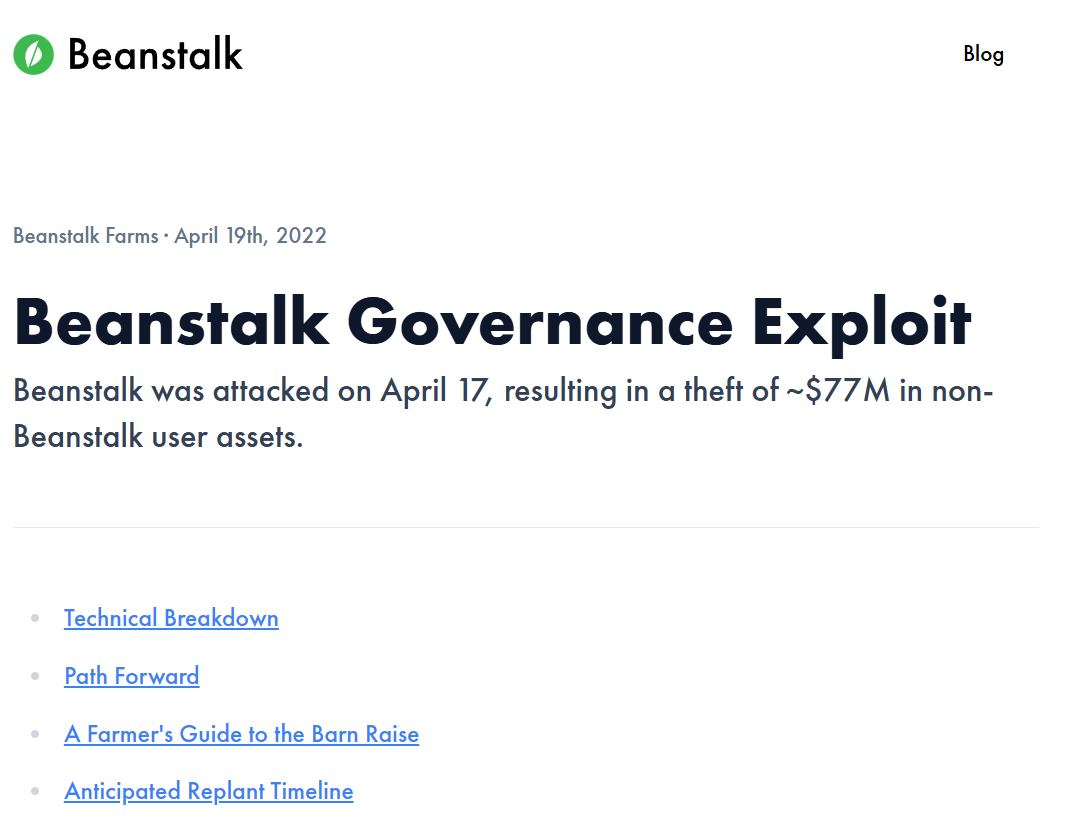
Beanstalk suffered a governance attack in April 2022. According to its official disclosure, the attacker used a flash loan to exploit its on-chain governance mechanism and stole roughly $77 million in non-BEAN user assets. The problem was not merely a vulnerability in an asset contract: temporarily acquired governance power could be converted into final execution power too quickly.
After the attack, Beanstalk paused the protocol and removed its former on-chain governance. Community decisions moved to Snapshot and were executed by a 5-of-9 community multisig. This reduced the same attack path but reintroduced signer trust, censorship, and operational risks. Security does not move in one direction from centralization to decentralization; a system reallocates risk among different places.
The case offers three lessons. First, voting power needs historical snapshots and time separation. Second, high-risk proposals should not execute without a review window. Third, a multisig or security council can serve as a temporary defense after an attack, but its powers, threshold, process, and exit path must be public.
Why Does “One Token, One Vote” Create Structural Problems?
One-token-one-vote is simple and verifiable, and it gives people who bear economic risk a voice. Token distribution, however, is rarely equal. Early investors, teams, and treasuries may control a large share of supply, while ordinary users may be numerous but still lack enough combined voting power and coordination to affect the result.
Tradable governance rights are also influenced by lending, derivatives, and custody. A token's nominal holder, economic risk bearer, and actual decision-maker may be different entities. Quadratic voting, identity credentials, and bicameral systems can reduce pure capital weighting, but introduce Sybil attacks, privacy issues, and rule complexity. No single institution suits every decision.
What Is Voter Apathy?
Voter apathy occurs when members are eligible to participate but repeatedly do not read, discuss, or vote. This does not necessarily mean they do not care about the DAO; it may be rational when one vote has little effect, proposals are excessive or highly technical, on-chain fees are high, or the expected benefit does not cover the time required.
Holders may also treat governance tokens as trading assets rather than memberships. If a protocol has operated steadily for years and proposals are rarely contentious, members assume someone else is supervising it. If every outcome is determined by whales, ordinary holders begin to expect that their votes do not matter.
Low participation should not be dismissed as community laziness. Governance design itself may create obstacles: voting windows may exclude major time zones, notifications may be incomplete, materials may be scattered, the delegation entry point may be hard to find, signatures may be difficult, or proposal descriptions may fail to answer the basic question, “What will this change?”
What Are the Consequences of Voter Apathy?
First, a small number of active addresses gain disproportionate influence. Even if a proposal satisfies the contract, it may represent only a small fraction of stakeholders. A high approval rate sometimes reflects genuine consensus and sometimes means opponents did not participate.
Second, the cost of a governance attack falls. When normal participation is low, voting power that an attacker buys or borrows has much greater relative weight, and a coordinated alliance among delegates can cross the threshold more easily.
Third, organizational legitimacy declines. If treasury spending, delegate compensation, and rule changes are repeatedly decided by a minority, nonparticipants may appear only when an outcome harms them, leading to disputes, exits, and community splits.
How Can a DAO Improve Voting Participation?
Start by reducing unnecessary votes. A community should not hold a universal vote for every reimbursement and daily task. Those duties should go to working groups with spending limits, fixed terms, and reporting obligations. Members' attention should be reserved for charters, core upgrades, large budgets, and important elections.
Next, establish a predictable governance rhythm. Fixed proposal-submission dates, discussion periods, and voting days let delegates schedule research, while votes should not end on weekends or major holidays. Arbitrum DAO, for example, uses minimum discussion periods and predictable voting days to reduce coordination costs. Such arrangements are governance infrastructure.
Third, improve information structure. Every proposal should provide a one-page summary, objectives, budget, risks, opposing arguments, conflicts of interest, executable actions, and accountable owners. Technical appendices can remain complete, but members should not have to read dozens of pages of code before understanding the consequences.
Fourth, support delegation and override mechanisms. Members can transfer voting power to professional delegates while retaining the ability to vote directly on important proposals. Delegates should publish their positions, attendance, and voting rationale regularly, and delegation should be revoked when participation is poor or trust is broken.
Fifth, design incentives carefully. Paying for research, explanation, and sustained attendance is more useful than offering a reward for each vote. Compensation should be tied to work quality, disclosure, and accountability.
Is Delegated Governance a Remedy or a New Form of Centralization?
Delegated governance turns a scarcity of attention into a problem of representative specialization. Strong delegates can continuously read proposals, attend meetings, consult specialists, and explain their reasoning, allowing small holders to avoid monitoring governance all day. Assets usually do not move to the delegate; only voting power does.
The risk is that the delegate market becomes oligopolistic. Highly ranked delegates attract more new delegation, institutions serving multiple DAOs can face conflicts of interest, and incentive programs may reward perfect attendance rather than independent judgment. Delegates paid by one foundation may also lack independence on critical issues.
Where Do DAO Efficiency Bottlenecks Come From?
10.1 Proposal Overload and Governance Fatigue
When a forum receives many ideas, grant applications, and parameter changes every day, members struggle to distinguish urgent matters from noise. Low barriers promote open innovation, but also create duplicate proposals, marketing pitches, and wish lists with no one responsible for execution.
10.2 Gaps Between Discussion, Voting, and Execution
Forum consensus may not be encoded correctly in an on-chain payload. After a vote passes, the responsible party may lack a contract, budget, or delivery capacity. A multisig may then delay execution because of address verification, signer absence, or legal review. The DAO ends up with a “passed” state, but not necessarily a result.
10.3 Expertise and Information Asymmetry
Protocol risk parameters, cross-chain upgrades, taxation, and security responses require specialist knowledge. Ordinary holders cannot independently judge every field, while experts, developers, and service providers possess more context. A public vote can be transparent without eliminating informational advantages.
10.4 Conflict Between Security Speed and Governance Speed
Normal upgrades require lengthy discussion, voting, and a Timelock, whereas vulnerability remediation may be measured in hours. Procedures that are too slow give attackers time; emergency powers that move too quickly can bypass the community. Before a crisis, a DAO must define what qualifies as an emergency, who can pause the system, how long the authority lasts, and how decisions are ratified afterward.
How Can a DAO Balance Decentralization and Efficiency?
The most effective method is not to let everyone decide everything, but to layer authority. The community determines the mission, charter, core upgrades, and annual budget; delegates review proposals; working groups handle daily execution; a treasury committee pays within limits; and a security council addresses only predefined emergencies.
Layering must be paired with revocable delegation. Every role needs a defined scope, budget, term, signature threshold, reporting frequency, and removal mechanism. Broader authority requires stronger transparency, audits, and exit mechanisms. A committee must not receive permanent, unlimited, or undisclosed power in the name of efficiency.
Proposals can also be categorized by risk. Low-risk operating matters follow a fast path, medium-risk budgets receive a temperature check and committee review, and high-risk upgrades, minting, and large transfers require a full on-chain vote and a longer Timelock. Different paths prevent the DAO from processing every issue at the same speed.
How Should Timelocks, Security Councils, and Vetoes Be Used?
A Timelock inserts a waiting period between approval and execution so members can inspect the final payload, leave the protocol, or organize a response. It is not an undo button. A queued malicious operation may still execute when the delay expires, so monitoring, cancellation powers, and public notice are also required.
A security council may pause a protocol, cancel a malicious proposal, or perform a rapid upgrade, but should use a multisig, rotate members, minimize permissions, and disclose its actions on-chain. Routine operations and emergency response should be separate so that “security” cannot become a pretext for bypassing budgets and governance disputes.
A veto is suitable as a limited safety valve, not as permanent founder control. Its trigger conditions, duration, post-incident report, and community ratification should be specified. As the institution matures, governance can reduce or remove the power.
OpenZeppelin's Governor modules provide components such as Voting Delay, Quorum, PreventLateQuorum, Proposal Guardian, and Timelock, but a contract will not choose the right parameters for a DAO. For an explanation of how the tools fit together, read DAO Governance Tools: Snapshot, Tally, and Governor.
How Can a DAO Build an Executable Proposal Process?
The first stage is problem definition. The author describes the current situation, objective, consequences of inaction, and alternatives, leaving enough time for discussion. An immature idea should not be rushed into a binary vote.
The second stage is executable design. Specify the budget, receiving address, owner, timeline, milestones, acceptance criteria, conflicts of interest, and failure handling. Contract-related proposals also require code diffs, an audit or review, tests, and transaction simulations.
The third stage is risk matching. Set proposal thresholds, voting periods, approval ratios, Quorum, and Timelock according to the decision's impact. A core-protocol upgrade should face substantially stricter requirements than a small event grant.
The fourth stage is independent verification. Technical, financial, and governance participants other than the author verify addresses, amounts, and calldata. Simulation results should match the natural-language description, and the front end must not be the only source of verification.
The fifth stage is execution and retrospective review. After approval, name the executor and completion deadline, and release funds against milestones. Publish the results, spending, and deviations afterward. Failed proposals should also record the reasons so the community does not repeatedly debate the same issue.
What Other Risks Affect Treasury and Operational Governance?
A public treasury is not necessarily a safe treasury. Members may see its balance without understanding token liquidity, stablecoin depeg risk, permission structures, or future liabilities. If a DAO keeps most assets in its own token, its budget and confidence can contract together during a market decline.
Service-provider proposals may also contain inflated budgets, related-party transactions, hard-to-verify deliverables, or recipients who disappear after funding. DAOs should use spending caps, milestone payments, multisig review, public reports, and conflict-of-interest disclosure, returning unused funds to the treasury where possible.
The Hotcoin SHIELD Six-Dimension Governance Diagnostic
The SHIELD method offers a quick way to identify a DAO's major risks. It is not a security rating, but a checklist to use before joining, delegating within, or creating a DAO.
15.1 S: Stake — Is Voting Power Concentrated?
Check the weights of the team, funds, treasury, exchanges, and the top ten delegates. Determine whether voting power can be borrowed, transferred, or amplified through derivatives.
15.2 H: Human — Is Genuine Participation Sustained?
Observe active voters, delegation coverage, proposal readership, and delegate explanations instead of relying only on the total address count. Votes from a one-time airdrop do not equal long-term participation.
15.3 I: Information — Is Information Symmetric?
Confirm that proposals provide summaries, opposing views, conflicts of interest, code changes, addresses, and simulations. Members who cannot understand the consequences cannot give meaningful consent.
15.4 E: Execution — Can Decisions Be Implemented on Time?
Track the time from passage to execution, the accountable owner, signers, milestones, and acceptance. A successful vote followed by prolonged non-delivery is also a governance failure.
15.5 L: Limits — Are Critical Powers Constrained?
Review multisig thresholds and the powers to delay, pause, cancel, upgrade, and mint. Confirm that emergency roles have a defined scope, duration, and post-event ratification process.
15.6 D: Disclosure — Is the Process Auditable?
Review delegate compensation, service-provider relationships, treasury reports, meeting records, and incident retrospectives. On-chain transparency cannot replace disclosure of off-chain interests.
How Can Ordinary Users Reduce the Risks of DAO Participation?
First, identify the scope of governance. Determine whether token voting controls the protocol, the treasury, or only provides advice, and review powers retained by the team, multisig, and foundation.
Second, verify the proposal's execution details. Read the recipient, amount, target contract, function, and timing instead of deciding only from the title, approval percentage, or delegate opinion.
Third, use a separate governance wallet. Isolate DApp connections, signatures, and a small amount of governance assets from primary holdings, revoke unnecessary approvals regularly, and access governance pages through official entry points.
Fourth, choose delegates carefully. Review their voting history, rationale, delegation concentration, compensation, and conflicts of interest, and revoke delegation if their position remains inconsistent with yours.
To see how mature DAOs handle upgrades, delegates, and security councils, continue with Case Studies of Leading DAOs: MakerDAO, Uniswap DAO, and Arbitrum DAO. If you are building an organization, use How to Create Your Own DAO: A Guide from Zero to Launch as a checklist.
Frequently Asked Questions
17.1 Does a DAO Governance Attack Always Require Hacking Skills?
No. An attacker may use flash loans and contracts, but can also buy voting power, control delegation, misrepresent proposal details, or manipulate a forum. The essence of a governance attack is abuse of decision-making and execution mechanisms.
17.2 Does a Higher Turnout Make a DAO More Decentralized?
Not necessarily. High turnout may come from a few large addresses, automated voting, or reward campaigns. Voting-power concentration, the number of independent participants, delegation relationships, and whether dissent enters the decision all matter.
17.3 Can a Higher Quorum Prevent Governance Attacks?
It can mitigate only some risks. An excessive Quorum can halt ordinary governance and give nonparticipants a de facto veto. Historical snapshots, voting delays, Timelocks, permission limits, and anomaly monitoring must also be used.
17.4 Will Delegating Voting Power Cause Me to Lose My Tokens?
Standard delegation usually transfers only governance power, not token ownership. Users should still verify the official contract and signature contents to avoid signing an asset approval or transfer on an impersonation site.
17.5 Is Multisig Governance Safer Than On-Chain Voting?
It depends on the situation. A multisig can respond quickly and avoid flash-loan voting, but introduces signer collusion, private-key, censorship, and execution-deviation risks. It can be appropriate in an early or emergency phase, but authority and accountability must be transparent.
17.6 Why Is an Approved DAO Proposal Sometimes Not Executed for a Long Time?
A vote may express only an opinion, or execution may still require a multisig, Timelock, legal contract, and working-group delivery. A proposal without an owner, budget, timeline, and acceptance criteria can easily remain in the “passed” state.
17.7 Can a DAO Eliminate Governance Risk Completely?
No. Code, capital, information, and people can all fail. Mature governance aims to limit single points of power, detect anomalies sooner, leave time for a response, and enable recovery and accountability after an incident.
Conclusion: Good Governance Means More Controllable Power, Not More Voting
The true test of a DAO is not the number of proposals or participating wallets, but whether power can be clearly allocated, verified, constrained, and revoked. Governance attacks reveal gaps in the rules, voter apathy reveals problems of attention and representation, and efficiency bottlenecks reveal unclear delegation and execution responsibilities.
Addressing these issues requires a combination of designs: historical voting power and a Voting Delay resist temporary capital; Timelocks and independent review give the community time to respond; delegation and a predictable rhythm reduce participation costs; layered authority lets experts and working groups handle routine matters; and public disclosure and retrospective review preserve accountability.
Returning to the Complete Guide to Decentralized Autonomous Organizations places these challenges within the wider structure of members, proposals, voting, execution, treasuries, and law. A secure DAO does not eliminate every center of power; it makes each one visible, limited, replaceable, and accountable.
To manage multichain assets and connect to governance applications, use Hotcoin Web3 Wallet. For mobile market and trading tools, visit Hotcoin App. Browse more educational content at Hotcoin.
Risk warning: This article is for educational and informational purposes only and does not constitute investment, legal, or tax advice. DAO tokens, voting rules, contract permissions, governance tools, legal structures, and project status may change. Before participating, delegating, or creating a DAO, verify the latest official documentation, contract addresses, proposal payloads, wallet signatures, and rules in your jurisdiction.
Lettura consigliata
Visualizza altro



Service@hotcoin.com
Product@hotcoin.com
Business@hotcoin.com
Casecn@hotcoin.com