
Cryptocurrency Types Explained: Payment Coins, Platform Tokens, Stablecoins, and Meme Coins
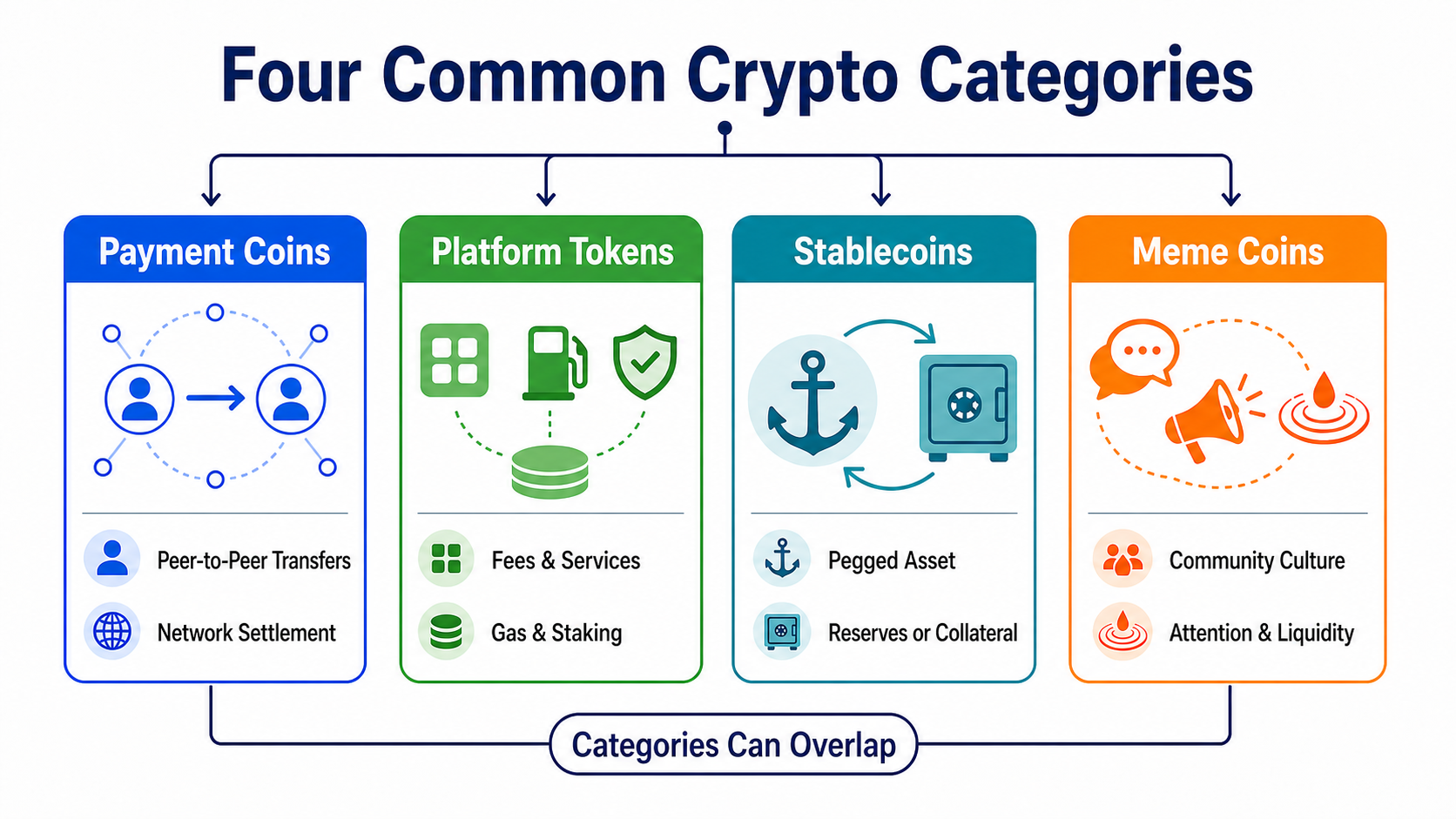
Cryptocurrencies can be grouped by their main use into payment coins, platform tokens, stablecoins, and meme coins, but these categories are not mutually exclusive. The same asset may support transfers, network fees, governance, and community culture at the same time.
Classification helps identify where demand comes from and where risks enter; it is not a ranking system. An assessment should also consider issuance, token supply, control rights, and real-world use cases. For a broader analytical framework, start with the guide to crypto assets.
What Is the Difference Between a Coin and a Token?
A Coin generally means the native asset of a blockchain. It may pay network fees, transfer value, or participate in consensus, such as BTC on the Bitcoin network. A Token is issued through a smart contract or token standard on an existing blockchain, such as an ERC-20 token on Ethereum.
This distinction describes technical origin, not use. A native Coin can carry meme culture, while a smart-contract Token can be designed as a stablecoin, platform token, or payment asset. You therefore cannot classify an asset only by the chain on which it runs.
When verifying an asset, first determine whether it is native to a network or issued by a contract, which asset pays Gas, and whether the token contract can mint, pause, freeze, or upgrade. Names and ticker symbols can be duplicated; the contract address and network identify an asset more reliably.
How Do the Four Cryptocurrency Categories Differ?
The main difference is why holders need the asset and what mechanism sustains its value. Payment coins rely on transfer and settlement demand, platform tokens on services or ecosystem utility, stablecoins on their peg and redemption mechanism, and meme coins more heavily on community attention and market consensus.
| Category | Primary use | Common examples | Source of value or demand | First things to verify |
|---|---|---|---|---|
| Payment coin | Peer-to-peer transfers, settlement, or value transmission | BTC, LTC | Network adoption, liquidity, scarcity, and settlement demand | Consensus rules, fees, issuance rules, and merchant acceptance |
| Platform token | Fees, service benefits, Gas, staking, or governance | BNB, KCS, GT | Platform usage, on-chain activity, and benefit rules | Whether benefits can change, issuer control, burns, and unlocks |
| Stablecoin | Unit of account, trading settlement, payments, and on-chain liquidity | USDT, USDC, DAI | Reserves, collateral, arbitrage, and redemption | Reserves, redemption terms, collateral ratio, contracts, and cross-chain origin |
| Meme coin | Community participation, tipping, trading, and cultural expression | DOGE, SHIB, PEPE | Attention, community consensus, liquidity, and later utility | Holder concentration, contract control, liquidity, and social momentum |
The examples show common classifications only. DOGE originated as an internet meme but also has its own blockchain and transfer function. BNB expanded from platform utility into the native asset of BNB Chain, where it pays Gas and can be staked. Asset functions evolve, so classifications should be reassessed as protocols and use cases change.
What Is a Payment Coin?
A payment coin uses value transfer as its primary purpose. The Bitcoin white paper describes Bitcoin as a peer-to-peer electronic cash system that lets users transfer value without relying on a conventional financial institution to process every payment. Networks such as Litecoin also center their design on on-chain transfers and settlement.
Payment capability does not mean price stability. Confirmation times, network fees, price volatility, merchant support, and exchange liquidity all affect practical use. A merchant's ability to accept an asset does not guarantee that the asset will maintain stable purchasing power.
When analyzing a payment coin, distinguish between whether the protocol can execute a transfer and whether people are willing to accept it. The first depends on blockchain rules; the second also depends on wallet support, market depth, taxes, and local regulations.
What Is a Platform Token?
A platform token is a crypto asset issued by a trading platform or blockchain ecosystem and tied to specific services. Common functions include fee discounts, access to activities, Gas payments, staking, and governance, but the exact rights differ by asset.
In Chinese-language usage, “platform token” has both narrow and broad meanings. The narrow meaning usually refers to tokens associated with trading platforms, while the broad meaning may also include the native assets of smart-contract platforms. BNB, for example, has platform-service use cases and is also the native asset of BNB Chain, where it pays network fees and supports staking. One label cannot capture all its functions.
A platform token's value may relate to ecosystem use, but it is not the same as stock in the issuing company. Holding the token generally does not automatically grant equity, debt claims, or profit distributions. Confirm specific rights in the published rules and check whether the platform can change them unilaterally. Supply, unlocks, burns, and demand can be assessed further with this tokenomics guide.
What Is a Stablecoin?
A stablecoin attempts to keep its price pegged to a reference asset such as the US dollar. It is commonly used for pricing, on-chain payments, and settlement between crypto assets. The key question is not simply whether volatility appears low, but what mechanism maintains the peg.
| Stabilization mechanism | Basic method | Risk sources to examine |
|---|---|---|
| Fiat or cash-equivalent backing | An issuer holds reserves and mints or redeems under defined rules | Reserve quality, custody, audits or attestations, redemption eligibility, and freeze powers |
| Crypto collateral | Smart contracts lock on-chain collateral to generate stablecoins | Collateral volatility, liquidation, oracles, governance, and smart contracts |
| Algorithmic or hybrid mechanism | Supply adjustments, arbitrage, or other assets absorb volatility | Market confidence, liquidity, death spirals, and mechanism failure |
Circle states that USDC is backed by highly liquid cash and cash equivalents and provides a US dollar redemption mechanism. Tether publishes reserve reports covering USDT reserves and circulating liabilities. DAI is generated through crypto collateral and protocol mechanisms. These models rely on different trust assumptions and should not be treated as carrying identical risks simply because they target the US dollar.
Stablecoins can also exist as natively issued, bridged, or wrapped versions. Their names may be similar, but their redemption counterparties, contract addresses, and bridge risks can differ.
What Is a Meme Coin?
A meme coin usually grows from an internet joke, character, or community culture. Demand is therefore more sensitive to social sharing, celebrity attention, and market sentiment. DOGE, SHIB, and PEPE are common examples, but they differ in technical structure, issuance, and utility.
“Meme” is a cultural and distribution label, not a single blockchain standard. DOGE is a Coin with an independent network, while SHIB and PEPE operate as contract-issued Tokens. Some meme coins later add payments, games, or governance without losing their community-cultural origins.
These assets require close review of holder concentration, initial allocation, contract control, and liquidity. Popularity can create trading demand quickly and can disappear just as fast. For more on community distribution and the differences among DOGE, SHIB, and PEPE, read this meme coin overview.
How Can You Determine Which Category a Cryptocurrency Belongs To?
Start with the asset's primary function, then examine the mechanism that sustains it. If a project fits several categories, keep multiple labels but identify which source of demand currently matters most.
- Identify the asset format. Check whether it is a blockchain-native Coin, a smart-contract Token, or an asset mapped through a cross-chain bridge.
- Identify the main users. Determine whether demand comes from payers, on-chain users, platform customers, collateral borrowers, or community traders.
- Verify what holders receive. Fee utility, redemption rights, voting rights, and activity eligibility are different rights and must not be combined into a promise of returns.
- Track supply changes. Review minting, additional issuance, burns, unlocks, and large holdings that could change circulating supply.
- Identify failure conditions. Payment coins can face congestion, platform tokens depend on rules and ecosystems, stablecoins can lose their peg, and meme coins are especially exposed to changes in liquidity and attention.
This method is more reliable than judging by name alone. “USD” in a name does not prove 1:1 redemption, while meme imagery does not mean the contract has no other functions.
How Should You Compare Risks Across Categories?
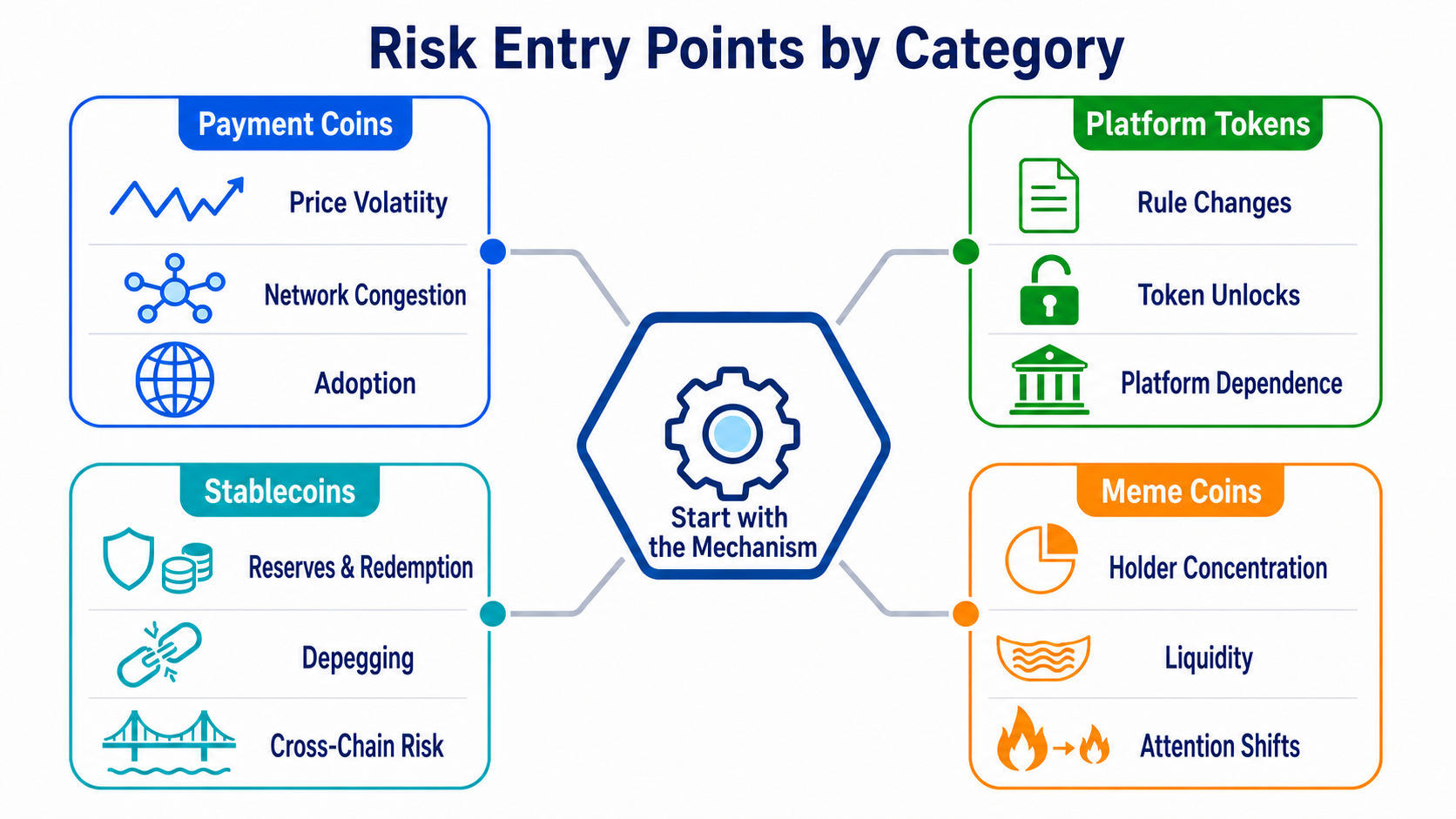
After classifying an asset, map risks to its actual mechanisms instead of labeling an entire category safe or dangerous.
| Review dimension | Payment coin | Platform token | Stablecoin | Meme coin |
|---|---|---|---|---|
| Supply | Mining or protocol issuance | Unlocks, buybacks, burns, or minting | Changes in reserves, minting, and redemptions | Initial allocation, whale concentration, and minting powers |
| Control | Consensus and development governance | Platform, foundation, or on-chain governance | Issuer, custodian, governance, or contract | Deployer powers, community, and liquidity providers |
| Price anchor | No fixed anchor | Demand for ecosystem services | Target asset and redemption mechanism | Market attention and trading demand |
| Technical exposure | Network congestion, forks, and wallet support | Platform rules, on-chain contracts, and account restrictions | Oracles, contracts, bridges, and freezing | Contract exploits, counterfeit tokens, and liquidity pools |
Classification is only the first layer of analysis. A deeper comparison should consider tokenomics, market capitalization and circulating supply, governance powers, actual on-chain usage, and market liquidity together.
Frequently Asked Questions
Is ETH a Platform Token?
Under the broad definition, ETH is the native asset of a smart-contract platform and is used for Gas and staking, so some people place it in this category. Under the narrow definition, platform tokens refer only to assets linked to trading platforms, in which case ETH does not qualify. Always state which definition is being used.
Are Altcoins the Same as Meme Coins?
No. “Altcoin” generally refers to crypto assets other than BTC and can include blockchain-native coins, stablecoins, DeFi tokens, and meme coins. Meme coins are only one subgroup defined by cultural origin and community-driven distribution.
Do NFTs Belong to These Four Cryptocurrency Categories?
Usually not. This article discusses fungible cryptocurrencies and tokens, while NFTs use non-fungible standards to represent distinct assets or credentials. Both can operate on the same blockchain, but their interfaces, liquidity, and valuation methods differ.
Why Do Trading Platforms Classify the Same Asset Differently?
Platforms use different classification dimensions. Some group assets by underlying technology, while others focus on use, ecosystem, or market sector. Asset functions can also change after protocol upgrades, so different labels do not necessarily mean the information is wrong. What matters is the basis for the classification.
Lettura consigliata
Visualizza altro


Service@hotcoin.com
Product@hotcoin.com
Business@hotcoin.com
Casecn@hotcoin.com